FLOAT 100 · Art · No. 9
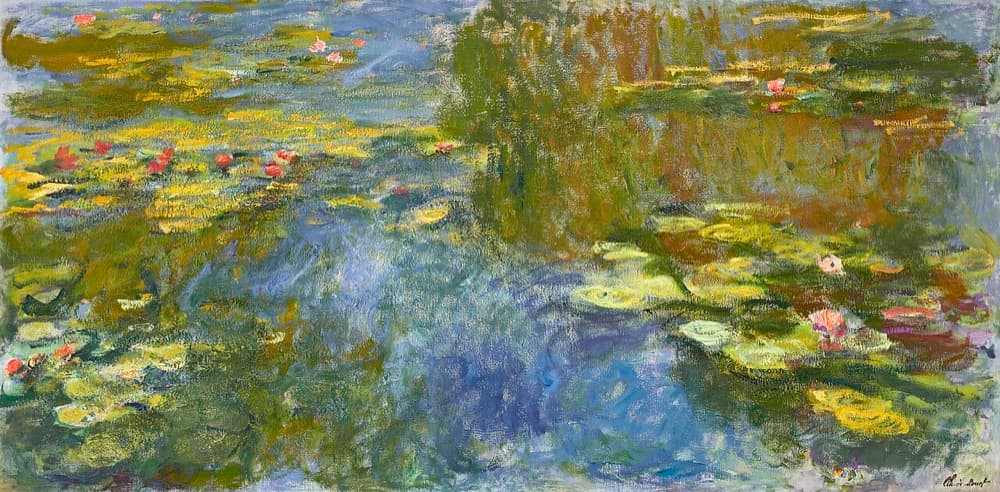
Le Bassin aux Nymphéas
Painted at Giverny as the First World War ground toward its end, this two-meter view of Monet's lily pond spent half a century unseen in one family's hands before it sold in New York for $74 million.
- Year
- 1917-1919
- Maker
- Claude Monet
- By price in art
- 9 of 100
Create a free account to see every recorded price and every grade.
Create a free account- Artist
- Claude Monet (1840-1926)
- Painted
- 1917-1919, at Giverny
- Medium
- Oil on canvas
- Size
- 100.1 x 200.6 cm, about 1 meter tall by 2 meters wide
- Series
- Water Lilies (Nympheas), the roughly 250 paintings of his garden pond
- First owner after Monet
- His son and heir, Michel Monet
- Held
- By one family from March 22, 1972, until 2023
- Public view
- Not known to have been shown publicly before 2023
- Sale
- $74,010,000 with fees, at auction in New York, November 9, 2023
A garden built to be painted
Claude Monet moved to Giverny, in Normandy, in April 1883, first renting a house and then buying it in 1890. In 1893, fascinated by light on reflective surfaces, he diverted a small tributary of the nearby River Epte onto his land to make a pond. 'I love water but I also love flowers,' he said. 'That's why, once the pond was filled, I thought about adorning it with plants. I got a catalogue and simply chose at random.'
The water lilies he planted became the subject of the rest of his life. Over about three decades he painted some 250 oil paintings of the pond, a series known as the Nympheas. The pond itself was enlarged in 1901 and 1910. Between 1904 and 1909 he painted more than 60 views of it, shown together in Paris in 1909 to reviews that found them remarkably abstract.
This canvas belongs to the late phase. It is dated 1917 to 1919 and measures about 1 meter tall by 2 meters wide, a long horizontal format that echoes the huge mural panels Monet was working on at the same time.
Monet at the end of the war
After the 1909 exhibition Monet barely painted for nearly five years. His wife Alice died in 1911 and his son Jean in 1914. In 1912 he learned he had a cataract, and floods from the Seine and the Epte damaged his gardens. He came back to work in the spring of 1914, at 73, with a plan he had nursed for years: mural-sized paintings of the water lilies, the Grandes Decorations.
In 1915 he began building a huge new studio to house the project. Between 1914 and 1917 he made some sixty Nympheas that tested ideas for the murals; he treated those as private studies and neither exhibited nor sold them. On April 30, 1918, he ordered a large number of pre-stretched canvases measuring 1 meter high by 2 meters wide, the same long horizontal format as the murals. This painting's dimensions match that format.
On November 12, 1918, the day after the Armistice, Monet wrote to Prime Minister Georges Clemenceau, his friend, offering two decorative panels to the French state: 'It's not much, but it is the only way I have of taking part in the victory.' Clemenceau and the critic Gustave Geffroy persuaded him to give the whole mural cycle instead. Monet finished the 22 mural canvases, more than 90 meters in all, months before his death at Giverny on December 5, 1926. The Musee de l'Orangerie in Paris opened with them in May 1927.
Many of the late water lilies were painted while Monet suffered from cataracts, which affected how he saw color. He had surgery in 1923.
Fifty years out of sight
The painting was in Monet's studio when he died. It passed to his second son and heir, Michel Monet, at Giverny. Most of Monet's late Nympheas stayed with his descendants for decades, little known outside a small circle, until audiences after the Second World War, schooled in Abstract Expressionism, came to value them.
From Michel Monet the painting went to the Paris dealer Katia Granoff, then to a private owner, a collection and a company in Vaduz, Liechtenstein. On March 22, 1972, the family that would keep it for the next half century acquired it.
When its sale was announced on September 28, 2023, the auction specialist leading it said, 'As far as we can tell, it has never been seen publicly, which also means it is in great condition.' It carried an estimate of $65 million and a guarantee from the auction house.
On November 9, 2023, at auction in New York, it sold for $74,010,000 with fees, above the estimate, in an evening sale of 20th-century art. The same evening a Cezanne still life brought nearly $39 million and a Richard Diebenkorn $46 million.
How to tell it apart
Monet used the title Le Bassin aux Nympheas for many canvases, so the dimensions and date matter. This one is 100.1 x 200.6 cm, dated 1917-1919, with lily pads floating across a broad expanse of water rendered in thick impasto and vivid brushwork.
It is a different painting from the Le Bassin aux Nympheas of 1919 that sold in London in June 2008 for 40.9 million pounds, reported as about $80.5 million, then a Monet auction record. That canvas measures 100 x 201 cm and has its own catalogue number. Another canvas of the same title, also dated about 1917-1919 and about the same size, sold for $70.4 million in 2021.
The sources consulted here do not give this painting's catalogue raisonne number, so it is not stated on this page.
Where it sits in the market
The 2023 price placed the painting among the most expensive Monets ever sold. The artist's auction record remains Meules (Haystacks) of 1890, sold for $110.7 million in May 2019. Among water lilies, Nympheas en fleur of about 1914-1917 brought about $85 million with fees in 2018.
The sale came during a New York fall auction series in which the two largest houses together sold more than $1.1 billion of art. A year later another large late water lily, from 1914-1917, sold in New York for $65.5 million, keeping the series at the top of the market for Impressionist painting.
The numbers
- Medium
- Oil on canvas
- Dimensions
- 100.1 x 200.6 cm
- Date
- 1917-1919
- Catalogue raisonne
- Not stated in the sources consulted
- Owner
- Private; the 2023 buyer was not publicly named
Timeline
Claude Monet is born in Paris.
Monet moves to Giverny, first renting the house.
Monet buys the Giverny house.
Monet diverts a stream of the Epte to create his water lily pond.
Water lily paintings of 1904-1909 are exhibited in Paris.
Monet's second wife, Alice, dies.
Monet is diagnosed with a cataract.
His son Jean dies; that spring Monet returns to painting the pond on a mural scale.
Monet begins building a large studio for the mural project.
Earliest date given for this painting (1917-1919).
Monet orders pre-stretched canvases of 1 by 2 meters for a new group of pond views.
Monet offers two decorative panels to the French state 'on the day of the Victory.'
Monet has cataract surgery.
Monet dies at Giverny; the painting passes to his son Michel.
The Musee de l'Orangerie opens with Monet's water lily murals.
The family that kept it for five decades acquires the painting.
Sale announced with a $65 million estimate; the work had never been shown publicly.
Sold at auction in New York for $74,010,000 with fees.
The world in 1918
President Woodrow Wilson sets out his Fourteen Points for peace.
Britain's Representation of the People Act gives most women over 30 the vote.
Germany launches its Spring Offensive on the Western Front.
Germany's Paris Gun begins shelling Paris from more than 70 miles away.
The influenza pandemic spreads worldwide, eventually killing an estimated 50 to 100 million people.
The Battle of Amiens opens the Allies' Hundred Days Offensive.
The Armistice ends fighting on the Western Front.
Price record
| Date | Price | Kind |
|---|---|---|
| Sep 28, 2023 | $65,000,000 | Estimate, not a salePre-sale estimate announced with the consignment. |
| Nov 9, 2023 | $74,010,000 | Sold at auctionSold at auction in New York, with fees. |
A realized auction price is what a buyer actually paid on the date shown, including the buyer's premium where the sale reported it. It is the strongest kind of reference price, and it is a record of one sale of one object on one day, not a promise of what the next example will bring.
By reference price, Le Bassin aux Nymphéas is number 9 of 100 in the art entries of the FLOAT 100. 88 of those 100 rest on a realized sale; the rest carry an asking price or a guide value, and each page says which. Rank within the FLOAT 100 itself (9 here) is editorial: how much an object defines its field, not price alone.
Did you know
- Monet said he chose his water lilies from a catalogue 'simply at random.'
- Monet created the pond by diverting a small tributary of the River Epte onto his property in 1893.
- As far as its sellers could tell, the painting had never been shown publicly before its 2023 sale.
- The day after the Armistice, Monet offered paintings to France as 'the only way I have of taking part in the victory.'
- The Orangerie murals that grew out of this period total more than 90 meters of canvas.
- At least three different Monet canvases of about 1 by 2 meters titled Le Bassin aux Nympheas have sold for more than $70 million each.
How this page is made
- The figure
- One reference price, shown with its own kind. FLOAT does not average it with anything or adjust it for time.
- Realized or not
- A realized price is a completed sale. An asking price, an estimate and a price-guide value are not sales, and are labeled as such wherever they appear.
- The story
- Researched from published records and checked fact by fact. Updated Oct 1, 2026.
- Archive
- Oct 5, 2026