FLOAT 100 · Art · No. 4
Meules (Haystacks)
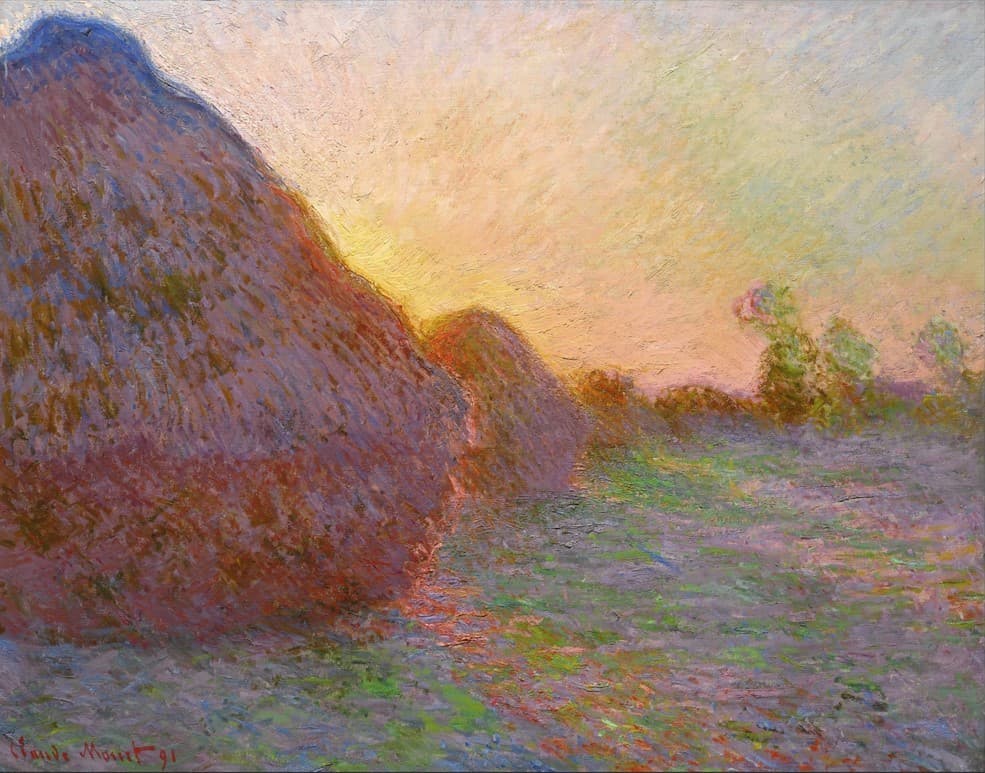
Monet painted the grain stacks in a neighbor's field outside his door, Chicago's most formidable collector bought this one twice in a single year, and 128 years later it became the first Impressionist painting to sell for more than $100 million.
- Year
- 1890
- Maker
- Claude Monet
- By price in art
- 3 of 100
Create a free account to see every recorded price and every grade.
Create a free account- Artist
- Claude Monet (1840-1926)
- Painted
- 1890, at Giverny; signed and dated '91' at lower left
- Series
- The Meules (Haystacks or Grainstacks), about 25 canvases begun in late summer 1890
- Medium
- Oil on canvas
- Size
- 72.7 x 92.6 cm (28 5/8 x 36 3/4 in)
- Catalogue raisonné
- Wildenstein 1273
- First collector
- Bertha Honoré Palmer of Chicago, who bought it in 1892
- Record sale
- $110.7 million at auction in New York, May 14, 2019
- Where it is
- Hasso Plattner collection, on display at the Museum Barberini, Potsdam, since September 2020
Stacks outside the door
Monet settled at Giverny, a village in Normandy, in April 1883, and for the rest of his life most of his paintings were of scenes within about 3 kilometers of his house. Each summer a field just west of the house, the Clos Morin, served as the stacking ground for one of the village's bigger farmers. After the harvest it filled with tall stacks of grain sheaves.
The English name 'haystacks' is not quite right. The stacks held unthreshed wheat or other grain, not hay. They stood 10 to 20 feet high, thatched on top to keep the sheaves dry until a traveling threshing machine reached the village, which could take until the following winter or spring. In Normandy they were round, with a steep, peaked top, and that is the shape Monet painted.
Monet had put stacks in his pictures before, and in 1888 he made them the main subject of five canvases. The series proper began near the end of the summer of 1890. According to one account, he asked his stepdaughter Blanche Hoschedé to bring him two canvases, one for sun and one for overcast. Soon she was bringing as many as her wheelbarrow could hold, and he moved among them as the light changed, sometimes working on 10 or 12 a day. He carried on through the following spring. The series runs to about 25 canvases, and he finished many of them in the studio.
This canvas breaks the series' usual pattern. Most of the Meules are built from horizontal bands of field, hills and sky. Here a strong diagonal runs from the left edge toward the horizon, and only one other canvas in the series (Wildenstein 1272) does the same. The largest stack is cut off at the left edge, and the sun, hidden behind the stacks, throws diagonal light toward the lower right, rimming the stacks and the ground with reds, oranges and vivid greens.
Monet at fifty
Claude Monet was born in Paris on November 14, 1840. His 1872 painting Impression, Sunrise, shown at the first Impressionist exhibition in 1874, gave the movement its name.
The 2019 sale catalog called 1890 a watershed year for him. He turned 50, bought property for the first time when he purchased the Giverny house he had rented since 1883, and negotiated the purchase of Édouard Manet's Olympia for the French national collection.
Monet was hard on his own work and destroyed more than one series he judged a failure. The Meules survived his judgment, and they established a working method he kept for the rest of his career, through the Poplars, Rouen Cathedral, the Houses of Parliament and the Water Lilies.
He married Alice Hoschedé in 1892 and died at Giverny on December 5, 1926, at 86.
Paris, May 1891
From May 4 to May 18, 1891, the dealer Paul Durand-Ruel showed 15 of the Meules in his Paris gallery. No photographs were taken of the installation, and the catalog descriptions are vague, so scholars still cannot say which 15 canvases hung there. The critic Gustave Geffroy, a friend Monet had met by chance at a hotel on Belle-Île in 1886, wrote the introduction.
The show was a hit with critics and buyers. Camille Pissarro, who did not usually admire Monet's work, wrote privately to his son that it was 'the work of a very great artist.' The critic Félix Fénéon wrote that the evening sun had 'most exalted' the stacks. Most of the paintings sold within a month, for as much as 1,000 francs each.
Elsewhere in 1890, Nellie Bly had finished her trip around the world in 72 days in January. Vincent van Gogh, who painted haystacks of his own that year, shot himself in July and died two days later. In the United States, the Sherman Antitrust Act became law, and the year ended with the Wounded Knee Massacre in South Dakota.
Bought twice in one year
Durand-Ruel bought the painting from Monet on July 2, 1891. Bertha Honoré Palmer, wife of the Chicago hotel and retail magnate Potter Palmer, had seen the 1891 exhibition and became the first collector to grasp the importance of Monet's series. She bought this canvas on March 7, 1892. She soon sold it back to Durand-Ruel, which sold it on April 19, 1892, to W.C. Van Horne in Montreal. It came back to Durand-Ruel later that year, and on November 22, 1892, the Palmers bought it again. This time she kept it.
Mrs. Palmer was called 'the queen of Chicago.' She was president of the Board of Lady Managers for the World's Columbian Exposition of 1893 and owned as many as 90 works by Monet at one time, including nine Haystacks, four Poplars, three Rouen Cathedrals and three mornings on the Seine. Potter Palmer left her his entire fortune when he died in 1903, and by her own death in 1918 she had more than doubled it. Part of her collection went to the Art Institute of Chicago, including two grainstack paintings, but this one passed to her son and daughter-in-law, Honoré and Grace Palmer.
The family kept it until May 14, 1986, when it sold at auction in New York for $2.53 million to the collectors who would consign it 33 years later. In 1945 it had been lent to a New York exhibition of Monet's paintings held for the benefit of the children of Giverny.
On May 14, 2019, it was offered again in New York with an estimate of about $55 million. Six bidders competed for eight minutes, and it sold for $110,747,000. The buyer turned out to be the collector Hasso Plattner, founder of the Museum Barberini in Potsdam, Germany, which opened in 2017. The painting has been on permanent loan and on display there since September 2020.
A record, and a potato protest
The 2019 price set a record for Monet and for any Impressionist work, and Meules became the first Impressionist painting to sell for more than $100 million at auction. It was one of only four Haystacks to come to auction in this century. Most of the series is in museums, including the Musée d'Orsay, the Art Institute of Chicago, which holds six, the Metropolitan Museum of Art and the Getty.
The series reached well beyond Impressionism. The Fauves, including Derain and Vlaminck, drew on it. Wassily Kandinsky wrote of the series in his memoirs that it revealed 'the unsuspected power of the palette, which I had not understood before and which surpassed my wildest dreams.'
On October 23, 2022, two activists from the German climate group Letzte Generation (Last Generation) threw mashed potatoes at the painting in the Museum Barberini and then glued themselves to the wall beneath it. The painting was not damaged. It was cleaned and put back on display.
The numbers
- Medium
- Oil on canvas
- Dimensions
- 72.7 x 92.6 cm (28 5/8 x 36 3/4 in)
- Catalogue raisonné
- Wildenstein 1273
- Inscriptions
- Signed 'Claude Monet' and dated '91' at lower left
- Current owner
- Hasso Plattner; on display at the Museum Barberini, Potsdam
Timeline
Claude Monet is born in Paris.
Monet moves to a rented house at Giverny.
Monet paints five canvases with grain stacks as the main subject.
Monet begins the Meules series near the end of the summer, buys the Giverny house, and paints this canvas.
Fifteen Meules go on view at Durand-Ruel in Paris through May 18.
Durand-Ruel acquires this canvas from Monet.
Mr. and Mrs. Potter Palmer of Chicago buy it.
After it returns to Durand-Ruel, W.C. Van Horne of Montreal buys it.
The Palmers buy it back from Durand-Ruel.
Bertha Palmer dies. The painting passes to Honoré and Grace Palmer.
Monet dies at Giverny, aged 86.
Lent to a New York exhibition of Monet's paintings held for the benefit of the children of Giverny.
Published as no. 1273 in volume III of Daniel Wildenstein's Monet catalogue raisonné.
Sold at auction in New York for $2.53 million.
Hasso Plattner's Museum Barberini opens in Potsdam.
Sold at auction in New York for $110.7 million, a record for any Impressionist work.
Goes on display at the Museum Barberini.
Climate activists throw mashed potatoes at the painting. It is not damaged.
The world in 1890
Nellie Bly completes her trip around the world in 72 days.
The Forth Bridge in Scotland opens to rail traffic.
Kaiser Wilhelm II forces Otto von Bismarck to resign as German chancellor.
The Sherman Antitrust Act becomes U.S. law.
Vincent van Gogh shoots himself. He dies two days later.
William Kemmler becomes the first person executed in the electric chair.
The Wounded Knee Massacre takes place in South Dakota.
Price record
| Date | Price | Kind |
|---|---|---|
| May 14, 1986 | $2,530,000 | Sold at auctionSold at auction in New York from the Palmer family. |
| May 2019 | $55,000,000 | Estimate, not a salePre-sale estimate reported at about $55 million. The official estimate was available on request. |
| May 14, 2019 | $110,747,000 | Sold at auctionSold at auction in New York after eight minutes of bidding among six bidders. Record for Monet and for any Impressionist work. |
A realized auction price is what a buyer actually paid on the date shown, including the buyer's premium where the sale reported it. It is the strongest kind of reference price, and it is a record of one sale of one object on one day, not a promise of what the next example will bring.
By reference price, Meules (Haystacks) is number 3 of 100 in the art entries of the FLOAT 100. 88 of those 100 rest on a realized sale; the rest carry an asking price or a guide value, and each page says which. Rank within the FLOAT 100 itself (4 here) is editorial: how much an object defines its field, not price alone.
Did you know
- The canvas is dated '91' though it was painted in 1890. Monet often finished the series in the studio.
- Bertha Palmer bought this painting, sold it, and bought it back, all in 1892.
- No photographs were taken of the 1891 Meules exhibition, so no one knows exactly which 15 canvases were shown.
- The 'haystacks' were actually stacks of unthreshed grain, waiting months for a traveling threshing machine.
- The 2019 price was more than 40 times the $2.53 million the painting brought in 1986.
- In 2022 activists threw mashed potatoes at the painting. It was not damaged, and it was cleaned and put back on display.
How this page is made
- The figure
- One reference price, shown with its own kind. FLOAT does not average it with anything or adjust it for time.
- Realized or not
- A realized price is a completed sale. An asking price, an estimate and a price-guide value are not sales, and are labeled as such wherever they appear.
- The story
- Researched from published records and checked fact by fact. Updated Oct 1, 2026.
- Archive
- Oct 5, 2026