FLOAT 100 · Coins · No. 77
1644 Oxford Triple Unite (Charles I)
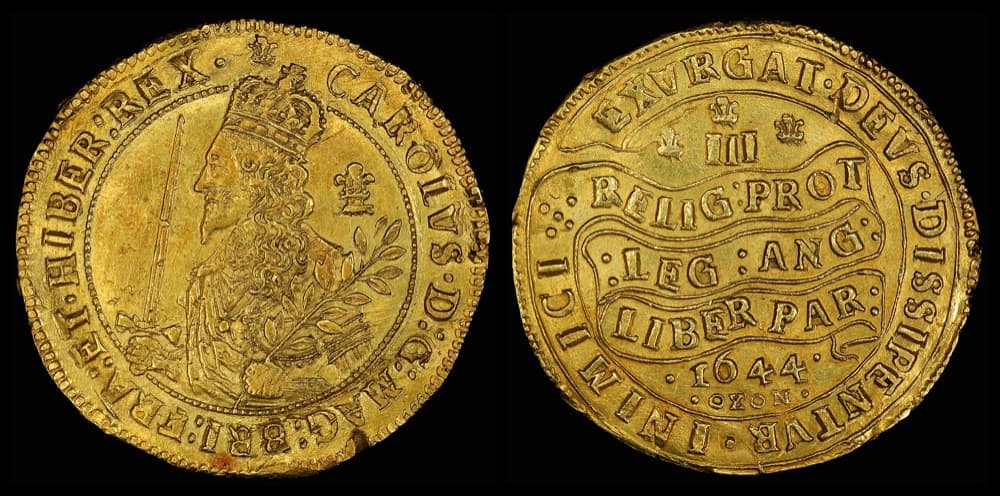
Driven out of London and running a war from an Oxford college, Charles I melted down plate to strike the most valuable coin England had ever made by hand, a three-pound gold piece that carried his political promises on its back like a campaign poster.
- Year
- 1642-1644
- Maker
- Royal Mint at Oxford (Great Britain), Charles I
- By price in coins
- 52 of 100
Create a free account to see every recorded price and every grade.
Create a free account- Struck
- 1644, at the royalist mint in New Inn Hall, Oxford
- Ruler
- Charles I, King of England, Scotland and Ireland, 1625-1649
- Denomination
- Triple unite: 60 shillings, or three pounds
- Weight
- About 421 grains (27.3 grams); sources give 27.0 to 27.3 grams
- Why it matters
- The highest denomination ever issued in England's hammered coinage, double any earlier coin
- Reverse
- The king's 1642 Wellington declaration: the Protestant religion, the laws of England, the liberty of Parliament
- Dies for 1644
- Only three reverse dies are known for the year, against eleven for 1643
- This coin
- The Virgil Brand specimen, described as virtually Mint State
- Last sale
- September 27, 2011, at auction in London: £180,000, reported as about $278,867
A king without his capital
Charles I became king on March 27, 1625. By January 1642 his quarrel with Parliament had reached the point where he left London, and on August 22, 1642, he raised his standard at Nottingham. The English Civil War had begun, and the king was cut off from the Tower of London and the Royal Mint inside it.
He was not without a mint. The crown already operated one at Aberystwyth in Wales, and it was moved first to Shrewsbury. There, according to the royalist historian Clarendon, it could coin no more than a thousand pounds a week and was 'more for reputation than use.' In September 1642, at Wellington in Shropshire, the king made the declaration that would later run across his coins: he would uphold the Protestant religion, the laws of England and the liberty of Parliament.
After the battle of Edgehill, Charles made a state entry into Oxford on October 29, 1642, and made the royalist university town his headquarters. The king lived at Christ Church, the queen at Merton, his Parliament sat in the university schools, and the mint was set up in New Inn Hall, on the site of today's St. Peter's College. According to the numismatist R. D. Beresford-Jones, the mint moved to Oxford on January 3, 1643, by the modern calendar; under the old calendar, in which the year began on March 25, the first Oxford coins are dated 1642.
College plate and a mint in a hall
The Oxford mint ran on what the king could gather. Silver and gold vessels belonging to the colleges were melted down, along with plate from supporters and foreign money treated as bullion. Thomas Bushell, who had run the Welsh silver mint at Aberystwyth, and Sir William Pankhurst were its mint masters. The records of the Oxford mint were later destroyed, so its output can only be estimated; Beresford-Jones reckoned it at no less than five or six thousand pounds a week, mostly in silver.
The coins themselves show that two workshops struck side by side: one, in effect, the Shrewsbury mint transplanted, the other staffed by workmen who came from London. The first triple unites were crude. The Shrewsbury engravers could not cut a single large punch for the king's figure, so they assembled it from separate punches for the head, body, sword and branch, which is why early pieces show a hunched king with a sword one writer likened to a paper knife.
The finest Oxford work is tied to Thomas Rawlins, a goldsmith and gem engraver who had worked under the great mint engraver Nicholas Briot in London. He was appointed Graver of Seals, Stamps and Medals at Oxford in 1643, and his signature appears on Oxford coins from 1644 to 1646.
Why strike so large a coin at all? Beresford-Jones weighed several explanations and favored propaganda. A royalist pamphlet printed at Oxford in early 1643, 'A Warning Piece,' praised 'his Majesty's new coin' and its inscription, and the Bodleian Library's copy includes a woodcut of a 1642-dated triple unite, probably one of the earliest printed pictures of an actual coin.
Gold in a year of defeat
The triple unite was the largest piece of money England had produced since the rose ryals of James I, last issued in 1624. It was about the same width as a silver crown but twice as thick, and it was worth three pounds when a royalist soldier's pay ran from six shillings to seventeen and sixpence a week. Charles never debased his wartime coinage; the gold and silver kept full weight even as the war turned against him.
And in 1644 it turned. On July 2 Parliament's armies crushed the royalists at Marston Moor in Yorkshire, ending the king's hold on the north. On October 6, according to the royalist newspaper Mercurius Aulicus, a fire broke out in north-west Oxford and burned the houses between Cornmarket and New Inn Hall Street. The mint's stone buildings survived, but Beresford-Jones argued that work must have stopped, and because only three reverse dies are known for 1644, he concluded that triple unites were probably not struck after the fire.
The Oxford mint kept working until 1646, but the triple unite was not revived. Charles was executed at Whitehall on January 30, 1649, and England never again struck a three-pound piece by hand.
The Brand coin
This example belonged to Virgil Brand of Chicago, a brewer who began collecting in 1889 and at his death in 1926 owned more than 350,000 coins, among the largest collections ever formed by one person. He left no will. His heirs fought over the collection, and it was broken up through more than a dozen auctions and many private sales.
The coin reappeared on September 27, 2011, at an auction of British coins in London held during the city's annual Coinex show week. It was offered with a 1643 triple unite, and the two were the stars of the sale. The 1644 Brand coin, described as virtually Mint State, was estimated at £110,000 to £120,000 and realized £180,000, which the trade press reported as about $278,867, including the 20 percent buyer's fee. The 1643 coin, the finer of the two, brought £162,000.
Together the pair accounted for nearly 27 percent of a sale that totaled £1,281,708. Two more triple unites were offered at another London auction the next day, an unusual crowd for a coin that rarely appears at all. Another triple unite of the series was reported sold for $178,250 in 2008.
How to read a triple unite
The obverse shows a half-length, crowned Charles in armor, holding an upright sword in his right hand and an olive branch in his left, war and peace in one image. The Oxford legend reads CAROLVS D G MAG BRI FRA ET HIBER REX: Charles, by the grace of God, King of Great Britain, France and Ireland.
The reverse carries three Prince of Wales plumes above the Roman numeral III for three pounds. Across a scroll runs the declaration, abbreviated RELIG PROT LEG ANG LIBER PAR, and around the edge runs EXURGAT DEUS DISSIPENTUR INIMICI, 'Let God arise and his enemies be scattered,' from Psalm 68. The date sits below, and on the 1644 coins the mint name appears beneath it, abbreviated OX or OXON.
Beresford-Jones sorted Oxford triple unites by their reverses into two parallel series, one following the Shrewsbury style with the legend separated from the declaration and one, by the London workmen, joining them on a single scroll. In 1644 the coin was struck on a smaller flan, and the king's crown on one of the year's obverse dies breaks through the inner circle.
Specifications vary between sources and between pieces. Trade reports give 421 grains and a diameter of about 40 millimeters; a guide to English gold gives about 27 grams; a 1643 example at the Cleveland Museum of Art weighs 27.127 grams and measures 4.6 centimeters. Collectors cite the varieties by their catalog numbers in the standard reference to English coins.
The last great hammered gold
Coins in England were still struck by hand with a hammer in the 1640s, and the triple unite marks the high point of that tradition: no larger denomination was ever hammered there. Its message was as important as its metal. Charles was using his most valuable coin to tell the country he, not Parliament, stood for religion, law and Parliament's own liberties.
Examples sit in museums, among them a 1643 coin in the Cleveland Museum of Art, and the unique Shrewsbury triple unite of 1642 is in the British Museum. Beresford-Jones thought that Shrewsbury coin was a pattern rather than a regular issue. The 1644 coins, from the last few dies of a war that the king was losing, close the series.
The numbers
- Denomination
- 60 shillings (three pounds)
- Weight
- About 421 grains (27.3 g) per trade reports; other sources give about 27 g
- Diameter
- About 40 mm per trade reports; 1644 coins were struck on a smaller flan than 1643
- Composition
- Gold
- Mint
- Oxford, New Inn Hall; mint masters Thomas Bushell and Sir William Pankhurst
- Engraving
- Oxford mint engravers; Thomas Rawlins's signature appears on Oxford coins 1644-1646
- Mintage
- Unknown; the Oxford mint records were destroyed
- Dies, 1644
- Three reverse dies known (eleven for 1643)
- Dates
- Oxford triple unites are dated 1642, 1643 and 1644; Shrewsbury 1642 (one known)
Timeline
Charles I becomes king.
Charles raises his standard at Nottingham; the Civil War begins.
At Wellington, Shropshire, the king makes the declaration later inscribed on his coins.
The Shrewsbury mint strikes a single known triple unite, now in the British Museum.
After Edgehill, Charles makes a state entry into Oxford and sets up his headquarters.
The mint moves to New Inn Hall, Oxford; its first triple unites are dated 1642, old style.
Eleven reverse dies for triple unites are cut during the year; Thomas Rawlins is appointed engraver at Oxford.
This coin is struck, from one of only three known 1644 reverse dies.
Fire sweeps north-west Oxford; triple unite production probably ends.
Charles I is executed at Whitehall.
Chicago brewer Virgil Brand begins collecting coins.
Brand dies with more than 350,000 coins and no will; his collection is later dispersed.
R. D. Beresford-Jones publishes his die study of the Oxford triple unites.
The Brand coin realizes £180,000 at auction in London.
The world in 1644
Parliamentarians defeat the royalists at Nantwich and lift the siege of the Cheshire town.
The Manchu Qing and Ming general Wu Sangui defeat Li Zicheng at Shanhai Pass.
The Qing army captures Beijing, beginning Manchu rule over China proper that lasts until 1912.
Parliament crushes the royalists at Marston Moor, ending Charles's hold on the north of England.
Montrose defeats the Covenanters at Tippermuir, reviving the royalist cause in Scotland.
Charles wins at Lostwithiel in Cornwall, his last major victory.
Price record
| Date | Price | Kind |
|---|---|---|
| Sep 27, 2011 | $282,258 | Sold at auctionAt auction in London: GBP 180,000 (including buyer's premium), shown in USD at the Federal Reserve rate on the sale date (1 GBP = 1.5681 USD). |
A realized auction price is what a buyer actually paid on the date shown, including the buyer's premium where the sale reported it. It is the strongest kind of reference price, and it is a record of one sale of one object on one day, not a promise of what the next example will bring.
By reference price, 1644 Oxford Triple Unite (Charles I) is number 52 of 100 in the coins entries of the FLOAT 100. 96 of those 100 rest on a realized sale; the rest carry an asking price or a guide value, and each page says which. Rank within the FLOAT 100 itself (77 here) is editorial: how much an object defines its field, not price alone.
Did you know
- The triple unite was worth three pounds, double the value of any English coin issued before it.
- Its reverse is political: the king's promise to defend the Protestant religion, the laws of England and the liberty of Parliament, the very body he was fighting.
- A royalist pamphlet of early 1643 contains a woodcut of a triple unite, probably one of the earliest printed pictures of an actual coin rather than a coin type.
- Because the year then began on March 25, the first triple unites struck at Oxford in early 1643 carry the date 1642.
- Oxford colleges' silver and gold vessels were melted down to feed the king's mint.
- The Brand coin's former owner, Virgil Brand, owned more than 350,000 coins when he died in 1926.
How this page is made
- The figure
- One reference price, shown with its own kind. FLOAT does not average it with anything or adjust it for time.
- Realized or not
- A realized price is a completed sale. An asking price, an estimate and a price-guide value are not sales, and are labeled as such wherever they appear.
- The story
- Researched from published records and checked fact by fact. Updated Oct 3, 2026.
- Archive
- Oct 5, 2026