FLOAT 100 · Coins · No. 91
1652 Pine Tree Threepence
Boston silversmiths struck this tiny silver coin without the King's permission and kept dating it 1652 for decades afterward, while the Crown insisted that making money was the King's right alone.
- Year
- 1652
- Maker
- Massachusetts Bay Colony (Boston mint, John Hull)
- By price in coins
- 92 of 100
Create a free account to see every recorded price and every grade.
Create a free account- Dated
- 1652; Pine Tree coins were struck from about 1667 to 1682
- Maker
- The Massachusetts Bay Colony mint in Boston, run by silversmiths John Hull and Robert Sanderson
- Denomination
- Threepence, the smallest of the colony's three silver coins
- Variety
- Noe-36, Salmon 2-B, W-640, without pellets at the trunk; Rarity-4
- This grade
- PCGS AU55 with CAC approval
- Standard
- Sterling silver, about 22.5% lighter than English coins of the same face value
- Finest sold
- Auction record for the PCGS type, $49,938 for an MS63 in May 2014
- Mint closed
- 1682; the colony's charter was revoked in 1684
A colony that made its own money
Before 1652 Massachusetts got by with barter and foreign coins, and the shortage of hard money held back the New England economy. In May 1652 the colony's General Court authorized a mint in Boston and appointed John Hull as mintmaster, without notifying or seeking permission from the English government. Coining money was a royal prerogative, but England was then a commonwealth under Parliament, with no king on the throne.
The law called for three silver coins: the shilling, the sixpence and the threepence. They used the English sterling standard of fineness but were made about 22.5 percent lighter than English coins of the same face value, so a 72-grain Massachusetts shilling compared with 92.9 grains for an English one. The lighter weight acted as a barrier that kept the coins circulating locally.
The first pieces simply bore the letters NE, for New England, and a Roman numeral: III for threepence, VI for sixpence, XII for a shilling. Then came the Willow Tree design, from 1652 to about 1660 or 1662; the Oak Tree, to about 1667; and finally the Pine Tree, struck from about 1667 until the mint closed in 1682.
John Hull and Robert Sanderson
John Hull was born on December 18, 1624, in Market Harborough, Leicestershire, and came to Boston with his family at age eleven, arriving on November 7, 1635. After two years at Boston Latin School he served a seven-year apprenticeship as a silversmith. He chose a fellow silversmith, Robert Sanderson, as his partner at the mint.
Hull kept one shilling and seven pence of every 20 shillings he coined, and his profits are said to have exceeded 1,000 pounds a year. He also served as treasurer of Boston and later of the Massachusetts General Court, and left an estate of about 6,000 pounds when he died in Boston on October 1, 1683.
A famous story holds that Hull paid his daughter Hannah's dowry, when she married Samuel Sewall in 1676, with her weight in Pine Tree shillings. The real dowry was 500 pounds; Nathaniel Hawthorne and other writers exaggerated the tale.
Why every coin says 1652
Nearly every Massachusetts tree coin carries the date 1652, the year the mint was authorized, even though the Pine Tree coins were struck 15 to 30 years later. Scholars still argue about why. The date may simply commemorate the founding law, or it may have been a political strategy tied to the years when England had no king.
The Crown noticed anyway. A royal commission in 1665 demanded that the colony stop, calling coinage a royal prerogative, but Massachusetts kept striking. The mint finally closed in 1682 under growing royal scrutiny, and in 1684 Charles II revoked the colony's charter on the advice of his colonial administrator Edward Randolph.
The pine tree itself pointed to the colony's most valuable export: tall timber used for the mainmasts of Royal Navy ships.
How to know a Noe-36 threepence
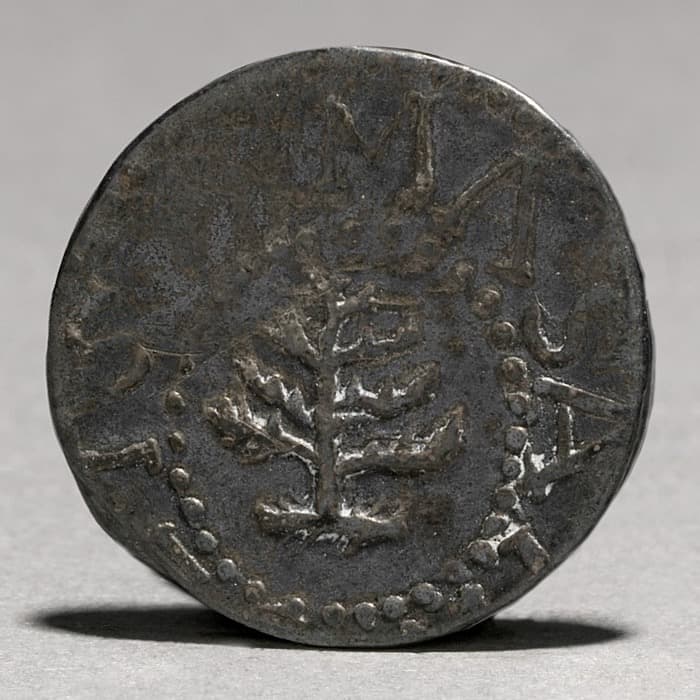
The threepence is a tiny coin with a pine tree on one side and the date 1652 with the Roman numeral III on the other, each framed by an inner circle of beads. Collectors identify individual die pairs with three reference systems: the numbers assigned by Sydney P. Noe, the newer Salmon numbers and W numbers. This variety is Noe-36, Salmon 2-B, W-640.
Noe-36 has no pellets, or small dots, beside the trunk of the tree, which separates it from the other Pine Tree threepence type. It is rated Rarity-4. Like most Massachusetts silver, these coins were struck on irregular planchets, so letters at the edge are often partly off the flan. A PCGS AU55 example sold in November 2024 weighed 16.7 grains and was described as sharp, with a full MA at top but the lower obverse edge off the flan.
The grade named here, AU55 with a CAC sticker, describes a coin with only slight wear that also carries the approval sticker of CAC. The threepence draws less attention than the larger shilling, and one cataloger noted that the small coins are often overlooked beside their bigger relatives.
What these coins bring
No sale of a Noe-36 threepence graded AU55 with a CAC sticker could be verified for this page. Uncertified AU55 sales give a sense of the level: a PCGS AU55 Noe-36 sold for $5,760 in November 2024, an NGC AU55 brought $10,200 in October 2022, and other AU55 examples of the no-pellets type brought $12,000 in January 2020 and $9,200 in August 2011.
Mint State coins are scarce and bring much more. The auction record for the PCGS no-pellets type is $49,938, for an MS63 in May 2014. More recently a PCGS MS62+ Noe-36 sold for $21,600 in November 2025, a PCGS MS63 for $28,800 in August 2023 and an NGC MS64 for $31,200 in August 2025.
The numbers
- Mintage
- Not recorded
- Rarity
- Noe-36 rated Rarity-4
- Weight
- A PCGS AU55 Noe-36 weighed 16.7 grains; Massachusetts coins ran about 22.5% lighter than English equivalents
- Composition
- Silver, English sterling standard
- Mint
- Boston, Massachusetts Bay Colony
- Makers
- John Hull, mintmaster, and Robert Sanderson
- Attribution
- Noe-36, Salmon 2-B, W-640; no pellets at trunk
- Struck
- About 1667-1682, all dated 1652
Timeline
John Hull is born in Market Harborough, Leicestershire.
Hull arrives in Boston with his family.
The Massachusetts General Court authorizes a mint and names Hull mintmaster, without asking England.
The first NE coins are struck, followed by the Willow Tree design.
Around 1660-1662 the Oak Tree design replaces the Willow Tree.
A royal commission demands the colony stop coining money; Massachusetts refuses.
About this year the Pine Tree design begins, still dated 1652.
Hull's daughter Hannah marries Samuel Sewall, with a dowry of 500 pounds.
The Massachusetts mint closes.
John Hull dies in Boston.
Charles II revokes the Massachusetts Bay charter.
A PCGS MS63 no-pellets Pine Tree threepence sells for $49,938, the record for the type.
A PCGS AU55 Noe-36 threepence weighing 16.7 grains sells for $5,760.
The world in 1652
The Tender of Union is proclaimed, joining Scotland to the English Commonwealth.
Jan van Riebeeck founds a Dutch supply station at the Cape of Good Hope, the start of Cape Town.
Rhode Island passes the first law in North America making slavery illegal.
The Battle of Dover opens the First Anglo-Dutch War.
George Fox preaches at Firbank Fell, a founding moment for the Quakers.
Maryland signs Articles of Peace with the Conestoga.
The Great Fire of Glasgow destroys a third of the city.
Price record
A price-guide value is an editorial estimate, not a transaction and not an asking price. Guides lag the market and smooth over grade and condition. It is neither a floor nor a ceiling: a sale can land above or below it, and it should be checked against a realized sale before anything rests on it.
By reference price, 1652 Pine Tree Threepence is number 92 of 100 in the coins entries of the FLOAT 100. 96 of those 100 rest on a realized sale; the rest carry an asking price or a guide value, and each page says which. Rank within the FLOAT 100 itself (91 here) is editorial: how much an object defines its field, not price alone.
Did you know
- Massachusetts opened its mint in 1652 without telling or asking the English government.
- Pine Tree coins were struck for about 15 years but nearly all carry the date 1652.
- The mintmaster kept one shilling and seven pence of every 20 shillings he made.
- The legend that Hull paid his daughter's dowry in her weight in shillings is an exaggeration; the dowry was 500 pounds.
- The pine tree stood for New England's tall timber, prized for Royal Navy masts.
- Massachusetts shillings were about 22.5% lighter than English ones, to keep them from leaving the colony.
How this page is made
- The figure
- One reference price, shown with its own kind. FLOAT does not average it with anything or adjust it for time.
- Realized or not
- A realized price is a completed sale. An asking price, an estimate and a price-guide value are not sales, and are labeled as such wherever they appear.
- The story
- Researched from published records and checked fact by fact. Updated Oct 3, 2026.
- Archive
- Oct 5, 2026