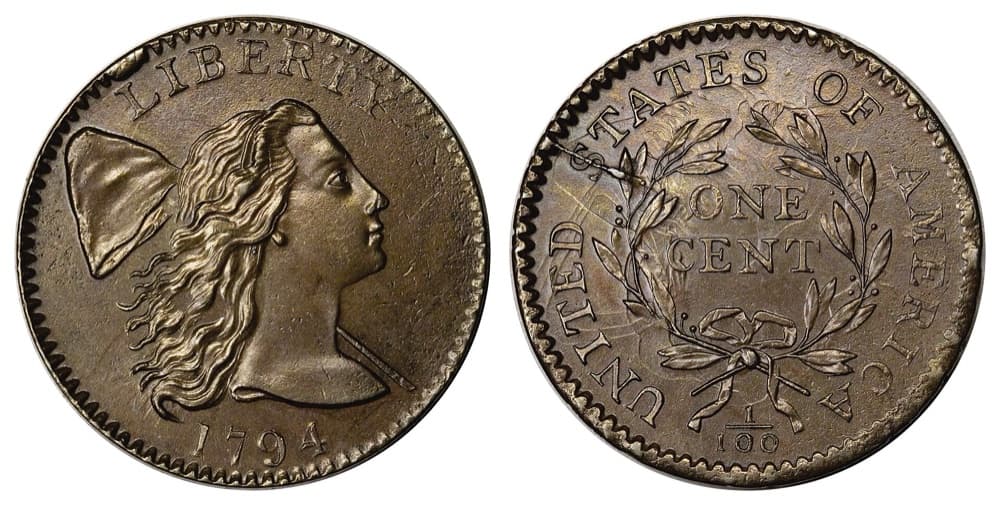
FLOAT 100 · Coins · No. 93
1794 Liberty Cap Large Cent (Head of 1794)
In its second year the young U.S. Mint made nearly a million copper cents from dozens of hand-finished dies, each one a little different, and collectors have spent more than a century sorting them by the bend of a single lock of Liberty's hair.
- Year
- 1794
- Maker
- U.S. Mint (Philadelphia)
- By price in coins
- 83 of 100
Create a free account to see every recorded price and every grade.
Create a free account- Struck
- 1794, Philadelphia Mint (no mintmark)
- Mintage, all 1794 cents
- 918,521
- Variety
- Sheldon 22, Head of 1794, known as Bent Lock or Bent Hair; Rarity-1
- Design
- Liberty Cap; type designed by Joseph Wright in 1793, the 1794 heads attributed to Robert Scot
- Metal and size
- Copper; 13.48 grams; 28 to 29 mm (sources differ)
- Edge
- Lettered ONE HUNDRED FOR A DOLLAR
- This coin
- PCGS MS63 Brown, cert #36382326, with a pedigree back to the Charles J. Dupont sale of September 1954
- Latest sale
- $32,400, February 9, 2023, at auction
A cent the public could accept
The United States began striking large cents in 1793, and its first two designs did not go over well. The Chain cent drew criticism, and Mint Director David Rittenhouse, dissatisfied with the Wreath cent that followed, hired the painter Joseph Wright to redesign the coin again in that same troubled first year. Wright turned Liberty to the right, tamed her wild hair, added a Phrygian cap on a pole as an ancient symbol of freedom, and gave the reverse a recognizable laurel wreath.
The new design debuted at the end of 1793 and worked well enough to last into 1796, far longer than the two types before it, which were each issued for less than a year. In 1794 the Mint struck 918,521 cents of this Liberty Cap type. In 1795 a weight reduction made the planchets too thin for edge lettering, and later cents had plain edges.
To produce that many coins the Mint needed many dies, and that is what makes 1794 a world of its own. The year's cents come from dozens of obverse and reverse dies, which yield 69 collectible die varieties.
Hubs, hand tools and three heads
Robert Scot, appointed Chief Engraver of the Mint on November 23, 1793, had a hand in revising the design over the next three years, and PCGS attributes the 1794 cents to him. Rather than cut every die entirely by hand, as had been done for the Chain and Wreath cents, Scot used a master hub to transfer Liberty's portrait, hair, cap and pole into each working die. The same master image served for the half cents of the period.
The early hubbing process often transferred the image imperfectly, so each die was finished by hand, and the dates and letters were punched in one at a time. That handwork gave every die its own character. Varieties of these early cents can often be told apart with the naked eye, unlike modern varieties that need high magnification.
Three head styles appear on cents dated 1794. The high-relief Head of 1793 was carried over for Sheldon 17 through 20. The Head of 1795, with the bottom curl looping upward, appears on Sheldon 67 through 72. Between them is the Head of 1794, a lower-relief design that struck up more consistently and covers most of the year's production, Sheldon 21 through 66.
The doctor who numbered them
The S in S-22 stands for William Herbert Sheldon, a psychologist who published Early American Cents, 1793-1814 in 1949 and revised it as Penny Whimsy in 1958. His catalogs were the most exhaustive lists of early large cent varieties, and his variety numbers are still in use. Sheldon also devised the 1-to-70 grading scale that remains standard among American collectors, which is why this coin is described as MS63.
Sheldon's reputation carries an asterisk. After his death, the American Numismatic Society accused him of substituting lower-grade cents of his own for high-grade examples from the society's cabinets.
Collecting every 1794 variety is one of the hardest pursuits in early American copper. Its champions have studied the finest example of each variety for decades, and many pedigrees reach back to the late 19th century. Among the best-preserved are cents from the Lord St. Oswald collection, said to have been acquired at the Mint in 1794 and kept on the family's English estate until they were dispersed at auction in 1964.
One Bent Lock cent and its owners
Sheldon 22 pairs Obverse 5 with Reverse C. Liberty's sixth lock of hair bends downward, which gives the variety its names, Bent Hair or Bent Lock. In the die state researcher William Noyes labels B/C, a crack runs through the 4 of the date and well-defined mounds rise on the reverse wreath, though earlier die states do not always show the mounds. It is rated Rarity-1, the most available level, and it is one of the varieties that can be found in Mint State.
This entry is one coin, a PCGS MS63 Brown with certification number 36382326. Its recorded history begins in the Charles J. Dupont sale of September 1954 and runs through a long line of early copper specialists, among them Dorothy I. Paschal, Darwin B. Palmer Jr., Gordon J. Wrubel, Dr. Robert J. Shalowitz, Dr. Sheldon Freed, Jack H. Robinson, Evan Kopald, Dr. Thomas Turissini, Mark Hagan, Glenn Strauss and the R.J. Rudolph collection. It passed through auctions in 1987, 1993, 2014, 2018, 2019 and 2020.
On August 6, 2020, it sold for $21,600. On February 9, 2023, it sold again for $32,400.
Other Mint State Sheldon 22 cents show the range. The finest listed, a PCGS MS64+ Brown with a pedigree back to the W.W. Hays collection in 1900, sold for $28.50 in March 1907 and $72,000 in March 2021. Another PCGS MS63 Brown, from the Walter J. Husak collection, sold for $37 in 1926 and $48,875 in February 2008. Among other 1794 varieties, a Sheldon 31 graded PCGS MS67 Brown with a CAC sticker, found in England in the 1950s, sold for $258,500 in October 2020 and $264,000 in January 2022.
How to know one
A 1794 Liberty Cap cent shows Liberty facing right with a cap on a pole behind her head, LIBERTY above and the date below. The reverse carries the denomination inside a laurel wreath, with a fraction below whose bar length and berry counts help identify the die. The edge reads ONE HUNDRED FOR A DOLLAR, with a leaf ornament. The coin is copper, weighs 13.48 grams and carries no mintmark, since all were struck in Philadelphia; one reference gives the diameter as 28.00 millimeters and another as 29.00.
To tell a Head of 1794 from the other two heads, compare relief and hair: the Head of 1793 stands higher, and the Head of 1795 has a bottom curl that loops upward. Within the Head of 1794 group, the Sheldon 22 is recognized by the sixth lock bent downward and, on later die states, a crack through the 4 and mounds on the reverse wreath.
PCGS estimates about 3,000 Head of 1794 cents survive across all its varieties.
The numbers
- Mintage
- 918,521 cents dated 1794, all varieties
- Die varieties
- 69 collectible varieties for 1794; Head of 1794 covers Sheldon 21 through 66
- Survival estimate
- About 3,000 Head of 1794 cents, all varieties (PCGS)
- Weight
- 13.48 grams
- Diameter
- 28.00 mm (PCGS) or 29.00 mm (another reference)
- Composition
- Copper
- Edge
- Lettered: ONE HUNDRED FOR A DOLLAR
- Designer
- Joseph Wright (Liberty Cap type, 1793); 1794 heads attributed to Robert Scot
- S-22 rarity
- Rarity-1; available in Mint State
Timeline
The Mint strikes its first cents, the Chain and Wreath types; Joseph Wright then designs the Liberty Cap.
Robert Scot is appointed Chief Engraver of the Mint.
The Mint strikes 918,521 Liberty Cap cents from many dies; the Head of 1794 covers most of them.
A weight reduction ends the lettered edge on the cent.
The Liberty Cap cent is replaced by the Draped Bust design.
The Sheldon 22 later graded PCGS MS64+ Brown sells for $28.50.
William H. Sheldon publishes Early American Cents, 1793-1814, introducing the variety numbers.
This coin appears in the Charles J. Dupont sale, the start of its recorded pedigree.
Sheldon revises his book as Penny Whimsy.
The Lord St. Oswald cents, kept in England since 1794, are sold at auction.
This coin sells in the McLaughlin and Robinson collections auction.
Another PCGS MS63 Brown Sheldon 22, from the Walter J. Husak collection, sells for $48,875.
This coin sells for $21,600.
The PCGS MS64+ Brown Sheldon 22 sells for $72,000.
This coin sells for $32,400.
The world in 1794
Congress provides for a flag of 15 stars and 15 stripes after Vermont and Kentucky join the Union.
Eli Whitney is granted a patent for the cotton gin.
Congress authorizes the first six ships of the U.S. Navy.
In the Whiskey Rebellion, 500 armed Pennsylvanians burn General John Neville's home.
Washington mobilizes 12,500 militia to put down the rebellion.
The United States and Great Britain sign the Jay Treaty.
Fire destroys more than 200 buildings in New Orleans' French Quarter.
Price record
| Date | Price | Kind |
|---|---|---|
| Aug 6, 2020 | $21,600 | Sold at auctionThis coin, S-22, PCGS MS63 Brown, cert #36382326. |
| Feb 9, 2023 | $32,400 | Sold at auctionThis coin, S-22, PCGS MS63 Brown, cert #36382326. |
A realized auction price is what a buyer actually paid on the date shown, including the buyer's premium where the sale reported it. It is the strongest kind of reference price, and it is a record of one sale of one object on one day, not a promise of what the next example will bring.
By reference price, 1794 Liberty Cap Large Cent (Head of 1794) is number 83 of 100 in the coins entries of the FLOAT 100. 96 of those 100 rest on a realized sale; the rest carry an asking price or a guide value, and each page says which. Rank within the FLOAT 100 itself (93 here) is editorial: how much an object defines its field, not price alone.
Did you know
- Every 1794 cent die was finished by hand, so many varieties can be told apart without a magnifier.
- The man who numbered the 1794 varieties, William H. Sheldon, also invented the 70-point grading scale still used today.
- A group of 1794 cents believed to have been obtained at the Mint that year stayed on an English estate until 1964.
- The finest known Sheldon 22 sold for $28.50 in 1907 and $72,000 in 2021.
- The Liberty Cap was the Mint's third cent design in its first year; the first two lasted less than a year each.
- Sheldon 22 is called Bent Lock because a single curl of Liberty's hair bends downward.
How this page is made
- The figure
- One reference price, shown with its own kind. FLOAT does not average it with anything or adjust it for time.
- Realized or not
- A realized price is a completed sale. An asking price, an estimate and a price-guide value are not sales, and are labeled as such wherever they appear.
- The story
- Researched from published records and checked fact by fact. Updated Oct 3, 2026.
- Archive
- Oct 5, 2026