FLOAT 100 · Coins · No. 99
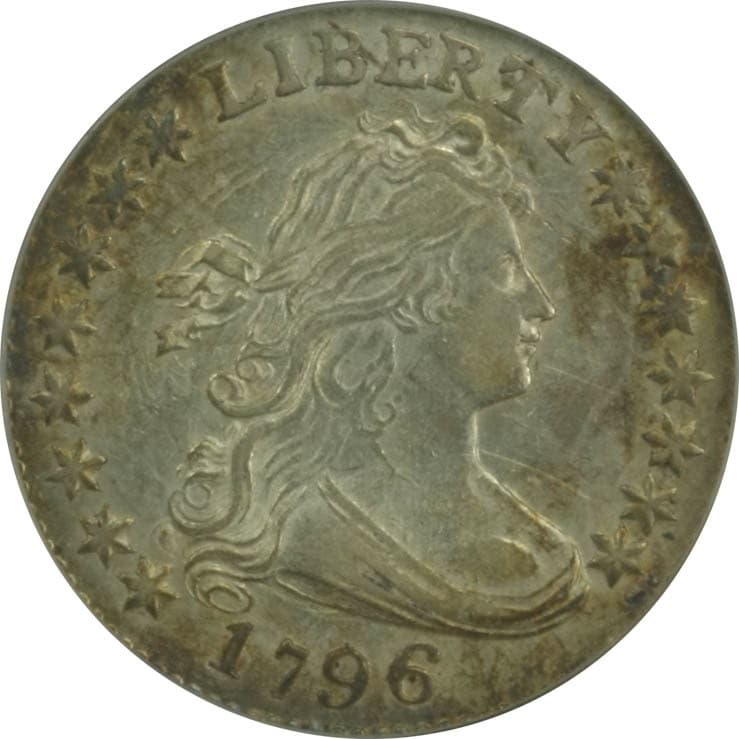
1796 Draped Bust Dime (First US Dime)
The first American dimes left the Philadelphia Mint in January 1796, and one of them, struck from fresh dies with mirror-like fields, may be the very first dime the United States ever made.
- Year
- 1796
- Maker
- U.S. Mint (Philadelphia)
- By price in coins
- 29 of 100
Create a free account to see every recorded price and every grade.
Create a free account- Struck
- 1796, Philadelphia Mint; first delivery January 18, 1796
- Designer
- Robert Scot, Chief Engraver of the U.S. Mint
- Mintage
- 22,135 for calendar year 1796; possibly 32,379 if two 1797 deliveries used 1796-dated dies
- Survivors
- About 850 in all grades (PCGS); 800 to 1,200 (2015 variety guide)
- This coin
- The Hayes-Walter-Gardner-Simpson JR-1, graded PCGS MS67 with a CAC sticker in 2014, now PCGS Specimen 67
- Why it matters
- The earliest known die state of the first variety of the first year of the dime; possibly the first dime struck
- Highest price for this coin
- $881,250, June 23, 2014, at auction in New York
- Most recent sale
- $750,000, September 17, 2020, at auction, as SP67
A coin promised in 1792
The Coinage Act of 1792 set up the dollar and its decimal parts: the dime, spelled disme in the law, the cent and the mill, worth a tenth, a hundredth and a thousandth of a dollar. The word comes from the Old French disme, a tithe or tenth part. A pattern disme was made in 1792, but no dimes were struck for circulation for another four years.
The Mint started with copper cents and half cents in 1793. Half dollars and silver dollars followed in 1794, half dimes in March 1795, and the first gold coins later in 1795. Dimes came last, in 1796, which made that year the first in which the Mint struck every authorized denomination, something that would not happen again until 1849.
The first dimes, 14,520 of them, were delivered on January 18, 1796. Further deliveries on February 13, March 30, April 9 and May 27 brought the 1796 total to 22,135. Some scholars think two deliveries in early 1797, of 3,864 and 6,380 coins, were also struck from 1796-dated dies, which would raise the total to 32,379.
Robert Scot's Liberty
In 1796 a new design replaced the much-criticized Flowing Hair type. Robert Scot, the Mint's chief engraver from 1793 to 1823, adapted a portrait by Gilbert Stuart into the Draped Bust Liberty; some accounts identify the sitter as the Philadelphia socialite Ann Willing Bingham. The same obverse went on copper and silver coins alike.
On the reverse Scot placed a small, naturalistic eagle inside a wreath, the design collectors call the Small Eagle. It was used on dimes only in 1796 and 1797 before the heraldic eagle replaced it, so the 1796 is one of just two dates of its type. The dime carried no mark of value; its size and silver content were meant to show what it was worth.
Stars were added for new states. By 1796 there were 15, and when Tennessee joined that June a 16th star appeared on some coins, until Mint Director Elias Boudinot ordered a return to 13. Early dimes were 89.24 percent silver and 10.76 percent copper, an alloy that kept them small and thin.
The first of the first
Dimes of 1796 were struck from several die pairings, catalogued by the John Reich Collectors Society as JR numbers; one source counts seven, another six. JR-1 is the most available, and enough Mint State examples survive to suggest that many were saved as the first dimes to reach the public. The authors of the standard reference on early dimes considered JR-1 the first variety struck.
This coin stands apart. Every other known JR-1 shows a large die break, a cud, joining the first star to the rim. On this coin the cud is absent, making it the earliest die state known by far, and catalogers have asked whether it could be the very first example struck. Its fields are fully prooflike, its devices frosted, and its strike so bold that the eagle's breast feathers show in full and a partial wire rim appears on each side.
When it was sold from the Jimmy Hayes collection in 1985, it was described as a Gem Brilliant Proof. PCGS at the time did not recognize proofs dated before 1817, and graded it MS67; CAC approved it at that grade. It was later reholdered as Specimen 67, and it is the only Draped Bust dime of any date that PCGS has certified as a Specimen strike.
From Hayes to Simpson
The coin's recorded pedigree begins at an auction in November 1957. It later belonged to Congressman Jimmy Hayes, whose silver collection was sold in New York on October 22, 1985, and then to John Whitney Walter, known as Mr. 1796, whose 1999 sale assembled 92 Mint issues and varieties dated 1796 along with four 1796 tokens. This dime was one of the keystones of that collection.
Pennsylvania collector Eugene H. Gardner owned it next. On June 23, 2014, it led the first sale of his collection at auction in New York, bringing $881,250 including the 17.5 percent buyer's fee; all 637 lots sold for a total of $19,627,872. One report of the sale described the coin as MS66, but the grade on the holder and in the catalog was MS67.
Collector Bob R. Simpson acquired it, and by the time he sold it on September 17, 2020, it had been regraded SP67. Bidding pushed it to $750,000, part of a sale that passed $14.6 million.
Where it ranks
This coin is the finest certified 1796 dime of the JR-1 variety, but it is not the highest-graded 1796 dime. PCGS has certified one MS68, a JR-6, the variety nicknamed the hyphenated date for its bold die breaks. That coin brought $793,125 at auction in August 2014, and a PCGS MS68 1796 dime with a CAC sticker has since sold online for $1,406,250. NGC has graded one MS67 of the JR-4 variety.
Mint State 1796 dimes are rare. PCGS estimates about 75 survive at MS60 or better and about 18 at MS65 or better, with most uncirculated pieces in the MS62 to MS64 range. Other top examples include an MS66+ from the D. Brent Pogue collection that sold for $235,000 and an MS66 from the Eric P. Newman collection that brought $188,000 in November 2013; Newman had paid $30 for it.
How to know a 1796 dime
A 1796 dime weighs 2.7 grams, measures about 19 millimeters and has a reeded edge. The obverse shows Scot's draped bust of Liberty with the word LIBERTY and a ring of stars; the reverse shows the small eagle and UNITED STATES OF AMERICA. There is no denomination on the coin.
Varieties are identified by die characteristics such as star counts, die cracks and the cud near star 1 that marks nearly every JR-1. Because 1796 is the first year of the denomination and the Small Eagle type lasted only two years, type collectors and early-dime specialists compete for the same coins.
The numbers
- Mintage
- 22,135 (1796 deliveries); possibly 32,379
- Known survivors
- About 850 (PCGS); 800-1,200 (2015 estimate); about 75 at MS60+, 18 at MS65+
- Weight
- 2.7 grams
- Diameter
- 19 mm
- Composition
- 89.24% silver, 10.76% copper
- Edge
- Reeded
- Designer
- Robert Scot
- This coin
- JR-1, earliest known die state; PCGS SP67, formerly MS67 CAC; sole finest certified JR-1
Timeline
The Coinage Act establishes the dime, spelled disme, as a tenth of a dollar.
The Philadelphia Mint begins regular production with cents and half cents.
The first 14,520 dimes are delivered.
The last 1796 delivery, 1,435 coins, brings the year's total to 22,135.
This coin is sold at auction, the first recorded entry in its pedigree.
It is sold from the Jimmy Hayes collection, described as a Gem Brilliant Proof.
It is sold with John Whitney Walter's collection of 1796-dated coins.
The Eric P. Newman MS66 1796 dime sells for $188,000.
Graded PCGS MS67 with CAC approval, it brings $881,250 in the Gardner sale in New York.
The PCGS MS68 JR-6, the highest-graded 1796 dime, sells for $793,125.
A Bust dime variety guide estimates 800 to 1,200 survivors of the date.
Now graded SP67, it sells for $750,000 from the Bob R. Simpson collection.
The world in 1796
The Jay Treaty with Britain takes effect.
Tennessee becomes the 16th state.
The United States takes possession of Detroit from Britain.
Surveyors name a spot in Ohio Cleveland, after Moses Cleaveland.
George Washington issues his Farewell Address.
John Adams defeats Thomas Jefferson for the presidency.
The Treaty of Tripoli is signed.
Price record
| Date | Price | Kind |
|---|---|---|
| Jun 23, 2014 | $881,250 | Sold at auctionThis coin, graded PCGS MS67 with CAC approval, Gardner collection, New York; includes 17.5% buyer's fee. |
| Sep 17, 2020 | $750,000 | Sold at auctionThis coin, regraded PCGS SP67, Bob R. Simpson collection. |
A realized auction price is what a buyer actually paid on the date shown, including the buyer's premium where the sale reported it. It is the strongest kind of reference price, and it is a record of one sale of one object on one day, not a promise of what the next example will bring.
By reference price, 1796 Draped Bust Dime (First US Dime) is number 29 of 100 in the coins entries of the FLOAT 100. 96 of those 100 rest on a realized sale; the rest carry an asking price or a guide value, and each page says which. Rank within the FLOAT 100 itself (99 here) is editorial: how much an object defines its field, not price alone.
Did you know
- The 1792 law that created the dime spelled it disme, from an Old French word for a tenth.
- 1796 was the first year the Mint struck every authorized denomination, and that did not happen again until 1849.
- The 1796 dime has no denomination on it; size and silver content told users what it was worth.
- This is the only Draped Bust dime of any date that PCGS has certified as a Specimen.
- A 1796 dime that Eric P. Newman bought for $30 sold for $188,000 in 2013.
- This coin sold for more in 2014 than the higher-graded MS68 did two months later.
How this page is made
- The figure
- One reference price, shown with its own kind. FLOAT does not average it with anything or adjust it for time.
- Realized or not
- A realized price is a completed sale. An asking price, an estimate and a price-guide value are not sales, and are labeled as such wherever they appear.
- The story
- Researched from published records and checked fact by fact. Updated Oct 3, 2026.
- Archive
- Oct 5, 2026