FLOAT 100 · Coins · No. 43
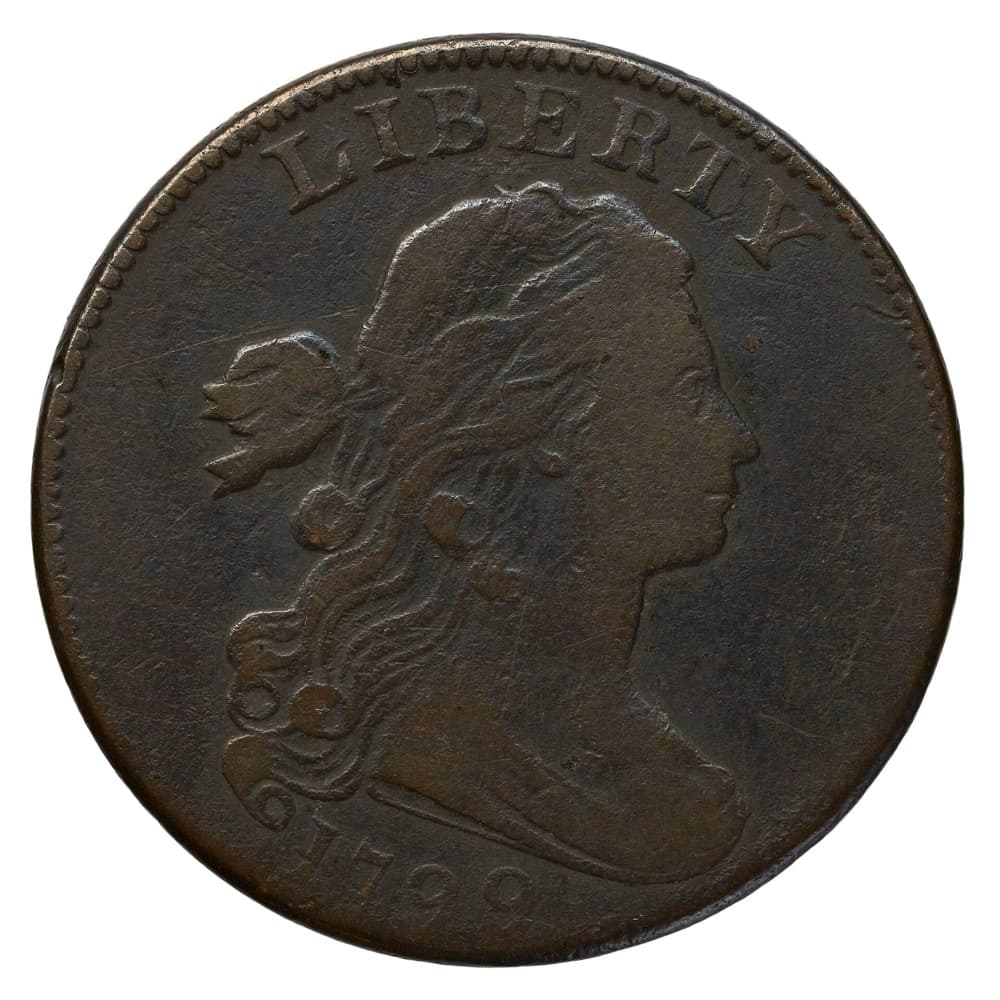
1799 Draped Bust Large Cent
The Mint reported more than 900,000 cents for 1799, yet the man who would become the father of American coin collecting could not find one with his birth year in his change, and the finest survivor spent more than a century hiding in England.
- Year
- 1799
- Maker
- U.S. Mint (Philadelphia)
- By price in coins
- 84 of 100
Create a free account to see every recorded price and every grade.
Create a free account- Denomination
- One cent (large cent), copper
- Struck
- 1799 (some likely into 1800), Philadelphia Mint
- Designer
- Robert Scot, first Chief Engraver of the U.S. Mint
- Cents delivered in 1799
- 904,585, but most were struck from dies dated 1798
- Dated varieties
- 1799/8 overdate (Sheldon-188), the prohibitively rare 1799/8 NC-1, and the normal or "Perfect" date (Sheldon-189)
- This entry
- Sheldon-188, the 1799/8 overdate, rated Rarity-4
- Finest known
- One Mint State coin, a normal date graded PCGS MS61; the finest 1799/8 is PCGS AU58
- Highest price reported
- $977,500 for the Mint State coin at auction in September 2009
- Status
- Key date of the Draped Bust cent series (1796-1807)
A year that is mostly missing
Mint records show the Philadelphia Mint delivered 904,585 cents in 1799. The catch is in the dies. According to PCGS's survey of the issue, the vast majority of those cents were struck with dies still dated 1798, and coins bearing the 1799 date make up only a fraction of the total. A later cataloging note goes further: some cents dated 1799 appear to have been struck in 1800, judging by color characteristics they share with 1800 cents.
For decades collectors worked from a much smaller figure. The numismatist Walter Breen, drawing on research from the 1940s and 1950s, gave a mintage of about 42,540 (another guide prints it as 42,542). Later research showed the number was wrong, and in 1999 the standard annual reference for U.S. coins replaced it with the 904,585 delivery figure, with a caveat that it does not tell you how many coins actually carry the 1799 date. Some specification tables still print the old 42,540.
The reason so many 1798 dies stayed in service is the condition of the early Mint itself. PCGS describes a money factory working with fragile, rudimentary equipment and short of die steel, so officials used whatever dies were on hand, damaged or out of date. For the 1799/8 overdate, a leftover 1798 obverse die was salvaged and a 9 was punched over the final 8.
The scramble ran in both directions. A 1798 cent variety, Sheldon-186, shares its reverse die with the 1799/8, and a heavy crack on that reverse shows the 1798-dated coins were actually struck after the 1799/8. The following year the Mint again reworked 18th-century dies to produce the 1800/1798 and 1800/79 overdates.
Robert Scot's Draped Bust
The design belongs to Robert Scot, who was born in England in 1744, came to America in 1775 and first settled in Fredericksburg, Virginia. He moved to Philadelphia around 1783, made a name engraving bank notes and portraits, and received his appointment at the Mint on November 23, 1793. He served as the Mint's first Chief Engraver until his death on November 1, 1823, and was succeeded by William Kneass.
In 1796 Scot redesigned the whole of the nation's coinage around a bust of Liberty wearing drapery at the neckline and a ribbon in her flowing hair. On the cent, the right-facing Liberty has wind-swept hair held back by a bow, LIBERTY above and the date below, with the fields left mostly bare. The reverse centers on ONE CENT inside a wreath tied with a ribbon bow, surrounded by UNITED STATES OF AMERICA, with the fraction 1/100 below. Sources differ on whether to call the wreath laurel or olive.
Because letters and numerals were punched into each die by hand, the Draped Bust series is full of blunders that collectors prize, from the LIHERTY cent, where the B was punched upside down and crudely corrected, to a wrong fraction reading 1/000. The 1799/8 is one more product of that hand-made world.
More than 16 million Draped Bust cents were made between 1796 and 1807. Within that run, 1799 stands alone as the rare date.
Worked to the bone
At the end of the 1790s the young United States was still trying to push foreign coins out of everyday use, and it needed copper coins to do it. The 1799 cents went straight into commerce and stayed there. Large cents held no precious metal, so they were not exported or melted for profit the way silver and gold were, and they circulated for decades. Some were struck on poorly prepared planchets that left them dark even when new.
By the time anyone thought to look for them, the damage was done. American coin collecting caught on in the 1850s, as the big copper cent was being replaced by the small Flying Eagle cent in 1857, and many collections began as an attempt to pull every date from circulation. Cents of 1793 and 1799 proved the hardest to find. Most 1799s that turned up were heavily worn, and many had been in the ground or another damp place and were corroded.
The issue's fame is tied to one collector. Joseph J. Mickley, often called the father of American coin collecting, was born in 1799 and wanted a cent of his birth year. By the usual account he never found one in circulation, though he did eventually acquire examples. Prices followed the legend: in the second half of the 19th century a "common" 1799 could cost $25, which one guide equates to roughly two weeks' wages for a semi-skilled laborer at the time.
There is also a darker story in dealer literature about why the date is scarce: that thousands of 1799 cents bound for Africa by a Salem, Massachusetts firm, to be traded for enslaved people, were lost at sea. It is told as a story, not documented history, and the sources that repeat it present it that way.
The famous survivors
The finest 1799 cent is a normal-date coin graded PCGS MS61, the only Mint State example known. It was found in England before 1928 in the stock of a London coin dealer, apparently having crossed the Atlantic soon after it was struck. It came back to America around 1928 through the numismatist Frank Shumway, then passed through some of the great early-copper cabinets: Henry C. Hines, Dr. William H. Sheldon, Dr. James O. Sloss (whose 1959 sale realized $10,600 for it), R.E. "Ted" Naftzger Jr., W.M. "Jack" Wadlington and Daniel W. Holmes Jr. At the Holmes sale in September 2009 it brought $977,500. It sold again on March 31, 2017, from the D. Brent Pogue family collection, for $540,500.
One of the best-traveled coins is a normal-date example now graded PCGS XF45. Its pedigree begins around 1845, when a collector named C. Rogers bought it from a countryman for $2. It then sold at auction in 1864 for $32.50, in 1866 for $27 and again for $45, in 1869 for $55, in 1874 for $67.50, in 1895 for $125, in 1912 for $85 and in 1916 for $160. It passed through the collection of Col. E.H.R. Green, sold on a 1944 fixed-price list for $900, joined the Louis E. Eliasberg Sr. collection and brought $46,200 at the Eliasberg sale in 1996. It realized $161,000 on February 15, 2008, and $210,000 on January 9, 2025.
The 1799/8 overdate has its own champions. The finest known is the Mickley-Ellsworth-High Desert coin at PCGS AU58BN; no Mint State 1799/8 is known. An XF40 that Dr. Sheldon owned sold for $225 in 1897, $500 in 1947, $3,500 in 1959 and $39,100 in 2001, then went to Col. Steven K. Ellsworth in a 2004 trade for the finest S-188, and brought $150,000 on January 9, 2025. The ex-Garrett XF45, once owned by Johns Hopkins University by gift of John Work Garrett, sold for $4,200 in 1979 and $164,500 on March 31, 2017.
Even damaged coins draw strong prices. An example graded only Poor-1 sold for $1,320 in 2021, and a Fine 12 brought $19,200 at a 2021 convention auction. Prices rise steeply from Very Fine 30 upward.
How to tell a 1799 cent
Two obverse dies carried the 1799 date. On both, the tip of Liberty's curl points between the B and E of LIBERTY. On the 1799/8 overdate, traces of the 8 show under the final 9. On the normal date, which collectors call the "Perfect Date," the numerals are more closely spaced and the date sits more centered than on the overdate.
The overdate obverse was paired with two reverses. Sheldon-188, the variety of this entry, is the one most often seen; it is rated Rarity-4. Its reverse is shared with the 1798 Sheldon-186: two leaf clusters, one above the E and one beside the ME of AMERICA, do not touch the stem. Late die states of S-188 are rare and show a crack through ERTY on the obverse and, on a handful of coins, the beginnings of the heavy reverse crack from the 6 o'clock rim toward the M of AMERICA. The other overdate, NC-1, uses a different reverse and is prohibitively rare.
Sources differ slightly on which 1799 is rarer, but the main references describe the overdate as somewhat scarcer than the normal date, with most overdates grading no finer than Very Fine. The normal date, Sheldon-189, is rated Rarity-2 in cataloging.
Problem-free coins are the real prize. Most survivors are worn, and many are corroded, repaired or otherwise impaired. Collectors should also know that deceptive counterfeits of the 1799/8 were produced in the mid-20th century, modeled on a specific XF40 coin with distinctive scratches near the first 9 and around ONE CENT. The places that wear first on the type are the hair above the forehead and ear, the shoulder drapery, and on the reverse the wreath leaves and ribbon knot.
The key that every copper collector needs
For collectors who build a set of Draped Bust cents by date, 1799 is the coin that decides whether the set can be finished. A type collector can stop at any common date; a date collector cannot. That demand has existed since Mickley's day, and it is why even honestly worn 1799s in Very Fine or better are known by pedigree among early-copper specialists.
The issue also sits at the heart of large-cent scholarship. Dr. William H. Sheldon's Early American Cents and its 1958 update, Penny Whimsy, gave the varieties their S-numbers, and several of the finest 1799s passed through Sheldon's own hands. The stories behind the coins, from a $2 purchase in the 1840s to six-figure sales in the 2020s, are as much a part of the date's appeal as the coins themselves.
The numbers
- Mintage
- 904,585 cents delivered in 1799, most from 1798-dated dies; the number actually dated 1799 is unknown. Walter Breen's older 42,540 figure is discredited.
- Known survivors
- No total is published in the sources used. One Mint State coin is known (normal date); the finest 1799/8 is PCGS AU58. Rarity ratings: S-188 R-4, S-189 R-2, NC-1 prohibitively rare.
- Weight
- 10.89 grams
- Diameter
- 28.00 millimeters
- Composition
- Copper
- Edge
- Plain
- Designer
- Robert Scot
Timeline
Robert Scot is appointed to the U.S. Mint; he becomes its first Chief Engraver.
Scot's Draped Bust design replaces earlier designs on the cent.
The Mint delivers 904,585 cents, most of them struck from 1798-dated dies; a leftover 1798 obverse is overpunched to create the 1799/8.
Joseph J. Mickley, later the leading early American collector, is born; he will hunt for a cent of his birth year.
Around this year, C. Rogers buys a 1799 cent from a countryman for $2; it becomes one of the best-documented examples.
The Rogers coin sells at auction for $32.50, the first of many public sales.
A 1799/8 later owned by Dr. William H. Sheldon sells for $225.
Around this year the only Mint State 1799 cent, found in England, returns to America.
Sheldon's 1799/8 XF40 sells for $500.
The Mint State coin sells for $10,600 in the Dr. James O. Sloss collection sale.
The Eliasberg collection's 1799 normal date sells for $46,200.
The standard annual U.S. coin reference drops Walter Breen's discredited 42,540 mintage in favor of 904,585, with a caveat.
Col. Steven K. Ellsworth acquires the finest known 1799/8 in a trade.
The ex-Eliasberg normal date, PCGS XF45, sells for $161,000.
The Mint State coin sells for $977,500 at the Dan Holmes collection sale.
From the D. Brent Pogue family collection, the PCGS MS61 sells for $540,500 and a 1799/8 PCGS XF45 for $164,500.
A 1799/8 PCGS VF25 brings $52,800 and a normal date PCGS VF30 $56,400.
From the Ellsworth collection, a 1799/8 PCGS XF40 sells for $150,000; the same day the ex-Eliasberg normal date PCGS XF45 brings $210,000.
The world in 1799
British Prime Minister William Pitt the Younger introduces an income tax.
In the undeclared Quasi-War with France, USS Constellation captures the French frigate L'Insurgente.
New York passes a law aimed at gradually abolishing slavery in the state.
French Captain Pierre Bouchard finds the Rosetta Stone in the Egyptian port city of Rosetta.
Napoleon overthrows the French Directory in the Coup of 18 Brumaire.
George Washington, the first President of the United States, dies at Mount Vernon, Virginia.
The Dutch East India Company's charter is allowed to expire.
Price record
| Date | Price | Kind |
|---|---|---|
| Oct 1864 | $33 | Sold at auctionNormal date, later PCGS XF45; bought around 1845 from a countryman for $2. |
| Nov 1874 | $68 | Sold at auctionSame normal-date coin, E. Harrison Sanford collection. |
| Jun 1897 | $225 | Sold at auction1799/8 S-188, later PCGS XF40 and owned by Dr. William H. Sheldon. |
| May 1916 | $160 | Sold at auctionNormal date, later PCGS XF45, Clarence C. Bement collection. |
| 1944 | $900 | Asking price, not a saleSame normal-date coin offered on a fixed-price list, Oscar J. Pearl collection. |
| Jun 11, 1946 | $238 | Sold at auction1799/8 S-188, later PCGS VF25, William Cutler Atwater collection. |
| Aug 23, 1947 | $500 | Sold at auctionSheldon's 1799/8 S-188, later PCGS XF40. |
| Oct 1959 | $10,600 | Sold at auctionThe only Mint State 1799 (normal date, later PCGS MS61), Dr. James O. Sloss collection. |
| Oct 21, 1959 | $3,500 | Sold at auction1799/8 S-188, later PCGS XF40. |
| Nov 1979 | $4,200 | Sold at auction1799/8 S-188, later PCGS XF45, Garrett collection. |
| May 1996 | $46,200 | Sold at auctionNormal date, later PCGS XF45, Eliasberg collection. |
| Feb 17, 2001 | $39,100 | Sold at auction1799/8 S-188, later PCGS XF40. |
| Jan 2005 | $89,125 | Sold at auction1799/8, PCGS F15. |
| Feb 15, 2008 | $161,000 | Sold at auctionNormal date, PCGS XF45, Walter J. Husak collection. |
| Feb 15, 2008 | $48,875 | Sold at auction1799/8 S-188, PCGS VF35, Husak collection. |
| Jul 30, 2009 | $31,625 | Sold at auction1799/8 S-188, PCGS VF25, ex Eliasberg. |
| Sep 2009 | $977,500 | Sold at auctionThe only Mint State 1799, Dan Holmes collection. Highest price reported for the date. |
| Mar 25, 2010 | $48,875 | Sold at auctionNormal date, PCGS VF35. |
| Jan 22, 2013 | $99,875 | Sold at auctionSame normal-date coin, PCGS VF35 CAC, Cardinal Collection. |
| Jan 10, 2014 | $70,500 | Sold at auction1799/8 S-188, PCGS VF25, Adam Mervis collection. |
| May 12, 2015 | $73,438 | Sold at auctionNormal date S-189, NGC AU Details (environmental damage), Eugene H. Gardner collection; ex Mickley. |
| Mar 31, 2017 | $540,500 | Sold at auctionThe only Mint State 1799, PCGS MS61, D. Brent Pogue family collection. |
| Mar 31, 2017 | $164,500 | Sold at auction1799/8 S-188, PCGS XF45, ex Garrett and Holmes, Pogue family collection. |
| Aug 15, 2018 | $14,400 | Sold at auction1799/8 S-188, PCGS XF Details (repaired rim); the same coin brought $48,875 in 2008 as VF35. |
| Jan 12, 2022 | $52,800 | Sold at auction1799/8 S-188, PCGS VF25, ex Eliasberg and Mervis. |
| Jan 12, 2022 | $56,400 | Sold at auctionNormal date S-189, PCGS VF30. |
| Jan 14, 2022 | $117,000 | Sold at auction1799/8 S-188, PCGS XF40. |
| Jan 9, 2025 | $150,000 | Sold at auction1799/8 S-188, PCGS XF40, Col. Steven K. Ellsworth collection; ex Sheldon. |
| Jan 9, 2025 | $210,000 | Sold at auctionNormal date S-189, PCGS XF45 CAC; the coin bought for $2 around 1845. |
A realized auction price is what a buyer actually paid on the date shown, including the buyer's premium where the sale reported it. It is the strongest kind of reference price, and it is a record of one sale of one object on one day, not a promise of what the next example will bring.
By reference price, 1799 Draped Bust Large Cent is number 84 of 100 in the coins entries of the FLOAT 100. 96 of those 100 rest on a realized sale; the rest carry an asking price or a guide value, and each page says which. Rank within the FLOAT 100 itself (43 here) is editorial: how much an object defines its field, not price alone.
Did you know
- Most cents the Mint struck in 1799 actually carry the date 1798.
- The only Mint State 1799 cent spent more than a century in England and was found in a London dealer's stock before returning to America around 1928.
- A 1799 cent bought from a countryman for $2 around 1845 sold for $210,000 in January 2025.
- Joseph Mickley, often called the father of American coin collecting, chased the 1799 cent because 1799 was his birth year.
- Coins dated 1798 (Sheldon-186) were struck after the 1799/8, which a growing crack on their shared reverse die proves.
- In 2021 an example graded Poor-1, the lowest grade on the scale, sold for $1,320.
- Deceptive counterfeits of the 1799/8 made in the mid-20th century were modeled on one specific XF40 coin.
- In the late 19th century a $25 price for a common 1799 cent equaled about two weeks' wages for a semi-skilled laborer.
How this page is made
- The figure
- One reference price, shown with its own kind. FLOAT does not average it with anything or adjust it for time.
- Realized or not
- A realized price is a completed sale. An asking price, an estimate and a price-guide value are not sales, and are labeled as such wherever they appear.
- The story
- Researched from published records and checked fact by fact. Updated Oct 1, 2026.
- Archive
- Oct 5, 2026