FLOAT 100 · Coins · No. 89
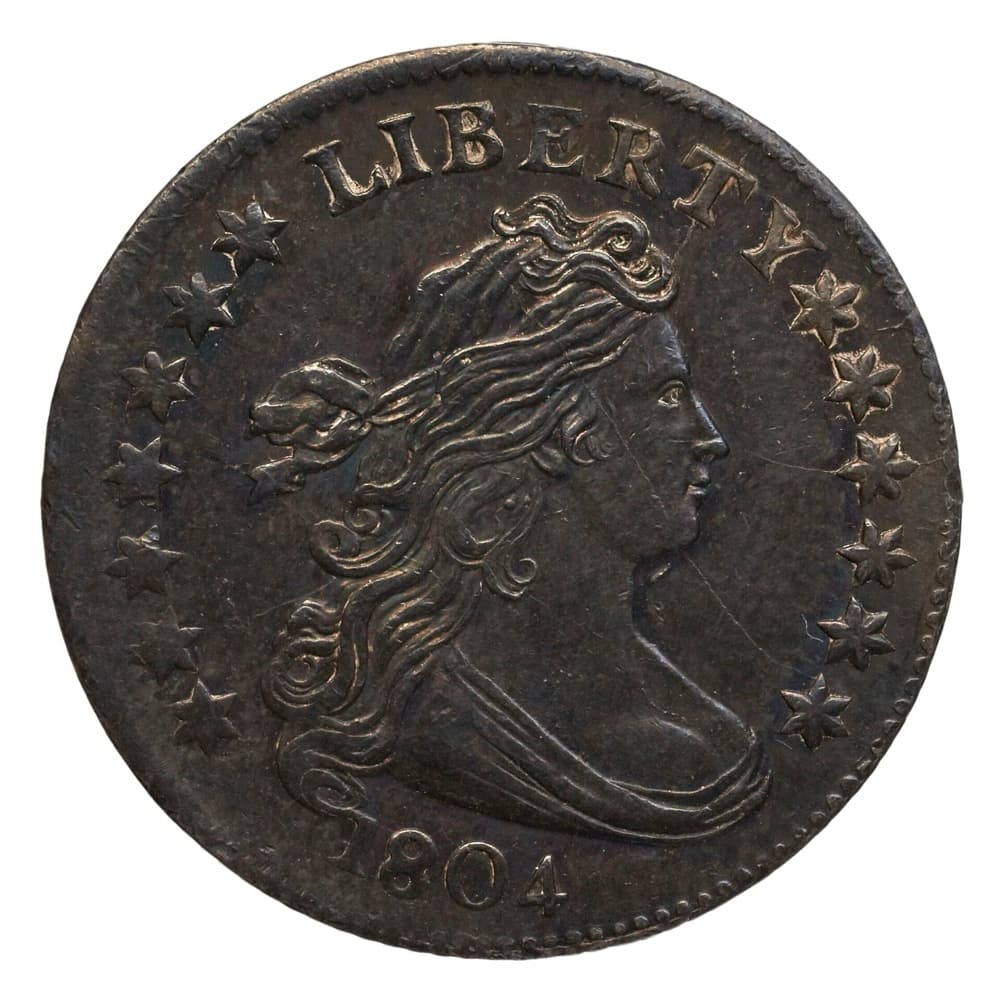
1804 Draped Bust Dime
An engraver put one star too many on a die that struck both dimes and gold coins in 1804, and the best surviving dime from it spent decades lost in a box of junk coins before selling for $632,500.
- Year
- 1804
- Maker
- U.S. Mint (Philadelphia)
- By price in coins
- 37 of 100
Create a free account to see every recorded price and every grade.
Create a free account- Struck
- 1804, Philadelphia Mint
- Type
- Draped Bust dime, Heraldic Eagle reverse, 14 stars above the eagle (JR-2)
- Designer
- Robert Scot, after a portrait by Gilbert Stuart
- Mintage
- 8,265 for the year, both varieties; the lowest of any Draped Bust dime
- Survivors
- About 20 of the 14-star variety in all grades (PCGS estimate)
- Odd fact
- Its reverse die also struck 1804 quarter eagles, a $2.50 gold coin
- This coin
- The Eliasberg specimen, graded NGC AU58 with CAC approval
- Sold
- $632,500, July 30, 2008, the auction record for the variety
The smallest silver coin of a busy year
The dime was one of the first silver coins of the new nation, and the Draped Bust design carried it from 1796 to 1807. Robert Scot, the Mint's chief engraver from 1793 to 1823, adapted a portrait by the painter Gilbert Stuart, said to be of a Philadelphia society woman, possibly Ann Willing Bingham. From 1798 the reverse showed a heraldic eagle with a shield on its breast and the motto E PLURIBUS UNUM on a ribbon.
In 1804 the Mint struck only 8,265 dimes, the smallest output of any Draped Bust dime. It was the only dime with a mintage under 10,000 until the 1860s. Two reverse dies were used that year, one with the regular 13 stars above the eagle and one with 14.
The 1804 date carries extra pull among collectors because of the famous 1804 silver dollar, but the 1804 dime and quarter are real rarities on their own. No half dimes or half dollars carry the 1804 date at all.
One star too many
The stars on early U.S. coins once tracked the number of states. When the count reached 15 and Tennessee's admission threatened more, Mint Director Elias Boudinot ordered coins to go back to 13 stars, one for each original state. The 14-star reverse broke that rule. Numismatist Ron Guth calls it an inexplicable error, since Vermont, the 14th state, had joined the Union more than a decade earlier.
The same die did not stop at dimes. In this era the dime and the quarter eagle, the $2.50 gold piece, were nearly the same size and neither carried a statement of value, so the Mint could use one reverse die for both. Both 1804 dime reverses were also used for the two 1804 quarter eagle varieties, so the 14-star die struck both silver and gold. A shared reverse between two such different denominations is very unusual in regular American coinage.
America in 1804
The year these dimes were struck, the United States took formal possession of the Louisiana Purchase in a ceremony at St. Louis, and in May the Lewis and Clark Expedition set out up the Missouri River. In July Aaron Burr shot Alexander Hamilton in a duel; Hamilton died the next day.
Thomas Jefferson won reelection in December, the Twelfth Amendment changed how presidents and vice presidents were chosen, and New Jersey became the last northern state to abolish slavery.
From a junk box to a record
This coin's history begins in a March 1907 sale of the David Wilson collection. It passed to the collector Virgil Brand, then to Armin Brand, who consigned it for sale on September 30, 1935; from there it entered the collection of Louis E. Eliasberg Sr.
Then it dropped out of sight. Around 2004 or 2005 his son Richard Eliasberg found it in a box full of junk coins. It sold at auction in January 2007 for $161,000 and went to the Ed Price collection.
On July 30, 2008, graded NGC AU58 with CAC approval, it sold for $632,500, the auction record for the 1804 14-star dime. It later joined the D. Brent Pogue collection and sold at auction in May 2015 for $329,000, now in a PCGS AU58 holder. PCGS ranks it second finest known for the variety.
For decades AU58 was the best grade known for any 1804 dime. In 2013 an example graded MS63 by NGC surfaced from the William Jacob collection and sold for $367,187.50, taking the top spot. A PCGS AU53 example brought $184,000 in 2007 and $99,875 in 2015, and a PCGS AU58 example sold for $252,000 in August 2018.
How to know an 1804 14-star dime
Count the stars above the heraldic eagle: fourteen means JR-2, the variety this coin represents; thirteen means the more usual reverse. Both varieties share the same obverse, with Liberty facing right and the date 1804 below. The coin weighs 2.70 grams, measures about 19.8 millimeters, has a reeded edge and is 89.2 percent silver and 10.8 percent copper.
Both varieties are hard to find in Extremely Fine or better, and many survivors are damaged, so a well-struck, problem-free coin is especially scarce. PCGS has certified only nine examples of the 14-star variety, all circulated, and estimates about 20 survive in all grades.
The numbers
- Mintage
- 8,265 (1804, both varieties)
- Known survivors
- About 20 of the 14-star variety (PCGS estimate); 9 certified by PCGS, all circulated
- Weight
- 2.70 grams
- Diameter
- 19.8 mm (PCGS); 19 mm in another reference
- Composition
- 89.2% silver, 10.8% copper
- Edge
- Reeded
- Designer
- Robert Scot, from a Gilbert Stuart portrait
- Variety
- JR-2, 14-star reverse; reverse die shared with 1804 quarter eagles
Timeline
The Draped Bust dime is introduced.
The Heraldic Eagle reverse replaces the small eagle on the dime.
The Mint strikes 8,265 dimes, using a 13-star and a 14-star reverse die.
The Draped Bust dime ends.
This coin appears in the David Wilson sale.
Armin Brand consigns the coin; it enters the Louis E. Eliasberg Sr. collection.
Around 2004-2005 Richard Eliasberg finds the coin in a box of junk coins.
The coin sells at auction for $161,000.
Graded NGC AU58 CAC, it sells for $632,500, the variety's auction record.
An NGC MS63 example from the William Jacob collection sells for $367,187.50 and becomes finest known.
This coin, from the Pogue collection, sells at auction for $329,000 as PCGS AU58.
A PCGS AU58 14-star dime sells for $252,000.
The world in 1804
New Jersey becomes the last northern state to abolish slavery.
Stephen Decatur leads a raid to burn the captured USS Philadelphia in the First Barbary War.
A ceremony in St. Louis completes the transfer of the Louisiana Purchase.
The Lewis and Clark Expedition leaves Camp Dubois and heads up the Missouri River.
Aaron Burr shoots Alexander Hamilton in a duel; Hamilton dies the next day.
Tennessee's ratification settles adoption of the Twelfth Amendment.
Thomas Jefferson defeats Charles C. Pinckney for the presidency.
Price record
| Date | Price | Kind |
|---|---|---|
| Jul 30, 2008 | $632,500 | Sold at auctionThe Eliasberg 1804 14-star dime, NGC AU58 CAC. Auction record for the variety. |
A realized auction price is what a buyer actually paid on the date shown, including the buyer's premium where the sale reported it. It is the strongest kind of reference price, and it is a record of one sale of one object on one day, not a promise of what the next example will bring.
By reference price, 1804 Draped Bust Dime is number 37 of 100 in the coins entries of the FLOAT 100. 96 of those 100 rest on a realized sale; the rest carry an asking price or a guide value, and each page says which. Rank within the FLOAT 100 itself (89 here) is editorial: how much an object defines its field, not price alone.
Did you know
- The 14-star reverse die that struck these silver dimes also struck $2.50 gold quarter eagles.
- Nobody knows why the engraver cut 14 stars; the 14th state, Vermont, had joined more than a decade earlier.
- This coin was found around 2004-2005 in a box of junk coins from the Eliasberg family.
- The coin sold for $161,000 in 2007 and $632,500 eighteen months later.
- The 1804 dime was the only dime with a mintage under 10,000 until the 1860s.
- No coins at all carry the date 1804 among half dimes and half dollars.
How this page is made
- The figure
- One reference price, shown with its own kind. FLOAT does not average it with anything or adjust it for time.
- Realized or not
- A realized price is a completed sale. An asking price, an estimate and a price-guide value are not sales, and are labeled as such wherever they appear.
- The story
- Researched from published records and checked fact by fact. Updated Oct 3, 2026.
- Archive
- Oct 5, 2026