FLOAT 100 · Coins · No. 10
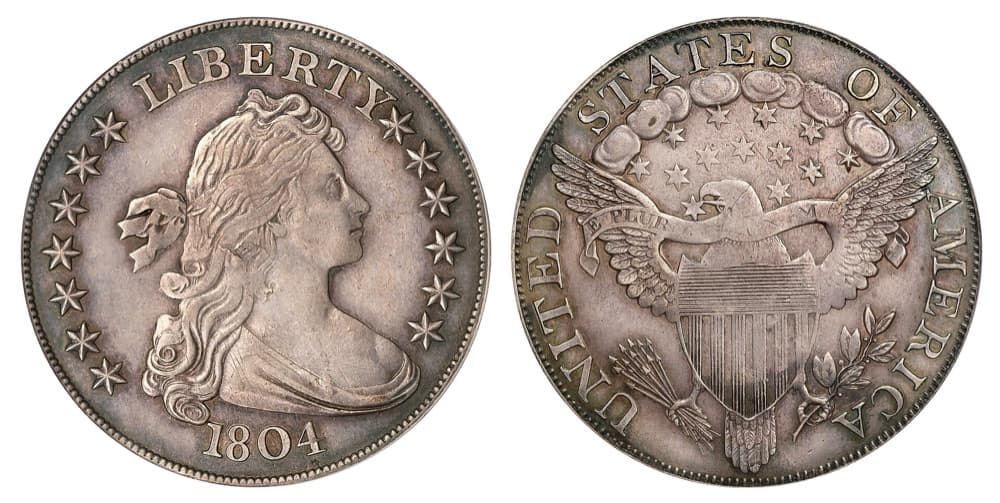
1804 Draped Bust Dollar, Class III
No silver dollar dated 1804 was struck in 1804; this one was made in secret at the Philadelphia Mint around 1858 to 1860, given a fake edge and a fake history in the 1870s, and still became the most famous coin a collector can chase.
- Year
- 1804 (Class III restrike, c.1858-60)
- Maker
- U.S. Mint (Philadelphia, later restrike)
- By price in coins
- 11 of 100
Create a free account to see every recorded price and every grade.
Create a free account- Date on coin
- 1804
- Actually struck
- About 1858 to 1860, Philadelphia Mint, without authorization; edge lettering added about 1875
- Type
- Draped Bust silver dollar, Class III restrike (lettered edge), variety BB-306
- Known
- 7 Class III examples, out of 16 known 1804 dollars of all classes
- Where they are
- Four Class III coins are in private hands; three are in museum collections
- How to spot one
- Struck from the 'Reverse Y' die shared with the Class II; Class I originals use 'Reverse X'
- This entry
- The Adams-Carter specimen, PCGS PR58, sold from the Presidio Collection
- Latest sale of this coin
- $3,538,000 at auction, January 14, 2026
- Finest Class III
- The James A. Stack Sr. coin, PCGS PR65 CAC, unpublished until 2025; sold for $6,000,000 in December 2025
A date that never existed
The United States stopped making silver dollars in March 1804, and the pieces struck that year carried the date 1803. On May 1, 1806, Secretary of State James Madison formally suspended dollar coinage, citing 'considerable purchases' of dollars 'for the purpose of exporting them,' and ordered that the Mint coin silver only in small denominations.
Three decades later the State Department needed sets of American coins as diplomatic gifts. Envoy Edmund Roberts was to carry them to the rulers of Siam, Muscat, Japan and Cochin China. The dollar and the $10 eagle were no longer being made, so Mint officials looked up the last year each had been issued and struck new pieces with that date. For the eagle, 1804 was right. For the dollar it was wrong: every dollar coined in 1804 had been struck from 1803-dated dies. Those diplomatic strikings, made around 1834 and 1835, are the Class I 'originals.' Eight are known.
Roberts delivered sets to the Sultan of Muscat and the King of Siam, then died of dysentery at Macao in June 1836 before reaching Japan or Cochin China. Collectors learned the coin existed in 1842, when Mint officials Jacob R. Eckfeldt and William E. DuBois illustrated an 1804 dollar in their Manual of Gold and Silver Coins of All Nations. In 1843 Massachusetts collector Matthew Stickney traded Pine Tree coins and a gold Immune Columbia piece to the Mint Cabinet for one. The legend had started, and the supply was gone.
The 'Midnight Mint'
Collecting boomed in the late 1850s, driven partly by the new small cent and the scarce 1856 Flying Eagle cent. Under Mint Director James Ross Snowden, who served from June 1853 to May 1861, the Philadelphia Mint struck rare dates from old and backdated dies for collectors and dealers. On January 22, 1859, Snowden wrote to Treasury Secretary Howell Cobb that the Mint was 'duly pressed upon, by Collectors of Coins from all parts of the Country,' and that some pieces it issued 'got into the hands of dealers and are sold at excessive prices.'
About a dozen new 1804 dollars were struck in this period, using the original 1804 obverse die but a different reverse die, now called Reverse Y. These coins had plain edges, which made collectors suspicious when they appeared for sale in the summer of 1860. According to Mint curator William DuBois, four were sold before the scandal forced Snowden to recover them. All but one recovered coin were melted. That survivor, the only Class II 1804 dollar, is in the Smithsonian. It was struck over an 1857 Swiss coin: one detailed account calls it a Bern 5-franc piece, while others call it a Swiss shooting thaler.
Who actually struck the coins is still argued. For more than a century the blame fell on Theodore Eckfeldt, son of a Mint foreman, and some references still name him as the likely culprit. Researchers Craig Sholley and John Dannreuther argue instead that the work was done by Archibald Loudon Snowden, the director's nephew and the Mint's registrar of deposits, and Henry R. Linderman, its chief clerk, with dealer William Idler and his son-in-law, Philadelphia dealer Captain John W. Haseltine, handling sales.
Seven of the plain-edge dollars stayed hidden, unsellable without the lettered edge a genuine Bust dollar should have. In March 1873 Linderman became Director of the Mint, and Snowden by then was Chief Coiner. Snowden found an old Bust dollar edge-lettering device in the Mint vault, and around 1875 the seven coins were run through it. The operator was inexperienced: the lettering is blundered on the coins that have been examined, and the pass through the device raised a slight wire rim that had to be filed down. Those seven are the Class III dollars.
How to tell a Class III
Every authentic 1804 dollar was struck from the same obverse die. The reverse tells the classes apart. On Reverse X, used for the Class I originals, the S in STATES sits slightly left of the gap between the two leftmost clouds, and the top-left berry touches its leaf. On Reverse Y, used for Classes II and III, the S sits entirely above the leftmost cloud and the top-left berry is centered between the leaves. One detailed account also distinguishes the dies by where the E in STATES falls over the clouds.
The Class III edge reads HUNDRED CENTS ONE DOLLAR OR UNIT, applied after striking, a process that left the surfaces slightly concave. Four of the seven Class III coins were deliberately worn to look like circulation finds, so they could be offered as newly found circulation pieces rather than as unauthorized Mint products. Three are unworn: the Stack coin, possibly first owned by A. Loudon Snowden, and the coins owned by Linderman and Idler, men who knew where the coins really came from.
The Adams-Carter coin is one of the worn group, though only very lightly: its 2026 catalog describes no loss of detail, satiny luster under gunmetal-gray toning with lavender, gold and green, and glimpses of mirrored field. All Class III coins show some doubling on the reverse from a double strike, and it is most prominent on this one, on STATES OF AMERICA, the stars at right, the eagle's wing and the olive branch. In a die-state study of the surviving Reverse Y coins, Sholley and Dannreuther placed it fifth of seven in the order they were struck.
The Adams-Carter coin: 150 years of owners
The coin's known history begins in 1876, when Captain John W. Haseltine showed it and said it came from a private English source. It went to Phineas Adams of Manchester, New Hampshire, then through Boston dealer Henry Ahlborn to John Pickering Lyman, a Boston bank president. When Lyman's collection was sold on November 7, 1913, the coin brought $340 and went to Baltimore banker Waldo C. Newcomer, who displayed it at the American Numismatic Society in 1914.
In 1932 Newcomer consigned it to the Texas dealer B. Max Mehl, who sold it to Col. Edward H.R. Green, son of Hetty Green, the 'Witch of Wall Street.' Green also owned all five 1913 Liberty Head nickels and at one time the whole sheet of the Inverted Jenny airmail stamp. After Green died in 1936 the coin was sold in 1943 to A.J. Allen of Plainfield, New Jersey, and then in 1946 to F.C.C. Boyd. Percy A. Smith, a Portland, Oregon, desk manufacturer, showed it to the Oregon Numismatic Society in September 1946 and sold it back to Mehl late in 1949.
Mehl offered it in his Golden Jubilee Sale in May 1950, calling the 1804 dollar 'the most famous of all American coins and probably the most famous coin in the world.' Fort Worth newspaper publisher Amon G. Carter Sr. paid $3,250. It stayed with the Carter family until after Amon G. Carter Jr. died in 1982, then sold at auction in January 1984 for $198,000 to an agent for Texas collector L.R. French Jr. French's collection sold in January 1989, where the coin brought $242,000.
From there it moved quickly through dealers and collectors. It was placed with Ohio businessman Phillip Flannagan in 1998, who sold his early coins to raise money for a Christian school and youth camp; it brought $874,000 at his November 2001 sale and $1,207,500 at auction in Baltimore in August 2003. Census records list private sales at $2,250,000 and, in March 2006, $2,475,000. In April 2009 it sold at auction for $2,300,000 to dealer John Albanese, and it later went privately to the Presidio Collection. On January 14, 2026, it was the top lot of a major January coin auction at $3,538,000.
The King of American Coins
The 1804 dollar's royal nickname is old. The pioneering dealers S.H. and Henry Chapman called it the 'King of United States Coins' at least as early as 1885, and the same year George C. Evans called it 'The King among Rarities' in his History of the United States Mint. It has ranked first in the book 100 Greatest U.S. Coins in four of its six editions.
A Class III graded PR55 sold for $1,880,000 in August 2014. Then, in 2025, a Class III no one had published emerged from the collection of New York banker James A. Stack Sr., who bought it before his death in 1951. Graded PCGS PR65 with CAC approval, it is the finest known Class III, and it sold for $6,000,000 on December 9, 2025. Its emergence raised the Class III count to seven, where for generations collectors had believed only six survived.
That discovery also settled a technical question. Examining the Stack coin before it was certified, Sholley and Dannreuther found it was struck before the Class II coin in the Smithsonian, confirming that every Reverse Y dollar started life with a plain edge.
The numbers
- Mintage
- No record; 7 Class III coins are known (about a dozen Reverse Y coins were struck, most later melted or converted)
- Known survivors
- 16 1804 dollars in all: 8 Class I, 1 Class II, 7 Class III; 6 in museums, 10 in private hands
- Weight
- About 27 grams (27.00 g and 26.96 g in two sources)
- Diameter
- 40 mm
- Composition
- Silver and copper: listed as 90/10 by one source and 89.24/10.76 by another
- Edge
- Lettered HUNDRED CENTS ONE DOLLAR OR UNIT, added about 1875
- Designer
- Robert Scot (Draped Bust design)
Timeline
U.S. silver dollar production stops; the coins struck in 1804 carry the date 1803.
Secretary of State James Madison formally suspends silver dollar coinage.
The Mint strikes the first 1804-dated dollars, the Class I originals, for diplomatic presentation sets.
Eckfeldt and DuBois illustrate an 1804 dollar in their Mint manual, revealing the coin to collectors.
Matthew Stickney trades for an 1804 dollar from the Mint Cabinet.
Mint Director James Ross Snowden writes to the Treasury Secretary about the Mint supplying rare coins to collectors.
Plain-edge 1804 dollars (Class II) appear for sale in the summer; four are recovered and all but one melted.
Henry R. Linderman becomes Director of the Mint; A. Loudon Snowden is Chief Coiner.
About this year, edge lettering is added to the seven hidden plain-edge 1804 dollars, creating the Class III coins.
Captain John W. Haseltine shows the Adams-Carter coin, claiming an English source; it goes to Phineas Adams.
The John P. Lyman collection is sold; the coin brings $340 and goes to Waldo C. Newcomer.
Newcomer consigns the coin; it is sold to Col. E.H.R. Green.
Amon G. Carter Sr. buys the coin for $3,250.
The Carter coin sells at auction for $198,000.
The L.R. French Jr. collection is sold; the coin brings $242,000.
Sold from the Phillip Flannagan collection for $874,000.
Sells at auction in Baltimore for $1,207,500.
Sells at auction for $2,300,000.
The newly revealed James A. Stack Sr. Class III, PCGS PR65, sells for $6,000,000.
The Adams-Carter coin, PCGS PR58, sells from the Presidio Collection for $3,538,000.
The world in 1859
Oregon is admitted as the 33rd state.
The Comstock Lode is discovered in present-day Nevada.
Edwin Drake drills the first oil well in the United States, near Titusville, Pennsylvania.
John Brown's raid on the Harpers Ferry Armory begins.
John Brown is hanged at Charles Town.
Price record
| Date | Price | Kind |
|---|---|---|
| Nov 7, 1913 | $340 | Sold at auctionThis coin, John P. Lyman collection. |
| Jun 1946 | $2,875 | Sold at auctionA different Class III, the Idler coin, now in the American Numismatic Association collection. |
| Jun 1947 | $3,125 | Sold at auctionThe Idler Class III again, one year later. |
| May 1950 | $3,250 | Sold at auctionThis coin, bought by Amon G. Carter Sr. |
| Apr 1954 | $8,000 | Sold at auctionA different Class III, the Davis coin. |
| May 1963 | $36,000 | Sold at auctionThe Davis Class III. |
| Mar 1980 | $400,000 | Sold at auctionA different Class III, the Berg coin, from the Garrett collection of Johns Hopkins University. |
| Jan 1984 | $198,000 | Sold at auctionThis coin, Carter collection. |
| Jan 1985 | $308,000 | Sold at auctionThe Idler Class III, from the Dr. Jerry Buss collection. |
| Jan 1989 | $242,000 | Sold at auctionThis coin, L.R. French Jr. collection. |
| Nov 2001 | $874,000 | Sold at auctionThis coin, Phillip Flannagan collection. |
| Aug 2003 | $1,207,500 | Sold at auctionThis coin, sold at auction in Baltimore. |
| Mar 2006 | $2,475,000 | Private saleThis coin, to an East Coast collector. A prior private sale at $2,250,000 is recorded without a date. |
| Apr 5, 2009 | $2,300,000 | Sold at auctionThis coin, bought by John Albanese. |
| Aug 2014 | $1,880,000 | Sold at auctionThe Berg Class III, then graded NGC PR55. |
| Mar 20, 2020 | $1,440,000 | Sold at auctionThe Berg Class III, PCGS PR55, after the death of collector D. Brent Pogue. |
| Dec 9, 2025 | $6,000,000 | Sold at auctionThe James A. Stack Sr. Class III, PCGS PR65 CAC, the finest known. Record for a Class III. |
| Jan 14, 2026 | $3,538,000 | Sold at auctionThis coin, PCGS PR58, from the Presidio Collection. |
A realized auction price is what a buyer actually paid on the date shown, including the buyer's premium where the sale reported it. It is the strongest kind of reference price, and it is a record of one sale of one object on one day, not a promise of what the next example will bring.
By reference price, 1804 Draped Bust Dollar, Class III is number 11 of 100 in the coins entries of the FLOAT 100. 96 of those 100 rest on a realized sale; the rest carry an asking price or a guide value, and each page says which. Rank within the FLOAT 100 itself (10 here) is editorial: how much an object defines its field, not price alone.
Did you know
- No U.S. silver dollar dated 1804 was struck in 1804. The coins made that year were dated 1803.
- The Class III coins were made around 1858 to 1860 but could not be sold for about 15 years, until someone found an old edge-lettering device in the Mint vault.
- Four of the seven Class III dollars were deliberately worn so they could pass as old coins found in circulation.
- Col. E.H.R. Green, who owned the Adams-Carter coin in the 1930s, also owned all five 1913 Liberty Head nickels.
- Another Class III, the Berg coin, was once traded for eight acres of land in El Paso, Texas.
- A Class III stolen from the DuPont family in 1967 was recovered in the early 1980s and is now in the Smithsonian.
- Until 2025, collectors believed only six Class III dollars survived. A seventh, the finest of all, had been sitting unpublished in a New York banker's estate since 1951.
How this page is made
- The figure
- One reference price, shown with its own kind. FLOAT does not average it with anything or adjust it for time.
- Realized or not
- A realized price is a completed sale. An asking price, an estimate and a price-guide value are not sales, and are labeled as such wherever they appear.
- The story
- Researched from published records and checked fact by fact. Updated Oct 1, 2026.
- Archive
- Oct 5, 2026