FLOAT 100 · Coins · No. 56
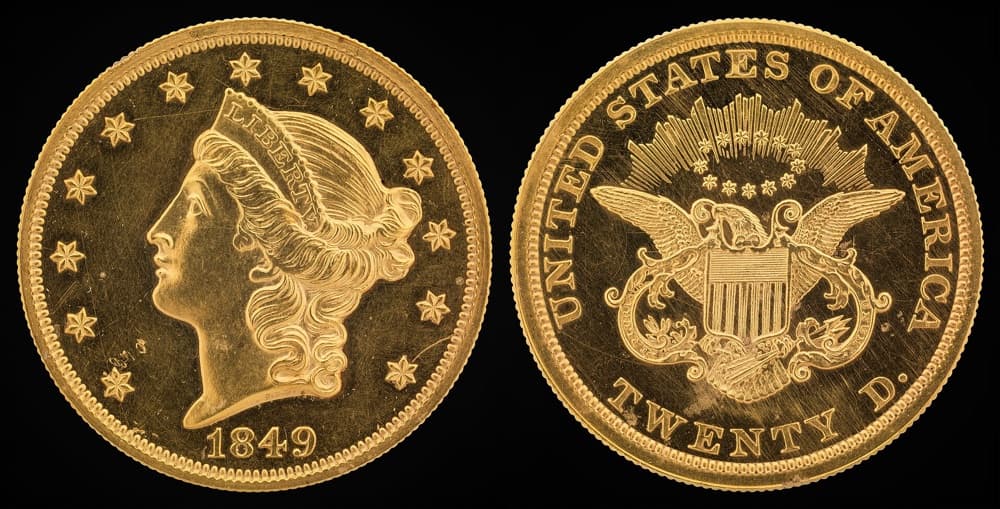
1849 Liberty Head Double Eagle
Born of the California Gold Rush and a bitter feud inside the Philadelphia Mint, the first American $20 gold piece survives as a single coin in the Smithsonian, which turned down J.P. Morgan and has never let it go.
- Year
- 1849
- Maker
- U.S. Mint (Philadelphia)
- By price in coins
- 1 of 100
Create a free account to see every recorded price and every grade.
Create a free account- What it is
- The first U.S. double eagle ($20 gold piece), struck in December 1849 as a pattern before regular coinage began in 1850
- Designer
- James Barton Longacre, Chief Engraver of the U.S. Mint, with help on the dies from engraver Peter F. Cross
- Struck
- Philadelphia Mint, by hand on a medal press; Mint Director Robert M. Patterson reported the dies finished on December 22, 1849
- Authorized by
- The Act of March 3, 1849, signed by President James K. Polk, which created both the gold dollar and the double eagle
- Known today
- One. It is in the National Numismatic Collection at the Smithsonian Institution
- The missing twin
- A second gold example sent to Treasury Secretary William M. Meredith has been unlocated for decades
- Grade (opinion only)
- Two experts who examined it through display glass in August 2009 thought it would grade Proof 63 or 64, probably 64; it has never been certified
- Ever sold?
- Never. No 1849 double eagle has been offered at public auction
- Nickname
- Called by many the "ruby slippers" of American coins
- Where to see it
- The Value of Money exhibition, National Museum of American History, Washington, D.C.
A coin for a flood of gold
Until 1849 the largest American coin was the $10 gold eagle. The idea of a bigger gold piece had been floated before: in 1836 the Philadelphia newspaper the Public Ledger complained that twenty silver dollars were "an encumbrance in a pocket" and proposed a gold "double eagle" the size of a silver dollar. Nothing came of it until gold was found in California in 1848 and bullion began pouring east to the Mint.
In January 1849 North Carolina Congressman James Iver McKay amended his bill for a gold dollar to add a $20 piece. Mint Director Robert M. Patterson was unenthusiastic, writing that "there can be no other objection to the Double eagle except that it is not needed." An opponent in the House warned the coin would be "doubled into a ponderous and unparalleled size." The bill passed both houses by large margins anyway, and President James K. Polk signed it on March 3, 1849.
The numismatist David Lange summed up the purpose: the double eagle "was a banker's coin intended to simplify transfers of large sums between financial institutions and between nations." It became exactly that. Over the denomination's life, from 1850 to 1933, far more gold went into double eagles than into all other U.S. gold coins combined.
Longacre against the Mint
The job of designing the new coin fell to Chief Engraver James B. Longacre, a former copper-plate engraver who had been appointed through the influence of South Carolina Senator John C. Calhoun. The other senior officers at the Philadelphia Mint, including Chief Coiner Franklin Peale, were mostly friends and relatives of Director Patterson, who despised Calhoun. Longacre was an outsider, and in May 1849 Patterson refused his request for an assistant.
What followed, in the account of the numismatist Walter Breen, was harassment. Longacre's large wax model was handed to Peale for a metal copy to use in the reducing lathe; the process failed and the model was destroyed. Longacre had kept a plaster cast and used that instead, but the steel die that resulted "unluckily split" while being hardened in Peale's department. The numismatic historian Don Taxay found the string of failures "more than coincidental."
On his third attempt Longacre had outside help. His friend, the New York engraver Charles Cushing Wright, arranged for Peter F. Cross to assist with hubs and dies. Cross made the first obverse die in November and December 1849 at Longacre's direction, and Longacre made the reverse. On December 22, 1849, Patterson wrote to Treasury Secretary William M. Meredith that the dies were finished and enclosed a double eagle for his approval.
Two days later Peale objected that Liberty's head stood so high that the Mint's steam presses could not bring up the design, and that the coins would not stack; the piece sent to Meredith had been struck by hand on a medal press. Longacre finished lower-relief dies around January 12, 1850. Patterson then told him the new Taylor administration wanted him gone and urged him to resign. Longacre went to Washington instead, met Meredith, and found that Patterson had misled the secretary: Meredith was surprised to be handed a fresh double eagle from dies he had been told were broken. Longacre kept his job.
One in the cabinet, one gone missing
Because production dies were not ready until 1850, almost nothing dated 1849 was struck in gold. Accounts agree that at least two pieces survived the year: one kept for the Mint's own coin cabinet in Philadelphia and one sent to Secretary Meredith. Breen wrote that "at least two proofs were coined on Dec. 22." Later writers treat that claim with caution, noting that the Smithsonian coin appears to come from a corrected die of lower relief.
The Mint Cabinet coin was later transferred to the Smithsonian Institution, which describes it as the only one of its kind and the first twenty dollar gold coin made by the U.S. Mint. In 1876 Elizabeth Johnston, describing the Mint Cabinet, singled it out as a coin that "cannot be purchased"; in 1885 A.M. Smith called it the rarest United States coin, "of which there is only one in existence."
The Meredith coin is the great loose end. It is said to have left Meredith's estate and to have been owned by the Philadelphia coin dealer Nagy, a former business partner of the old-time dealer John W. Haseltine; in the 1950s Nagy told Breen it had gone into a private collection. Sources disagree even on the dealer's first name: some give William K. Nagy, others Steven K. Nagy. The Dayton dealer James Kelly also claimed firsthand knowledge of a second example. None of this has been confirmed, and the numismatist David Akers wrote that its existence "must be considered a matter of conjecture."
A third 1849 piece is just as elusive. Breen recorded that around 1859 or 1860 Mint Director James Ross Snowden gave a brass striking to Robert Coulton Davis, a Philadelphia druggist and early student of pattern coins, and a gilt brass 1849 double eagle was offered in the 1892 Woodside Collection sale. Its whereabouts are unknown.
How to know the real one
The coin carries Longacre's Liberty Head design: Liberty facing left with her hair gathered in a bun, a coronet inscribed LIBERTY, thirteen stars and the date. On the reverse a heraldic eagle based on the Great Seal holds a double ribbon reading E PLURIBUS UNUM, which Longacre meant as an allusion to the coin's double value. His initials, JBL, sit on the truncation of Liberty's neck; the gold dollar and the double eagle were the first U.S. federal coins to carry a designer's initials.
The denomination on this first type reads TWENTY D., and there is no IN GOD WE TRUST; the motto was added in 1866. The Smithsonian records the coin as gold, about 3.4 centimeters across and 0.3 centimeters thick. A grading service lists it at 34.00 millimeters and 33.40 grams of 90 percent gold and 10 percent copper, with a reeded edge.
Die details recorded for the Smithsonian coin include a four-digit date with the numerals about evenly spaced, a 4 with a prominent serif at the end of its crossbar, and a 9 whose right side slants inward. Overall it resembles the regular coins struck in 1850 except for its date.
Anyone offered an "1849 double eagle" today should know that modern one-ounce tribute pieces and replicas exist. The only verified example is behind glass in Washington.
The coin nobody can buy
The 1849 has long been treated as the summit of American coins. In 1909 J.P. Morgan reportedly offered $35,000 for it; one later account gives the figure as $25,000. The government refused. Akers wrote that if knowledgeable numismatists were polled on which U.S. Mint issue they would most like to own, the 1849 would be one of the most often named.
When the Smithsonian closed its History of Money and Medals exhibit in 2004, a group of dealers and numismatists helping move the coins into the vault gathered about 30 of the greatest rarities on one tray, including both 1933 double eagles, all three classes of 1804 dollar and the 1913 Liberty Head nickel. Asked which coin on the tray they would choose, most picked the 1849 double eagle.
In August 2009 the coin traveled to a national coin show with other Smithsonian rarities. Two experts who studied it through the case thought it would grade Proof 63 or 64, probably 64. Asked what it was worth, one veteran trader answered, "The most." Because it has never been sold, every figure attached to it is opinion, not a price.
The design it introduced ran, with changes, until 1907, when Augustus Saint-Gaudens's double eagle replaced it. Today the coin is the centerpiece of the Legendary Coins case in The Value of Money exhibition at the National Museum of American History.
The numbers
- Mintage
- Not recorded; accounts say at least two gold pieces were struck in December 1849
- Known survivors
- One, in the Smithsonian's National Numismatic Collection; the Meredith example is unlocated
- Weight
- 33.40 grams (grading service figure; 33.431 g is also given for the Liberty Head series)
- Diameter
- 34.00 mm (Smithsonian: about 3.4 cm across, 0.3 cm thick)
- Composition
- 90% gold, 10% copper
- Edge
- Reeded
- Designer
- James Barton Longacre, obverse and reverse
- Mint
- Philadelphia
- Status
- Pattern; never certified, never sold
Timeline
The Public Ledger of Philadelphia proposes a gold dollar and a $20 "double eagle."
Gold is discovered in California, sending a flood of bullion east to the Mint.
Senator Charles Atherton introduces the gold dollar and double eagle bill in the Senate.
President James K. Polk signs the act authorizing the double eagle.
Mint Director Patterson refuses Longacre's request for an assistant engraver.
Peter F. Cross begins the first obverse die under Longacre's direction, working into December.
Patterson tells Treasury Secretary Meredith the dies are finished and sends him a double eagle.
Chief Coiner Franklin Peale objects that the relief is too high to strike on production presses.
Longacre completes lower-relief dies, which Peale rejects about two weeks later.
Regular double eagle production begins; Breen dates the first coins to about January 26, Bowers to February.
Around 1859 or 1860, by Breen's account, Mint Director Snowden gives a brass 1849 striking to Robert Coulton Davis.
Elizabeth Johnston's study of the Mint Cabinet singles out the 1849 as a coin that "cannot be purchased."
A.M. Smith calls the 1849 double eagle the rarest U.S. coin.
A gilt brass 1849 double eagle is offered in the Woodside Collection sale; its location is now unknown.
J.P. Morgan reportedly offers $35,000 for the Mint Cabinet coin and is refused.
The Smithsonian closes its History of Money and Medals exhibit; most of the experts handling the rarities name the 1849 as the coin they would choose.
The coin is shown at a national coin show; two experts estimate it would grade Proof 63 to 64.
A market report on the 1933 double eagle's record sale says the 1849 would break the eight-figure mark if it were ever offered.
The world in 1848
The California Gold Rush begins.
Elizabeth Blackwell receives her M.D., becoming the first woman doctor in the United States.
The steamship California reaches San Francisco Bay, opening regular steamship service between the coasts.
Congress establishes the Department of the Interior and Minnesota Territory, the same day the double eagle is authorized.
Zachary Taylor is sworn in as the 12th president.
The Astor Place Riot breaks out in Manhattan.
Harriet Tubman frees herself from slavery.
California voters ratify the state's first constitution.
Price record
A price-guide value is an editorial estimate, not a transaction and not an asking price. Guides lag the market and smooth over grade and condition. It is neither a floor nor a ceiling: a sale can land above or below it, and it should be checked against a realized sale before anything rests on it.
By reference price, 1849 Liberty Head Double Eagle is number 1 of 100 in the coins entries of the FLOAT 100. 96 of those 100 rest on a realized sale; the rest carry an asking price or a guide value, and each page says which. Rank within the FLOAT 100 itself (56 here) is editorial: how much an object defines its field, not price alone.
Did you know
- Longacre's first wax model was destroyed and his first die split while in the hands of the Mint department run by his chief rival.
- The double ribbon the eagle holds on the reverse was Longacre's allusion to the coin's double value.
- The gold dollar and the double eagle were the first U.S. federal coins to carry their designer's initials.
- Longacre originally cut LIBERTY on the coronet as LLBERTY, then converted the second L into an I; the correction shows under magnification on double eagles of 1850 to 1858.
- Of all the gold the U.S. struck into coins from 1795 to 1933, 78 percent went into twenty-dollar pieces.
- The Smithsonian coin is often called the "ruby slippers" of American numismatics.
How this page is made
- The figure
- One reference price, shown with its own kind. FLOAT does not average it with anything or adjust it for time.
- Realized or not
- A realized price is a completed sale. An asking price, an estimate and a price-guide value are not sales, and are labeled as such wherever they appear.
- The story
- Researched from published records and checked fact by fact. Updated Oct 1, 2026.
- Archive
- Oct 5, 2026