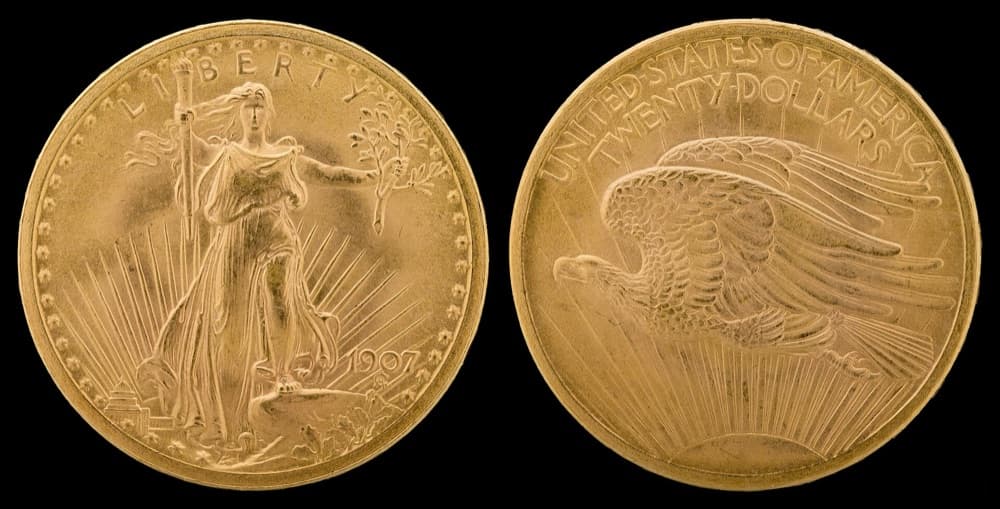
FLOAT 100 · Coins · No. 58
1907 Saint-Gaudens Double Eagle (Arabic Numerals)
Theodore Roosevelt wanted a coin as beautiful as ancient Greece's, the sculptor he chose died before it was finished, and the Mint engraver he had fought with flattened the design and swapped its Roman date for plain numbers: the result was the first Saint-Gaudens double eagle struck by the hundreds of thousands.
- Year
- 1907
- Maker
- U.S. Mint (Philadelphia), designed by Augustus Saint-Gaudens
- By price in coins
- 96 of 100
Create a free account to see every recorded price and every grade.
Create a free account- What it is
- The 1907 $20 gold double eagle in low relief with the date in Arabic numerals, the first Saint-Gaudens double eagle made in quantity for circulation
- This entry
- The type graded PCGS MS65
- Designer
- Augustus Saint-Gaudens, with his assistant Henry Hering; relief lowered and date changed by Chief Engraver Charles E. Barber
- Mintage
- 361,667, all at Philadelphia
- Released
- At the end of December 1907
- No motto
- Struck without IN GOD WE TRUST at Roosevelt's wish; Congress forced the motto back in 1908
- Stars
- 46, one for each state in 1907
- Survivors
- About 90,833 in all grades and 6,000 in MS65 or better, by one grading service's estimate
- Finest
- One graded MS68 by PCGS; a numismatist rates an ungraded Smithsonian example about MS68
- Auction high
- $276,000 for a PCGS MS67 example in May 2022
A president's war on ugly money
On December 27, 1904, President Theodore Roosevelt wrote to his Treasury Secretary, Leslie Mortier Shaw: "I think the state of our coinage is artistically of atrocious hideousness. Would it be possible, without asking permission of Congress, to employ a man like Saint-Gaudens to give us a coinage which would have some beauty?" Augustus Saint-Gaudens was the country's leading sculptor and Roosevelt's friend.
Saint-Gaudens had sworn off the Mint once already. In 1892 his medal for the World's Columbian Exposition was attacked as obscene, and the reverse was replaced with one by Mint engraver Charles E. Barber. He agreed to Roosevelt's project anyway, and the Mint engaged him for the cent and the four gold coins, the denominations that could be changed without Congress. No U.S. coin had ever been designed by anyone outside the Mint.
Roosevelt had been admiring the high-relief gold of ancient Greece. Saint-Gaudens proposed a figure of Liberty "striding forward as if on a mountaintop," torch raised, drapery flowing: "My idea is to make it a living thing, and typical of progress." In May 1906 he asked to put the date in Roman numerals. Shaw objected that "we should confine ourselves to the English language." Roosevelt overruled him.
From high relief to a coin that could be made
Saint-Gaudens was dying of cancer, and much of the work fell to his assistant, Henry Hering. The first dies, from the sculptor's plaster, produced about two dozen patterns that took up to nine blows of a medal press each; these are the Ultra High Relief pieces. A second set of dies with lower relief still needed three blows. On May 8, 1907, Roosevelt told the sculptor it had "proved hitherto impossible to strike them by one blow." Saint-Gaudens replied: "Evidently it is no trifling matter to make Greek art conform with modern numismatics."
Saint-Gaudens died on August 3, 1907. Roosevelt ordered the Mint to finish the design and have the coin circulating by September 1. When Hering finally brought a new set of models on September 28, Barber rejected them as uncoinable and began his own low-relief version of the design.
On November 18 Roosevelt ordered the second-set dies put into use, telling the Mint to "begin the new issue, even if it takes you all day to strike one piece!" Over 12,000 High Relief coins with the Roman date MCMVII followed. Meanwhile Barber finished his reworking, with the relief greatly lowered so the coin could be struck in one blow on the Mint's production presses. Among his changes, he replaced MCMVII with the Arabic numerals 1907.
The Mint struck 361,667 of the low-relief coins in 1907 and released them at the end of December. Barber's alterations were denounced by the sculptor's family and by Hering, and Barber's reputation has suffered for them since. A later numismatist offered a defense: "a mint is a coin factory, not an artist's studio."
How to identify one
Liberty stands facing forward, torch in her right hand and olive branch in her left, her left foot on a rock, with the U.S. Capitol and the rays of the sun at her side. LIBERTY runs across the top, split by the torch, and 46 small stars circle the rim, one for each state in 1907. The date 1907 sits at lower right above the rock, with Saint-Gaudens's monogram, ASG, below it. The reverse shows an eagle in flight across a rising sun beneath UNITED STATES OF AMERICA and TWENTY DOLLARS.
What sets this coin apart from the High Relief that preceded it is easy to see: a plain Arabic date instead of MCMVII, and a much flatter design. There is no IN GOD WE TRUST anywhere on the coin. E PLURIBUS UNUM appears in raised letters on the edge, separated by stars. All were struck at Philadelphia, so there is no mintmark.
Barber's flattening makes many coins look weakly struck, especially on Liberty, though the numismatist David Akers wrote that the strike is usually sharp and the dies simply lacked detail. Luster is soft and frosty, and color runs from greenish gold to orange, with some rose and coppery examples.
Proofs are a different matter. One estimate puts proof production at 40 to 50 pieces, but fewer than seven proofs of the No Motto type have been certified, and another numismatist knows of a single matte proof, from a famous cased set. The PCGS MS65 grade of this entry describes an ordinary business strike.
Saved, shipped abroad, brought home
As the first coins of a much-discussed new design, the 1907 low-relief pieces were widely saved as souvenirs, which is why so many survive in high grades. Double eagles of this era rarely circulated at home; they were used for international payments and held by banks. Many 1907s went to European banks, and they still turn up in gold shipments returning to the United States.
Those overseas hoards changed the coin's reputation. Once considered scarcer, it is now plentiful: a leading numismatist estimated the Mint State population at 45,000 to 60,000 or more in 2004, and one grading service estimates about 55,833 survivors in MS60 or better.
Gem quality is where the type thins out. The same grading service estimates 6,000 survivors in MS65 or better, and one grading service alone had graded 816 examples MS65 at the time of writing. In MS65, PCGS-graded coins have recently sold at auction for $4,800 to about $5,700; in MS67, sales from 2006 to 2016 ran from $27,600 to $60,375, and one example with an additional quality sticker brought $276,000 in 2022.
The $276,000 coin had sold before. The same PCGS MS67 coin, certificate 25578861, had sold for $60,375 in August 2011 before reaching $276,000 at auction in May 2022.
The design that outlived the coin
Congress, angered by the missing motto, ordered IN GOD WE TRUST restored, and the No Motto design that began with these coins lasted only into 1908. In 1912 two stars were added for New Mexico and Arizona. The double eagle was struck until 1933, when Franklin Roosevelt's gold recall ended it and sent millions of coins to the melting pot.
Roosevelt never wavered. In January 1908 he wrote that it was "the best coin that has been struck for two thousand years." Many collectors agree that Saint-Gaudens's double eagle is the most beautiful American coin.
The obverse returned in 1986 on American gold bullion coins, with stars added for Alaska and Hawaii. In November 2025 the Mint announced a 2026 gold reissue dated in Roman numerals, as Saint-Gaudens wanted, for the 250th anniversary of American independence.
The numbers
- Mintage
- 361,667 (Philadelphia only); proofs estimated at 40 to 50, though far fewer are confirmed
- Known survivors
- About 90,833 in all grades, 55,833 in MS60 or better and 6,000 in MS65 or better (one grading service's estimates); a 2004 estimate put the Mint State population at 45,000 to 60,000 or more
- Weight
- 33.40 g (sources also give 33.436 g)
- Diameter
- 34.00 mm
- Composition
- 90% gold, 10% copper
- Edge
- Lettered E PLURIBUS UNUM, with stars
- Designer
- Augustus Saint-Gaudens and Henry Hering; modifications by Charles E. Barber
- This coin's grade
- PCGS MS65
Timeline
Saint-Gaudens's Columbian Exposition medal reverse is replaced with a design by Barber; the sculptor vows to avoid the Mint.
Roosevelt writes that U.S. coinage is of "atrocious hideousness" and asks for Saint-Gaudens.
Roosevelt suggests the new gold coins be struck in high relief, like ancient Greek coins.
Saint-Gaudens asks for a Roman-numeral date; Treasury Secretary Shaw objects and Roosevelt overrules him.
Hering delivers coin-sized models to Roosevelt, who calls them "simply splendid."
Roosevelt tells Saint-Gaudens the Ultra High Relief design cannot be struck in one blow.
Augustus Saint-Gaudens dies.
Hering brings new models; Barber rejects them and starts his own low-relief version.
Frank Leach takes office as Director of the Mint.
Roosevelt orders the High Relief coins struck "even if it takes you all day to strike one piece."
The low-relief Arabic numerals coins, 361,667 struck, are released at the end of the month.
Congress requires IN GOD WE TRUST on the coin; Roosevelt calls the design "the best coin that has been struck for two thousand years."
Two stars are added for New Mexico and Arizona.
Americans are ordered to turn in gold coins; millions of double eagles are later melted.
Saint-Gaudens's obverse returns on American gold bullion coins.
A PCGS MS67 example sells at auction for $42,550.
PCGS MS67 certificate 25578861 sells at auction for $60,375.
The same coin brings $276,000, the auction record for the issue.
The Mint announces a 2026 gold reissue of the design with a Roman-numeral date.
The world in 1907
Ellis Island has its busiest day ever, in a record year of 1.1 million immigrants.
The liner Lusitania makes her maiden voyage from Liverpool to New York.
The Panic of 1907: a run forces New York's Knickerbocker Trust Company to suspend operations.
J.P. Morgan and other financiers pool $25 million to prop up the plunging stock market.
Oklahoma becomes the 46th state.
The Monongah mine explosion in West Virginia kills 362 workers.
The Great White Fleet sets out from Hampton Roads to circle the globe.
The first electric ball drops in Times Square.
Price record
| Date | Price | Kind |
|---|---|---|
| May 7, 2005 | $633 | Sold at auctionA PCGS AU55 example. |
| Nov 2006 | $42,550 | Sold at auctionA PCGS MS67 example. |
| Jan 2007 | $37,375 | Sold at auctionA PCGS MS67 example, from the John Kutasi collection. |
| 2008 | $27,600 | Sold at auctionAn NGC MS67 example, the top NGC grade for the issue. |
| Aug 2011 | $60,375 | Sold at auctionPCGS MS67, certificate 25578861. |
| Jan 3, 2012 | $48,999 | Sold at auctionA PCGS MS67 example. |
| Apr 2013 | $47,000 | Sold at auctionA PCGS MS67 example. |
| Apr 22, 2015 | $30,550 | Sold at auctionAn NGC MS67 example. |
| Oct 2015 | $42,594 | Sold at auctionA PCGS MS67 example, sold at auction in New York; one source gives $42,593. |
| Apr 27, 2016 | $44,650 | Sold at auctionThe same PCGS MS67 coin as the October 2015 sale. |
| Apr 27, 2016 | $3,173 | Sold at auctionA PCGS MS65+ example. |
| May 8, 2022 | $276,000 | Sold at auctionPCGS MS67 with an added quality sticker, certificate 25578861 (the August 2011 coin); auction record for the issue. |
| Jan 15, 2023 | $4,800 | Sold at auctionA PCGS MS65 example. |
| Jan 15, 2023 | $4,200 | Sold at auctionAn NGC MS65 example, same sale. |
| Jan 15, 2023 | $8,100 | Sold at auctionA PCGS MS65+ example, same sale. |
| Jul 23, 2023 | $4,800 | Sold at auctionA PCGS MS65 example. |
| Jul 23, 2023 | $5,760 | Sold at auctionA PCGS MS65+ example, same sale. |
| Mar 28, 2026 | $5,734 | Sold at auctionA PCGS MS65 example. |
| Mar 28, 2026 | $29,280 | Sold at auctionA PCGS MS66+ example, same sale. |
A realized auction price is what a buyer actually paid on the date shown, including the buyer's premium where the sale reported it. It is the strongest kind of reference price, and it is a record of one sale of one object on one day, not a promise of what the next example will bring.
By reference price, 1907 Saint-Gaudens Double Eagle (Arabic Numerals) is number 96 of 100 in the coins entries of the FLOAT 100. 96 of those 100 rest on a realized sale; the rest carry an asking price or a guide value, and each page says which. Rank within the FLOAT 100 itself (58 here) is editorial: how much an object defines its field, not price alone.
Did you know
- Saint-Gaudens's Liberty was based on his figure for New York's monument to General William Tecumseh Sherman, and ultimately on the Nike of Samothrace.
- Treasury Secretary Shaw opposed the Roman-numeral date, threatening to dismiss any architect who put a V where a U was meant; the Arabic date on this coin was Barber's change after Saint-Gaudens died.
- Roosevelt left off IN GOD WE TRUST because he felt putting God's name on money that might be spent on crimes was a debasement.
- The coin's 46 stars matched the 46 states; Oklahoma became the 46th on November 16, 1907, weeks before the coin's release.
- The finest 1907 business strike one numismatist has seen is not in a collector's hands but in the Smithsonian, which he rates about MS68.
- Barber feared the High Relief coins came out so well that "the President may demand the continuance of this particular coin."
How this page is made
- The figure
- One reference price, shown with its own kind. FLOAT does not average it with anything or adjust it for time.
- Realized or not
- A realized price is a completed sale. An asking price, an estimate and a price-guide value are not sales, and are labeled as such wherever they appear.
- The story
- Researched from published records and checked fact by fact. Updated Oct 1, 2026.
- Archive
- Oct 5, 2026