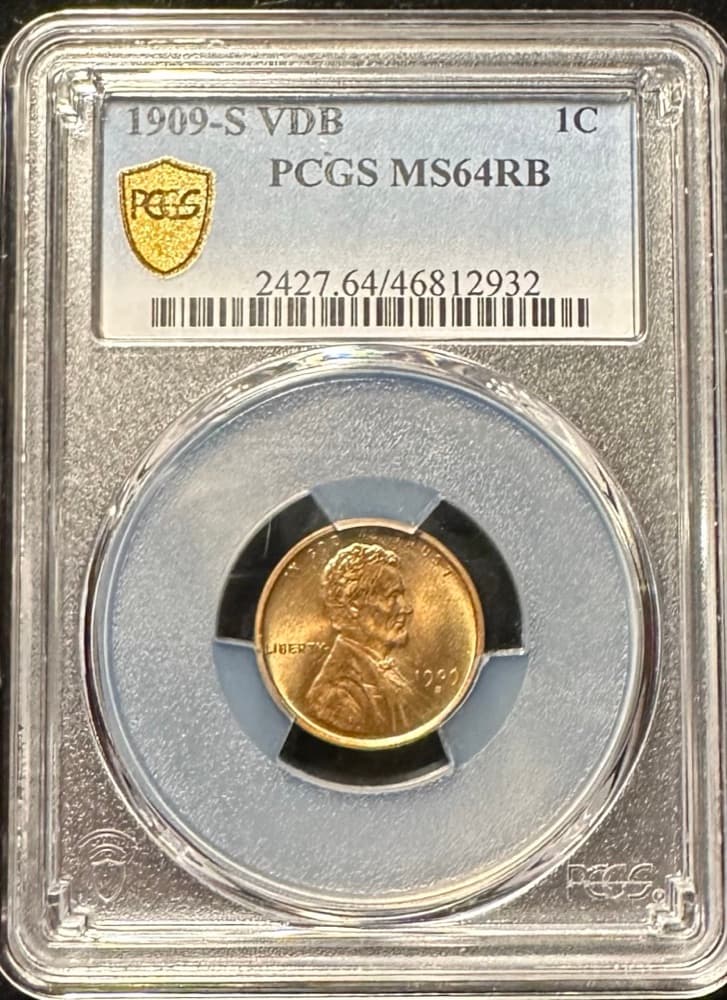
FLOAT 100 · Coins · No. 35
1909-S VDB Lincoln Cent
Three small letters on the back of a new penny caused an uproar in August 1909, and the San Francisco Mint had struck only 484,000 before they were scraped off, creating the coin nearly every American collector has dreamed of finding.
- Year
- 1909
- Maker
- U.S. Mint (San Francisco)
- By price in coins
- 95 of 100
Create a free account to see every recorded price and every grade.
Create a free account- Struck
- 1909, San Francisco Mint (S mintmark below the date)
- Designer
- Victor David Brenner, whose initials V.D.B. appear at the bottom of the reverse
- Released
- Lincoln cents went into circulation August 2, 1909
- Mintage
- 484,000, against 27,995,000 VDB cents at Philadelphia
- Why so scarce
- The initials were ordered off the dies within days of release, before San Francisco struck more
- This entry
- Mint State 65 Red (full original mint color), graded by PCGS
- Specs
- 3.11 grams, 19 mm, bronze, plain edge
- Watch for
- It is among the most altered and counterfeited collectible coins in the world
- Highest price found
- $168,000 for a PCGS MS67 Red, April 2022
Roosevelt's penny
President Theodore Roosevelt thought American coins were common and uninspiring, and he set out to change them. For the cent, the occasion was the hundredth anniversary of Abraham Lincoln's birth, February 12, 1909. Roosevelt revered Lincoln as the savior of the Union, and he wanted the new coin out in time for the centennial. The Indian Head cent it replaced had been in use for about half a century.
The portrait came from an artist Roosevelt already knew. Victor David Brenner had made medals for him in 1908, and Roosevelt had seen a bas-relief plaque of Lincoln that Brenner made from a Mathew Brady photograph. Brenner adapted the plaque for the obverse and put two stalks of durum wheat around the denomination on the reverse. It was the first everyday American coin to show a real person.
The coin missed the birthday. Its release was held up so that the motto IN GOD WE TRUST could be added above Lincoln's head, which President William Howard Taft, in office from March 1909, wanted on the coin. Models went to Taft in late May, and Treasury Secretary Franklin MacVeagh approved the final version on July 14 for an August 2 release. Philadelphia had a head start; the San Francisco Mint did not receive its dies until late June.
The medalist from Lithuania
Brenner was born Avigdor David Brenner on June 12, 1871, in Šiauliai, in present-day Lithuania, then part of the Russian Empire, to a Jewish family. His father taught him gem and seal engraving, and he arrived in the United States in 1890 with little more than that trade. He settled in the New York City area, took night classes at Cooper Union and learned English.
He later studied in Paris under the medalist Oscar Roty at the Académie Julian and won awards at the Paris Exposition of 1900. Back in the United States his career prospered, and by the time Roosevelt came to him he was one of the country's leading medalists. Among his works was a portrait of Roosevelt used on the Panama Canal Service Medal.
Brenner died on April 5, 1924, and is buried in Ridgewood, Queens. His Lincoln portrait is the longest-running design in the history of the United States Mint.
Three letters too many
Brenner had placed his full name in tiny letters at the bottom of the reverse. During changes to his models, Mint Engraver Charles Barber cut it down to the initials V.D.B. Designers had signed coins before, but once the cents were out, newspapers complained that the initials sat in plain view and amounted to free advertising for the artist.
The reaction was fast. On August 6, 1909, The Washington Post ran the headline 'V.D.B. Cent Doomed.' Secretary MacVeagh, who had either not seen the design closely or not looked at the initials, objected, and Brenner told the paper he would demand an explanation. A proposal to sign the coin with a single B was rejected because Barber's B already appeared on silver coins. Instead the Mint simply removed the initials, and new cents were struck without them.
By then Philadelphia had made nearly 28 million VDB cents. San Francisco, which got its dies late, had made 484,000. Collectors recognized the San Francisco coins as rarities at once and pulled them from circulation, often paying premiums, which is why many survive in high grades.
Brenner's initials came back in 1918, this time in small letters on Lincoln's shoulder. Barber had died in 1917, and some writers suspect he was the one who had opposed the initials.
Summer 1909
The new cents came out to crowds. People lined up when they went on sale on August 2, and in New York police were called in to control the lines. Because the coin honored Lincoln, many Black Americans called it 'emancipation money.'
When word spread on August 5 that the coin might be withdrawn, a buying frenzy broke out in New York. Newsboys were first in line, and the cents were resold for 25 cents each. When it became clear the Mint still had millions and would not recall them, the price fell from 25 cents to 20, 15, 10, 5, two for a nickel, and finally face value. Stores in Illinois, Pennsylvania and Indiana advertised the new pennies as giveaways and souvenirs.
It was a busy year. The NAACP was founded on February 12, the Lincoln centennial. Taft was sworn in on March 4, and Roosevelt left that month for an African expedition. Alice Huyler Ramsey became the first woman to drive across the country, Indianapolis Motor Speedway held its first event on August 12, Sigmund Freud lectured at Clark University in September, and the Pittsburgh Pirates won the World Series in October.
How to know a real one
Because a genuine coin is worth so much more than a 1909 VDB from Philadelphia, the 1909-S VDB is the most commonly altered and counterfeited collectible coin in the world, according to one grading service. The usual trick is adding an S to a Philadelphia coin.
A single S mintmark punch was used on every San Francisco Lincoln cent from 1909 to 1916. On genuine coins that S shows a small raised dot inside its upper curve, though it can be weak, and its serifs are straight rather than slanted. Mintmarks were still punched into dies by hand in 1909, and researchers have identified only four obverse dies for the 1909-S VDB, each with its own mintmark position, moving down and to the right from the first die to the fourth.
The initials matter too. On genuine coins the crossbar of the B and the base of the D are slanted, and the letters often show slight strike doubling; altered coins often have flat ones. Entirely fake coins also exist, and a die made from a genuine host coin can copy every marker, so expert authentication is the safest course.
Color drives price. Uncirculated coins come in Brown, Red Brown and full Red. Many were handled or stored badly, so there are about three times as many Brown coins as Red Brown and nearly seven times as many Brown as full Red. This entry is a full Red MS65; above that grade the coin becomes hard to find. In 2022 one grading service reported 15 graded MS67 Red with none finer.
The king of Lincoln cents
The 1909-S VDB is not the lowest-mintage Lincoln cent or the most expensive, but it is the most famous. One writer called it the 'Holy Grail' of penny collecting, collectors say it 'may always be the king of Lincoln Cents,' and the book 100 Greatest U.S. Coins ranked it 14th. Its authors note that with millions of people collecting Lincoln cents, there are simply not enough of these to go around.
It is a first-year coin, with the 1909 VDB a one-year subtype, and the rarest of the four regular 1909 Lincoln cents: 1909 VDB, 1909-S VDB, 1909 and 1909-S. The 1909-S without initials had about four times the mintage of the VDB coin.
One writer recalls asking a roomful of collectors to name the most famous United States coin; a complete newcomer answered, 'That penny, that 1909-S VDB penny.' His own son, collecting Lincoln cents at 12 and unable to afford one, put it more simply: 'Dad, I'd eat worms for an S VDB.'
The numbers
- Mintage
- 484,000 (Philadelphia struck 27,995,000 VDB cents)
- Known survivors
- No firm census; many were saved in 1909. One grading service alone reports 974 graded MS65 Red with 367 finer, and 16 at MS67 Red
- Weight
- 3.11 grams
- Diameter
- 19 mm (0.75 inch)
- Composition
- Bronze: 95% copper, 5% tin and zinc (one source gives 2.5% each)
- Edge
- Plain
- Designer
- Victor David Brenner
- Obverse dies
- Four identified, each with a different mintmark position
Timeline
Victor David Brenner is born Avigdor David Brenner in Šiauliai, Russian Empire.
Brenner emigrates to the United States.
Lincoln's 100th birthday, the date the new cent was meant to appear.
William Howard Taft is inaugurated; he wants IN GOD WE TRUST on the cent.
The San Francisco Mint receives its Lincoln cent dies late in the month.
Treasury Secretary Franklin MacVeagh approves the final design.
Lincoln cents are released to long lines.
The Washington Post reports 'V.D.B. Cent Doomed'; production with the initials stops.
The Treasury announces that all V.D.B. Lincoln cents have passed into public hands.
Chief Engraver Charles Barber dies.
Brenner's initials return to the cent, small, on Lincoln's shoulder.
Brenner dies, aged 52.
A PCGS MS67 Red sells at auction in Atlanta for $117,500.
A PCGS MS67 Red, one of 15 with none finer, sells at auction for $168,000.
A PCGS MS65 Red, this entry's grade, sells at auction for $5,880.
The world in 1909
The NAACP is founded on the centennial of Lincoln's birth.
The Great White Fleet returns to Hampton Roads after circling the globe.
Theodore Roosevelt leaves New York for the Smithsonian-Roosevelt African Expedition.
Alice Huyler Ramsey sets out from Manhattan to become the first woman to drive across the United States.
Indianapolis Motor Speedway holds its first event.
Sigmund Freud gives his only American lectures, at Clark University in Worcester, Massachusetts.
The Pittsburgh Pirates beat the Detroit Tigers to win the World Series.
The U.S. Navy founds a base at Pearl Harbor, Hawaii.
Price record
| Date | Price | Kind |
|---|---|---|
| Feb 2014 | $117,500 | Sold at auctionPCGS MS67 Red, sold at auction in Atlanta. |
| Jun 2018 | $4,200 | Private salePCGS MS65 Red, this entry's grade; accepted offer in an online marketplace. |
| Jun 2019 | $50,400 | Sold at auctionPCGS MS67 Red, sold at auction in Long Beach, California. |
| Apr 2022 | $168,000 | Sold at auctionPCGS MS67 Red, one of 15 at that grade with none finer. |
| Jun 2023 | $5,880 | Sold at auctionPCGS MS65 Red, this entry's grade. |
A realized auction price is what a buyer actually paid on the date shown, including the buyer's premium where the sale reported it. It is the strongest kind of reference price, and it is a record of one sale of one object on one day, not a promise of what the next example will bring.
By reference price, 1909-S VDB Lincoln Cent is number 95 of 100 in the coins entries of the FLOAT 100. 96 of those 100 rest on a realized sale; the rest carry an asking price or a guide value, and each page says which. Rank within the FLOAT 100 itself (35 here) is editorial: how much an object defines its field, not price alone.
Did you know
- Brenner first signed the coin with his full name; the Mint's engraver shortened it to V.D.B., and even that proved too much.
- In August 1909, New York newsboys resold new Lincoln cents for 25 cents apiece, until the price sank back to one cent.
- One S punch made the mintmark on every San Francisco Lincoln cent from 1909 to 1916, and it leaves a tiny dot inside the S that helps expose fakes.
- Only four obverse dies struck the 1909-S VDB, and each put the S in a slightly different spot.
- The 1909-S cent without initials had about four times the mintage of the VDB version.
- Brenner's initials returned in 1918, after the death of Chief Engraver Charles Barber, whom some suspect opposed them.
- Brenner's Lincoln portrait is the longest-running design in United States Mint history.
How this page is made
- The figure
- One reference price, shown with its own kind. FLOAT does not average it with anything or adjust it for time.
- Realized or not
- A realized price is a completed sale. An asking price, an estimate and a price-guide value are not sales, and are labeled as such wherever they appear.
- The story
- Researched from published records and checked fact by fact. Updated Oct 1, 2026.
- Archive
- Oct 5, 2026