FLOAT 100 · Coins · No. 75
1911-D Indian Head Quarter Eagle
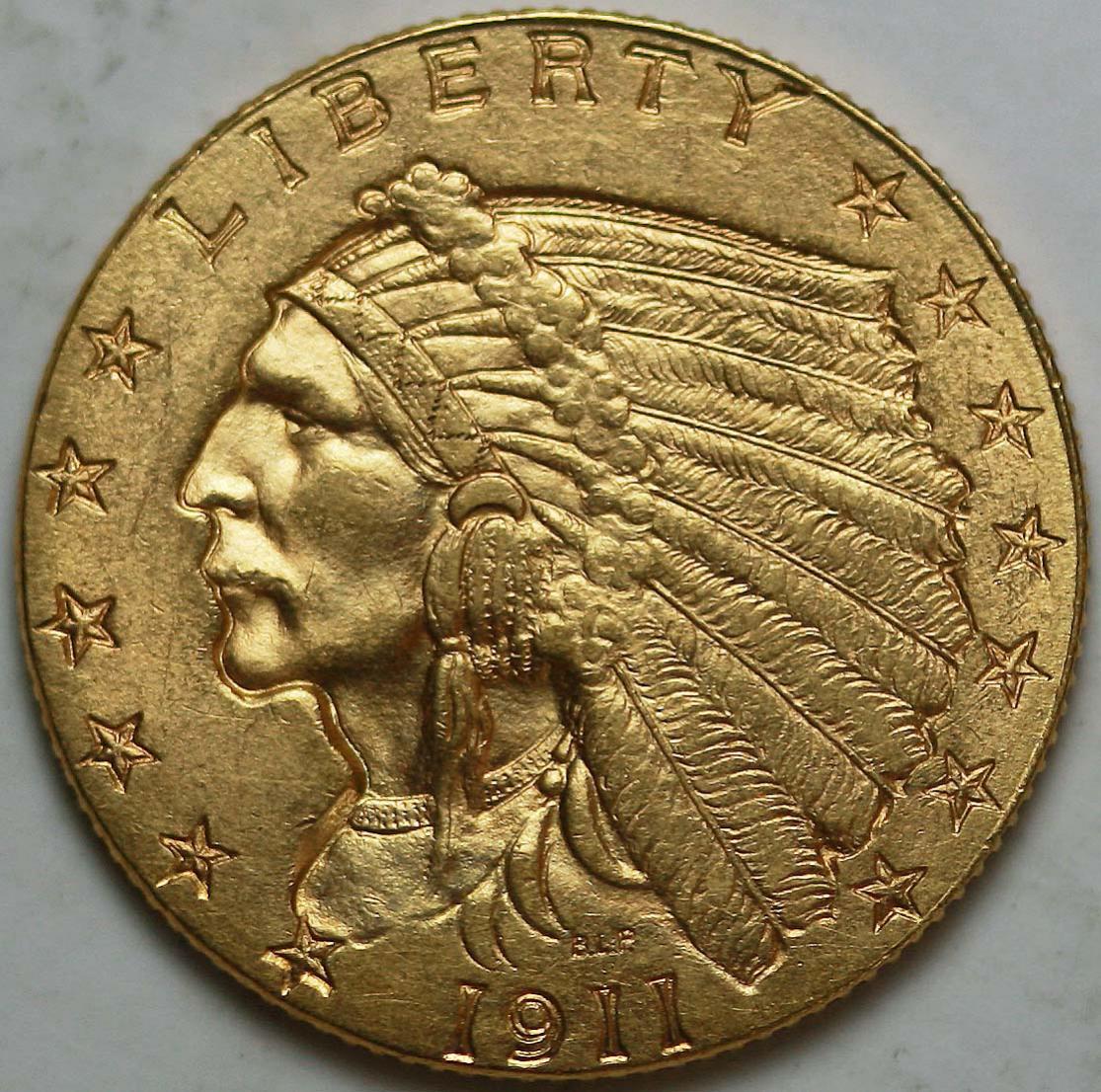
The only American circulating coins with their designs sunk below the surface were mocked as germ traps when they appeared, and the smallest of them, struck at Denver in 1911, became the coin every collector of the series must find and every forger tries to fake.
- Year
- 1911
- Maker
- U.S. Mint (Denver)
- By price in coins
- 51 of 100
Create a free account to see every recorded price and every grade.
Create a free account- Struck
- 1911, Denver Mint
- Mintage
- 55,680, the lowest of the Indian Head quarter eagle series
- Designer
- Bela Lyon Pratt, at the urging of William Sturgis Bigelow and President Theodore Roosevelt
- Design
- Incuse: everything but the D mintmark is recessed below the field
- Denomination
- $2.50 gold (quarter eagle)
- This entry
- PCGS MS66+, Strong D
- Auction record
- $312,000, January 19, 2025, for a PCGS MS66+
- Main risk
- Common 1911 Philadelphia coins with an added D mintmark
A President's coin project
In 1904 Theodore Roosevelt complained about the look of American coins and had the Mint hire his friend Augustus Saint-Gaudens to redesign the cent and the four gold pieces, denominations that could be changed without an Act of Congress. Saint-Gaudens finished designs for the $10 and $20 coins before he died in August 1907, and the Mint planned simply to scale his double eagle down for the $5 and $2.50 pieces. The small coins could not hold the inscriptions well.
Another friend of the President, the Boston physician and art collector William Sturgis Bigelow, had a different idea. Inspired by Egyptian reliefs, he proposed coins whose designs were sunk into the surface, so the flat field would protect them from wear and let the coins stack evenly. He enlisted Boston sculptor Bela Lyon Pratt, a former student of Saint-Gaudens. At a White House lunch on April 3, 1908, Roosevelt and Bigelow won over Mint Director Frank Leach, who even reimbursed Pratt's $300 fee from government funds.
The new quarter and half eagles entered circulation in early November 1908. They remain the only U.S. circulating coins with recessed designs.
Pratt, Barber and the critics
Pratt based his obverse on a photograph of an unnamed Native American man from his own collection and adapted Saint-Gaudens's standing eagle for the reverse. Chief Engraver Charles E. Barber made master dies from Pratt's models and altered them. Pratt was furious, writing to his mother that the Mint's engravers had made a mess of his design.
Philadelphia coin dealer Samuel Chapman attacked the coins in a letter to Roosevelt in December 1908: the recesses would harbor dirt and germs, the coins would be easy to counterfeit, they would not stack, and the Indian looked emaciated. Bigelow answered, over his own signature, that the head was taken from a recent photograph of an Indian whose health was excellent. The fears about disease proved unfounded, and the design stayed.
Denver, 1911
The Denver Mint had struck its first coins only on February 1, 1906, in a city whose minting roots went back to the private gold coins of Clark, Gruber and Company during the Pikes Peak gold rush. When the quarter eagle was introduced in 1908, Director Leach ordered that it be coined only at Philadelphia. By 1911 Denver was striking it too, but only 55,680 pieces; the next-lowest issue of the series, the 1914, had almost four times as many.
It was a year of firsts across the country. Eugene Ely landed an airplane on a ship in January, the Army adopted the M1911 pistol in March, the first Indianapolis 500 was run in May, and the Supreme Court ordered Standard Oil broken up. On March 25 the Triangle Shirtwaist Factory fire killed 146 people in New York.
From Christmas gift to six figures
Indian Head quarter eagles saw little use in commerce. They were popular as Christmas gifts, and the series ran through 1915 and again from 1925 to 1929. In 1933 Franklin Roosevelt ended the issue of gold coins, and many pieces were recalled and melted. Because many collectors disliked the incuse design when it was new, fewer were saved than the mintages suggest.
For a long time the 1911-D in mint state was a five-figure coin. Strong D examples graded PCGS MS63 sold for more than $10,000 for over five years up to 2019, peaking at $14,100 in February 2015 and April 2016, then settled in the $7,000 to $10,000 range. In 2020 PCGS had graded 435 Strong D coins MS63 and 390 finer, with a single MS66+ at the top that had never appeared at auction.
On January 19, 2025, a PCGS MS66+ 1911-D sold for $312,000, the auction record for the date.
Strong D, Weak D and fakes
The coin is 90 percent gold and 10 percent copper, weighs 4.18 grams and measures 18 millimeters. The obverse shows a Native American in a feathered war bonnet facing left, with LIBERTY above, the date below, thirteen stars and Pratt's initials B.L.P. above the date. The reverse shows a standing eagle on a bundle of arrows with an olive branch. Every element is incuse except the D mintmark, which is raised and sits to the left of the arrowheads.
Many genuine 1911-D coins have weakly struck mintmarks. NGC labels these Weak D; PCGS recognizes only well-defined Strong D coins, and a strong mintmark matters greatly to value.
The 1911-D is a favorite of forgers. Some add a D to a common 1911 Philadelphia coin, carving or chasing it into the field and leaving gouges or oddly shaped letters. One reported fake began as a 1914-D whose date was filed away and recut as 1911, with mismatched and misaligned digits. The raised mintmark is a key test, and experts advise buying only certified examples.
The numbers
- Mintage
- 55,680
- PCGS mint state census (2020)
- 435 Strong D graded MS63, 390 finer, one MS66+ at the top
- Weight
- 4.18 grams
- Diameter
- 18 mm
- Composition
- 90% gold, 10% copper
- Designer
- Bela Lyon Pratt; master dies by Charles E. Barber
- Mintmark
- Raised D, left of the arrowheads
Timeline
Theodore Roosevelt begins pressing for new coin designs.
The Denver Mint strikes its first coins.
Augustus Saint-Gaudens dies before designing the smaller gold coins.
William Sturgis Bigelow writes to Roosevelt about Pratt's sunken-design idea.
Roosevelt and Bigelow win over Mint Director Frank Leach at a White House lunch.
The new incuse quarter and half eagles enter circulation.
Dealer Samuel Chapman attacks the coins in a letter to the President.
Denver strikes 55,680 quarter eagles, the series' lowest mintage.
Quarter eagle production pauses.
Quarter eagle coinage resumes, at Denver only that year.
The last Indian Head quarter eagles are struck.
Franklin Roosevelt ends the issue of gold coins.
A PCGS MS63 Strong D sells for $14,100.
A PCGS MS66+ sells for $312,000, the auction record for the date.
The world in 1911
Eugene Ely lands an airplane on the USS Pennsylvania in San Francisco Bay.
The Triangle Shirtwaist Factory fire kills 146 in New York City.
The Army adopts the M1911 pistol.
The Supreme Court orders Standard Oil dissolved.
The first Indianapolis 500 is run.
Hiram Bingham reaches Machu Picchu.
Groundbreaking begins for Fenway Park in Boston.
Price record
| Date | Price | Kind |
|---|---|---|
| Jan 19, 2025 | $312,000 | Sold at auctionPCGS MS66+, Strong D. Auction record for the date. |
A realized auction price is what a buyer actually paid on the date shown, including the buyer's premium where the sale reported it. It is the strongest kind of reference price, and it is a record of one sale of one object on one day, not a promise of what the next example will bring.
By reference price, 1911-D Indian Head Quarter Eagle is number 51 of 100 in the coins entries of the FLOAT 100. 96 of those 100 rest on a realized sale; the rest carry an asking price or a guide value, and each page says which. Rank within the FLOAT 100 itself (75 here) is editorial: how much an object defines its field, not price alone.
Did you know
- Indian Head quarter and half eagles are the only U.S. circulating coins with designs sunk below the surface.
- The Mint Director paid the designer's $300 fee back to Bigelow out of government funds.
- A critic claimed the coins' recesses would spread germs; the fear proved unfounded.
- The raised D is the only raised element on the coin, which makes it a key to spotting fakes.
- The quarter eagle was a popular Christmas gift, and coinage resumed in 1925 mainly to meet that demand.
How this page is made
- The figure
- One reference price, shown with its own kind. FLOAT does not average it with anything or adjust it for time.
- Realized or not
- A realized price is a completed sale. An asking price, an estimate and a price-guide value are not sales, and are labeled as such wherever they appear.
- The story
- Researched from published records and checked fact by fact. Updated Oct 3, 2026.
- Archive
- Oct 5, 2026