FLOAT 100 · Coins · No. 95
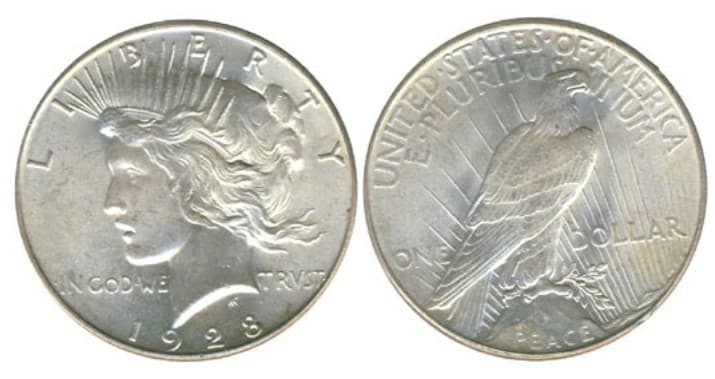
1928 Peace Dollar
The last silver dollars owed under a wartime law were struck in Philadelphia in 1928, only 360,649 of them, and a mix-up over a Tammany Hall cornerstone convinced a generation of collectors they had been made for ceremonies alone.
- Year
- 1928
- Maker
- U.S. Mint (Philadelphia), designed by Anthony de Francisci
- By price in coins
- 88 of 100
Create a free account to see every recorded price and every grade.
Create a free account- Struck
- 1928, Philadelphia Mint (no mintmark)
- Mintage
- 360,649, the lowest of the regular Peace dollars
- Designer
- Anthony de Francisci; Liberty modeled on his wife, Teresa
- Specifications
- 90% silver, 10% copper; 26.73 grams; 38.10 mm; reeded edge
- This coin
- PCGS MS66, cert #50078942, ex Anne Kate Collection
- Finest graded
- PCGS MS66+ (two coins as of May 2024)
- Survival estimate
- About 40,000 in all grades; about 800 in 65 or better (PCGS)
- Latest sale of this coin
- $16,800, September 14, 2023, at auction
- Record for the date
- $129,250 for a PCGS MS66+ with a CAC sticker, April 27, 2023
Silver owed, and a coin for peace
The 1928 Peace dollar exists because of a debt the Treasury owed itself. During World War I, rumors and hoarding pushed the price of silver up and threatened the British war effort, and Britain asked the United States for silver. Congress answered with the Pittman Act of April 23, 1918. More than 270 million silver dollars were melted, 47 percent of all Morgan dollars struck to that point, and the law required the Treasury to replace them with new dollars made from American-mined silver.
Striking of Morgan dollars resumed under the act at Philadelphia on May 9, 1921. Meanwhile collectors wanted a coin to mark the peace. In August 1920 a paper by numismatist Farran Zerbe was read to the American Numismatic Association's convention, and the association began lobbying for a peace coin. By November 1921 its supporters realized they did not need Congress: the 43-year-old Morgan design could be replaced at the Treasury Secretary's discretion under an 1890 law.
The Commission of Fine Arts ran a competition among invited sculptors, with $1,500 for the winner and $100 for everyone else. The judges unanimously chose Anthony de Francisci, at 34 the youngest and among the least experienced of the competitors. Treasury Secretary Andrew Mellon approved the design in December 1921, and the first Peace dollars were struck on December 28, 1921.
The sculptor and his wife
De Francisci based Liberty on his wife, Teresa, born Teresa Cafarelli in Naples. She later said that at five years old, as her family's immigrant steamer passed the Statue of Liberty, she struck a pose in imitation of it. Her husband recalled opening the studio window to let the wind blow her hair as he worked, and said the nose and the fullness of the mouth were much like hers, though he elongated the face.
The reverse shows a bald eagle at rest, clutching an olive branch, with the word PEACE. The announced design also included a broken sword, which the public read as a symbol of defeat. The Mint removed it, and Chief Engraver George T. Morgan did the painstaking work on the hub with fine tools under magnification. The coin completed the redesign of U.S. coinage that had begun in 1907.
The cornerstone dollar
By 1928 silver dollars hardly circulated in the East; most sat in the Treasury or in bank vaults. Philadelphia struck 360,649 dollars that year simply to finish the Pittman Act obligation. At the end of 1928 the Treasury held 481,960,397 silver dollars and the Federal Reserve Banks another 11,526,004, while only 46,475,374 were counted in circulation. With the Pittman silver used up, the Mint stopped making Peace dollars until new legislation brought them back in 1934 and 1935.
Then came the legend. The February 1929 issue of The Numismatist reported that when Tammany Hall wanted a 1928 dollar for the cornerstone of its new building in New York, neither its bank nor the Federal Reserve had one, and the coin came by registered mail from the Mint director with word that 1928 dollars were to be used exclusively for cornerstone laying and other dedicatory purposes. A March 1929 follow-up explained the real reason for the scarcity, but the cornerstone story stuck. It appeared in a popular coin handbook in 1942 and in early editions for years after, and collectors came to believe only a few 1928 dollars had been released.
Researcher Thomas S. LaMarre debunked the claim in a January 1991 article, noting that the Mint Director's Report never mentioned any such purpose. Q. David Bowers recalled finding one of these 'cornerstone dollars' at a local bank as a teenager in 1952 or 1953, and then another, and another. Bags reportedly came out in Ohio and Pennsylvania in the 1950s and were used to pay millworkers, with Cleveland and Pittsburgh named as dispersal points.
This coin
Because it was always known as the key date, the 1928 was widely saved, and most survivors are uncirculated. Mint State coins usually grade MS63 to MS64, and Gems are readily available. PCGS estimates about 40,000 survive in all grades and about 800 in 65 or better. MS66 was long the top grade; values there have eased over the past decade, partly because three coins were certified MS66+, at least one of them apparently restored before its upgrade.
This entry is a PCGS MS66 with certification number 50078942. It sold on August 15, 2018, from the Anne Kate Collection, for $28,800, and on September 14, 2023, for $16,800. A 2025 collector's guide describes smears of gold and clay color on both sides and calls its eye appeal subpar, which helps explain the lower second price.
Other MS66 coins show how much toning and marks matter. A PCGS MS66 with rose toning brought $21,600 in May 2023. One in an old green holder brought $48,875 in April 2011 and $39,950 in August 2015. A coin that gained a CAC sticker sold for $28,200 in 2015, $33,600 in 2019, $35,250 in April 2022 and $44,400 in October 2022. The top coin, which brought $26,400 as an MS66 in January 2020, was apparently conserved, upgraded to MS66+ with a CAC sticker, and sold for $129,250 in April 2023.
How to know one
A 1928 Peace dollar has no mintmark; the Philadelphia coins of that year are the low-mintage ones. Liberty wears a radiate crown meant to recall the Statue of Liberty, and the reverse shows the eagle at rest with an olive branch and the word PEACE. The coins have a distinctive beveled rim, which made them easy to spot in a bag of dollars even when the date was hidden.
The coin is 90 percent silver and 10 percent copper, weighs 26.73 grams and measures 38.10 millimeters with a reeded edge.
As early as July 1964 a dealer advertised a Brilliant Uncirculated 1928 for $95, and by August 1978 Gem examples were advertised at $295 each.
The numbers
- Mintage
- 360,649
- Survival estimate
- About 40,000 in all grades; 25,000 in 60 or better; 800 in 65 or better (PCGS)
- Top population
- PCGS MS66+: 2 (May 2024)
- Weight
- 26.73 grams
- Diameter
- 38.10 mm
- Composition
- 90% silver, 10% copper
- Edge
- Reeded
- Designer
- Anthony de Francisci
Timeline
The Pittman Act authorizes melting silver dollars for Britain and requires their replacement.
Farran Zerbe's paper to the ANA convention launches the campaign for a peace coin.
Philadelphia resumes striking Morgan dollars under the Pittman Act.
Treasury Secretary Andrew Mellon approves Anthony de Francisci's Peace dollar.
The first Peace dollars are struck.
Philadelphia strikes 360,649 Peace dollars, finishing the Pittman Act recoinage.
The Numismatist reports that 1928 dollars are released only for cornerstones and dedications.
New legislation brings the Peace dollar back for 1934 and 1935.
A coin handbook repeats the cornerstone story.
Thomas S. LaMarre debunks the cornerstone myth in The Numismatist.
A PCGS MS66 in an old green holder sells for $48,875.
This coin sells from the Anne Kate Collection for $28,800.
A conserved PCGS MS66+ with a CAC sticker sets the record for the date at $129,250.
This coin sells for $16,800.
The world in 1928
The St. Francis Dam north of Los Angeles fails, killing 400.
Mickey and Minnie Mouse first appear, in Plane Crazy.
Amelia Earhart begins her flight to become the first woman to cross the Atlantic by air.
The first machine-sliced, machine-wrapped loaf of bread is sold in Chillicothe, Missouri.
The Okeechobee Hurricane kills at least 2,500 people in Florida.
Herbert Hoover defeats Al Smith for president.
Steamboat Willie, the first Mickey Mouse sound film, is released.
Congress approves construction of Boulder Dam, later Hoover Dam.
Price record
| Date | Price | Kind |
|---|---|---|
| Aug 15, 2018 | $28,800 | Sold at auctionThis coin, PCGS MS66, cert #50078942, from the Anne Kate Collection. |
| Sep 14, 2023 | $16,800 | Sold at auctionThis coin, PCGS MS66, cert #50078942. |
A realized auction price is what a buyer actually paid on the date shown, including the buyer's premium where the sale reported it. It is the strongest kind of reference price, and it is a record of one sale of one object on one day, not a promise of what the next example will bring.
By reference price, 1928 Peace Dollar is number 88 of 100 in the coins entries of the FLOAT 100. 96 of those 100 rest on a realized sale; the rest carry an asking price or a guide value, and each page says which. Rank within the FLOAT 100 itself (95 here) is editorial: how much an object defines its field, not price alone.
Did you know
- Peace dollar Liberty is a portrait of the designer's wife, who as a child posed like the Statue of Liberty as her ship sailed into New York.
- For decades collectors believed 1928 dollars were struck only for cornerstones, because of a 1929 Tammany Hall story.
- The 1928 has a beveled rim that made it easy to pick out of a bag of dollars.
- Its low mintage was an accident of accounting: the Mint simply ran out of Pittman Act silver.
- The first Peace dollar design included a broken sword, removed after the public read it as a sign of defeat.
- This coin sold for $12,000 less in 2023 than it did in 2018.
How this page is made
- The figure
- One reference price, shown with its own kind. FLOAT does not average it with anything or adjust it for time.
- Realized or not
- A realized price is a completed sale. An asking price, an estimate and a price-guide value are not sales, and are labeled as such wherever they appear.
- The story
- Researched from published records and checked fact by fact. Updated Oct 3, 2026.
- Archive
- Oct 5, 2026