FLOAT 100 · Stamps · No. 54
China 1878 'Large Dragon'
China's first postage stamps were born of a turf war between an Irishman in Peking and a German in Tianjin, printed in Shanghai behind their London agent's back, and dismissed by him as "a most crude affair"; today a single envelope bearing three of them is the most expensive Chinese philatelic item ever sold.
- Year
- 1878
- Maker
- Imperial Maritime Customs Post, China
- By price in stamps
- 6 of 100
Create a free account to see every recorded price and every grade.
Create a free account- Issued
- July 1878, by the Customs Post of the Chinese Imperial Maritime Customs
- Values
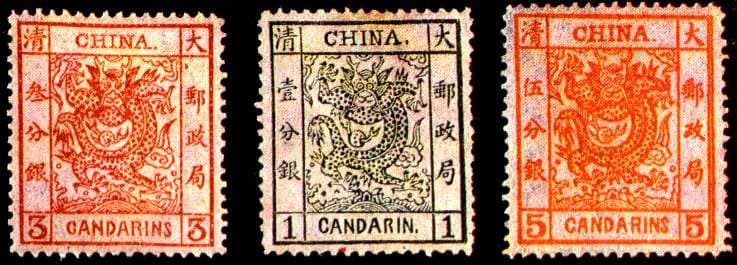
- 1 candarin green, 3 candarins red, 5 candarins orange-yellow
- Uses
- 1ca for printed matter, 3ca for ordinary letters, 5ca for registered mail
- Design
- A single coiled five-clawed imperial dragon around a flaming pearl, by an unnamed Chinese artist
- Inscriptions
- "CHINA" in Roman letters and Chinese, "Great Qing Post Office" in Chinese, and the value in bankers' numerals
- Printed
- By the Customs Statistical Department in Shanghai
- Printings
- 1878 thin paper; 1882 wide margins; 1883 thick paper, clean-cut perforations; 1885 rough perforations
- Key figures
- Robert Hart, Inspector General of Customs; Gustav Detring, Customs Commissioner at Tianjin; James Duncan Campbell, the Customs agent in London
- Earliest known cover
- Peking to Shanghai, October 5, 1878, with three 5ca stamps; one of four known 1878 covers
- Record
- HK$18,975,000 (US$2,417,700) for that cover at auction in Hong Kong, June 2018
A post office inside the customs house
China's Imperial Maritime Customs was an unusual institution: an arm of the Qing government, staffed at the top by foreigners, created under the 1858 Treaty of Tianjin and its trade rules to collect duties on foreign trade at the treaty ports. Under the Irishman Robert Hart, appointed sole Inspector General in 1863, it grew far beyond tax collection into lighthouses, harbors, surveys and navigation. Hart later said he had proposed a Chinese post office in his first meetings with Prince Gong and the official Wenxiang in the summer of 1861.
The Customs already carried mail. It ran a courier service for the foreign legations between Beijing and Tianjin, including an arduous overland route in winter when Tianjin's port was frozen, and opened it to outsiders by subscription. No stamps were used. Hart wanted a postal service on the Victorian British model, in which the sender paid fixed rates and anyone could post a letter, and stamps were central to that plan.
There was a much older system too. Imperial China had for centuries run routes, messengers and posthouses for government business, while ordinary people relied on private couriers. A modern public post was set up in the fourth year of the Guangxu Emperor's reign, 1878.
The stamp war inside the Customs
The man Hart put in charge of postal expansion was Gustav Detring, a German Customs commissioner who had won the trust of the powerful Viceroy Li Hongzhang during the 1876 Chefoo Convention talks. Early in 1877 Detring drew up the first stamp designs and sent them straight to James Duncan Campbell, the Customs agent in London, without going through Hart. Campbell, who had worked briefly in the British Post Office, balked. On July 4, 1877, he telegraphed Hart in the middle of a tour of the treaty ports: local manufacture was "impracticable," and stamps should be made in England to guard against forgery.
Campbell commissioned a report from the London security printer De La Rue, which proposed stamps designed with fraud in mind, made in England, in 1, 2 and 5 cent values in lake, green and orange with two stylized dragons. Back in Beijing in October 1877, Hart agreed that Detring's plan would not do, writing that he did not want to follow "the sanguine Detring too rashly," and told Campbell "we'll get our stamps made there." Yet the London printer never got the commission; the philatelist Philip Ireland later called its designs insipid and suggested that was why. Detring, meanwhile, sent new designs and an order signed only by himself. The standoff dragged into 1878.
On March 9, 1878, about to sail for the Paris Exposition, Hart authorized Detring to expand the postal service and left him to finish the stamp. Detring opened a daily Tianjin-Beijing service on March 23, and the service opened to the public on May 1, 1878, before any stamps were ready. He had them printed by the Customs Statistical Department in Shanghai, where one of his own staff, H.B. Morse, was acting statistical secretary, so he needed no further approval from Hart or London.
Nobody was satisfied. Campbell wrote that "the stamps are a most crude affair and do not possess any of the qualities requisite for a true stamp." Detring still preferred his own first design. Hart, back from France in 1879, complained that Detring had commissioned the stamp without consulting colleagues. Even so, on December 22, 1879, Hart named Detring "Commissioner for Postal Matters."
Why a dragon
The Statistical Department tried several designs in a similar style: an elephant, a six-storied pagoda and a dragon. The chosen design, by a Chinese artist whose name was not recorded, shows a single coiled five-clawed dragon around a flaming pearl, a motif from Qing imperial iconography. The dragon was already the emblem of the state: an azure dragon chasing a pearl on a yellow field had been adopted as the Qing flag in 1862, and the Customs took a similar flag in 1873.
The design also closely resembled the coiled dragon on the stamps of the Shanghai Local Post, run since 1865 by the foreign Municipal Council of the International Settlement. One historian reads the Customs dragon as an effort to reclaim the imperial symbol from a council that often behaved as if it were sovereign.
The 3 candarin, the ordinary letter rate, was printed in auspicious red. The 5 candarin was lightened from orange toward imperial yellow, and the 1 candarin was green. The Chinese border text read "Great Qing Post Office," though no imperial edict had created such an office. "CHINA" appeared in Roman letters, as the Universal Postal Union expected, and the values were printed in Chinese bankers' numerals that gave the stamps an air of authority.
For a long time some believed the stamps were designed by an American, partly because the pagoda essay shows six stories, when pagodas traditionally have an odd number. It is now accepted that the artist was Chinese and the missing story a mistake.
Four printings, many varieties
The Large Dragons were printed in Shanghai for about seven years, and collectors divide them by paper and spacing. The first printing of 1878 is on thin, hard, unwatermarked paper in sheets of 25 (five by five), with the stamps spaced 2.5 mm apart and perforated 12 1/2.
The 1882 printing, called the wide margins, is on thin or pelure paper, with the stamps spaced 4.5 mm apart: the 3 candarins in sheets of 15 and the other values in sheets of 25. A few 1ca and 3ca stamps show part of the papermaker's watermark, "MONCKTON KENT." In 1883 came thick, opaque paper, stamps spaced 3.25 mm apart in sheets of 20, with clean-cut perforations. From 1885 the perforating needles had worn blunt, giving rough perforations that collectors treat as a subtype.
Shades, cancellations and varieties multiply from there and give specialists a great deal to study. The 1885 Small Dragon set kept much of the 1878 design.
How many were sold is reported differently. A dealer's history says just 25,000 of each value were printed for the first issue, while an academic study, citing the 1921 Chinese Post Office report, says only a few thousand of each value were bought in the first year.
The envelope that set the record
Only four covers bearing Large Dragons from 1878 are known, and all are believed to come from the same chain of letters between the same two correspondents in Peking and Shanghai. The earliest was posted on October 5, 1878, from Peking to Messrs. Hall and Holtz in Shanghai, marked "pr. Customs Courier" and franked with three orange 5 candarin stamps, which suggests a registered letter of some importance.
At auction in Hong Kong in June 2018 the cover carried an estimate of HK$7 million to HK$9 million and sold for HK$18,975,000 (reported as US$2,417,700; the same report's headline rounds it to $2.43 million), making it the most expensive Chinese philatelic item ever sold. The sale as a whole made HK$79 million. Because it is a cover with three stamps, it is not a price for a single Large Dragon.
The material around the issue has also become prized. In February 2011, at auction in Hong Kong, an elephant-design essay pair brought HK$920,000 (US$118,116), a mint pair of the 1882 wide-margin 5 candarins HK$805,000 (US$103,352), and an 1883-85 1 candarin vertical pair imperforate between HK$1,092,500 (US$140,263). On January 17, 2016, from the collection of the Japanese collector Meiso Mizuhara, an essay showing the dragon and the six-storied pagoda side by side made $512,429 and an elephant essay $384,322. The London essays that prompted Campbell's 1877 telegram, never made into a stamp, sold in 2017 for over HK$2 million.
From Customs Post to Imperial Post
The early Customs Post struggled. Most Chinese did not use it, foreign residents often trusted their mail to free steamer services instead, and in March 1879 the North China Herald scoffed at those who risked important letters on it. Campbell, reading the newspapers, called the experiment a failure begun before the arrangements were ready.
Yet the stamps did what Hart wanted. In 1878 China was invited to join the Postal Union, because from Berne the Customs Post now looked like a proper postal service. Hart declined, on the grounds that it could not yet claim to be China's national post while the imperial relay system, private couriers and foreign post offices all still operated. China became a full member only in 1914.
By the 1880s the Customs Post was well established, and on March 20, 1896, it became the Imperial Post, still under the Inspector General of Customs. The Large Dragons that began it remain, in one historian's words, a tiny portable illustration of how the Customs thought China should be understood by the wider world.
The numbers
- Issue date
- July 1878
- Values
- 1ca green, 3ca red, 5ca orange-yellow
- Quantity
- Reported as 25,000 of each value for the first printing by one dealer; an academic study says only a few thousand of each were bought in the first year
- 1878 printing
- Thin, hard, unwatermarked paper; sheets of 25 (5 x 5); 2.5 mm spacing; perforated 12 1/2
- 1882 printing
- Thin or pelure paper; 4.5 mm spacing; 3ca in sheets of 15, others in sheets of 25; some show part of a MONCKTON KENT watermark
- 1883 printing
- Thick, opaque paper; 3.25 mm spacing; sheets of 20; clean-cut perforations
- 1885
- Rough perforations from worn perforating needles
- Printer
- Customs Statistical Department, Shanghai
- 1878 covers known
- Four
Timeline
Robert Hart, newly appointed joint acting Inspector General, says he proposes a Chinese post office to Prince Gong and Wenxiang.
Hart becomes sole Inspector General of the Imperial Maritime Customs.
The Shanghai Local Post, run by the foreign Municipal Council, begins issuing stamps with a coiled dragon.
Early in the year, Gustav Detring sends the first stamp designs to the Customs agent in London.
James Duncan Campbell telegraphs Hart that local stamp production is impracticable.
Leaving for the Paris Exposition, Hart authorizes Detring to expand postal services and settle the stamp.
Detring opens a daily postal service between Tianjin and Beijing.
The Customs postal service opens to the public, still without stamps.
The Large Dragons are issued in 1, 3 and 5 candarin values.
The earliest known Large Dragon cover is sent from Peking to Shanghai with three 5ca stamps.
Hart appoints Detring Commissioner for Postal Matters.
The wide-margin printing appears on thin or pelure paper.
The thick-paper printing with clean-cut perforations appears.
Worn perforating needles produce rough-perforated stamps; the Small Dragon issue follows.
The Customs postal service becomes the Imperial Post.
China becomes a full member of the Universal Postal Union.
Large Dragon essays and pairs bring six-figure US dollar sums at auction in Hong Kong.
A dragon-and-pagoda essay sells for $512,429 at auction in Hong Kong.
The October 5, 1878 cover sells at auction in Hong Kong for HK$18,975,000, a record for Chinese philately.
The world in 1878
Thomas Edison patents the phonograph.
Electric lights are first used at the Palace of Westminster.
The Exposition Universelle opens in Paris, the fair Robert Hart left China to attend.
Gilbert and Sullivan's H.M.S. Pinafore opens in London.
Eadweard Muybridge photographs The Horse in Motion in California.
The Treaty of Berlin redraws the map of the Balkans.
Cleopatra's Needle is erected beside the Thames in London.
Price record
| Date | Price | Kind |
|---|---|---|
| Jun 2018 | $2,418,091 | Sold at auctionAt auction in Hong Kong: HKD 18,975,000 (including buyer's premium), shown in USD at the Federal Reserve monthly average (1 HKD = 0.1274 USD). |
A realized auction price is what a buyer actually paid on the date shown, including the buyer's premium where the sale reported it. It is the strongest kind of reference price, and it is a record of one sale of one object on one day, not a promise of what the next example will bring.
By reference price, China 1878 'Large Dragon' is number 6 of 100 in the stamps entries of the FLOAT 100. 82 of those 100 rest on a realized sale; the rest carry an asking price or a guide value, and each page says which. Rank within the FLOAT 100 itself (54 here) is editorial: how much an object defines its field, not price alone.
Did you know
- The Customs postal service opened to the public on May 1, 1878, two months before it had any stamps to sell.
- A memorandum about the stamps that Detring mailed to London was lost when the ship carrying it, the Meikong, sank off Somalia in June 1877.
- The design closely copied the dragon on the stamps of the Shanghai Local Post, which was run by foreigners, as a way of reclaiming the imperial symbol.
- The Chinese inscription names a "Great Qing Post Office" that did not officially exist until 1896.
- All four known 1878 covers are believed to come from the same correspondence between Peking and Shanghai.
- China was invited to join the Postal Union in 1878 but its Customs chief turned the invitation down.
How this page is made
- The figure
- One reference price, shown with its own kind. FLOAT does not average it with anything or adjust it for time.
- Realized or not
- A realized price is a completed sale. An asking price, an estimate and a price-guide value are not sales, and are labeled as such wherever they appear.
- The story
- Researched from published records and checked fact by fact. Updated Oct 1, 2026.
- Archive
- Oct 5, 2026