FLOAT 100 · Stamps · No. 100
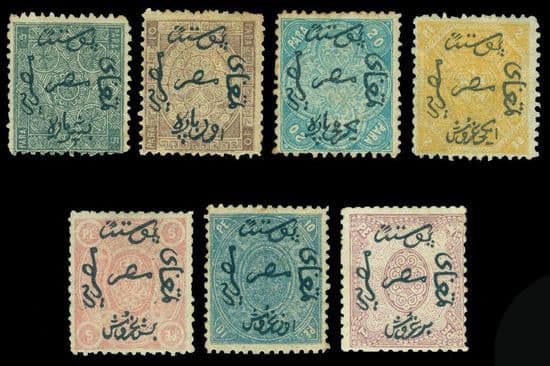
Egypt 1866 First Issue
Egypt's first stamps were dreamed up by an Italian courier boss, printed in Genoa, inscribed in Turkish, and nearly ruined by bad paper that the printer tried to rescue by dunking whole sheets in an alum bath.
- Year
- 1866
- Maker
- Khedivate of Egypt
- By price in stamps
- 88 of 100
Create a free account to see every recorded price and every grade.
Create a free account- Issued
- January 1, 1866
- Ruler
- Ismail Pasha, viceroy of Egypt from January 1863 (Khedive from 1867)
- Printer
- Pellas Brothers, Genoa, Italy
- Values
- Seven: 5, 10 and 20 paras; 1, 2, 5 and 10 piastres
- Language and currency
- Turkish inscriptions; Ottoman paras and piastres (40 paras to the piastre)
- Watermark
- A pyramid with a star (sun) above, on all values except the unwatermarked 1 piastre
- Perforation
- 12 1/2, 13 or compounds of the two, applied in Italy; imperforate and part-perforated stamps also exist
- Printing
- Lithography for most values; the 1 piastre typographed; the 2 piastres lithographed with a typographed inscription
- Followed by
- The 1867 issue showing the Sphinx and a pyramid
An Italian courier's idea
Before Egypt had a state post, much of its mail moved through the Posta Europea, a private courier service run by the Italian Giacomo Muzzi. A decree of March 5, 1862, gave it the postal monopoly for Lower Egypt, and the volume of mail grew so quickly that marking each letter by hand became almost impossible for Muzzi's staff. Adhesive stamps were his answer.
By 1863 Muzzi had essays made for stamps of his own, inscribed POSTA EUROPEA, and asked several printers to bid, among them Pellas Brothers of Genoa and the imperial printing house in Vienna. On June 7, 1864, he wrote to the viceroy, Ismail Pasha, proposing adhesive stamps and a flat rate of 25 centimes per 10 grams regardless of distance, and suggested the stamps might carry the viceroy's portrait.
Ismail took the post itself instead. On January 2, 1865, the Posta Europea passed to the Egyptian government through the French banker Dervieu for 950,000 gold francs, and Muzzi, now Muzzi Bey, became Egypt's first postmaster general. The next day the minister of public works, Nubar Pasha, ordered postage stamps to be prepared. A later account in a society article dates Ismail's purchase of the concession from Muzzi to 1857, which does not fit with Ismail's accession in 1863; the 1865 date comes from the contracts themselves.
Made in Genoa, with trouble
On April 19, 1865, Nubar Pasha sent Muzzi to Europe to arrange the printing. His instructions set out the watermarked paper in detail, with a drawing of the watermark, a rough sketch of the design and the wording for each value. The choice of colors was left to Muzzi, except that green was ruled out. The contract went to Pellas Brothers, Muzzi's fellow Italians.
The paper nearly sank the project. It was so poor that the gum soaked through and the sheets looked oil-stained. Giuseppe Pellas wrote on September 27, 1865, that he had plunged the printed sheets in an alum bath to make them gum-proof; this worked for some sheets and failed for others, and an enormous quantity of paper was lost. The bath also shrank the sheets, which then perforated badly on a machine that punched two sheets at once. So for the 1 piastre, the last value printed, Pellas abandoned the watermarked paper altogether, which is why the 1 piastre is on unwatermarked paper.
Most values were printed by lithography, both the ornamental background and the Turkish inscription. The 1 piastre was printed by typography instead, and the 2 piastres combined a lithographed design with a typographed inscription. Pellas reported that, because the lithographic stones were defaced after printing, the designs could not be sent to Egypt, though he shipped the watermark plate and the inscription plates for the 2 piastres.
The finished stamps sailed from Genoa on an English steamer at the end of September 1865, and Egypt's first stamps went on sale on January 1, 1866. Their ornamental designs differ from value to value, with the country's name and the value in Turkish; no portrait of the ruler was used.
Reading the set
The seven values are the 5 paras greenish gray, 10 paras brown, 20 paras greenish blue, 1 piastre claret (also described as purple), 2 piastres yellow, 5 piastres rose and 10 piastres slate blue. One catalogue gives quantities of 300,000 for the 5 paras, 250,000 each for the 10 and 20 paras, 1,200,000 for the 1 piastre, 500,000 for the 2 piastres, 300,000 for the 5 piastres and 200,000 for the 10 piastres.
Those numbers are printing figures, not usage. Pellas recorded sending 1,000 sheets of the 10 piastres, 200,000 stamps, while Muzzi's own statement of August 25, 1868, says only 23,000 were issued and only 7,600 actually used. The rest went back to the Ministry of Finance.
Perforation is a study in itself. Pellas used two single-line machines gauging 12 1/2 and 13, apparently at random on the same sheets, which produced many compound combinations, all known used from the start. Some sheets reached Egypt unperforated, and a few stamps were later perforated 12 1/2 by 15 in Alexandria on the machine prepared for the 1867 issue. The 10 paras and 2 piastres with that trial perforation are counted among the greatest rarities of Egypt.
The most dramatic error is the 5 piastres carrying the inscription for 10 piastres. Proofs and essays also exist, including lithographed versions of the 1 piastre that were never issued and imperforate trial printings on unwatermarked paper.
Collectors and the market
Much of what is known about the issue comes from a find made in the 1940s. Ibrahim Bey Chaftar, president of the Philatelic Society of Egypt, discovered fifteen documents in the King Fouad I Postal Museum, including Muzzi's 1864 proposal, the 1865 contracts, the Pellas letters and Muzzi's 1868 accounting, and used them as the centerpiece of the first Cairo philatelic exhibition, held from February 28 to March 8, 1946, under the patronage of King Farouk.
Stamps with perforation gauges other than the recognized ones are treated by specialists as either proofs with trial perforations or forgeries, so the gauge is one of the first things checked on any unusual copy.
Complete sets do not command great sums. On March 14, 2024, a complete unused set of seven with a few minor faults sold at auction in Switzerland for 420 Swiss francs against an estimate of 300 francs. The sale was recorded only in Swiss francs, so it is not listed as a dollar price here. Proofs and varieties, such as the 5 piastres with the 10 piastres inscription, trade separately.
A short life and a long shadow
The first issue was soon replaced. On May 14, 1867, the Ottoman sultan granted Ismail the title of Khedive, and the second issue of 1867, perforated in Alexandria, introduced the Sphinx and a pyramid, the image that would define Egyptian stamps for decades.
Ismail's ambitions were far larger than his post office. He expanded railways, telegraphs and harbors and backed the Suez Canal, which opened on November 17, 1869. His spending raised the state's debt more than thirtyfold between 1863 and 1874, and in 1879 he was forced to abdicate in favor of his son Tawfik. The stamps of 1866 mark the start of the state postal service that outlived him.
The numbers
- Issue date
- January 1, 1866
- Values and colors
- 5pa greenish gray, 10pa brown, 20pa greenish blue, 1pi claret/purple, 2pi yellow, 5pi rose, 10pi slate blue
- Quantities (catalogue figures)
- 300,000 / 250,000 / 250,000 / 1,200,000 / 500,000 / 300,000 / 200,000
- 10 piastres actually issued
- 23,000, of which 7,600 used, per Muzzi's 1868 statement
- Printer
- Pellas Brothers, Genoa
- Printing method
- Lithography (5pa, 10pa, 20pa, 5pi, 10pi); typography (1pi); lithography with typographed inscription (2pi)
- Paper and watermark
- Pyramid and star watermark; 1 piastre on unwatermarked paper
- Perforation
- 12 1/2, 13 and compounds; imperforate and part-perforated exist; 12 1/2 x 15 trial perforation on 10pa, 2pi and the 5pi with 10pi inscription
Timeline
A decree grants the Posta Europea the postal monopoly for Lower Egypt.
Said Pasha dies and Ismail becomes viceroy of Egypt.
Pellas Brothers quotes a price, including machine perforation, for stamps for Muzzi.
Giacomo Muzzi proposes adhesive stamps to Ismail.
The Egyptian government takes over the Posta Europea for 950,000 gold francs; Muzzi becomes postmaster general.
Nubar Pasha orders postage stamps to be prepared.
Muzzi is sent to Europe to arrange printing, with the watermark specified.
Giuseppe Pellas writes that the stamps are shipping and explains the alum bath and the unwatermarked 1 piastre.
Egypt's first stamps go on sale.
Ismail receives the title of Khedive; the Sphinx and pyramid issue follows the same year.
Muzzi signs an accounting of first-issue stamps issued, used and returned.
The Suez Canal opens.
Ismail is forced to abdicate in favor of his son Tawfik.
The first Cairo philatelic exhibition opens, built around newly found documents on the first issue.
A complete unused set sells at auction in Switzerland for 420 Swiss francs.
The world in 1866
The U.S. Congress passes the Civil Rights Act of 1866.
The Ottoman sultan sanctions construction of the Suez Canal.
London bank Overend, Gurney and Company collapses, setting off the Panic of 1866.
The Austro-Prussian War begins.
Prussia defeats Austria at the Battle of Koniggratz.
The SS Great Eastern completes the transatlantic telegraph cable between Ireland and Newfoundland.
The Treaty of Vienna ends the war between Austria and Italy and confirms Italy's annexation of Venetia.
Price record
| Date | Price | Kind |
|---|---|---|
| Mar 14, 2024 | $475 | Sold at auctionAt an online auction in Switzerland: CHF 420 (hammer price), shown in USD at the Federal Reserve rate on the sale date (1 CHF = 1.1320 USD). |
A realized auction price is what a buyer actually paid on the date shown, including the buyer's premium where the sale reported it. It is the strongest kind of reference price, and it is a record of one sale of one object on one day, not a promise of what the next example will bring.
By reference price, Egypt 1866 First Issue is number 88 of 100 in the stamps entries of the FLOAT 100. 82 of those 100 rest on a realized sale; the rest carry an asking price or a guide value, and each page says which. Rank within the FLOAT 100 itself (100 here) is editorial: how much an object defines its field, not price alone.
Did you know
- Egypt's first stamps were proposed by the head of a private Italian courier company, who suggested putting the viceroy's portrait on them. They ended up with no portrait at all.
- The printer dipped sheets in an alum bath to stop the gum soaking through poor paper, and lost an enormous quantity of paper in the process.
- The 1 piastre is the only value on unwatermarked paper, because the alum bath shrank the watermarked sheets.
- Green was ruled out as a color in the Egyptian government's instructions to the printer.
- Of 200,000 10 piastres stamps sent from Genoa, Egypt's postmaster general reported only 23,000 issued and 7,600 used.
- Much of the issue's history was unknown until the 1940s, when fifteen original documents turned up in the King Fouad I Postal Museum.
How this page is made
- The figure
- One reference price, shown with its own kind. FLOAT does not average it with anything or adjust it for time.
- Realized or not
- A realized price is a completed sale. An asking price, an estimate and a price-guide value are not sales, and are labeled as such wherever they appear.
- The story
- Researched from published records and checked fact by fact. Updated Oct 3, 2026.
- Archive
- Oct 5, 2026