FLOAT 100 · Stamps · No. 74
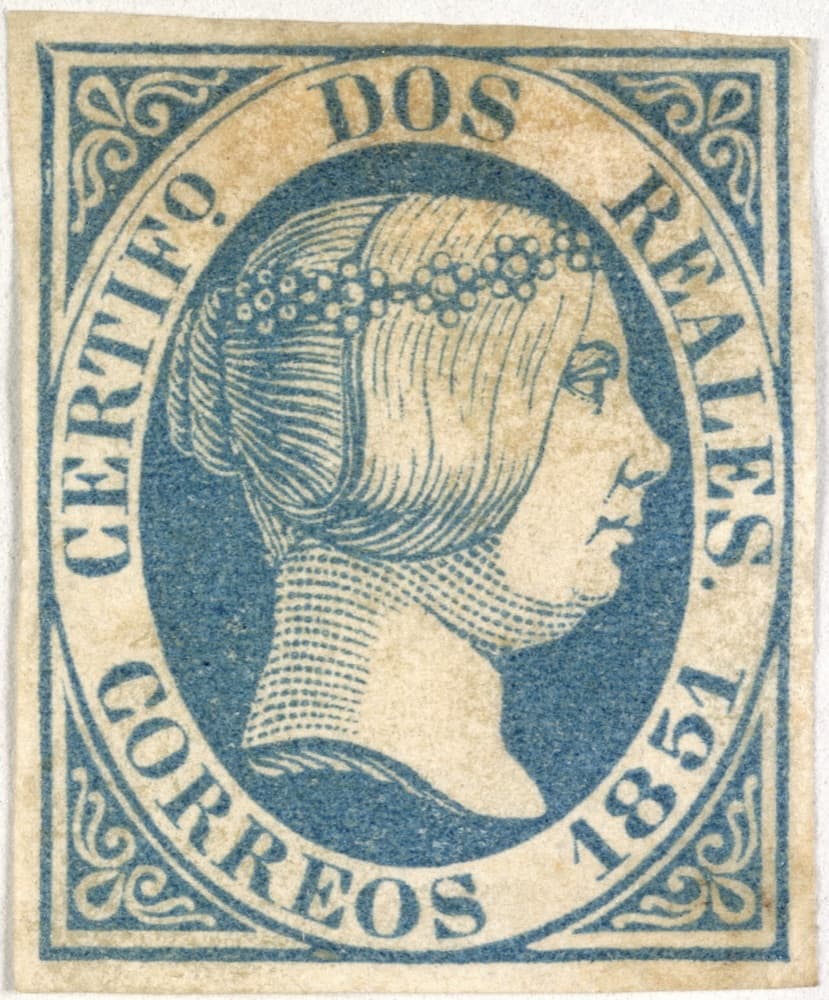
Spain 1851 '2 Reales' Error of Color
One wrong printing block in Madrid in 1851 turned Spain's red 2 reales stamp blue; only three are known, one was found by a shop assistant cutting up a block a rival dealer had refused, and that one disappeared in 2001 and was still missing 15 years later.
- Year
- 1851
- Maker
- Spain (Isabella II)
- By price in stamps
- 26 of 100
Create a free account to see every recorded price and every grade.
Create a free account- What it is
- Spain's 1851 2 reales stamp of Queen Isabella II printed in blue, the color of the 6 reales: an error of color
- Issue
- Spain's second set of stamps, in use from January 1, 1851
- Normal color
- 2 reales: red or red-orange. 6 reales: blue
- Known examples
- Three: the Westoby copy, the Tapling copy and a vertical pair with a 6 reales
- Condition
- All three are used; the Tapling copy, long thought unused, was found to have had its cancellation removed
- Where they are
- One in the British Library in London; one with a Barcelona collector; the pair has been missing since 2001
- Total owners
- Only 18 owners across all three copies, by one 2016 count
- Value
- Described in 2026 as a 'million-euro stamp'
A new stamp for letters to Portugal
Spain issued its first stamps in 1850 and its second set on January 1, 1851. That set included a new value, 2 reales, which had not existed before. Its purpose was to pay for registered letters to Portugal under a postal convention Spain had just signed with its neighbor, dated December 10, 1850, by one account.
The 1851 stamps were printed by letterpress at the National Stamp Factory in Madrid. Bartolomé Coromina designed them and engraved one steel die in which the value inscription could be swapped, instead of a separate die for each value. Every value was printed in sheets of 170, and each had its own color to tell them apart: red or red-orange for the 2 reales and blue for the 6 reales.
Very few registered letters went to Portugal, so the normal 2 reales is itself rare. A 2016 history based on a factory document gives a printing of 16,660 stamps in 98 sheets, of which only 1,432 were sold during the year; the rest were returned for destruction. Another account gives an order of 13,600 and sales of 3,394, so the figures differ.
How a red stamp came out blue
The error arose when a 2 reales printing block, or cliché, was placed by mistake in the plate for the 6 reales. Every sheet printed from that plate carried one 2 reales value in the 6 reales' blue.
How many were printed is not known. The 6 reales printing was 145,350 stamps in 855 sheets, and 42,323 were sold in 1851. The 2016 history reasons that if the error went unnoticed, up to 855 blue 2 reales could have been printed, and suggests many were refused by postal customers, returned and burned. In 2022 a researcher, José Antonio Herráiz, found circulars from the National Stamp Factory in the provincial archive in Zaragoza, dated December 24, 1850, to March 28, 1851, that describe the discovery of the error and the instructions sent to provincial governors to correct it.
For decades experts argued over whether the blue stamp was a true printing error or a color trial. The Belgian dealer Jean-Baptiste Moens insisted it was a proof, while British collectors mostly backed the error theory. Moens conceded after the pair with a 6 reales surfaced. Even so, Hugo Griebert, author of a major 1919 book on the stamps of Spain, revived the doubts in the early 20th century.
Three copies, three stories
The first copy surfaced in England. In the February 1, 1868, issue of a British stamp magazine, a collector signing himself 'a lover of rarities' announced he had a canceled 2 reales in blue and asked for information. He was William Amos Scarborough Westoby, a leading collector and editor. Around 1881 the stamp went to Philipp von Ferrary, who by one report paid 250 francs for a stamp Westoby had bought for 125.
The second copy belonged to Thomas Keay Tapling, a British collector who began as a 10-year-old schoolboy and built the most important collection of his day after Ferrary's. He acquired it around 1886. Tapling died of pleurisy on April 11, 1891, at 35 and left his collection to the British Museum. It is now in the British Library, still intact, so this copy has had only two owners. It was long considered the only unused example, until an expert committee of the Royal Philatelic Society London examined it and found that the faint shadows on it were the remains of a removed cancellation.
The third copy is the only one still joined to a 6 reales. In 1898 Francisco Mifsut, a prosecutor at the court in Toledo, offered a heavily canceled block of 6 reales stamps to the Madrid dealer Miguel Gálvez at 20 pesetas a stamp. Gálvez's shop turned it down. Mifsut sold it to Antonio Vives, whose shop was across the street. A Vives employee was cutting the block into singles, as was customary, and as she reached the last vertical pair she saw that one stamp read 'DOS' instead of 'SEIS.' Gálvez later wrote that he lost it over perhaps 500 or 1,000 pesetas.
Kings, collectors and a disappearance
The Paris dealer Pierre Marie Mahé, curator of Ferrary's collection, bought the Vives pair for 15,000 pesetas. Ferrary now owned two of the three. France seized his collection as war reparations in 1918 and sold it in Paris in a series of sales from 1921 to 1925. Hugo Griebert, the same expert who had doubted the error, bought the pair for the American collector Arthur Hind for 152,700 francs, with a blank check from Hind. Gálvez bid up to about 130,000 francs and lost it a second time. Griebert also bought the Westoby single for Hind in November 1923.
Hind's collection was sold in London in 1935. The single went on March 25, 1935, to the Barcelona collector Manuel García Nieto for 33,250 pesetas. It was nearly lost when patrols seized his collection during the Spanish Civil War and was recovered with the help of the Greek consul in Barcelona. It passed to Francisco Samaranch in 1942 for 100,000 pesetas, to the Italian count Alessandro Contini in the mid-1950s, and on October 23, 1958, at auction in Brussels, to the Belgian collector Jean Dupont for the equivalent of 717,600 pesetas, hailed then as the most expensive European stamp ever sold. Antonio Perpiñá Sebriá bought it privately in 1977 in a deal valued at 17 million pesetas, Juan José Folchi bought it in 1991 for 33 million pesetas, and it was a star of the Granada '92 world exhibition. In 1995 it went to José María Ventura Ferrero, a Barcelona pharmacist and businessman, who still owned it in 2016.
The pair went from Hind's 1935 sale to Dr. J. Ramberg for £2,200, then to King Carol II of Romania, then in 1950 privately to Rene Berlingin. That same year, by one account, Manuel Gálvez, Miguel's son, finally bought it; the same history elsewhere dates the purchase to 1954. It stayed with the Gálvez family business until mid-2001, when its owner found it had 'disappeared.' A police report was filed in Madrid on October 23, 2001, and in 2004 auction houses were formally warned after a foreign dealer announced plans to sell it. As of 2016 it was still missing.
Very little price evidence exists in dollars. One account says a fine copy sold privately in Barcelona in 1974 for $450,000, but the detailed 2016 history of all three copies records no 1974 sale, so that figure is unconfirmed. A 2026 documentary called it a stamp worth about one million euros.
How to recognize one
The 1851 stamps show Queen Isabella II and are imperforate. A genuine error is a 2 reales value in exactly the blue ink and paper of the 1851 6 reales. The first reporter of the Westoby copy argued for its authenticity precisely because its ink and paper matched the 6 reales.
Forgeries appeared soon after the error became famous, though experts found them fairly easy to detect. Collectors should not confuse the error with the normal red 2 reales, itself a major rarity: about 150 copies are said to exist, and a perfect unused example sold for $23,200 in 1996.
The numbers
- Issue date
- January 1, 1851
- Face value
- 2 reales (printed in the 6 reales color)
- Printing
- Letterpress, National Stamp Factory, Madrid; design and die by Bartolomé Coromina
- Sheet
- 170 stamps; one 2 reales cliché in the 6 reales plate
- Separation
- Imperforate
- 6 reales printing
- 145,350 stamps in 855 sheets; 42,323 sold in 1851
- Normal 2 reales printing
- 16,660 stamps in 98 sheets, 1,432 sold (another account: 13,600 ordered, 3,394 sold)
- Known copies
- 3, all used
Timeline
Spain signs a postal convention with Portugal, by one account, creating the need for a 2 reales stamp.
Date of the first factory circular, later found in Zaragoza, dealing with the error.
Spain's 1851 stamps come into use.
William Westoby announces the first known copy in a British stamp magazine.
Around this year Philipp von Ferrary acquires the Westoby copy.
Around this year Thomas Tapling acquires the second copy.
Tapling dies; his collection, with the error, goes to the British Museum.
A Vives employee in Madrid finds the error in a pair with a 6 reales while cutting up a block.
France seizes Ferrary's collection as war reparations.
The Westoby copy is bought for Arthur Hind at a Ferrary sale in Paris.
At the Hind sale in London, the Westoby copy goes to Manuel García Nieto for 33,250 pesetas.
Francisco Samaranch buys the Westoby copy for 100,000 pesetas.
The pair leaves King Carol II's collection; Manuel Gálvez buys it (one passage gives 1954).
The Westoby copy sells at auction in Brussels to Jean Dupont.
Antonio Perpiñá Sebriá buys the Westoby copy privately.
Juan José Folchi buys it for 33 million pesetas.
José María Ventura Ferrero buys the Westoby copy.
A police report is filed in Madrid over the disappearance of the Gálvez pair.
José Antonio Herráiz finds the factory circulars in the Zaragoza provincial archive.
A documentary on the stamp premieres in Zaragoza.
The world in 1851
Hong Xiuquan formally begins the Taiping Rebellion in China.
Queen Victoria opens the Great Exhibition in the Crystal Palace, London.
The first Australian gold rush is proclaimed.
The yacht America wins the first America's Cup race.
The New York Times is founded.
Herman Melville's 'Moby-Dick' is published in New York.
Louis-Napoleon Bonaparte dissolves France's National Assembly.
Price record
A realized private sale is a completed transaction outside an auction room. The amount is what changed hands on the date shown. Private sales are reported less consistently than auction results, so a single comparable carries less weight than a run of them.
By reference price, Spain 1851 '2 Reales' Error of Color is number 26 of 100 in the stamps entries of the FLOAT 100. 82 of those 100 rest on a realized sale; the rest carry an asking price or a guide value, and each page says which. Rank within the FLOAT 100 itself (74 here) is editorial: how much an object defines its field, not price alone.
Did you know
- The third copy was found by a shop employee cutting up a block that a rival dealer across the street had refused over a small difference in price.
- The expert who spent years calling the error a fake later bought two of the three copies on behalf of Arthur Hind.
- The British Library copy was thought for decades to be the only unused one, until experts found its cancellation had been removed.
- One copy survived the Spanish Civil War only after the Greek consul in Barcelona helped recover a seized collection.
- A Canadian collector reportedly refused to collect Spain at all unless he could own this stamp, and never did.
- The pair disappeared from its owners in 2001 and was still missing 15 years later.
- The pair with a 6 reales once belonged to King Carol II of Romania.
How this page is made
- The figure
- One reference price, shown with its own kind. FLOAT does not average it with anything or adjust it for time.
- Realized or not
- A realized price is a completed sale. An asking price, an estimate and a price-guide value are not sales, and are labeled as such wherever they appear.
- The story
- Researched from published records and checked fact by fact. Updated Oct 3, 2026.
- Archive
- Oct 5, 2026