FLOAT 100 · Stamps · No. 68
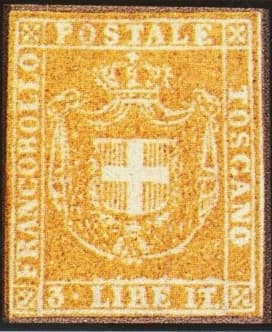
Tuscany '3 Lire' (Italian States)
In the months between a grand duke's flight and Italy's birth, Tuscany's caretaker government printed a 3 lire stamp worth more than most letters would ever need; it became the first stamp to carry the letters 'IT' for Italy, and the most valuable stamp of the Italian states.
- Year
- 1860
- Maker
- Grand Duchy of Tuscany (Provisional Government)
- By price in stamps
- 43 of 100
Create a free account to see every recorded price and every grade.
Create a free account- What it is
- The 3 lire yellow ochre, top value of the 1860 Provisional Government issue of Tuscany
- Issued
- January 1, 1860
- Design
- Arms of the House of Savoy under a royal crown, in the old Tuscan frame
- Catalogue
- Sassone 23
- Known today
- About 50 unused, around 270 used (another count says fewer than 300), four on fragments, two on cover
- Famous covers
- One owned by Alphonse de Rothschild, one by King Farouk of Egypt
- Firsts
- Described as the first stamp to carry 'IT' for the new Italian lira
- Notable sale
- An example sold for 114,000 euros at auction in Turin, December 2014
A government between two states
On the evening of April 27, 1859, on the eve of the Second Italian War of Independence, Grand Duke Leopold II of Tuscany left Florence for Bologna in a convoy of four carriages. He left no government behind, so the city of Florence appointed a provisional government that same night. Carlo Bon Compagni became extraordinary commissioner, and from May 11 Bettino Ricasoli served as interior minister.
Daily life, including the mail, had to go on. Unlike other provinces in central Italy, Tuscany's provisional government let people keep using the old grand-ducal stamps with the Marzocco, Donatello's lion of Florence, until new ones were ready. Tuscany had issued its first stamps on April 1, 1851.
The new stamps went on sale on January 1, 1860. Tuscans voted on March 11 and 12, 1860, by 366,571 to 14,925, to join the Kingdom of Sardinia, and the annexation was signed on March 22. Tuscany kept its own administration until February 14, 1861.
Savoy arms and a new currency
The 1860 set had seven values, 1, 5, 10, 20, 40 and 80 centesimi and 3 lire. It kept the old frame, but the Savoy coat of arms on an ermine mantle replaced the lion. The stamps were 23 millimeters high and 19 wide, typographed, imperforate and printed in sheets of 240 divided into three panes of 80.
The values were in the Sardinian lira of 100 centesimi, the currency of the coming Kingdom of Italy, not the old Tuscan lira. To mark the difference, the value tablet carried the letters 'IT.' for 'italiane,' which writers on the stamp call the first appearance of Italian unity on a postage stamp.
Why a 3 lire stamp at all? Sardinia and the other provisional governments stopped at 80 centesimi. Tuscany's own explanation, as summarized in a history published by an Italian auction house, was that its trade and cultural ties reached far abroad and needed high postage rates for distant mail. Because of its high face value, few 3 lire stamps were printed or used.
Fifty unused, two covers
The series was officially valid until December 31, 1861, although scattered examples stayed in use through 1862 and into early 1863. Its short life and high value left very few 3 lire stamps. Counts agree on about 50 unused examples. One count gives around 270 used stamps and four fragments, while another says fewer than 300 used. Only two covers are known.
One of the two, known as the Faruk letter, was mailed on January 7, 1860, the first week of the issue, by the Medina firm of Livorno to its branch in Alexandria, Egypt. It later belonged to King Farouk I of Egypt. The other belonged to the banker Alphonse de Rothschild, who reportedly bought it in 1880. After his death it went to another French collector. After several more owners it sold at auction in Milan in 1989 for 795 million lire.
Single stamps rarely come to market in top condition. In December 2014 an example sold for 114,000 euros at a two-day sale in Turin, the top lot of a sale that totaled 3 million euros. A 2020 article called it the most valuable Italian stamp of its kind on the market. A Wikipedia survey of Tuscan stamps calls the mint 3 lire the most valuable Italian stamp.
The forger's favorite
High value and rarity attracted forgers. The 3 lire was reprinted on the wrong watermarked paper, and it has been forged as well, so experts' certificates matter more than usual. An unused example offered at a U.S. auction in 2026 carried a 1995 certificate and the signature of the expert A. Diena. It was described with a light crease and a small repaired nick that the certificate did not mention, and it was withdrawn from the sale.
The stamp also has a place in the story of Jean Sperati, the most famous stamp forger of the 20th century. Born in Pistoia in 1884, he is said to have turned to forgery after being cheated with a fake Tuscan 3 lire for which he paid 100,000 francs in 1920. He went on to make thousands of high-quality forgeries, and today his fakes are collected in their own right.
Italy's first word on a stamp
For Italian collectors the 3 lire stands for more than rarity. It was issued while Tuscany was legally neither a grand duchy nor yet part of Italy, and it was priced in the money of a country that did not exist yet. Collectors from the Rothschilds to the king of Egypt sought it out.
A U.S. auction description calls it one of the key rarities of the Italian states and one of the highest-cataloguing classic stamps in the world that is not an error. Its major catalogue lists an unused example at 220,000 euros. Actual sales of unused stamps have been rare.
The numbers
- Issue date
- January 1, 1860
- Validity
- Officially to December 31, 1861; used into early 1863
- Color
- Yellow ochre (ocra arancio)
- Printing
- Typographed, imperforate, sheets of 240 in three panes of 80
- Size
- 23 mm high by 19 mm wide
- Known unused
- About 50
- Known used
- Around 270 (one count), fewer than 300 (another), plus four fragments
- Known covers
- 2
Timeline
Tuscany issues its first stamps, showing the Marzocco lion.
Grand Duke Leopold II leaves Florence, and the city appoints a provisional government.
Bon Compagni forms a cabinet with Bettino Ricasoli as interior minister.
The Provisional Government issue goes on sale, with values from 1 centesimo to 3 lire.
The Medina firm of Livorno mails the later 'Faruk' cover to Alexandria, franked with a 3 lire.
Tuscany votes to join the Kingdom of Sardinia, 366,571 to 14,925.
The act of annexation is signed.
Official end of validity for the 1860 stamps; scattered use continues into early 1863.
Alphonse de Rothschild reportedly buys one of the two known covers.
Jean Sperati is said to pay 100,000 francs for a fake 3 lire, a story told about why he became a forger.
The Rothschild cover sells at auction in Milan for 795 million lire.
An example sells for 114,000 euros at auction in Turin.
An unused example with a repaired nick is withdrawn from a U.S. auction.
The world in 1860
Abraham Lincoln gives his Cooper Union speech in New York.
The Pony Express begins service from Missouri to California.
Garibaldi sails from Quarto with the Expedition of the Thousand.
Garibaldi's forces take Naples.
Piedmontese troops defeat papal forces at Castelfidardo.
At Teano, Garibaldi hands southern Italy to Victor Emmanuel II.
Lincoln is elected president of the United States.
HMS Warrior, the first iron-hulled armored battleship, is launched.
Price record
| Date | Price | Kind |
|---|---|---|
| Dec 2014 | $140,551 | Sold at auctionAt auction in Turin: EUR 114,000 (including buyer's premium), shown in USD at the Federal Reserve monthly average (1 EUR = 1.2329 USD). |
A price-guide value is an editorial estimate, not a transaction and not an asking price. Guides lag the market and smooth over grade and condition. It is neither a floor nor a ceiling: a sale can land above or below it, and it should be checked against a realized sale before anything rests on it.
By reference price, Tuscany '3 Lire' (Italian States) is number 43 of 100 in the stamps entries of the FLOAT 100. 82 of those 100 rest on a realized sale; the rest carry an asking price or a guide value, and each page says which. Rank within the FLOAT 100 itself (68 here) is editorial: how much an object defines its field, not price alone.
Did you know
- Neighboring governments topped out at an 80 centesimi stamp; Tuscany alone issued a 3 lire.
- Its 'IT.' marked the new Italian lira, a currency for a country that did not yet exist.
- One of only two covers went from a Livorno firm to Alexandria in the issue's first week and ended up with Egypt's King Farouk.
- The forger Jean Sperati is said to have started his career after being cheated with a fake Tuscan 3 lire.
- The stamps stayed in use more than a year after they officially expired.
How this page is made
- The figure
- One reference price, shown with its own kind. FLOAT does not average it with anything or adjust it for time.
- Realized or not
- A realized price is a completed sale. An asking price, an estimate and a price-guide value are not sales, and are labeled as such wherever they appear.
- The story
- Researched from published records and checked fact by fact. Updated Oct 3, 2026.
- Archive
- Oct 5, 2026