FLOAT 100 · Stamps · No. 27
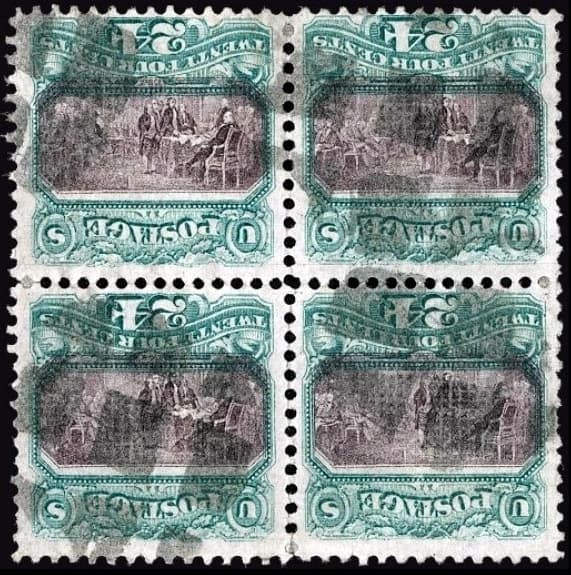
US 1869 24c 'Declaration of Independence' Invert
The Founding Fathers turned upside down on a stamp most Americans never needed: only four unused copies are known, and in 2008 one of them set the auction record for any U.S. invert.
- Year
- 1869
- Maker
- United States (USPOD), National Bank Note Co.
- By price in stamps
- 12 of 100
Create a free account to see every recorded price and every grade.
Create a free account- Catalog number
- Scott 120b, 24-cent green and violet, center inverted
- Issue
- 1869 Pictorial Issue; earliest documented use of the 24-cent is April 7, 1869
- Printer
- National Bank Note Company, New York
- Design
- Violet vignette after John Trumbull's painting Declaration of Independence, about 1/300th its size, in a green frame
- Known today
- 94 in the census: 4 unused (all without gum, one in the British Library), 83 used singles, 1 used pair, 1 on cover and a unique block of four
- Paper and perforation
- G grill, perforated 12, sheets of 100
- Unique multiple
- A used block of four, found in England in the 1880s and later in the collections of William Thorne, Ryohei Ishikawa and William H. Gross
- Record
- $1,270,000 for an unused copy at auction in New York, February 9, 2008, then the record for a U.S. invert
Trumbull's great painting, shrunk to an inch
The 24-cent stamp of 1869 reproduced one of the most famous pictures in America. John Trumbull sketched his Declaration of Independence in Paris in 1785 and, hoping to paint every face from life, spent 1789 to 1794 in New York, then the seat of government, collecting portraits. After the British burned Washington in the War of 1812, Congress commissioned large works from him for the rebuilt Capitol's rotunda, among them the Declaration, a canvas 12 feet tall by 18 feet wide. The Smithsonian's National Postal Museum notes that the violet vignette on the stamp is about 1/300th the size of the original.
The stamp was one of four bicolored high values in the 1869 Pictorial Issue, the first U.S. stamps printed in two colors. The others were the 15-cent Landing of Columbus, the 30-cent Shield, Eagle and Flags and the 90-cent Lincoln. The National Bank Note Company printed them under a contract signed in December 1868, and the issue began in March 1869. A Post Office circular warned postmasters that the 15-cent and higher values came in sheets of 100, not 150 like the low values.
Few people needed a 24-cent stamp. It paid multiples of the 3-cent domestic letter rate or the 12-cent rate to Great Britain through December 31, 1869 (the British rate fell to 6 cents after that), and the museum notes it typically franked heavy domestic letters or expensive foreign mail. The museum puts the number printed for the issue at 235,350. Philatelic historian Calvet M. Hahn, working from Post Office reports and the printer's ledger sheets, gives 235,250 issued and 1,307,300 printed, so by his figures fewer than one in five of the 24-cent stamps printed was ever issued. He concluded that the unissued stock was destroyed, though no record of its destruction is known.
One sheet the wrong way round
Each bicolored stamp went through the press twice, once for each color. On a few sheets of the 15-, 24- and 30-cent values the paper went in upside down for the second pass, producing America's first invert errors. On the 24-cent the result is a Declaration scene hanging upside down inside an upright frame.
Hahn's study of the printing plates adds a further twist. He found that two vignette plates were used for the issued 24-cent: the original plate 20 and a replacement, plate 24, which he argued was made in the spring of 1869. He noted that the plate 24 vignette is wider, filling the space inside the beaded border and overlapping it when well struck, and that some inverts clearly show that full-width vignette. His suggestion that plate 20 was replaced because of an earlier, suppressed error is a theory, not an established fact.
The Post Office replaced the whole pictorial set in April 1870, little more than a year after it appeared. The short run kept every high value scarce and gave the inverts very little time to be found at the post office window.
Found late, and mostly in England
The 24-cent invert was first mentioned in print in the December 20, 1870, issue of the American Journal of Philately, the New York journal of J. Walter Scott, which reported inverts on both the 15- and 24-cent stamps. Hahn notes that at that point Scott had found half a dozen used 15-cent inverts in his own stock but was still looking for a 24-cent. Neither error was in Scott's 1870 catalog; both appeared in the 1871 edition. In July 1871 the writer W. Dudley Atlee reported in a British collectors' magazine that a few copies of "the lately defunct 24 cent" had passed through the post with the center "topsy-turvy."
Because the 24-cent paid the rate to Britain, most used copies went across the Atlantic, and Hahn concluded from the record that most of the known 24-cent inverts turned up in England during the 1880s. The most famous of them was a block of six found in Liverpool. It passed through the dealer Thomas Ridpath to the collector William Thorne, who exhibited it by 1889 and, Hahn writes, reduced it to the block of four he preferred to collect.
No British auction record of a 24-cent invert appears until February 1892, according to the London records Hahn consulted, and early writers considered it much scarcer than the 15-cent. Today the census shows the opposite of that early impression: 94 copies of the 24-cent are recorded, about as many as of the 15-cent.
Four unused copies and a record
Only four unused 24-cent inverts are known, all without gum, and one of them is in the Tapling Collection at the British Library, so just three can ever change hands. On February 9, 2008, one of the three sold at auction in New York for $1,270,000 including a 13 percent buyer's premium, against a presale estimate of $200,000 to $300,000. It was described as the only completely sound, fault-free unused example and the second-best centered known. The sale report called it a new world auction record for a U.S. invert, and said the same anonymous collector also bought the 15-cent and 30-cent inverts offered that day.
Those stamps had last changed hands in 1974, when they were bought as part of the Charles A. Schaefer collection. "In 34 years, he made 20 times his money," the auctioneer said of the earlier owner.
The unique used block of four has its own line of owners. After William Thorne it was part of Ryohei Ishikawa's collection of U.S. stamps from 1847 to 1869, which sold in New York in 1993 for $9.5 million as a whole. One provenance record lists Ishikawa around 1977, Steven C. Walske in 1997 and William H. Gross in 2003, and records the block selling at auction in 2018 for $625,000.
Used singles trade far more often, and condition drives the price. One sound, well-centered copy brought $40,000 hammer in September 2012 and $29,000 when it sold again in October 2024; a used copy with a small corner crease brought $17,500 in 2014. The National Postal Museum also holds a 24-cent invert in the national collection and has had it on exhibit.
What to look for
The census maintained by a New York stamp firm lists four unused copies, 83 used singles, one used pair, one copy on cover and the unique block of four, 94 copies in all. A 2024 description of that census adds that only five used copies qualify as well centered, and that four of those five are either reperforated or have added margins.
Genuine stamps carry the G grill, a small field of embossed points used only on the 1869 issue, and are perforated 12. The 1875 reissues of the 24-cent have no grill. Proofs with inverted centers also exist, including impressions made after 1879 for Dr. James Petrie and plate proofs on card. They are not postage stamps and should not be confused with the issued error.
Used copies offered in recent years carry cork or rosette cancels, some with a trace of a red transit mark from mail sent abroad. Sale descriptions consistently single out cancels that leave the inverted vignette clearly visible.
The numbers
- Issue date
- Pictorial Issue began March 19, 1869; earliest documented 24-cent use April 7, 1869
- Quantity
- 235,350 printed for issue (National Postal Museum); 235,250 issued of 1,307,300 printed (Hahn)
- Known inverts
- 94: 4 unused, 83 used singles, 1 pair, 1 on cover, 1 block of four
- Paper and grill
- G grill
- Perforation
- 12
- Sheet size
- 100 stamps
- Colors
- Green frame, violet vignette
Timeline
John Trumbull sketches his Declaration of Independence in Paris.
The National Bank Note Company's contract for the 1869 issue is signed.
The 1869 Pictorial Issue begins, according to a Post Office memorandum.
Earliest documented use of the 24-cent stamp.
Replacement stamps go on sale and the pictorials are withdrawn from use.
The American Journal of Philately reports inverted pictures on the 15- and 24-cent stamps.
W. Dudley Atlee reports a few 24-cent stamps with the center "topsy-turvy" in a British collectors' magazine.
William Thorne exhibits the block found in Liverpool, later reduced to the unique block of four.
First 24-cent invert recorded at a British auction.
Three 1869 inverts, including an unused 24-cent, are bought as part of the Charles A. Schaefer collection.
Ryohei Ishikawa's collection, including the block of four, sells in New York for $9.5 million as a whole.
An unused 24-cent invert sells at auction in New York for $1,270,000, a record for a U.S. invert.
The unique block of four sells at auction for $625,000.
A sound, well-centered used copy sells for $29,000.
The world in 1869
Dmitri Mendeleev presents his periodic table to the Russian Chemical Society.
The first transcontinental railroad is completed at Promontory, Utah.
Susan B. Anthony and Elizabeth Cady Stanton form the National Woman Suffrage Association in New York.
The Cincinnati Red Stockings open the season as the first fully professional baseball team.
Black Friday: the Fisk-Gould gold scandal sets off a financial panic.
The Suez Canal is inaugurated in Egypt.
The clipper ship Cutty Sark is launched at Dumbarton, Scotland.
Price record
| Date | Price | Kind |
|---|---|---|
| Feb 9, 2008 | $1,270,000 | Sold at auctionUnused without gum, certified Fine, sold at auction in New York including 13% buyer's premium; a record for a U.S. invert at the time. |
| Sep 2012 | $40,000 | Sold at auctionUsed, sound and well centered; hammer price before buyer's premium. |
| 2014 | $17,500 | Sold at auctionUsed copy with rosette cancel and a small corner crease, sold at auction. |
| Oct 2024 | $29,000 | Sold at auctionThe same sound, well-centered used copy sold in 2012, described as one of the finest in existence. |
A realized auction price is what a buyer actually paid on the date shown, including the buyer's premium where the sale reported it. It is the strongest kind of reference price, and it is a record of one sale of one object on one day, not a promise of what the next example will bring.
By reference price, US 1869 24c 'Declaration of Independence' Invert is number 12 of 100 in the stamps entries of the FLOAT 100. 82 of those 100 rest on a realized sale; the rest carry an asking price or a guide value, and each page says which. Rank within the FLOAT 100 itself (27 here) is editorial: how much an object defines its field, not price alone.
Did you know
- The vignette is about 1/300th the size of Trumbull's 12-by-18-foot painting in the Capitol.
- By one historian's figures, fewer than one in five of the 24-cent stamps printed for the 1869 issue was ever issued.
- One of the four unused copies is in the British Library, so only three can ever be bought.
- J. Walter Scott had half a dozen 15-cent inverts in stock in December 1870 but was still hunting for a 24-cent.
- The unique block of four was found in Liverpool as a block of six and cut down by a collector who preferred blocks of four.
- The 2008 record copy was estimated at $200,000 to $300,000 and sold for more than four times the high estimate.
How this page is made
- The figure
- One reference price, shown with its own kind. FLOAT does not average it with anything or adjust it for time.
- Realized or not
- A realized price is a completed sale. An asking price, an estimate and a price-guide value are not sales, and are labeled as such wherever they appear.
- The story
- Researched from published records and checked fact by fact. Updated Oct 1, 2026.
- Archive
- Oct 5, 2026