FLOAT 100 · Stamps · No. 29
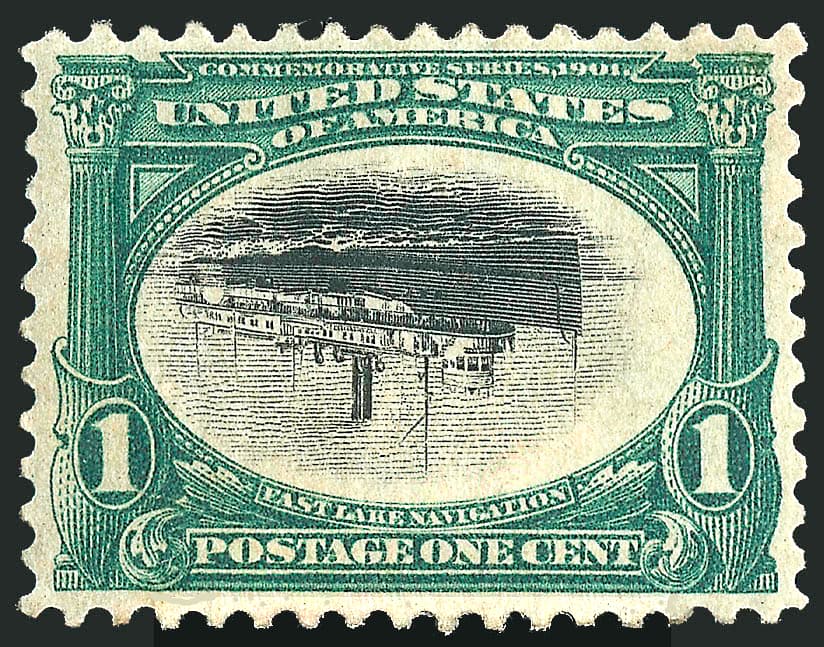
US 1901 Pan-American 1c Invert
An Alabama jeweler was about to mail a batch of circulars when someone noticed the steamboats were sailing upside down, and one of the best-known American stamp errors was saved from the mailbag.
- Year
- 1901
- Maker
- United States (USPOD), Bureau of Engraving and Printing
- By price in stamps
- 54 of 100
Create a free account to see every recorded price and every grade.
Create a free account- Catalog number
- Scott 294a: 1 cent green and black, center inverted
- Issued
- The normal stamp went on sale May 1, 1901, opening day of the Pan-American Exposition in Buffalo, New York
- Design
- "Fast Lake Navigation": the Great Lakes steamer City of Alpena, engraved from a photograph
- Printer
- Bureau of Engraving and Printing, Washington; designed by Raymond Ostrander Smith, vignette engraved by George F. C. "Fred" Smillie
- The error
- Sheets went through the press the wrong way round on the second pass, so the ship sits upside down relative to its frame
- First found
- Bessemer, Alabama, by the Carrell Jewelry Company, on circulars about to be mailed; inverts turned up in at least four post offices
- How many
- The most available of the three Pan-American inverts; one account says ten sheets were found, so fewer than 1,000 exist
- Used copies
- A published census records 54 used (51 off cover plus three on cover); only six off-cover singles and one pair are confirmed sound
- This entry
- An unused example graded Extremely Fine 90, the highest grade Professional Stamp Experts had awarded this error as of 2013
- Benchmark sale
- $51,750 for an XF 90 example at auction in New York, October 6, 2016
A two-color stamp for a new century
The Pan-American issue was the first set of United States stamps of the twentieth century. Six values, from 1 cent to 10 cents, were released for the Pan-American Exposition, a world's fair held in Buffalo, New York, from May 1 to November 2, 1901, to promote what its organizers called "commercial well being and good understanding among the American Republics." The fair had been conceived in 1897 for Cayuga Island near Niagara Falls, then moved to Buffalo and delayed by the Spanish-American War.
The exposition's promoters asked the Post Office Department for commemorative stamps in 1899. Collectors were wary after the expensive Columbian and Trans-Mississippi sets, and the government also balked at the inscription the promoters wanted, "Pan-American Series–1901," which an assistant attorney general ruled was a commercial advertisement that the law barred from postage stamps. The finished stamps read "Commemorative Series 1901" instead, and the six values added up to just 30 cents, against $3.80 for the Trans-Mississippi set and $16.34 for the Columbians.
Every stamp in the set showed modern, fast transportation, and to drive the point home each was printed in two colors: a black center picture, or vignette, inside an ornate colored frame. It was the Bureau of Engraving and Printing's first attempt at two-color postage stamps, and the Post Office's first two-color issue since the 1869 Pictorial issue, which had also produced inverted centers on its first three values.
The public loved them. Shortly after the set appeared, the New York Times reported that five to six million of the stamps were being bought every day. The bureau printed 91,401,500 of the 1-cent value alone, which typically paid the one-cent postcard rate.
The ship, the engraver and the press
The whole set was designed by Raymond Ostrander Smith, who had started at a New York bank note company at fourteen before joining the bureau. The 1-cent vignette was engraved by George F. C. "Fred" Smillie, the bureau's chief engraver from 1894 to 1911, whose work diary records some 300 portraits and 135 vignettes. Lyman F. Ellis cut the lettering and numerals. The two standard reference books disagree over who engraved the frames of the higher values, but both credit the 1-cent frame to Robert Ponickau.
The picture is captioned "Fast Lake Navigation" and shows the steamer City of Alpena on the Great Lakes. Sources do not agree on the ship's particulars. One detailed study of the issue describes a 1,282-ton sidewheeler launched in 1893 by the Detroit and Cleveland line, able to carry 400 passengers, and notes that the vessel is sometimes confused with others of similar name. The Smithsonian's National Postal Museum describes a 917-ton City of Alpena built in 1880 that collided with the Tecumseh on Lake Huron on May 2, 1887.
The stamps were printed from frame and vignette plates of 200 subjects each, in 20 rows of 10, with the vignettes printed first and the frames second. Each full sheet was then cut into upper and lower panes of 100. If a sheet was turned the wrong way before its second pass, every frame landed upside down around its picture. Collectors call the result a center inverted error, though strictly it is the frame that was printed upside down.
Like the rest of the set, the stamp is engraved on paper watermarked with the double-line letters USPS and is perforated 12.
Found on a jeweler's circulars
The standard reference on twentieth-century U.S. stamps, by Max Johl and Beverly King, records that "the first known copies of this error were discovered at Bessemer, Alabama, by the Carrell Jewelry Company on some circulars just prior to mailing them. When they realized the find they had made they lost no time in removing the stamps from the circulars and thus saved them to philately."
Not every one was saved. The earliest documented use of the error is a cover postmarked at Bessemer on August 2, 1901. Four days later, on August 6, another went through the post office at Birmingham, about 15 miles away, on a piece that also carries a pen-canceled 1-cent postage due stamp, a sign of an ordinary, non-collector use. A third cover was mailed from Oakland, California, on August 24, 1901, addressed to France.
Inverts surfaced at at least four different post offices soon after the issue went on sale. One history of the issue places the other finds in New York, Connecticut and Virginia, and says the stamps were soon selling for $25 each. Another account says ten sheets were discovered, meaning fewer than 1,000 exist.
The finds caused a stir inside the Post Office Department, and its response produced the strangest stamp of the set: the 4-cent invert, printed on purpose after an erroneous report that the public had found one.
How to read one, and why grade matters
A genuine 294a is the green and black 1-cent stamp with the steamer upside down inside a right-side-up frame. Because the two plates were never perfectly registered, the position of the ship inside the frame varies from stamp to stamp, and well-centered copies are hard to find; one used example was described in 2016 as having "choice centering for this difficult issue." Most are found unused with hinge marks. Census records note 13 blocks of four, one block of six and one block of 20, some of which may since have been broken up.
Used copies are far scarcer than unused ones. A published census lists 51 used examples off cover and three on cover, 54 in all. Only six off-cover singles, plus one in the only recorded used pair, are confirmed sound; 40 off-cover stamps and one cover have faults ranging from creases to repairs, and three have not been seen since 1953, 1960 and 1979. One used copy shows a stitch watermark, a line left by the paper-making machine, and is the only one known to its cataloger with that feature.
This FLOAT 100 entry is an unused copy graded Extremely Fine 90 by Professional Stamp Experts. In 2011 an XF 90 example was described as the highest grade awarded to date, with only four others at the same grade; in 2013 another description counted five stamps at XF 90, all with previously hinged original gum, still the top of the population report. A 2013 cataloger argued that one of those stamps, with margins only slightly wider at the sides, was perfectly balanced and deserved a 95.
The error was reproduced in 2001 on a souvenir sheet for the centennial, using images taken from the original engraved dies. The copies are printed with the date "2001" in the lower left corner, which separates them from the real thing.
From $25 to more than $50,000
The 1-cent is the most available of the three Pan-American inverts and has always been the entry point to the group. The Bessemer cover of August 2, 1901, the earliest recorded use, brought $110,000 before buyer's premium at auction in 1999.
In April 2009 a top-quality single from the Alan B. Whitman collection sold for $19,000 before premium at auction. The same stamp, by then graded XF 90, returned in the Beverly Hills collection of U.S. inverts on October 9, 2013, and sold for $30,000.
Grade has since pulled prices apart. At a March 15, 2016 sale in New York, an ordinary unused copy brought $4,750 and the only recorded used pair $19,000. Seven months later, on October 6, 2016, an XF 90 copy from the Hanover collection of superb-quality twentieth-century stamps sold for $51,750, part of what one trade report headlined as the Pan-American inverts surging past the $100,000 level for the scarcer values.
The numbers
- Issue date
- May 1, 1901 (normal stamp); inverts found by early August 1901
- Normal stamps printed
- 91,401,500 of the 1-cent value
- Inverts
- One account says ten sheets were discovered, fewer than 1,000 stamps
- Used census
- 54 recorded (51 off cover, 3 on cover); 6 sound off-cover singles plus one sound stamp in the only used pair
- Colors
- Green frame, black vignette
- Printing
- Engraved, two passes on flat plates of 200 subjects (20 rows of 10), cut into panes of 100; vignette printed first
- Paper and perforation
- Double-line USPS watermark; perforated 12
- Top grade
- XF 90 (Professional Stamp Experts), five stamps at that grade as of 2013
Timeline
The Pan-American Exposition is conceived, originally for Cayuga Island near Niagara Falls.
Exposition promoters petition the Post Office Department for commemorative stamps.
The New York Times reports the ruling that the requested "Pan-American Series–1901" inscription would be an illegal advertisement.
The six Pan-American stamps go on sale on the exposition's opening day.
Earliest documented use of the 1-cent invert, on a cover from Bessemer, Alabama, where the Carrell Jewelry Company found the error on its circulars.
An invert is used at Birmingham, Alabama, on a piece with a 1-cent postage due stamp.
An invert pays postage on a cover from Oakland, California, to France.
The only recorded used pair is offered at auction.
The August 2, 1901 Bessemer cover sells for $110,000 before premium.
The Postal Service issues a centennial souvenir sheet reproducing the three Pan-American inverts.
A choice single from the Whitman collection sells for $19,000 before premium.
Four unused copies sell in one New York session, from $6,000 to $15,500; the top lot is graded XF 90.
The ex-Whitman copy, now graded XF 90, sells for $30,000 in the Beverly Hills collection of U.S. inverts.
A block of four, the only used pair and several used singles are sold in New York.
An XF 90 copy from the Hanover collection sells for $51,750 in New York.
The world in 1901
The Pan-American Exposition opened in Buffalo to promote trade and goodwill among the republics of the Americas; it ran until November 2.
The fair's buildings and grounds were lit by electricity sent over long distances with Nikola Tesla's alternating-current system.
President William McKinley was shot by Leon Czolgosz while greeting the public in the exposition's Temple of Music.
McKinley died of an infected abdominal wound, and Vice President Theodore Roosevelt became president.
Czolgosz was executed in the electric chair, about six weeks after the shooting.
Postmaster General Charles Emory Smith, in office since April 1898, was succeeded by Henry C. Payne; Smith's department had been marred by influence-peddling and kickback scandals.
Price record
| Date | Price | Kind |
|---|---|---|
| 1999 | $110,000 | Sold at auctionThe August 2, 1901 Bessemer cover, earliest documented use; price before buyer's premium. |
| Apr 14, 2009 | $19,000 | Sold at auctionChoice unused single, Whitman collection, sold at auction; price before premium. |
| Oct 13, 2011 | $15,500 | Sold at auctionUnused, lightly hinged, graded XF 90; sold at auction in New York (estimate $12,500). Listing does not say whether premium is included. |
| Oct 13, 2011 | $14,000 | Sold at auctionUnused, lightly hinged, described as Extremely Fine Gem; same New York sale. |
| Oct 13, 2011 | $13,000 | Sold at auctionUnused, described as Extremely Fine; same New York sale. |
| Oct 13, 2011 | $6,000 | Sold at auctionUnused with disturbed gum, creases and soiling; same New York sale. |
| Oct 9, 2013 | $30,000 | Sold at auctionThe ex-Whitman copy, graded XF 90, Beverly Hills collection, sold at auction in New York (estimate $30,000). |
| Mar 15, 2016 | $4,750 | Sold at auctionUnused single, Fine, hinge remnant; same New York sale. |
| Mar 15, 2016 | $10,500 | Sold at auctionUsed single, one of six sound used singles recorded; same New York sale. |
| Mar 15, 2016 | $9,000 | Sold at auctionUsed single with stitch watermark; same New York sale. |
| Mar 15, 2016 | $7,500 | Sold at auctionUsed on piece, Birmingham, Ala., August 6, 1901, with faults; same New York sale. |
| Oct 6, 2016 | $51,750 | Sold at auctionUnused, graded XF 90, Hanover collection; sold at auction in New York. |
A realized auction price is what a buyer actually paid on the date shown, including the buyer's premium where the sale reported it. It is the strongest kind of reference price, and it is a record of one sale of one object on one day, not a promise of what the next example will bring.
By reference price, US 1901 Pan-American 1c Invert is number 54 of 100 in the stamps entries of the FLOAT 100. 82 of those 100 rest on a realized sale; the rest carry an asking price or a guide value, and each page says which. Rank within the FLOAT 100 itself (29 here) is editorial: how much an object defines its field, not price alone.
Did you know
- Strictly speaking, the ship is not upside down: the vignettes were printed first, so it is the green frames that were printed the wrong way round.
- The stamps were saved because a jewelry company in Bessemer, Alabama, noticed the error on its own advertising circulars before mailing them.
- One 1901 invert was used on mail alongside a 1-cent postage due stamp, which a cataloger took as a sign of an ordinary, non-collector use.
- The 1-cent Pan-American was the first U.S. 1-cent stamp printed in two colors; another multicolored 1-cent did not appear until 1991.
- The government refused the promoters' wording "Pan-American Series–1901" because it counted as an advertisement.
- A 2001 souvenir sheet reproduces the invert from the original dies; the copies carry a tiny "2001" in the lower left corner.
How this page is made
- The figure
- One reference price, shown with its own kind. FLOAT does not average it with anything or adjust it for time.
- Realized or not
- A realized price is a completed sale. An asking price, an estimate and a price-guide value are not sales, and are labeled as such wherever they appear.
- The story
- Researched from published records and checked fact by fact. Updated Oct 1, 2026.
- Archive
- Oct 5, 2026