FLOAT 100 · Coins · No. 26
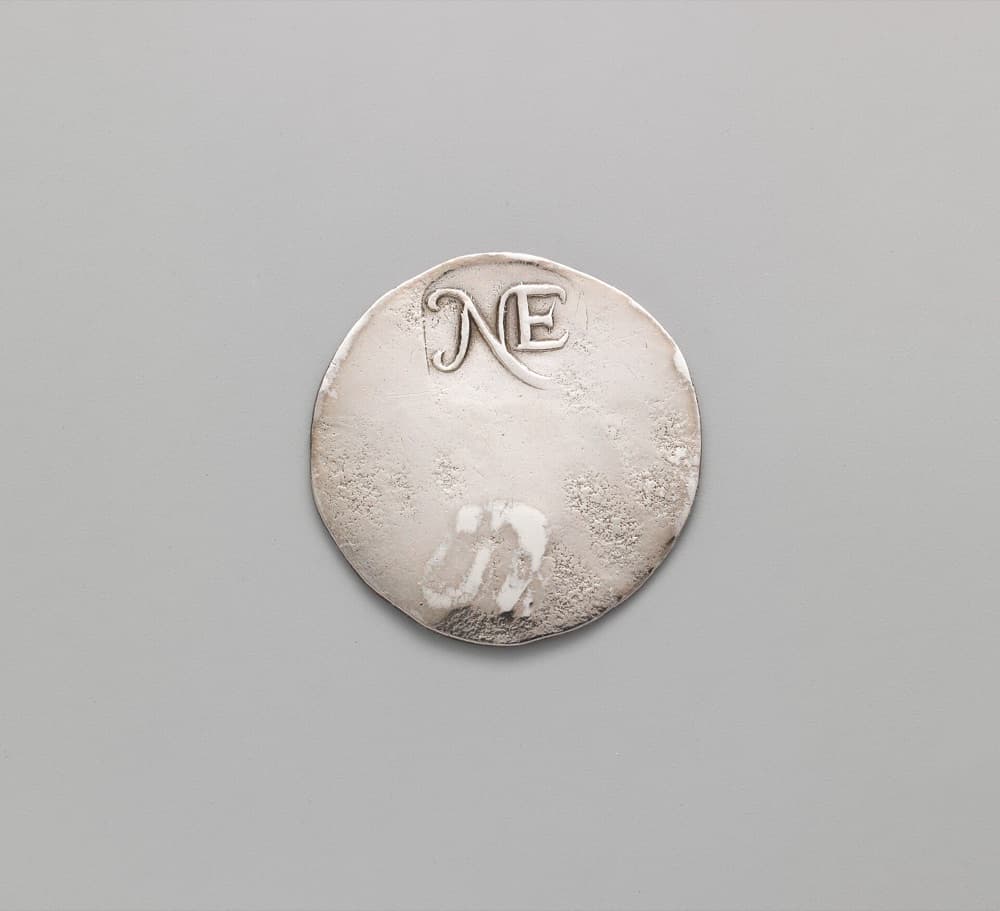
1652 New England (NE) Shilling
Two punch marks on a lumpy disk of silver, struck in Boston without the king's permission, made the New England shilling the first coin of what would become the United States, and only about 40 survive.
- Year
- 1652
- Maker
- Massachusetts Bay Colony (Boston mint, John Hull)
- By price in coins
- 58 of 100
Create a free account to see every recorded price and every grade.
Create a free account- Struck
- 1652, at the Boston mint of the Massachusetts Bay Colony, for a few months before the design was replaced
- Mintmasters
- Silversmith John Hull, with his partner Robert Sanderson (also spelled Saunderson)
- Design
- A punched "NE" for New England on one side and "XII" (12 pence) on the other; no date, no legend, no ruler's portrait
- Standard weight
- 72 grains of silver
- Known today
- About 40 examples in all grades, by a grading service's survival estimate and contemporary reports
- Varieties
- Six die varieties, catalogued by Sydney P. Noe with letter-number pairings such as Noe 1-A, II-A, III-B and III-C
- Finest certified
- NGC MS61, the only example graded Mint State by either major grading service; found in a candy tin in England
- Highest reported price
- $440,625 for a PCGS AU55 example, at auction on November 8, 2013
- Latest sales cited
- $192,000 and $60,000 for two examples at auction on November 19, 2024
A colony with no coins
For its first two decades the Massachusetts Bay Colony ran on barter and on whatever foreign coins drifted in: English, Spanish, Dutch and Portuguese pieces, plus counterfeits. English silver that arrived when merchants sold the colony's raw materials flowed straight back out when Bostonians bought English goods. The Smithsonian's National Museum of American History puts the problem plainly: England was not inclined to send gold and silver coins to the colonies, because they were in short supply at home.
In 1652 the Massachusetts General Court decided to make its own. It first asked the Boston silversmith John Hull to weigh, assay and countermark foreign coins, an idea Hull turned down because it would not pay. The court then authorized him to melt foreign silver and strike shillings, sixpences and threepences, appointed him mintmaster, and paid for tools and a mint house built on his land. Sources differ on the exact date of the authorization, giving May 26 or May 27, 1652.
The coins were legally dubious from the start. A legal coin had to be authorized by the Crown and carry the monarch's image; these had neither. But in 1652 England had no king. It was a republic under Oliver Cromwell, and as the colonists saw it there was no Crown to offend. The Smithsonian museum suggests the colony may have kept the date 1652 on its later coins so it could deny wrongdoing if the monarchy returned; a major grading service calls that a popular myth and says the date almost certainly refers to the year the court authorized the coinage.
The new money was deliberately light. One account gives the Massachusetts pieces as 22.5 percent smaller than the equivalent English sterling coins, and a grading service's history notes the shillings were valued by statute at 75 percent of an English shilling.
John Hull and Robert Sanderson
John Hull was born on December 18, 1624, in Market Harborough, Leicestershire, the son of a blacksmith. He sailed from Bristol with his family at age eleven and landed in Boston on November 7, 1635. After two years at Boston Latin School and a seven-year apprenticeship, he set up as a silversmith in a house and garden his father deeded him in 1646. In 1647 he married Judith Quincy, in a ceremony officiated by John Winthrop.
His partner Robert Sanderson worked beside him in the silver shop, and Sanderson's mark appears alongside Hull's on almost all of the shop's surviving pieces. One modern account suggests Sanderson may have been primarily responsible for actually producing the coins. The Smithsonian notes a family thread as well: Abigail Adams's great-grandfather was Hull's stepbrother.
The mint made Hull rich. He kept a seigniorage of one shilling and seven pence for every twenty shillings coined, in some years clearing more than 1,000 pounds, and the General Court tried at least seven times to renegotiate the arrangement. He went on to become a merchant shipping fish, furs and timber across the Atlantic, Boston's treasurer and later treasurer of the colony, and an early benefactor of Harvard College. His record also includes the slave trade: during King Philip's War he shipped Native American captives for sale in Spain, and as treasurer he recorded the sale of 185 people into slavery in 1676.
Hull died on October 1, 1683, and is buried in Boston's Granary Burying Ground. A legend popularized by Nathaniel Hawthorne has him giving his daughter Hannah her weight in pine tree shillings as a dowry when she married Samuel Sewall; the real dowry was 500 pounds, paid in two installments.
Reading a coin with almost nothing on it
A New England shilling is about as plain as a coin can be: an irregular disk of silver, not much larger than a U.S. quarter dollar, with a small "NE" punched near the edge on one side and "XII" (twelve pence) punched on the other. The punches were offset so that striking one side would not crush the other. There is no date, no legend and no border.
How they were made is still debated. The traditional account has blanks cut from strips of silver and weighed, with light blanks remelted and heavy ones clipped down to the standard 72 grains before punching. A newer theory holds that the strips were punched first and the coins cut out around the marks. The original legislation called for square coins and a privy mark; later legislation made them round, and no one has yet identified a privy mark on any surviving piece.
That simplicity was the design's undoing. Plain disks were easy to clip and to counterfeit, and in October 1652 the General Court ordered a more complicated design with a double ring of beads. The Willow Tree coinage followed, then the Oak Tree and finally the Pine Tree coins, until the mint closed in 1682. Accounts of how long the NE coins were struck differ slightly: one gives three months, another June to October 1652. A grading service also notes that some researchers believe at least one NE variety may have been made later, possibly illegally.
Collectors recognize six die varieties, all extremely rare, catalogued in Sydney P. Noe's study of Massachusetts silver and in later references. Auction records weigh survivors to the hundredth of a grain, and the best-documented examples run from about 70 to 72 grains.
A mint the Crown called treason
The monarchy did return, in 1660, and the Boston mint became plainly illegal. In 1665 the Privy Council ordered it to stop; the colony ignored the order. In 1674 Charles II created the Lords of Trade to oversee the colonies and sent Edward Randolph to investigate Massachusetts. Randolph counted the mint among the colony's offenses and in 1681 accused it of misdemeanors that amounted to high treason.
The Lords of Trade offered a way out: apologize, and put the king's face on the coins. The General Court refused for more than a year, scorning the royal stamp as a sign of the king's ownership of the colony. Coining ended in 1682, when Hull's contract expired and was not renewed, and in 1684 the colony's charter was annulled. Massachusetts was folded into the Dominion of New England under a royal governor.
The 1691 charter that followed specifically barred Massachusetts from coining money. Historians at Revolutionary Spaces, the Boston organization that stewards the Old State House, argue that the episode stayed in Massachusetts memory for a century and helped make the colony hypersensitive to royal overreach in the years before 1776.
Where the survivors have been
The coins were collected early. In 1781 the English collector Thomas Brand Hollis asked John Adams, then the American envoy in the Netherlands, for New England coins, and Adams wrote to Abigail asking for "a few of the New England shillings. Pray send me, half a dozen if you can procure them by different Occasions." Whether any reached Europe that way is not known.
Individual survivors can be followed for more than a century. One example was catalogued as "Very Fine" in the Richard B. Winsor collection sale of December 1895, where it brought $50; it later graded PCGS AU53 and sold at auction for $211,500 in March 2015, $186,000 in August 2019 and $174,000 in August 2023. Another passed from DeWitt Smith to Virgil Brand in 1908 and on through Waldo Newcomer, Carl Wurtzbach and F.C.C. Boyd to the John J. Ford Jr. collection. It brought $253,000 in October 2005 and $440,625 at auction on November 8, 2013, the auction record a grading service lists for the type, and it served as the plate coin in the standard references.
The finest of all turned up far from Boston. In 2021 the father of Wentworth Beaumont, a descendant of the early New England settler William Wentworth, found a candy tin full of coins at the family estate in Northumberland, England. Among them was an NE shilling. Graded MS61 by NGC, it is the only example either major grading service has called Mint State, and it sold at auction in London on November 26, 2021, for $351,912 (264,000 pounds) to an American buyer. The family believes an ancestor brought it back from America.
Recent prices have run below the 2010 to 2014 peaks: certified AU examples sold for $180,000 in 2021 and $156,000 in 2023, and two shillings brought $192,000 and $60,000 at auction on November 19, 2024. That same day a newly discovered NE threepence from the same 1652 issue sold for $2,520,000, a record for any American coin struck before the Revolution.
Why it matters
The NE shilling belongs to the first silver coinage ever struck on American soil, the opening chapter of coinage in what would become the United States. Its sister threepence is far rarer: one example has been at the Massachusetts Historical Society since 1905, one at Yale was lost before the mid-20th century, and a third was found in an old cabinet in the Netherlands and identified only in 2020.
Its rarity is easy to explain. The coins were struck for a few months at most, quickly replaced, and then spent, clipped and melted for decades. A grading service estimates about 40 survive in all grades, with none in Mint State by its own count, against a single NGC MS61. Even Andy Hain, who built one of the finest collections of Massachusetts silver, was able to find only two of the six varieties.
The numbers
- Mintage
- Not recorded
- Known survivors
- About 40 in all grades
- Weight
- 72 grains standard; documented survivors weigh about 70 to 72 grains
- Size
- Irregular; not much larger than a U.S. quarter dollar
- Composition
- Silver, coined from melted foreign coins
- Denomination
- Twelve pence (XII), valued by statute at 75% of an English shilling
- Makers
- John Hull and Robert Sanderson
- Mint
- Boston, Massachusetts Bay Colony
- Varieties
- Six known die varieties
Timeline
King Charles I charters the Massachusetts Bay Colony.
Eleven-year-old John Hull arrives in Boston with his family.
Hull marries Judith Quincy; John Winthrop officiates.
The Massachusetts General Court authorizes Hull to coin shillings, sixpences and threepences (sources give May 26 or May 27).
Hull and Robert Sanderson strike the first NE shillings, sixpences and threepences in Boston.
The General Court orders a more complex design with a beaded border; the Willow Tree type replaces the NE coins.
The Privy Council orders the Boston mint to stop; the colony ignores it.
Edward Randolph accuses Massachusetts of conduct amounting to high treason, the mint among its offenses.
Coining ends when Hull's contract expires and is not renewed.
John Hull dies in Boston.
The Massachusetts Bay charter is annulled.
John Adams asks Abigail to send him half a dozen New England shillings for an English collector.
An NE shilling sells for $50 in the Richard B. Winsor collection sale.
The Massachusetts Historical Society's NE threepence enters its collection.
Three NE shillings from the John J. Ford Jr. collection sell at auction.
The Ford example, graded PCGS AU55, brings $440,625 at auction.
The candy-tin shilling, graded NGC MS61, sells in London for $351,912.
Two NE shillings sell for $192,000 and $60,000 at auction; an NE threepence in the same sale brings $2,520,000.
The world in 1652
Samuel Sewall, the future judge who would marry John Hull's daughter Hannah, is born in England.
Jan van Riebeeck founds a Dutch East India Company supply camp at the Cape of Good Hope, the start of Cape Town.
Rhode Island passes the first law in North America making slavery illegal.
George Fox preaches on Firbank Fell in England, a founding moment for the Quakers.
Maryland and the Conestoga sign articles of peace ceding most of the land around the Chesapeake Bay.
The First Anglo-Dutch War formally begins as the English Commonwealth declares war on the Dutch Republic.
Price record
| Date | Price | Kind |
|---|---|---|
| Dec 1895 | $50 | Sold at auctionRichard B. Winsor collection, catalogued as Very Fine; later graded PCGS AU53. |
| Aug 9, 1989 | $16,500 | Private saleSold privately by collector Bertram Cohen; the coin later graded PCGS AU50. |
| Oct 2005 | $253,000 | Sold at auctionJohn J. Ford Jr. collection; Noe 1-A, later PCGS AU55. |
| Oct 2005 | $322,000 | Sold at auctionJohn J. Ford Jr. collection; Noe III-C, later PCGS AU50. |
| Oct 14, 2005 | $345,000 | Sold at auctionJohn J. Ford Jr. collection; Noe 3-B, later PCGS AU55. |
| Jan 2008 | $373,750 | Sold at auctionPCGS AU50, Noe III-C (the Ford coin). |
| Sep 2009 | $335,000 | Asking price, not a saleThe same Ford PCGS AU50, offered by a dealer. |
| Aug 11, 2010 | $416,875 | Sold at auctionPCGS AU50 CAC, Noe III-C (the Ford coin). |
| Nov 8, 2013 | $440,625 | Sold at auctionPCGS AU55, Noe 1-A; Ford and Sundman collections; the auction record listed for the type. |
| May 16, 2014 | $352,500 | Sold at auctionNGC AU55, Noe 1-A; Eric P. Newman collection. |
| Jan 7, 2015 | $293,750 | Sold at auctionNGC AU58 CAC, Noe 3-B; Donald G. Partrick collection. |
| Jan 7, 2015 | $188,000 | Sold at auctionNGC AU50, Noe 1-A; Partrick collection. |
| Jan 7, 2015 | $129,250 | Sold at auctionNGC-graded Very Fine example. |
| Mar 26, 2015 | $211,500 | Sold at auctionPCGS AU55, Noe III-B; Henry P. Kendall Foundation collection. |
| Mar 26, 2015 | $211,500 | Sold at auctionPCGS AU53 CAC, Noe II-A; Kendall Foundation collection (the Winsor coin). |
| Mar 26, 2015 | $152,750 | Sold at auctionPCGS-graded Very Fine example. |
| Jan 4, 2017 | $141,000 | Sold at auctionPCGS-graded Very Fine example. |
| Oct 30, 2018 | $204,000 | Sold at auctionPCGS AU50, Noe 1-A. |
| Aug 18, 2019 | $186,000 | Sold at auctionPCGS AU53 CAC, Noe II-A (the Winsor coin). |
| Jan 12, 2020 | $186,000 | Sold at auctionPCGS AU53, Noe 3-B; Alan B. Weinberg collection. |
| Feb 25, 2021 | $180,000 | Sold at auctionPCGS AU50, Noe 1-A. |
| Nov 26, 2021 | $351,912 | Sold at auctionNGC MS61, the candy-tin coin; sold in London for 264,000 pounds including premium. |
| Mar 29, 2023 | $156,000 | Sold at auctionPCGS AU50, Noe 1-A. |
| Aug 24, 2023 | $174,000 | Sold at auctionPCGS AU53 CAC, Noe II-A (the Winsor coin). |
| Nov 19, 2024 | $192,000 | Sold at auctionOne of two NE shillings in the same sale. |
| Nov 19, 2024 | $60,000 | Sold at auctionThe second NE shilling in the same sale. |
A realized auction price is what a buyer actually paid on the date shown, including the buyer's premium where the sale reported it. It is the strongest kind of reference price, and it is a record of one sale of one object on one day, not a promise of what the next example will bring.
By reference price, 1652 New England (NE) Shilling is number 58 of 100 in the coins entries of the FLOAT 100. 96 of those 100 rest on a realized sale; the rest carry an asking price or a guide value, and each page says which. Rank within the FLOAT 100 itself (26 here) is editorial: how much an object defines its field, not price alone.
Did you know
- The finest known New England shilling, and the only one graded Mint State, turned up in a candy tin in an English country house in 2021.
- In 1781 John Adams asked Abigail to send him half a dozen New England shillings for an English collector.
- The law that created the coins originally called for them to be square.
- The dated coins of the Boston mint carried 1652 for some 30 years; only a twopence of 1662 broke the pattern.
- John Hull kept one shilling and seven pence of every twenty shillings he coined, and the legislature tried at least seven times to cut his share.
- Hull married into the Quincy family, and the only NE threepence in private hands is traced to the Quincys of Boston.
How this page is made
- The figure
- One reference price, shown with its own kind. FLOAT does not average it with anything or adjust it for time.
- Realized or not
- A realized price is a completed sale. An asking price, an estimate and a price-guide value are not sales, and are labeled as such wherever they appear.
- The story
- Researched from published records and checked fact by fact. Updated Oct 1, 2026.
- Archive
- Oct 5, 2026