FLOAT 100 · Coins · No. 27
1955 Doubled Die Obverse Lincoln Cent
One badly made die at the Philadelphia Mint, a Mint decision to let its output go, and cigarette machines that gave change in pennies turned an ordinary 1955 cent into the coin that taught America to look twice at its pocket change.
- Year
- 1955
- Maker
- U.S. Mint (Philadelphia)
- By price in coins
- 89 of 100
Create a free account to see every recorded price and every grade.
Create a free account- Struck
- 1955, Philadelphia Mint, from a single misaligned obverse die
- How many
- About 40,000 struck in one shift, by the most cited account; about 24,000 released (estimates run from 20,000 to 24,000)
- What to look for
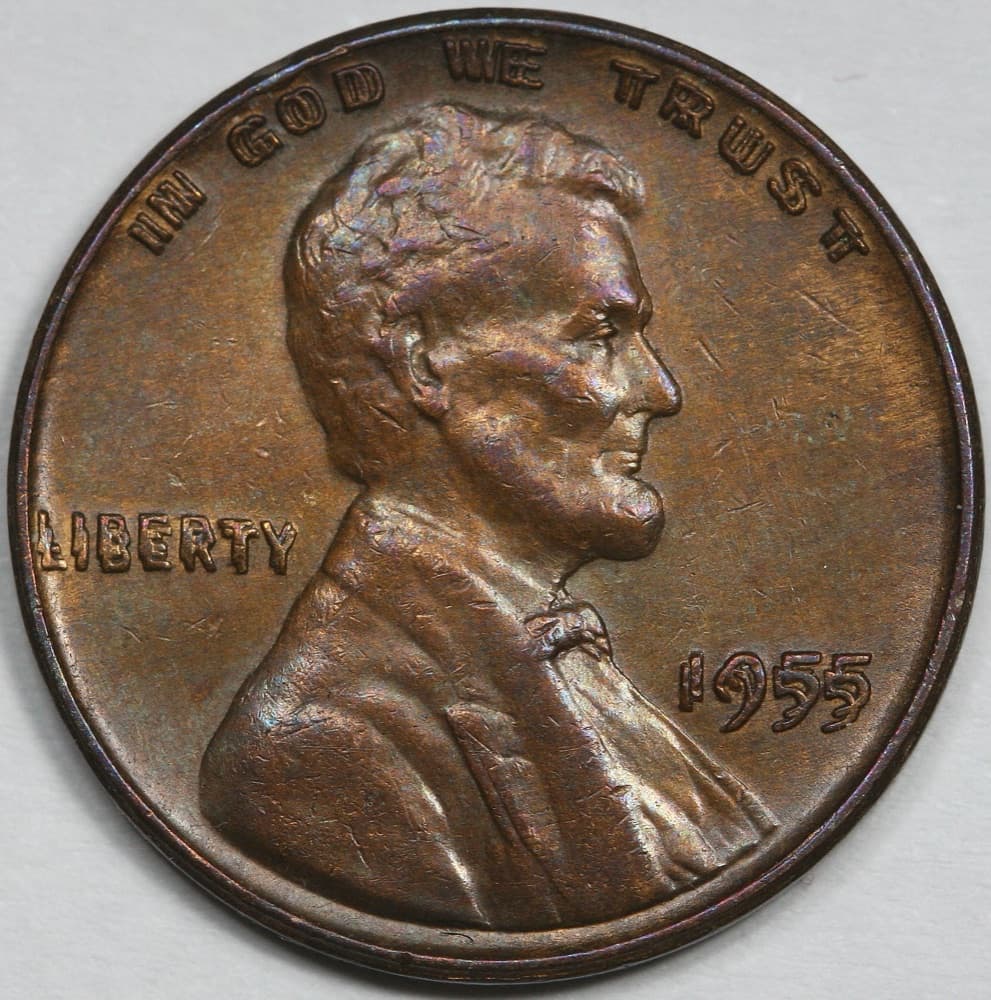
- Bold, widely spread doubling on the date, LIBERTY and IN GOD WE TRUST, visible without magnification
- Reverse diagnostics
- Reverse die misaligned by about 5%; fine vertical polishing lines to the left of the T in ONE CENT
- Attribution
- FS-101 doubled die obverse; certified in Brown, Red-Brown and Red color grades
- Designer
- Victor David Brenner (Lincoln cent, 1909)
- Where they turned up
- Mostly the Northeast: Boston and Pittsfield, Massachusetts, and Endicott, Johnson City and Binghamton, New York
- Highest reported price
- $320,625 for the finest PCGS MS65+ Red example, February 23, 2025
- This entry
- PCGS MS64 Red, a near-gem example with full original color; such coins sold for $8,540 and $18,300 in spring 2026
One bad die
In the 1950s the Mint made each working die by pressing a hub, a steel positive of the design, into a blank die more than once. If the die shifted or rotated slightly between impressions, the design came out twice, a little apart. That is what happened to one obverse die at the Philadelphia Mint in 1955. The result is true hub doubling, not the flat, shelf-like look of machine doubling or the smeared look of a worn die: the date, LIBERTY and IN GOD WE TRUST all appear twice, cleanly and boldly. Lincoln's bust shows very little doubling.
The die went into a coining press and ran. Q. David Bowers, who asked the Mint about it, wrote that several presses were dumping cents into a box where their output was mixed. Late in the afternoon an inspector noticed the doubled coins and pulled the die. By then somewhat more than 40,000 had been struck, about 24,000 of which were already mixed with normal cents. Another account says the coins were struck during one night shift; the timing differs between tellings.
The Mint destroyed the coins still in the bin and released the mixed ones. Bowers reported the reasoning: the Mint had no reason to think anyone would care, and saw them simply as defective coins. The Lincoln cent columnist Sol Taylor wrote that they were let go partly because of a cent shortage after Hurricanes Connie and Diane tore through the Atlantic coast that summer. One auction description, citing Bowers, says production schedules prevented the coins' destruction once they were mixed.
Cigarette cents
The coins went into circulation in the Northeast, especially around Boston and Pittsfield, Massachusetts, and Endicott, Johnson City and Binghamton. Many traveled an unusual route. A pack of cigarettes cost 23 cents, but vending machines took only quarters and could not make change, so distributors tucked two pennies inside the cellophane of each pack. Many 1955 doubled die cents reached the public that way, and collectors still call them cigarette cents.
The timing could hardly have been better. Coin collecting was growing fast in the mid-1950s, and here was a mistake anyone could see without a magnifier. The earliest commonly cited printed report is in the January 1956 Numismatic Scrapbook Magazine, in an article credited to Ameil Druila and W. S. Meadows; Bowers recalled that some first called it a "shift cent."
Two dealers turned the find into a market. James F. Ruddy advertised in Johnson City that he would pay 25 cents apiece, 25 times face value, and was quickly swamped. Bowers, his future business partner, set up a company, Endwell-Union Company, Inc., to buy and sell the coins and keep a two-way market, and the pair later offered $7.95 each.
How to tell a real one
The doubling should be bold and widely separated on all of the date, LIBERTY and IN GOD WE TRUST. Because one pair of dies made every example, genuine coins share reverse markers too: the reverse is misaligned by about 5 percent, and fine vertical die polishing lines run to the left of the T in ONE CENT.
Fakes are a constant problem. The 1955 doubled die is heavily counterfeited, and a much more common "poor man's doubled die" from a worn 1955 die shows a doubled-looking final digit and sells for a few dollars. A smaller doubled die also exists from the Denver Mint in 1955, but its doubling is far less obvious. Specialists advise buying only certified examples.
Grade and color drive the price. Copper cents are certified as Brown, Red-Brown or Red, and because so many of these circulated for years before anyone noticed, a grading service notes that nearly 70 percent of its certified Brown examples fall in Extremely Fine to About Uncirculated grades. Its estimates put about 7,000 in Mint State, with perhaps 1,200 still Red and only a couple of hundred at MS65 or better in any color.
This entry is a PCGS MS64 Red example: uncirculated, with full original red color, one step below gem. A grading-service commentary prices such a coin at $15,000 or more; in practice, PCGS MS64 Red examples brought $8,540 in April 2026 and $18,300 in May 2026 at auction. An MS64 Red example from the Jack Lee estate collection sold for $8,838 in February 2009.
From 25 cents to $320,625
The price has climbed steadily. Within a few years of release the coin sold for $7.95; by the 1980s examples brought upward of $250. After third-party grading arrived in the late 1980s, top examples rose dramatically, reaching nearly $60,000 for a strong MS65 Red in 2001. An MS65 Red brought $37,600 at a coin show auction in January 2016.
The top of the market belongs to a handful of MS65+ Red coins. The example from the ESM Collection sold for $114,000 on March 22, 2018, a figure some sources still describe as the record. On March 1, 2020, the single PCGS MS65+ Red with CAC approval sold online for $124,875 after 53 bids, described at the time as a world record.
Then came the collection of Stewart Blay, a New York sculptor who had collected Lincoln cents since he was eight and spent 50 years assembling the finest set. He died in late November 2022, aged 71, shortly before his coins were sold. In January 2023 his PCGS MS65+ Red doubled die realized $287,156.25, more than double the previous record. The same coin, carrying a green CAC sticker, sold again on February 23, 2025, for $320,625.
Below the top, the coin trades in the thousands. Examples up to PCGS AU58 Brown typically change hands for $2,500 to $3,000; a PCGS AU58 Brown brought $2,520 in June 2025, an NGC MS65 Red $20,400 in June 2024, a PCGS MS65 Red with CAC approval $90,000 on January 16, 2025, and an NGC MS66 Red-Brown $19,200 in summer 2025.
The coin that made varieties mainstream
It was not the first doubled die the Mint ever made, but it is widely regarded as the first error coin collected by mainstream collectors, and many consider it the most popular die variety in American numismatics. It sent millions of people searching through their change, and doubled dies as a class became famous after it.
It also lives in popular culture. A "1955 doubled die Denver mint penny" drives the plot of the film UHF, though the dramatic doubling is a Philadelphia coin, and the coin is mentioned in Stephen King's 2010 novella A Good Marriage. Seventy years on, for serious Lincoln cent collectors adding one is a rite of passage.
The numbers
- Mintage
- About 40,000 doubled die cents struck; about 20,000 to 24,000 released
- Known survivors
- Estimates conflict: 3,000 to 4,000 (experts cited in a 2011 auction description), "a few thousand," or about 15,000 (a 2025 grading-service article gives both of the last two)
- Survivors with full red color
- About 1,200, with about 75 at MS65 Red or better (grading-service estimate)
- Weight
- 3.11 grams
- Diameter
- 19.00 mm
- Composition
- 95% copper, 5% tin and zinc
- Edge
- Plain
- Designer
- Victor David Brenner
- Mint
- Philadelphia (no mintmark)
Timeline
The Lincoln cent, designed by Victor David Brenner, is introduced for the centennial of Lincoln's birth.
A misaligned obverse die strikes about 40,000 doubled cents at the Philadelphia Mint; about 24,000 are released mixed with normal cents.
Hurricanes Connie and Diane strike the East Coast; one account credits the resulting cent shortage for the Mint's decision to release the coins.
Numismatic Scrapbook Magazine carries the earliest commonly cited published report of the coin.
A strong MS65 Red example sells for nearly $60,000.
The Jack Lee estate's PCGS MS64 Red example sells for $8,838.
An MS65 Red example brings $37,600 at a coin show auction.
The ESM Collection's PCGS MS65+ Red sells for $114,000.
The single PCGS MS65+ Red with CAC approval sells online for $124,875 after 53 bids.
Stewart Blay's PCGS MS65+ Red realizes $287,156.25, more than double the prior record.
A PCGS MS65 Red with CAC approval brings $90,000.
The Blay coin resells for $320,625, the highest price reported for the variety.
The 1955 doubled die turns 70.
A PCGS MS64 Red example brings $18,300 at auction.
The world in 1955
Jonas Salk's polio vaccine receives full approval from the Food and Drug Administration.
Ray Kroc opens the first franchised McDonald's in Des Plaines, Illinois.
Disneyland opens in Anaheim, California, broadcast on national television.
Hurricane Diane hits the northeastern United States, killing more than 200 people.
President Eisenhower suffers a heart attack while on vacation in Denver.
Rosa Parks is arrested in Montgomery, Alabama, starting the Montgomery bus boycott.
The AFL and CIO merge to form the AFL-CIO.
Price record
| Date | Price | Kind |
|---|---|---|
| Feb 2009 | $8,838 | Sold at auctionPCGS MS64 Red, Jack Lee estate collection. |
| Jan 7, 2016 | $37,600 | Sold at auctionPCGS MS65 Red, at a coin show auction. |
| Mar 22, 2018 | $114,000 | Sold at auctionPCGS MS65+ Red CAC, ESM Collection. |
| Mar 1, 2020 | $124,875 | Sold at auctionPCGS MS65+ Red CAC, sold online after 53 bids; reported then as a world record. |
| Jan 2023 | $287,156 | Sold at auctionPCGS MS65+ Red, Stewart Blay collection ($287,156.25). |
| Jun 2024 | $20,400 | Sold at auctionNGC MS65 Red. |
| Jan 16, 2025 | $90,000 | Sold at auctionPCGS MS65 Red, older green-label holder, CAC approved. |
| Feb 23, 2025 | $320,625 | Sold at auctionPCGS MS65+ Red with green CAC sticker, ex Stewart Blay. |
| Jun 2025 | $2,520 | Sold at auctionPCGS AU58 Brown. |
| Apr 2026 | $8,540 | Sold at auctionPCGS MS64 Red. |
| May 2026 | $18,300 | Sold at auctionPCGS MS64 Red. |
| Jun 2026 | $14,640 | Sold at auctionPCGS MS64 Red-Brown. |
A realized auction price is what a buyer actually paid on the date shown, including the buyer's premium where the sale reported it. It is the strongest kind of reference price, and it is a record of one sale of one object on one day, not a promise of what the next example will bring.
By reference price, 1955 Doubled Die Obverse Lincoln Cent is number 89 of 100 in the coins entries of the FLOAT 100. 96 of those 100 rest on a realized sale; the rest carry an asking price or a guide value, and each page says which. Rank within the FLOAT 100 itself (27 here) is editorial: how much an object defines its field, not price alone.
Did you know
- Many of the coins reached the public as change tucked inside 23-cent packs of cigarettes from vending machines that took only quarters.
- The first dealer to advertise for them offered 25 cents apiece and was swamped with coins.
- The finest known example sold for $287,156.25 in 2023 and then for $320,625 two years later.
- About 16,000 more doubled cents were caught in the press operator's bin and destroyed before release.
- A "1955 doubled die Denver mint penny" is a plot device in the film UHF, though the famous variety comes from Philadelphia.
- A worn-die look-alike, the "poor man's doubled die," sells for only a few dollars.
How this page is made
- The figure
- One reference price, shown with its own kind. FLOAT does not average it with anything or adjust it for time.
- Realized or not
- A realized price is a completed sale. An asking price, an estimate and a price-guide value are not sales, and are labeled as such wherever they appear.
- The story
- Researched from published records and checked fact by fact. Updated Oct 1, 2026.
- Archive
- Oct 5, 2026