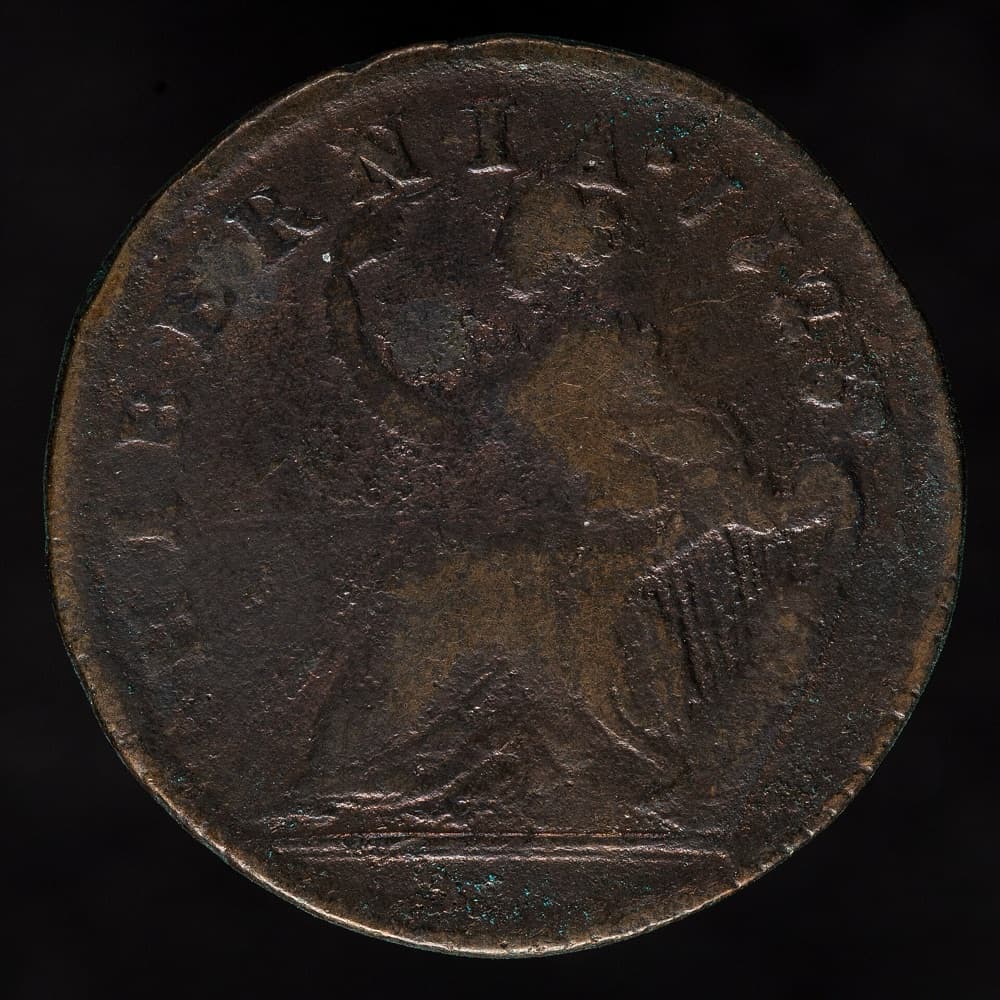
FLOAT 100 · Coins · No. 54
1723 Wood's Hibernia Halfpenny
A royal mistress sold the right to make Ireland's small change to an English ironmaster, Jonathan Swift wrote a nation into revolt against it, and the copper that Ireland refused has been collected ever since as early American money.
- Year
- 1723
- Maker
- William Wood (under royal patent, for Ireland/colonies)
- By price in coins
- 100 of 100
Create a free account to see every recorded price and every grade.
Create a free account- Struck
- 1723, under a royal patent held by William Wood of Wolverhampton; minting places in England are disputed (London, and possibly Bristol)
- Denomination
- Halfpenny, copper, for circulation in Ireland
- Obverse
- Laureate bust of King George I facing right, GEORGIUS DEI GRATIA REX
- Reverse
- Hibernia seated, holding a palm branch and leaning on a harp, with HIBERNIA and the date
- The patent
- Dated June 16, 1722: up to 360 tons of halfpence and farthings over 14 years, for a £800 annual fee to the king
- Bought for
- £10,000, paid by Wood to the Duchess of Kendal, King George I's mistress, who had obtained the patent
- Opposed by
- Jonathan Swift, writing as "M. B. Drapier" in the Drapier's Letters of 1724 and 1725
- Withdrawn
- Patent canceled in 1725; Wood was compensated with a pension of £3,000 a year
- This entry
- The 1723 halfpenny in choice Mint State (MS63 to MS65, Brown or Red Brown), attributed by Sydney Martin's die varieties
- Recent Gem sales
- MS65 Brown examples brought $1,140 to $1,769 at auction in 2025 and 2026
A patent with a price tag
In the first half of 1722, the Duchess of Kendal, mistress of King George I, obtained a patent from the Earl of Sunderland to coin copper money for Ireland. It was, in the words of one account, a way of providing her with something to live on after the king's death. She did not intend to make coins herself. She sold the patent for £10,000 to William Wood, an English hardware maker and ironmaster who thought the venture would pay. In A History of Ireland in 100 Objects, Fintan O'Toole called the deal a classic episode of 18th-century sleaze, with sex and money nicely intertwined.
Wood's indenture from the king, dated June 16, 1722, let him produce up to 360 tons of halfpence and farthings for Ireland at 30 pence to the pound of copper, over fourteen years, for an annual fee of £800 to the Crown. The face value of the whole issue is usually given as £100,800; one modern collector guide gives £108,000.
The coins were generous. Hibernia halfpence were struck at sixty to the pound, heavier than the coppers then circulating in Ireland and twice the weight of Wood's lighter Rosa Americana pieces made for the American colonies at about the same time. The numismatist Philip Mossman calculated that, after production costs and the £10,000 paid to the duchess, Wood would have lost £4,871 over the life of the patent. Critics assumed the only way he could profit was by cheating on weight or quality.
Where the coins were struck is not settled. One account places the mint in Phoenix Street, Seven Dials, London, from January 1722. Documents quoted by the University of Notre Dame's coin collection point to London and Bristol and suggest striking did not begin until 1723.
William Wood, ironmaster
William Wood was born in Wolverhampton in 1671, the son of a silk weaver. He married Margaret Molineaux, daughter of a Willenhall ironmonger, in 1690, went into business with her father, and raised 14 children in a large Wolverhampton house called The Deanery. From 1714 he built a network of ironworks partnerships across the Midlands and Wales, and by 1723 he also ran the Falcon Iron Foundry in Southwark.
The Irish patent made him the most hated coiner in Ireland. Swift's first anonymous verse attack called him "Grazier, Tinker, Hard-Ware Man, Coiner, Counterfeiter, Founder and Esquire." Even his Dublin brothers-in-law, the ironmongers John and Daniel Molyneux, publicly disclaimed any connection with his coinage in 1723.
After losing the patent, Wood turned to a new process for making iron with mineral coal, invented by his son Francis and re-patented by Wood himself in 1728. He built large works on Frizington Moor near Whitehaven, but the company financing him received only about 10 tons of his iron. His plan for a million-pound Company of Ironmasters of Great Britain was under investigation by the Privy Council when he died on August 2, 1730. One historian has called that venture the Frizington Fraud.
Swift, the Drapier, and a kingdom that said no
Ireland's leaders objected from the start. In July 1722 William King, Anglican archbishop of Dublin, warned that the coinage would drain the kingdom of the little gold and silver left in it. The Irish revenue commissioners said there was no shortage of small change. In September 1723 the Irish Parliament sent the king an address protesting the coins and the "Clandestine and Unpresedented manner" in which Wood had obtained his patent. Ballads, pamphlets and even puppet shows mocked the scheme.
The campaign found its genius in Jonathan Swift, dean of St Patrick's Cathedral in Dublin. Writing as "M. B. Drapier," an ordinary Dublin cloth merchant, he published the first letter, addressed to the shopkeepers, tradesmen, farmers and common people of Ireland, in March 1724; by April he claimed more than 2,000 copies had sold in Dublin. The second letter followed on August 4, 1724, and on August 17 a group of Dublin bankers signed an agreement refusing to accept the coin. A third came on August 25.
London tried to calm things. Sir Isaac Newton, Master of the Mint, assayed sample coins and reported the copper was "of the same goodness and value" as England's own. Swift's side answered that Wood had chosen the coins Newton tested. Wood offered to cut the issue from £100,800 to £40,000 and to limit how many halfpence anyone had to accept in a single payment. None of it worked.
Swift's fourth letter, To the Whole People of Ireland, appeared around October 22, 1724, the day the new lord lieutenant, Lord Carteret, arrived in Dublin. It turned a dispute about copper into an argument about Ireland's constitutional standing: "You ARE, and OUGHT to be as FREE a People as your Brethren in England." Carteret called passages of it treasonable. The printer John Harding was arrested and a £300 reward was offered for the Drapier's identity. Nobody claimed it. Another anonymous paper by Swift urged the Dublin grand jury to stand up to the chief justice, and Harding was released.
In 1725 the government gave way and the patent was withdrawn. Wood received a pension of £3,000 a year for eight years, though he lived to collect it for only three. The blind harper Turlough O'Carolan marked the defeat with a tune called Squire Wood's Lamentation on the Refusal of his Halfpence.
Did Ireland's rejected coppers become American money?
Collectors of American colonial coins have long counted Wood's Hibernia pieces as part of their series, on the theory that the coppers Ireland refused were sent across the Atlantic. The record is genuinely contested.
The numismatic historian Brian Danforth argued that the coins were in fact accepted in coin-starved Ireland at first and stayed in use there until 1737, when regal Irish coppers replaced them. He traced their movement to America through trade and emigration: Irish emigrants in the famine of the late 1720s and again in the mid-1730s carried copper because it was compact and valuable, and once a new royal copper coinage for Ireland was announced in 1736, Wood's coins were shipped to the colonies in bulk, especially to New York and the other Middle Colonies that traded most with Ireland.
Philip Mossman reached the opposite conclusion, writing that "there is no evidence of any substantial colonial circulation for these coppers," and suggesting some reached the United States only in the early 1800s alongside English trade tokens. The Notre Dame collection's summary sides with him and notes that very few Wood's Hibernias have been found in Ireland either.
Some certainly made the crossing. On July 20, 2012, an archaeological dig on Huguenot Street in New Paltz, New York, turned up a corroded 1723 Hibernia halfpenny in the ground between two of the street's historic stone houses.
Identifying a 1723 halfpenny
The 1723 halfpenny shows George I's laureate bust facing right with the legend GEORGIUS DEI GRATIA REX. On the reverse, Hibernia, the personification of Ireland, sits holding a palm branch in her right hand and leaning on a harp behind her, with HIBERNIA and the date. Most 1722 coins show her playing a harp placed to the left instead; all 1723 and 1724 coins use the palm-branch design. The coin is about the size of a modern U.S. quarter.
The striking thing to specialists is how many dies were used. Hibernia's figure was punched into each die with a blank harp, and the engravers cut the strings by hand, so the count of strings varies. Different letter punches, stops, star ornaments and die states multiply the possibilities. Sydney Martin's studies, published in the 1990s and in his 2007 book on the Hibernia coinage, assign each coin a number such as Martin 4.34-Gb.3; one estimate put the total number of halfpenny varieties at 200 to 400. Rare die marriages can sell for many times the price of a common one, even in worn condition: a Very Fine 1723 halfpenny of an unlisted variety, with a small star before the date, brought $12,925 in 2013.
The year 1723 is the commonly encountered Hibernia halfpenny, but most survivors are worn. Gem examples with original mint color are scarce. In 2014 one grading service had awarded Gem status to just six 1723 halfpence in all color grades. Among the finest pedigreed pieces is an MS65 Brown coin that belonged to Colonel E.H.R. Green and then to Eric P. Newman, whose records show he paid $3.00 for it; it was sold from his collection in New York in May 2014.
Weights vary. A collectors' catalog lists the type at about 7 grams and 27.5 millimeters in copper, while individual 1723 coins have been recorded at 129.3 grains and at 109 grains.
A small coin with a long reach
The affair of Wood's halfpence is remembered in Ireland less as a coinage than as a political awakening. The National Museum of Ireland's halfpenny was chosen as one of the objects in A History of Ireland in 100 Objects, where O'Toole argued that the Drapier's idea of Ireland as a free and equal kingdom had an ambiguous life in Protestant Ireland but "a more potent one in America." Swift's admirers called him the Hibernian Patriot, and the complete Drapier's Letters were first collected and published in Dublin in 1735.
For collectors, the 1723 halfpenny remains one of the most available ways to own a coin tied to colonial America, and one of the deepest variety series in early copper. Ordinary circulated pieces trade for modest sums, while gems and rare die marriages draw specialist competition.
The numbers
- Mintage
- Not recorded by year. The patent allowed up to 360 tons of halfpence and farthings (about £100,800 face value; one guide says £108,000), later offered at £40,000
- Known survivors
- No census of survivors; 1723 is the most commonly encountered Hibernia halfpenny, but Gem Mint State pieces are scarce
- Weight
- About 7 g by one catalog, struck at 60 halfpence to the pound; individual coins recorded at 109 and 129.3 grains
- Diameter
- About 27.5 mm, roughly the size of a U.S. quarter
- Composition
- Copper
- Designer
- Engraver not recorded in the sources consulted; struck under William Wood's patent
- Varieties
- Martin identified 10 obverse and 17 reverse halfpenny dies across 1722 to 1724; total varieties estimated at 200 to 400
Timeline
William Wood is born in Wolverhampton.
The Duchess of Kendal obtains a patent to coin copper for Ireland and sells it to Wood for £10,000.
George I's indenture authorizes Wood to coin up to 360 tons of halfpence and farthings over 14 years.
Archbishop William King of Dublin warns that the coinage will drain Ireland of gold and silver.
The 1723 Hibernia halfpenny is struck, with Hibernia holding a palm branch beside her harp.
The Irish Parliament addresses the king against the coinage.
Swift's first Drapier's Letter is printed in Dublin.
The second Drapier's Letter attacks the Privy Council's defense of the coin.
Dublin bankers sign an agreement refusing to accept Wood's coin.
Lord Carteret arrives in Dublin as the fourth letter circulates; the printer is arrested and a £300 reward is offered for the author.
The fifth Drapier's Letter is published.
Wood's patent is withdrawn; he is compensated with a £3,000 annual pension.
William Wood dies.
The Drapier's Letters are first published as a collection in Dublin.
A new royal copper coinage for Ireland is announced; by one account Wood's coins are then shipped to America in bulk.
By one account, Wood's coppers remain in use in Ireland until replaced by regal coppers this year.
Sydney Martin publishes his analysis and categorization of Wood's Hibernia halfpence.
Martin publishes his book on the Hibernia coinage of William Wood.
A 1723 Hibernia halfpenny is excavated on Huguenot Street in New Paltz, New York.
Eric P. Newman's MS65 Brown 1723 halfpenny, ex Colonel E.H.R. Green, is sold at auction in New York.
The world in 1723
Sir Christopher Wren, architect of St Paul's Cathedral, dies in London.
Parliament passes the Black Act, making poaching a capital offense.
Christopher Layer is executed for his part in the Jacobite Atterbury Plot.
Economist Adam Smith is born in Scotland.
Painter Joshua Reynolds is born.
Britain signs the Treaty of Charlottenburg with Prussia.
Robert Walpole, the Whig leader who defended Wood's patent, heads the British government.
Price record
| Date | Price | Kind |
|---|---|---|
| Feb 2013 | $12,925 | Sold at auctionVF35 (PCGS), an unlisted die variety with a star before the date, at auction in Baltimore. Not Mint State; for context. |
| Jul 2013 | $1,058 | Sold at auctionMS65 Brown (PCGS). A second MS65 Brown in the same sale brought the same price. |
| Nov 2023 | $6,600 | Sold at auctionThe same unlisted-variety VF35 coin sold in 2013, resold. |
| Apr 2025 | $192 | Sold at auctionXF45 Brown (NGC). |
| Apr 2025 | $168 | Sold at auctionXF40 Brown (NGC). |
| May 2025 | $360 | Sold at auctionMS63 Brown (PCGS). A second MS63 Brown in the same sale also brought $360. |
| Jul 2025 | $3,120 | Sold at auctionMS66 (PCGS). Finer than this entry's grade range. |
| Aug 2025 | $1,380 | Sold at auctionMS65 Brown (PCGS), Martin die variety. |
| Sep 2025 | $480 | Sold at auctionMS63 Brown (PCGS). |
| Nov 2025 | $1,140 | Sold at auctionMS65 Brown (PCGS). |
| Nov 2025 | $528 | Sold at auctionMS62 Brown (PCGS). |
| Nov 2025 | $312 | Sold at auctionAU55 Brown (PCGS). |
| Jan 2026 | $1,586 | Sold at auctionMS64+ Red Brown (PCGS). |
| Mar 2026 | $288 | Sold at auctionAU53 Brown (PCGS). |
| May 2026 | $4,392 | Sold at auctionMS66 Brown (PCGS), Martin die variety. Finer than this entry's grade range. |
| May 2026 | $4,148 | Sold at auctionMS66 Brown (PCGS), Martin die variety. Finer than this entry's grade range. |
| May 2026 | $2,318 | Sold at auctionMS64 Brown (PCGS), Martin die variety. |
| May 2026 | $1,769 | Sold at auctionMS65 Brown (PCGS), Martin die variety. |
| Jun 2026 | $512 | Sold at auctionMS63 Brown (PCGS). |
| Jun 2026 | $293 | Sold at auctionAU55 Brown (PCGS). |
| Jul 2026 | $512 | Sold at auctionAU55 Brown (PCGS). |
A realized auction price is what a buyer actually paid on the date shown, including the buyer's premium where the sale reported it. It is the strongest kind of reference price, and it is a record of one sale of one object on one day, not a promise of what the next example will bring.
By reference price, 1723 Wood's Hibernia Halfpenny is number 100 of 100 in the coins entries of the FLOAT 100. 96 of those 100 rest on a realized sale; the rest carry an asking price or a guide value, and each page says which. Rank within the FLOAT 100 itself (54 here) is editorial: how much an object defines its field, not price alone.
Did you know
- The right to coin Ireland's money was first given to the king's mistress, who sold it for £10,000.
- Isaac Newton personally assayed Wood's coins and found the copper as good as England's own.
- A £300 reward was offered to unmask the author of the Drapier's Letters, but Swift was never arrested or charged.
- The harp strings on each Hibernia die were cut by hand, so the number of strings can differ from one die to the next.
- Turlough O'Carolan, the blind harper, wrote a tune mocking Wood called Squire Wood's Lamentation on the Refusal of his Halfpence.
- One gem 1723 halfpenny cost the collector Eric P. Newman $3.00.
- A corroded 1723 halfpenny was dug up by archaeologists on Huguenot Street in New Paltz, New York, in 2012.
How this page is made
- The figure
- One reference price, shown with its own kind. FLOAT does not average it with anything or adjust it for time.
- Realized or not
- A realized price is a completed sale. An asking price, an estimate and a price-guide value are not sales, and are labeled as such wherever they appear.
- The story
- Researched from published records and checked fact by fact. Updated Oct 1, 2026.
- Archive
- Oct 5, 2026