FLOAT 100 · Coins · No. 53
1813 Holey Dollar (New South Wales)
A governor with too little money and a pardoned forger with a punch turned 40,000 Spanish dollars into Australia's first coins, and no two of the roughly 300 survivors are alike.
- Year
- 1813
- Maker
- Colony of New South Wales (Australia), overstruck on Spanish 8 reales
- By price in coins
- 66 of 100
Create a free account to see every recorded price and every grade.
Create a free account- Made
- 1813 to 1814, Sydney, colony of New South Wales, by order of Governor Lachlan Macquarie
- Made by
- William Henshall, a convicted forger, working in the basement of a government building known as The Factory
- What it is
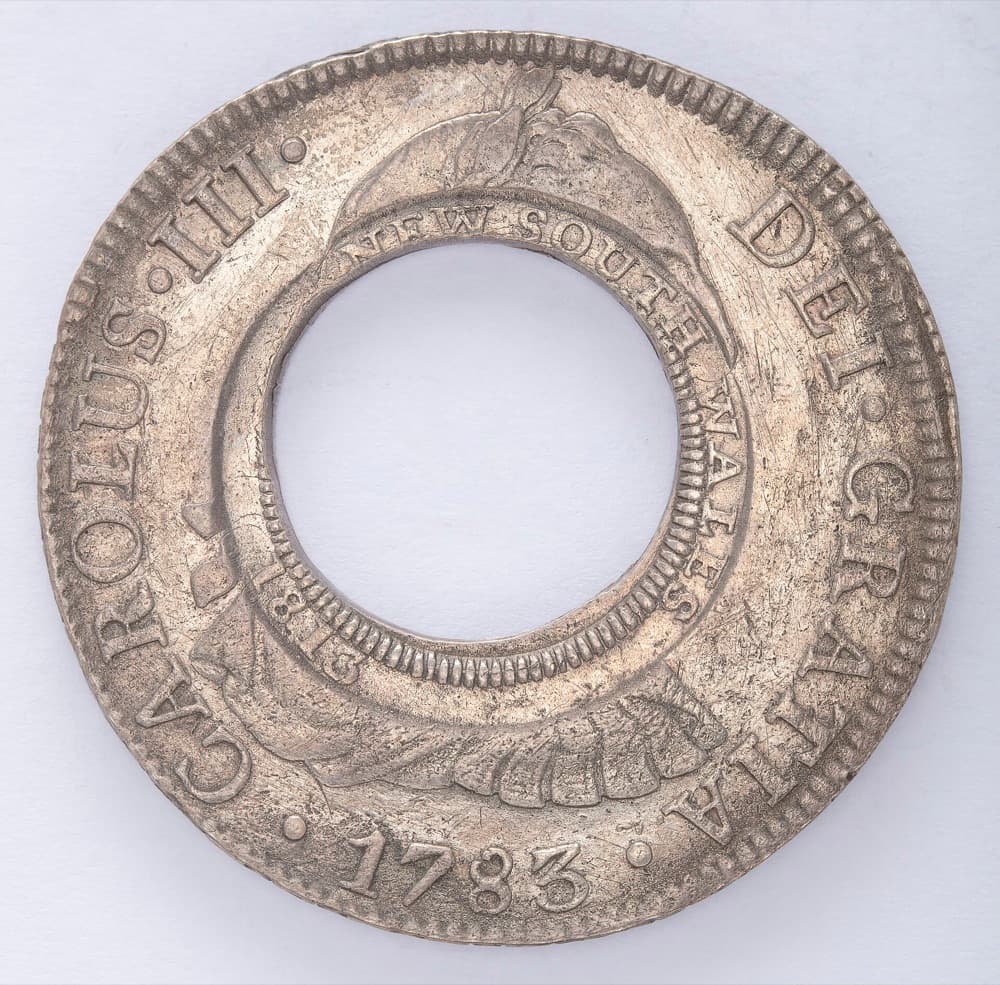
- A Spanish silver dollar (8 reales) with its center punched out and the ring counterstamped NEW SOUTH WALES 1813 on one side and FIVE SHILLINGS on the other
- The other half
- The punched-out center, restruck as a 15-pence coin called the dump
- Value
- Five shillings; ring and dump together passed for 6 shillings 3 pence, about 25 percent more than an intact Spanish dollar
- Host coins
- Struck at Spanish mints in Mexico, Lima, Potosi and Spain, dated as early as 1757; about 80 percent are from the Mexico City mint
- Converted
- 39,910 holey dollars from the 40,000 imported dollars
- Withdrawn
- Recalled from 1822 and demonetized in 1829; most were melted for bullion
- Survivors
- About 300 by museum and newspaper accounts; about 200 of them in private hands
- Highest reported sale
- About $508,000 (reported as A$495,000), Melbourne, March 2013
A colony with no money of its own
When the colony of New South Wales was founded in 1788, nobody planned for it to need cash. It was a penal settlement, expected to support itself. Coins that did arrive, British, Dutch, Indian and Portuguese, tended to leave again with the merchant ships that came to trade. Barter filled the gap, and rum became an unofficial currency.
Governors tried to fix the problem by decree. In 1800 Governor Philip Gidley King issued a proclamation setting fixed values for the most common foreign coins, valuing the Spanish dollar at five shillings, but there was never enough coin and much of it still drained away to pay for imported goods. Governor William Bligh's attempt to stop the use of rum as money ended in the Rum Rebellion of 1808, when he was deposed by the colony's own regiment.
Lachlan Macquarie, appointed governor in 1809, took a different approach. The British government arranged with the East India Company for £10,000 worth of Spanish dollars to be bought in India and shipped to Sydney on the government's account. Forty thousand of them, the silver eight-reales coins known as pieces of eight, arrived from Madras aboard the Samarang on November 26, 1812. A committee opened and counted the fourteen boxes of treasure at Government House on December 5, 1812.
Macquarie's problem was keeping the coins in the colony. The National Museum of Australia suggests he likely knew of an earlier practice in the British West Indies, where Spanish dollars were cut and counterstamped so they could not be re-exported. His answer was to punch the center out of every coin, turning one dollar into two pieces of local money, each worth more inside New South Wales than the silver was worth anywhere else.
The forger who became the first mint master
The man chosen for the job was William Henshall, who had worked as a metal plater and cutler in England and had been sentenced in 1805 to seven years' transportation for his part in counterfeiting. Researchers Peter Lane and Peter Fleig found that he had given the authorities information about other forgers, and about ways to fight the crime, in exchange for an assurance that his wife and family could follow him to New South Wales. On an 1811 muster he was listed simply as a convict. He was granted an absolute pardon on September 12, 1812, six months before his sentence was due to end.
Macquarie gave Henshall a workshop in the basement of The Factory, a building used by government printer George Howe near the corner of Bridge and Loftus streets on the eastern bank of the Tank Stream. The National Museum calls it effectively Australia's first mint, with Henshall as its first mint master. No documentation of the method survives. The museum says a drop hammer rather than a screw press seems to have been used; a specialist dealer notes that the machinery must have been hand-operated, since the colony's first steam engine did not run until 1815.
Macquarie expected the conversion to take three months. It took more than a year, as Henshall had to build and experiment with his own equipment. The first batch of finished coins was delivered to Deputy Commissioner-General David Allen on February 25, 1814, and the last in August 1814. Henshall left the colony for England in 1817, and what became of him is not known.
He did leave a signature. Henshall worked a small H into the spray of leaves on the FIVE SHILLINGS counterstamp, and put his initial between the words FIFTEEN and PENCE on the dump.
Reading a holey dollar
Every holey dollar is two coins at once. The ring is a Spanish dollar, with its original king, legend, mint mark and date still visible around the hole. Around the edge of the hole, Henshall's counterstamps read NEW SOUTH WALES and 1813 on one side and FIVE SHILLINGS on the other, with decorative twigs of six leaves. The application of those counterstamps is what turned a holed foreign coin into colonial money.
Because Macquarie's order specified no dates or mints, the host coins vary widely. Specialists sort them by the Spanish monarch named and portrayed: Ferdinand VI, Charles III, Charles IV and Ferdinand VII. Charles IV hosts are the most available. The Ferdinand VI type is known from just two examples. By one dealer's count, about 80 percent of holey dollars were cut from Mexico City mint dollars, about 10 percent from Lima and 8 percent from Potosi; only six are tied to mints in Spain, and only one of those, a Madrid coin, is in private hands. One holey dollar from the mint in Guatemala is held by a museum in Quebec. A 2013 newspaper account listed Chile and Colombia among the source mints, but the same dealer's research says no holey dollar tied to either has been found.
Four standard counterstamp dies have been identified, two for the NEW SOUTH WALES side and two for the FIVE SHILLINGS side, and they appear in fixed combinations on all but five known coins. Henshall's placement was random: the hole was not always centered and the counterstamps sit at every angle. One celebrated coin, cut from a 1788 Mexico dollar, has NEW SOUTH WALES, 1813 and the host date 1788, the year the colony was founded, lined up vertically.
Condition is unusually hard to find. Most of the Spanish dollars Macquarie imported were already worn. Of about 179 holey dollars that one dealer counted in private hands, more than half were made from well-circulated coins, fewer than 30 from coins in Good Very Fine or better, and only one survives in Uncirculated condition. The counterstamps themselves often show little wear, because the five-shilling coins were stored by the Bank of New South Wales as backing for its notes rather than passed hand to hand.
From the bullion pot to the record books
A proclamation by Macquarie made the new silver money legal tender and made it an offense to melt or export it. Accounts of its date differ: one history gives July 1, 1813, published in the Sydney Gazette on July 10, while the state's history museum marks September 30, 1813, and notes the coins were not available for general issue until January 1814. From 1822 the colonial government began recalling them in favor of sterling coinage. By the time the holey dollar was demonetized in 1829, most had been exchanged and melted into bullion. The few that survived were mostly held by wealthy colonists, banks or companies that could afford to keep demonetized money.
Survivor counts vary by source and by year. The National Museum of Australia says about 300 holey dollars and just over 1,000 dumps remain. A 1989 estimate cited by a standard Australian catalog put it at 350 holey dollars and 1,500 dumps. A 2011 numismatic news report said about 300 holey dollars and 800 dumps. A leading dealer in the series puts about 200 in private hands and perhaps 100 in museums.
Some survivors carry their own histories. One was given by Macquarie himself to a Scottish family; it was acquired by a dealer in 1972, sold to the collector Ken Wilson in 1974 for $2,200 (the report does not give the currency), and first offered at auction in Sydney in July 2015, when it brought A$477,000, reported as $350,307. The National Museum's example, one of only five known on Potosi host coins, passed from the 1930s collector Roy W. Farman to Jewell, a country motel manager and founding president of the Numismatic Association of Australia, who sold it at auction in 1965. The museum bought it at auction on November 6, 2011, for A$130,000 including fees.
The most famous single coin is the Hannibal Head, the only known holey dollar on its host design. Accounts of that design differ: a newspaper account and an encyclopedia entry describe the portrait as Joseph Bonaparte, briefly king of Spain, while the specialist classification describes the type as bearing Ferdinand VII's legend with an imaginary portrait. It was found in 1881 with other holey dollars in what is believed to have been a bushranger's hoard in Tasmania. An Australian newspaper reported that it carried a $45,000 estimate at a 1988 auction, was thought to have sold privately afterward for $40,500, changed hands in 2007 for $260,000 and sold at auction in August 2012 for about $450,000; those figures were reported without a currency and are left out of the price list below.
Prices climbed through the 2010s. In July 2011 a Melbourne dealer announced a record private sale of a near-mark-free example on a rare Charles III host for A$485,000, put at around $500,000 in U.S. terms. In March 2013 a collector from Western Australia paid A$495,000, about $508,000, for a coin made from an 1808 Lima Mint dollar. By September 2013 one dealer said she had sold 10 holey dollars in three years for a combined A$3.46 million.
A hole at the center of a nation's money
The holey dollar is remembered as the first distinct currency produced for New South Wales and the first coin made in Australia. It stayed the only one for decades: Queen Victoria did not consent to a Sydney branch of the Royal Mint until 1853, and Australia's first gold sovereigns were struck in 1855. Coins marked Commonwealth of Australia did not arrive until 1910.
The design has outlived the money. The Macquarie Group, the Australian investment bank named for the governor, uses the holey dollar as its logo, and in 2013 it marked the bicentenary with a free public exhibition of 13 significant examples at 1 Martin Place in Sydney. In 2026 the Royal Australian Mint issued a $1 coin reproducing a holey dollar from the National Coin Collection made on an 1804 Mexican host, to mark 60 years of diplomatic relations between Australia and Mexico.
The numbers
- Mintage
- 39,910 holey dollars (and 39,910 dumps) from 40,000 imported Spanish dollars
- Known survivors
- About 300 (National Museum of Australia); 350 by a 1989 estimate; about 200 in private hands
- Composition
- Silver; each is a holed Spanish 8-reales coin, so weight and diameter vary with the host
- Face value
- Five shillings (the dump: 15 pence)
- Maker
- William Henshall, under Governor Lachlan Macquarie
- Counterstamp dies
- Four standard dies in fixed pairings; five known coins show non-standard dies
Timeline
The colony of New South Wales is founded with no provision for its own coinage.
Governor Philip Gidley King fixes values for foreign coins in the colony, setting the Spanish dollar at five shillings.
William Henshall is sentenced to seven years' transportation for counterfeiting.
Henshall receives an absolute pardon, six months early.
Forty thousand Spanish dollars arrive in Sydney from Madras aboard the Samarang.
A committee at Government House opens and counts the fourteen boxes of treasure.
Macquarie proclaims the new silver money legal tender, according to one account; the Sydney Gazette prints the proclamation on July 10.
The date the state's history museum gives for the proclamation making the holey dollar and dump legal tender.
The first batch of finished coins is delivered to Deputy Commissioner-General David Allen.
The last batch is delivered. In all, 39,910 holey dollars and 39,910 dumps were made.
Henshall leaves the colony for England and disappears from the record.
The colonial government begins recalling holey dollars and dumps in favor of sterling coinage.
The holey dollar is demonetized; most are melted into bullion.
The unique Hannibal Head holey dollar is found in a suspected bushranger's hoard in Tasmania.
The holey dollar now in the National Museum of Australia is sold at auction by collector Jewell.
A holey dollar given by Macquarie to a Scottish family is sold to collector Ken Wilson.
A Melbourne dealer announces a record sale of a holey dollar on a rare Charles III host for A$485,000.
The National Museum of Australia buys a Potosi-host holey dollar at auction for A$130,000 including fees.
A Western Australian collector pays A$495,000, about $508,000, a new record.
A bicentenary exhibition of 13 holey dollars opens at 1 Martin Place, Sydney.
The Macquarie-provenance holey dollar brings A$477,000 at auction in Sydney, its first time at auction.
The world in 1813
Jane Austen's Pride and Prejudice is published anonymously in London.
Gregory Blaxland, William Lawson and William Charles Wentworth complete the first successful crossing of the Blue Mountains west of Sydney.
At the Battle of Vitoria, Wellington defeats the French army under Joseph Bonaparte, the king Spain's dollars would briefly portray.
John and Elizabeth Macarthur send the colony's first commercial shipment of wool to Britain.
In the War of 1812, Oliver Hazard Perry's American squadron wins the Battle of Lake Erie.
The Battle of Leipzig begins; by October 19 the allies have defeated Napoleon.
Surveyor George Evans reaches and names the Macquarie River beyond the Blue Mountains.
Price record
| Date | Price | Kind |
|---|---|---|
| Jul 2011 | $500,000 | Private saleReported as A$485,000; one report put the U.S. equivalent at around $500,000. Sold through a Melbourne dealer; Charles III host, among the best preserved known. |
| Nov 6, 2011 | $134,654 | Sold at auctionAt auction in Australia, bought by the National Museum of Australia: AUD 130,000 (including buyer's premium), shown in USD at the Federal Reserve rate on the sale date (1 AUD = 1.0358 USD). |
| Mar 2013 | $508,000 | Sold at auctionReported as A$495,000 in Melbourne; host coin struck at Lima in 1808. One report calls it an auction, another a purchase through a Melbourne dealer. |
| Jul 2015 | $350,307 | Sold at auctionA$477,000 including premium at auction in Sydney; hammer A$400,000. Host a 1792 Mexico City dollar; provenance to Macquarie. |
| Apr 2016 | $175,566 | Sold at auctionA$232,538 including premium at auction in Sydney; 1799 Mexico City host in about Very Fine, counterstamps Extremely Fine. |
A realized auction price is what a buyer actually paid on the date shown, including the buyer's premium where the sale reported it. It is the strongest kind of reference price, and it is a record of one sale of one object on one day, not a promise of what the next example will bring.
By reference price, 1813 Holey Dollar (New South Wales) is number 66 of 100 in the coins entries of the FLOAT 100. 96 of those 100 rest on a realized sale; the rest carry an asking price or a guide value, and each page says which. Rank within the FLOAT 100 itself (53 here) is editorial: how much an object defines its field, not price alone.
Did you know
- The man who made Australia's first coins had been transported to the colony for counterfeiting.
- Henshall hid his initial H in the leaves of the FIVE SHILLINGS counterstamp.
- Punching out the center doubled the number of coins and raised their combined local value by 25 percent, which made exporting them a losing trade.
- Most survivors were saved by banks and wealthy colonists, not collectors; the five-shilling coins sat in the Bank of New South Wales as backing for its notes.
- One holey dollar lines up NEW SOUTH WALES, 1813 and 1788, the year the colony was founded, in a single vertical row.
- Australia's Macquarie Group uses the holey dollar as its logo.
- A dealer's census found only one holey dollar surviving in Uncirculated condition.
How this page is made
- The figure
- One reference price, shown with its own kind. FLOAT does not average it with anything or adjust it for time.
- Realized or not
- A realized price is a completed sale. An asking price, an estimate and a price-guide value are not sales, and are labeled as such wherever they appear.
- The story
- Researched from published records and checked fact by fact. Updated Oct 1, 2026.
- Archive
- Oct 5, 2026