FLOAT 100 · Coins · No. 3
1787 Brasher Doubloon 'EB on Wing'
A New York silversmith who lived next door to George Washington struck a gold coin of his own design two years before the Constitution took effect, and the finest of the seven survivors has set a world auction record every time it has been sold.
- Year
- 1787
- Maker
- Ephraim Brasher (New York)
- By price in coins
- 4 of 100
Create a free account to see every recorded price and every grade.
Create a free account- Struck
- 1787, New York City, privately, by goldsmith and silversmith Ephraim Brasher
- Type
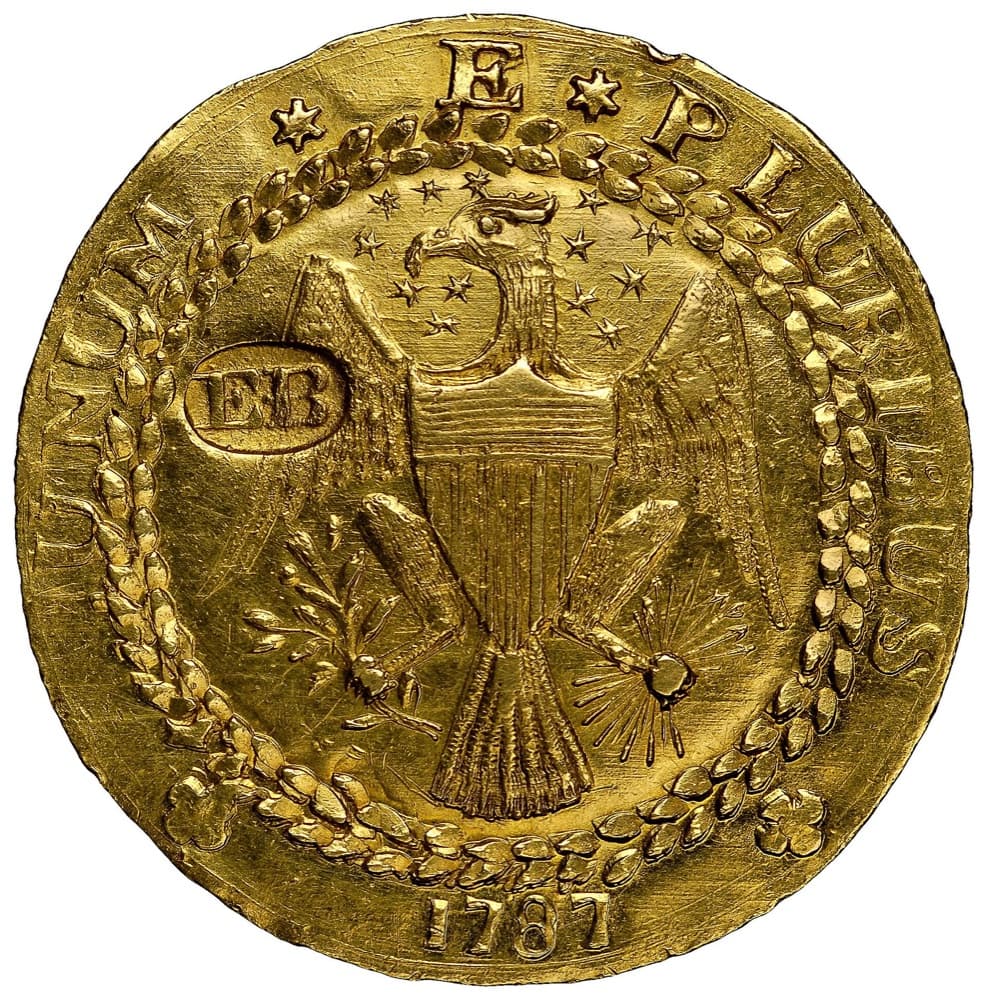
- Gold doubloon, New York style, with Brasher's EB counterstamp on the eagle's wing
- Value in its day
- $15 in New York currency, about equal to a Spanish doubloon of 16 Spanish dollars
- Known examples
- Seven New York-style doubloons (six EB on wing, one EB on breast), plus two earlier Lima-style pieces
- This specimen
- The Stickney-Ellsworth-Garrett-Partrick coin, the finest known, graded NGC MS65 with a star for eye appeal
- Weight and size
- 26.43 grams for this coin; the type is listed at 26.41 grams and 29.8 mm
- Owners since 1848
- Matthew A. Stickney, James W. Ellsworth, John Work Garrett and Johns Hopkins University, Donald G. Partrick, then an anonymous buyer in 2021
- Record
- $9,360,000 at auction in Dallas, January 21, 2021, then a record for any gold coin at auction
A gold coin before there was a U.S. Mint
Between the end of the Revolutionary War in 1783 and the founding of the U.S. Mint in 1792, Americans paid their large bills with a jumble of foreign gold: coins of Brazil and Portugal, Britain and France, and above all the Spanish doubloons struck in Mexico and Peru. A doubloon of eight escudos was worth about 16 Spanish dollars, and every merchant of substance knew one on sight. Several states authorized their own copper coins, and private entrepreneurs filled other gaps.
Ephraim Brasher was one of them. His first gold piece, dated 1786, was a copy of the Spanish colonial doubloons struck at Lima, and only two survive. In 1787 he produced something new: a gold coin whose design was entirely American. The landscape side, adapted from the arms of New York, shows the sun rising over a mountain above the water, with his name, BRASHER, in small letters below the waves and the legend NOVA EBORACA COLUMBIA EXCELSIOR. The other side carries an eagle with a shield on its breast, arrows and an olive branch in its claws, thirteen stars about its head and the date 1787, devices close to those of the Great Seal of the United States. No denomination appears.
Brasher then punched his hallmark, the letters EB in an oval, into each finished coin. On one known example the punch sits on the eagle's breast; on the other six, including this one, it falls at slightly different places on the eagle's wing, which is one of the easiest ways to tell the survivors apart. In New York currency the coin was valued at $15, putting it on par with the Spanish doubloon of 16 Spanish dollars.
Why Brasher struck the coins has been argued for a century and a half. Earlier writers called them patterns, bribes to legislators or souvenirs. The weight and gold content fall within the tolerance of the Spanish doubloons then circulating, and most known examples show wear, which has led modern researchers to conclude they were made to circulate in large transactions between merchants and banks.
Ephraim Brasher, Washington's neighbor
Brasher was baptized on April 18, 1744, in the Reformed Dutch Church of New York and lived in the city all his life except during the British occupation, when his family moved to Red Hook in Dutchess County. He married Ann Gilbert on November 10, 1766, and probably trained as a silversmith alongside her brother William. His descendants have said the family name is pronounced Bray-zher.
In 1775 he was a lieutenant of grenadiers in Colonel Lasher's regiment of the New York Provincial Army, and he later rose to major in the militia. After the war he belonged to the city's Gold and Silversmiths Society, which met on Wednesdays under the chairmanship of Myer Myers. When New York was briefly the national capital, the 1789 city directory listed Brasher at 1 Cherry Street, next door to President Washington at number 3. Washington was also a customer: a receipt survives for four skewers, and four Neoclassical trays bought on September 6, 1790, are at Mount Vernon.
Brasher's reputation rested on his assaying. Goldsmiths of the period weighed and tested the foreign coins brought to banks and stamped those found to be of full weight and fineness; foreign gold pieces bearing Brasher's EB are known today. In 1792, when the new Mint's own officers could not post the bonds required of them, Brasher was among those engaged to make assays for the Mint on the instructions of Treasury Secretary Alexander Hamilton. He was paid years later, through a $27 Treasury warrant recorded in 1796.
In 1787 Brasher, apparently with the sword maker John Bailey, petitioned New York for the right to coin copper; the legislative record of February 12, 1787, notes their petitions. The state declined to create a coinage, and the pair struck Nova Eborac coppers on their own account. The number punches and four-lobed rosettes used on those coppers later appear on the gold doubloon's dies. Brasher held a run of city posts, from coroner to commissioner of excise, and died on November 10, 1810, aged 66.
New York and Philadelphia, 1787
The doubloon was struck in the year the country rewrote its government. Delegates began to convene in Philadelphia on May 25, 1787, nominally to amend the Articles of Confederation, with George Washington presiding. On July 13 Congress passed the Northwest Ordinance, and on September 17 the convention adopted the Constitution. The first of the Federalist essays urging ratification appeared in a New York paper on October 27, and Delaware became the first state to ratify on December 7.
Money was part of the argument. On April 21, 1787, the Congress of the Confederation authorized the copper Fugio cent, often called the first official circulating coin of the United States. A national mint was still five years away. Into that gap stepped a New York craftsman with a die, a press and his own reputation for honest gold.
Four owners in 173 years
Nothing is known of this coin before March 16, 1848, when a New York bullion and exchange house sent Matthew Adams Stickney of Salem, Massachusetts, a bag of fourteen gold coins on approval. First on the list was a $16 piece labeled 'U.S. Nova Eboraca.' The letter was found among Stickney's papers at the Peabody Essex Museum in 2015, and it is the only record of how the finest Brasher doubloon entered a collection. Stickney, a grocer who began collecting around 1820, kept it until his death in 1894; his daughters held his collection another 13 years.
At the Stickney sale in June 1907 the doubloon brought $6,200, nearly triple the previous record of $2,165 for any U.S. coin, paid the year before for an 1822 half eagle. The buyer was James W. Ellsworth, a Chicago coal magnate who bid as 'Hercules' and in the same sale bought Stickney's 1804 dollar for $3,600. Ellsworth showed the doubloon at the American Numismatic Society's 1914 exhibition. In 1923 he sold his whole collection for $100,000 to John Work Garrett, a Baltimore diplomat, in partnership with the dealer Wayte Raymond; Garrett took the colonial coins, doubloon included.
Garrett died in 1942 and left his coins to Johns Hopkins University. After thefts in the 1960s took Brasher doubloons from the duPont family and from Yale, the university decided to sell. The coin was offered in November 1979 in New York, where Martin Monas, bidding for the New York real estate developer and colonial-coin collector Donald G. Partrick, bought it for $725,000, a record for any coin at auction that stood for a decade. A descendant of Brasher, Milton Brasher, was in the room.
Partrick kept it for more than 40 years. Offered in Dallas on January 21, 2021, graded MS65 with a star by NGC, it sold for $9,360,000, at the time the highest price for any gold coin at auction and the second-highest for any U.S. coin. The winning telephone bidder had never bought rare coins before and took every Brasher coin in the session, for $11,940,000 in all.
The seven, and how to tell this one
Seven New York-style doubloons are known. Six carry the EB on the wing: this Stickney coin; the Gilmor coin, known to a Baltimore collector by 1840; the McCoy coin, which was stolen from Yale in 1965 and recovered in 1967; the duPont coin, stolen in 1967 and recovered in 1968; the Jackman coin, dug up by laborers excavating a Philadelphia cellar in 1897 and now at the American Numismatic Society; and the Mint Cabinet coin, pulled from a deposit of gold at the Philadelphia Mint around 1838 and now in the Smithsonian. The seventh, the Bushnell coin, carries the punch on the breast. Five of the seven are in private hands.
On this coin the EB punch is bold and slightly angled, halfway over the wing and running into the field almost to the wreath. An engraver's guide line circles the landscape side. The edges are smooth and a little irregular, as on coins struck without a confining collar, and some letters of EXCELSIOR and the tips of the wing feathers are softly struck. The coin weighs 26.43 grams. At the 1979 sale, before third-party grading, it was described as Mint State 63; NGC now grades it MS65 with a star, two full points above any other Brasher doubloon.
One analysis gives the alloy as 89.3% gold, 6.4% silver and about 3% copper, close to but different from the Spanish doubloons of the day, which suggests Brasher refined his own gold rather than melting down foreign coins. Other published figures differ: one source gives a surviving example as 26.6 grams of .917 gold. A half doubloon from the same dies is in the Smithsonian.
The archetype of a rare coin
The first known mention of a Brasher doubloon in print is a March 18, 1840, letter from W.G. Stearns to a British collector describing 'a gold coin of New York' owned by Mr. Gilmor of Baltimore. By 1859 four were known, and that census stood for almost 30 years. The first auction appearance of any New York-style doubloon, in October 1864, brought $400, a staggering sum for a coin at the time.
The coin's fame reached far beyond collectors. Raymond Chandler built his 1942 Philip Marlowe novel The High Window around a stolen Brasher doubloon, and Hollywood filmed the story as Time to Kill in 1942 and The Brasher Doubloon in 1947. Lawrence Block and John Bellairs worked the coin into their mysteries too. For most Americans who have never owned a rare coin, the Brasher doubloon is the rare coin.
The numbers
- Mintage
- Not recorded
- Known survivors
- 7 New York style (6 EB on wing, 1 EB on breast); 5 in private hands. Also 2 Lima style, dated 1786
- Weight
- 26.41 grams (type, per NGC); this coin 26.43 grams
- Diameter
- 29.8 mm (per NGC)
- Composition
- About 89.3% gold, 6.4% silver, 3% copper (one published analysis)
- Edge
- Plain
- Designer and maker
- Ephraim Brasher, New York goldsmith and silversmith
Timeline
Ephraim Brasher is baptized in the Reformed Dutch Church of New York.
Brasher marries Ann Gilbert.
Brasher serves as a lieutenant of grenadiers in the New York Provincial Army.
Brasher strikes his Lima-style gold doubloons, copies of Spanish colonial coins; two survive.
New York's legislative record notes petitions from Brasher and John Bailey to coin copper; the state declines.
Brasher strikes the New York-style gold doubloon and stamps each with his EB hallmark.
The city directory lists Brasher at 1 Cherry Street, next door to President Washington.
Brasher makes assays of gold and silver coins for the new U.S. Mint.
Brasher dies in New York, aged 66.
W.G. Stearns describes a 'gold coin of New York' owned by Robert Gilmor Jr., the earliest known mention in print.
A New York bullion house offers Matthew A. Stickney a '$16 U.S. Nova Eboraca' gold piece; this coin enters his collection.
A New York-style doubloon appears at auction for the first time and brings $400.
Laborers digging a Philadelphia cellar find another example, later the Jackman coin.
At the Stickney sale, this coin brings a record $6,200 from James W. Ellsworth.
Ellsworth exhibits the doubloon at the American Numismatic Society exhibition.
Ellsworth sells his collection for $100,000 to John Work Garrett and Wayte Raymond; Garrett takes the doubloon.
Garrett dies and his coins go to Johns Hopkins University. Raymond Chandler publishes The High Window.
Offered from the Garrett collection in New York, the coin sells to Donald G. Partrick's agent for a record $725,000.
Graded NGC MS65 with a star, it sells at auction in Dallas for $9,360,000.
The world in 1787
The Congress of the Confederation authorizes the copper Fugio cent.
The Constitutional Convention begins to convene in Philadelphia, with George Washington presiding.
Congress enacts the Northwest Ordinance, setting rules for the Northwest Territory and for admitting new states.
John Fitch demonstrates a 45-foot steam-powered boat on the Delaware River.
The Constitutional Convention adopts the U.S. Constitution.
The first Federalist essay is published in a New York paper.
Delaware ratifies the Constitution and becomes the first state.
Price record
| Date | Price | Kind |
|---|---|---|
| Mar 16, 1848 | $16 | Private saleThis coin, listed at $16 in a New York bullion house's offer to Matthew A. Stickney. |
| Oct 1864 | $400 | Sold at auctionThe McCoy example (EB on wing), the first New York-style doubloon at auction. |
| Jun 1882 | $505 | Sold at auctionThe Bushnell example (EB on breast). |
| Jun 1890 | $415 | Sold at auctionThe McCoy example, from the Parmelee collection. |
| Jun 1907 | $6,200 | Sold at auctionThis coin, Stickney sale; a record for any U.S. coin. |
| Jun 1909 | $4,100 | Sold at auctionThe McCoy example, from the Zabriskie collection. |
| Jun 1918 | $3,900 | Sold at auctionThe Jackman example, found in a Philadelphia cellar in 1897. |
| May 1922 | $3,000 | Sold at auctionThe Gilmor example, from the James Ten Eyck collection. |
| Jul 1979 | $430,000 | Sold at auctionThe Gilmor example. |
| Nov 1979 | $725,000 | Sold at auctionThis coin, from the Garrett collection, at auction in New York; a record for any coin. |
| Mar 1981 | $625,000 | Sold at auctionThe Bushnell example (EB on breast), from the Garrett collection. |
| Jan 12, 2005 | $2,415,000 | Sold at auctionThe McCoy example, EB on wing, NGC AU55. |
| Jan 12, 2005 | $2,990,000 | Sold at auctionThe unique EB-on-breast example, NGC XF45. |
| Dec 2011 | $7,395,000 | Private saleThe EB-on-breast example, sold privately to an undisclosed Wall Street investment firm. |
| Jan 2014 | $4,582,500 | Sold at auctionThe Gilmor example, MS63. |
| Jun 2020 | $15,000,000 | Asking price, not a saleThe EB-on-breast example, reportedly offered privately at this price. |
| Jan 21, 2021 | $9,360,000 | Sold at auctionThis coin, NGC MS65 with a star, at auction in Dallas; then a record for any gold coin at auction. |
A realized auction price is what a buyer actually paid on the date shown, including the buyer's premium where the sale reported it. It is the strongest kind of reference price, and it is a record of one sale of one object on one day, not a promise of what the next example will bring.
By reference price, 1787 Brasher Doubloon 'EB on Wing' is number 4 of 100 in the coins entries of the FLOAT 100. 96 of those 100 rest on a realized sale; the rest carry an asking price or a guide value, and each page says which. Rank within the FLOAT 100 itself (3 here) is editorial: how much an object defines its field, not price alone.
Did you know
- Brasher's next-door neighbor at 1 Cherry Street in 1789 was President George Washington, who bought silver from him.
- This coin has been offered at public auction only three times, in 1907, 1979 and 2021, and set a world record each time.
- Its 1979 price of $725,000 remained the record for any coin at auction for about a decade.
- One New York-style doubloon was found by workmen digging a Philadelphia cellar in 1897. It is often wrongly called the 'sewer' coin.
- Two Brasher doubloons were stolen in the 1960s, from Yale and from the duPont family, and both were recovered.
- The buyer in 2021 had never bought a rare coin before.
- Raymond Chandler built a Philip Marlowe novel, The High Window, around a stolen Brasher doubloon.
How this page is made
- The figure
- One reference price, shown with its own kind. FLOAT does not average it with anything or adjust it for time.
- Realized or not
- A realized price is a completed sale. An asking price, an estimate and a price-guide value are not sales, and are labeled as such wherever they appear.
- The story
- Researched from published records and checked fact by fact. Updated Oct 1, 2026.
- Archive
- Oct 5, 2026