FLOAT 100 · Coins · No. 33
1787 Fugio Cent
Before there was a Constitution or a Mint, Congress ordered a copper cent stamped with a sundial and the words MIND YOUR BUSINESS, and handed the job to a contractor who had bribed his way into it.
- Year
- 1787
- Maker
- United States contract coinage (James Jarvis)
- By price in coins
- 90 of 100
Create a free account to see every recorded price and every grade.
Create a free account- Authorized
- April 1787 by the Congress of the Confederation; design set by resolution of July 6, 1787
- Struck
- Dated 1787, struck largely in 1788 under contract by James Jarvis's company
- Dies
- Engraved by Abel Buell of New Haven, Connecticut
- Design
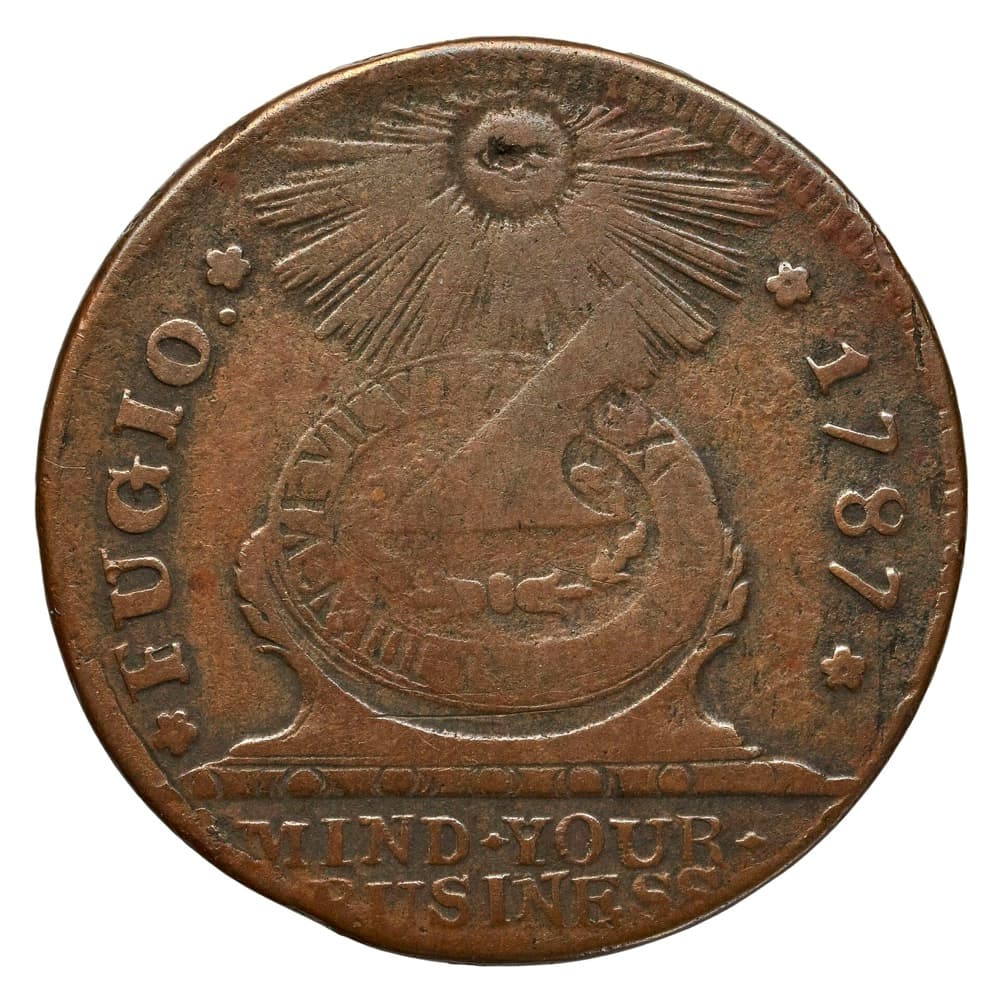
- Sun over a sundial with FUGIO ("I fly") and MIND YOUR BUSINESS; reverse of 13 linked rings around UNITED STATES and WE ARE ONE
- Design credit
- Mottos and motifs traced to Benjamin Franklin's 1776 Continental currency
- This entry
- STATES UNITED, 4 Cinquefoils, Pointed Rays, Newman 12-X, Mint State 66 Brown
- Mintage
- Disputed: 398,577 by the government's 1791 audit; about 554,741 by the contractor's 11,910 pounds
- Classification
- Reclassified by a leading grading service in January 2022 as the first regular-issue United States coin
- Famous hoard
- A keg held by the Bank of New York; 1,641 coins examined in 1948, 819 still with the bank about 1988
A cent before there was a Mint
In the 1780s the new United States had no national mint, and its pockets were full of counterfeit and lightweight coppers. Every time a worker or shopkeeper accepted an underweight copper at face value, he lost money, because others would take it only at a discount. Several states struck their own coppers. Congress, still governing under the Articles of Confederation, decided to contract for a national one.
The groundwork had been laid on August 8, 1786, when Congress defined the cent as one hundredth of a federal dollar and set the standard at two and a quarter pounds of copper to 100 cents, which works out to 157.5 grains a coin. In April 1787 Congress authorized the Board of Treasury to contract for 300 tons of copper coin 'of the federal standard,' following a proposal from a merchant named James Jarvis. The journals record the committee report on April 21, 1787; a 2022 study of the records says the authorizing vote was taken on April 20, with ten states present, more than the nine the Articles required.
On July 6, 1787, Congress spelled out the design: on one side thirteen linked circles around a small circle reading 'United States,' with 'We are one' at the center; on the other a sundial under a meridian sun, the word 'Fugio' and the date, and below the dial the words 'Mind your Business.' FUGIO is Latin for 'I fly,' a reminder that time flies.
The imagery was borrowed. The same sundial, rings and mottos had appeared on Continental currency of February 17, 1776, and on the 1776 Continental dollar, a coin made only as patterns and never circulated. The numismatist Eric Newman showed those designs and mottos were Benjamin Franklin's work, which is why the coin has long been called the Franklin cent. Nineteenth-century catalogs also called it the Sun Dial, Ring and Mind Your Business cent.
Jarvis, Buell and a contract gone wrong
Two men competed for the contract: Matthias Ogden of New Jersey and James Jarvis, who had bought a controlling interest in a Connecticut mint called the Company for Coining Coppers. Jarvis won. According to the University of Notre Dame's account, he had paid a $10,000 bribe to William Duer, secretary of the Board of Treasury. A 2022 study by nine numismatists likewise describes Jarvis as having engaged in bribery.
Jarvis obtained about thirty tons of government copper to start, on the promise that he would pay for it out of the coinage. He hired Abel Buell of New Haven to cut the dies, put his father-in-law, Samuel Broome, in charge of the minting, and sailed to Europe to find more copper and backing. He sought help from Matthew Boulton of the Soho Mint in Birmingham, without success, because he had no cash to put up front.
At home, Broome used much of the federal copper to strike about three and a half million 1787 Connecticut coppers, which were lighter and more profitable. Only about 400,000 Fugio cents, a few tons out of the 300 contracted, were sent to the Treasury, on May 21, 1788. Congress voided the contract on September 16, 1788, and a committee reported on September 30 that Jarvis had received a large quantity of federal copper and paid for only a small part. When the government sued him in 1790, he did not appear in court.
The operation scattered. Thomas Machin bought Jarvis's equipment, Broome joined Jarvis in Europe, and Abel Buell left his tools with his son Benjamin and also left the country. On July 9, 1789, a New York merchant, Royal Flint, bought all the Fugio cents left in the Treasury on credit at about a third of face value. Eleven days later, on July 20, a copper panic cut the value of most coppers by about three quarters, and the loss sent Flint to debtors' prison.
The summer of the Constitution
The Fugio cent was authorized in the same months the country was remaking itself. Delegates began gathering in Philadelphia on May 14, 1787, and opened the Constitutional Convention on May 25 with a mandate to amend the Articles of Confederation. On July 13, a week after it settled the cent's design, Congress enacted the Northwest Ordinance, setting rules for governing the Northwest Territory.
On August 27 John Fitch ran a 45-foot steam-powered boat on the Delaware River. On September 17 the convention adopted the Constitution, and on October 27 the first of the Federalist papers appeared in a New York newspaper. Delaware ratified on December 7, followed by Pennsylvania and New Jersey before the year was out.
The first United States Mint opened in Philadelphia in 1792. The Fugio cent was the old Confederation government's coin, struck by a private contractor for a Congress that would soon be replaced.
A keg in a Wall Street bank
The Fugio cents saw modest use; some may have circulated in Massachusetts, since collectors in the 1840s and 1850s took them for Massachusetts coins.
The high-grade coins come mostly from one place. The Bank of New York, founded in 1784, acquired a keg of new Fugio cents around the time they were made. The keg, kept at 44 Wall Street, went unopened until 1856, and by 1860 a writer reported a keg of the coins 'found in the vault of a New York City bank, in fresh proof condition.' Accounts differ on what came next: Notre Dame's history says the coins were bagged and forgotten until a second rediscovery in 1926, while another account has bank officials handing them to favored clients and employees from at least 1859.
By about 1948, 1,641 coins remained, and the American Numismatic Society examined them. Damon G. Douglas's analysis found the blanks came from two batches averaging about 143 and 155 grains. Some coins went to the Society and others to collectors. Around 1988 Anthony Terranova reviewed the 819 coins the bank still held in a cloth sack, ranging from red Uncirculated to water-stained, and had them moved into protective holders. Another 50 or 60 had been set in lucite as gifts for customers.
The hoard shapes the market today. One die pairing, Newman 13-X, made up 726 of the 1,641 coins, and Newman 12-X is also plentiful from the hoard. A Newman 12-X graded MS66 Brown by NGC, with orange-red at the borders and the familiar vertical reverse crack at 6 o'clock, was described as likely from the Bank of New York holdings when it sold at auction in February 2021 for $13,200.
How to read a Fugio
Collectors divide the series by the sun's rays and by the reverse label. One researcher counts at least 55 varieties from 24 obverse and 33 reverse dies. Pointed rays are considered the best-executed coins and are attributed to Abel Buell's dies. Club rays, with blunt ends, come in a convex style averaging about 150 grains and a rarer concave style averaging about 162 grains; one theory credits them to Buell's son Benjamin. On most reverses the words UNITED and STATES sit left and right on the label; this entry's variety reads STATES UNITED, and a scarce group places UNITED above and STATES below.
Cinquefoils, five-petaled ornaments, appear in the legends, and the punctuation of MIND YOUR BUSINESS varies from die to die. Buell's original sundial hub carried a mistake, an extra fifth stroke in the Roman numeral IIII, so on every die made from it an ornament was punched over the stray stroke. The G in FUGIO was made with a C punch and a hand-added crossbar, which often sits slightly out of line.
Newman 12-X pairs a pointed-rays obverse with reverse die X, the workhorse reverse, which shows a prominent crack from the border at 6 o'clock. In the top grade the pool is tiny: in early 2023 one grading service reported five coins of the STATES UNITED, 4 Cinquefoils type graded MS66 Brown across all die pairings, with none finer.
Beware the so-called New Haven restrikes. In 1858 Horatio N. Rust acquired several sets of Fugio dies and used them to strike three to four hundred copies in copper, plus some in silver and gold. The dies had been made in the 1850s, probably at the Scovill works in Waterbury, Connecticut. The copies are therefore neither restrikes from original dies nor from New Haven, and they are collected as a separate category.
Promoted to the first regular-issue coin
Early writers had no doubt about the Fugio's status. James Ross Snowden listed it under federal coinage in his 1860 catalog of the Mint cabinet, and Sylvester Crosby, in The Early Coins of America (1875), called these 'the earliest coins issued by the authority of the United States.' Over the twentieth century, though, the coins were filed among colonial coppers, and the leading variety guide called them 'coppers' rather than cents.
On January 3, 2022, a leading grading service announced that it would list Fugio cents as regular-issue federal coins, under the heading Federal Contract Coinage, after a study by nine specialists. Their argument: Congress set the cent's standard in 1786, authorized the Jarvis contract at that standard in 1787, and accepted the coins. They argued that a contract coinage is still a national coinage, and that a coin need not state its denomination; most early American gold and silver coins did not.
The same study takes on the mintage. Jarvis's company books show 11,910 pounds shipped, while the government recorded receiving 8,968 pounds, credited in a 1791 audit at $3,985.77. The study treats the government figure, equal to 398,577 cents, as official. Using the larger weight, a standard reference estimates 554,741 pieces. Notre Dame's history gives about 400,000. Readers should treat every Fugio mintage as an estimate.
The numbers
- Mintage
- 398,577 by the 1791 government audit (8,968 pounds); about 554,741 from the contractor's 11,910 pounds; about 400,000 in another account
- Known survivors
- No firm census; the Bank of New York hoard held 1,641 in 1948 and 819 about 1988
- Top population
- Five STATES UNITED, 4 Cinquefoils coins graded PCGS MS66 Brown, none finer (2023 report)
- Weight
- Standard of 157.5 grains (about 10.2 grams); actual coins vary
- Diameter
- About 29 mm (one catalog)
- Composition
- Copper
- Dies
- Abel Buell, New Haven; at least 55 varieties from 24 obverse and 33 reverse dies
- Designer
- Mottos and motifs from Benjamin Franklin's 1776 Continental currency
Timeline
Continental currency carries the sundial, FUGIO and MIND YOUR BUSINESS design later used on the cent.
Congress defines the cent as one hundredth of a federal dollar, with 2 1/4 pounds of copper to 100 cents.
The Journals of Congress record authority for the Board of Treasury to contract with James Jarvis for 300 tons of copper coin.
Congress resolves the design: linked rings and WE ARE ONE on one side, sundial, FUGIO and MIND YOUR BUSINESS on the other.
Fugio cents, about 400,000 by one account, are sent to the U.S. Treasury.
Congress voids the Jarvis contract after few coins and little payment for federal copper.
New York merchant Royal Flint buys the Treasury's remaining Fugio cents on credit at about a third of face value.
A copper panic cuts the value of most coppers by about 75 percent; Flint ends up in debtors' prison.
The government sues Jarvis; he does not appear in court.
The Bank of New York's keg of Fugio cents is opened.
Horatio N. Rust acquires Fugio dies made in Waterbury and strikes the so-called New Haven restrikes.
Sylvester Crosby calls the Fugios the earliest coins issued by the authority of the United States.
The bank's hoard is rediscovered, by one account, and coins are given to officials and favored customers.
The American Numismatic Society examines the 1,641 coins remaining in the hoard.
About this year Anthony Terranova reviews the bank's remaining 819 coins and has them housed in holders.
A Newman 12-X graded NGC MS66 Brown, likely from the Bank of New York holdings, sells at auction for $13,200.
A leading grading service reclassifies the Fugio cent as a regular-issue federal coin.
A Newman 13-X graded PCGS MS66 Brown, one of five in that grade with none finer, sells at auction for $28,800.
The world in 1787
The Constitutional Convention convenes in Philadelphia to amend the Articles of Confederation.
Franklin College, named for Benjamin Franklin, opens in Lancaster, Pennsylvania.
Congress enacts the Northwest Ordinance governing the Northwest Territory.
John Fitch demonstrates a 45-foot steam-powered boat on the Delaware River.
The Constitutional Convention adopts the United States Constitution.
The first of the Federalist papers is published in a New York newspaper.
Delaware ratifies the Constitution and becomes the first state.
Price record
| Date | Price | Kind |
|---|---|---|
| Nov 15, 2014 | $55,813 | Sold at auctionA different variety: Pointed Rays with raised rims, NGC MS64 Brown. |
| Mar 26, 2015 | $94,000 | Sold at auctionA rare different variety: Club Rays, concave ends, UNITED STATES, PCGS AU50 Brown. |
| Aug 6, 2017 | $30,550 | Sold at auctionA different variety: 4 Cinquefoils, Pointed Rays, UNITED STATES label, PCGS MS64 Brown. |
| Feb 2021 | $13,200 | Sold at auctionThis entry's exact variety and grade: STATES UNITED, 4 Cinquefoils, Pointed Rays, Newman 12-X, NGC MS66 Brown. |
| Nov 22, 2021 | $2,280 | Sold at auctionSTATES UNITED, 4 Cinquefoils, Newman 17-S, PCGS Extremely Fine 45; from the Pierre Fricke collection of Fugios. |
| Mar 2023 | $28,800 | Sold at auctionSTATES UNITED, 4 Cinquefoils, Pointed Rays, Newman 13-X, PCGS MS66 Brown; one of five in MS66 Brown with none finer. |
| May 2026 | $9,150 | Sold at auctionNewman 13-X, PCGS MS65 Brown. |
A realized auction price is what a buyer actually paid on the date shown, including the buyer's premium where the sale reported it. It is the strongest kind of reference price, and it is a record of one sale of one object on one day, not a promise of what the next example will bring.
By reference price, 1787 Fugio Cent is number 90 of 100 in the coins entries of the FLOAT 100. 96 of those 100 rest on a realized sale; the rest carry an asking price or a guide value, and each page says which. Rank within the FLOAT 100 itself (33 here) is editorial: how much an object defines its field, not price alone.
Did you know
- Abel Buell's sundial hub had an extra fifth stroke in the Roman numeral IIII, and every die made from it needed an ornament punched over the mistake.
- The G in FUGIO was struck with a C punch and finished by hand with a crossbar, which is often visibly out of line.
- The 'New Haven restrikes' are neither restrikes nor from New Haven: they came from new dies made in the 1850s, probably in Waterbury, Connecticut.
- A newspaper of the day hoped the motto MIND YOUR BUSINESS might prove 'an antidote to insurgency.'
- The Bank of New York set 50 or 60 of its hoard coins in lucite to give to favored customers.
- In the nineteenth century the collector Charles Bushnell argued the coin should properly be called the Rittenhouse Cent.
- Of the 1,641 coins left in the Bank of New York hoard in 1948, 726 came from a single die pairing, Newman 13-X.
How this page is made
- The figure
- One reference price, shown with its own kind. FLOAT does not average it with anything or adjust it for time.
- Realized or not
- A realized price is a completed sale. An asking price, an estimate and a price-guide value are not sales, and are labeled as such wherever they appear.
- The story
- Researched from published records and checked fact by fact. Updated Oct 1, 2026.
- Archive
- Oct 5, 2026