FLOAT 100 · Coins · No. 32
1652 Oak Tree Shilling
Struck in a mint built on a Boston silversmith's land, years after the date it carries and without the king's permission or his name, the Oak Tree shilling belongs to the first coinage made in the British American colonies.
- Year
- 1652 (struck c.1660-67)
- Maker
- Massachusetts Bay Colony (Boston mint)
- By price in coins
- 70 of 100
Create a free account to see every recorded price and every grade.
Create a free account- Struck
- About 1660-1667, Boston, all dated 1652
- Issuer
- Massachusetts Bay Colony mint of John Hull and Robert Sanderson
- Denomination
- Shilling (twelvepence); sixpence, threepence and a 1662-dated twopence were also struck
- Standard
- 72 grains of .925 sterling silver, 22.5% lighter than an English shilling
- Size
- About 26 mm; examples weigh about 70 to 72.6 grains
- Press
- Struck on a rocker press, according to Christopher Salmon's 2010 study
- This entry
- IN at Bottom, Noe-4 die variety, rarity 4, graded PCGS MS65
- Finest known
- The Weinberg-Del Mar Noe-4, called the finest of its variety with perhaps two other uncirculated examples
- Notable prices
- $105,750 for an NGC MS65 Noe-4 (2014); $117,500 for an IN at Left NGC MS65 (2016)
A colony makes its own money
Until the early 1650s the Massachusetts Bay Colony ran on barter and foreign coins, English, Spanish, Dutch and Portuguese, many of them counterfeit. In 1652 the Massachusetts General Court first asked silversmith John Hull to weigh, assay and countermark foreign coins. Hull declined, and in late May 1652 the court instead authorized him to make the colony's own shillings, sixpence and threepence by reminting foreign silver, without seeking permission from the English government. Sources give the date of the order as May 26 or May 27.
The first coins, struck from June to October 1652, were nearly blank discs stamped NE for New England and the value in Roman numerals. They were easy to clip and told merchants little, so in October 1652 the court ordered a more elaborate design ringed with beads. The tree coinages followed in sequence: Willow Tree from about 1652 or 1653 to 1660, Oak Tree from about 1660 to 1667, and Pine Tree from about 1667 to 1682.
The colony deliberately made its coins light. The standard was 72 grains of .925 sterling silver to the shilling, a 22.5 percent cut from the English standard of 92.9 grains, in the hope that the coins would stay in New England rather than be shipped abroad.
John Hull, mintmaster
John Hull was born December 18, 1624, in Market Harborough, England, and arrived in Boston at 11 in 1635. After a seven-year smithing apprenticeship he became a silversmith and took on Robert Sanderson in the business; Sanderson's mark appears beside Hull's on nearly all the shop's silver, and Sanderson may have been chiefly responsible for making the coins. The colony paid for the tools and the mint building, which stood on Hull's land.
Hull kept one shilling and sevenpence of every 20 shillings he coined, and in some years cleared more than 1,000 pounds. The court tried at least seven times to renegotiate the terms. He became a leading merchant with interests in more than a dozen ships, served as colony treasurer from 1676 to 1680, and, during King Philip's War, arranged the sale of Native American captives into slavery. He died October 1, 1683.
No individual engraver of the Oak Tree dies is documented. Writing about the Noe-4 variety, the coin cataloged here, Salmon pointed to features suggesting both dies were cut by the same hand, against an earlier cataloger's view that two engravers worked on the reverse.
Why a 1660s coin says 1652
Every Massachusetts silver coin except the NE pieces and the Oak Tree twopence carries the date 1652, even those struck 30 years later. Minting silver was a royal prerogative, and when the colony began, England had no reigning king. A long-standing explanation is that the frozen date made the coins look like a Commonwealth-era issue after Charles II was restored in May 1660. Numismatists have pointed out a problem with that theory: the twopence authorized in May 1662 is dated 1662, after the Restoration.
The coins named no king. After the Restoration the English government regarded the Boston mint as treasonous, and in 1665 the Privy Council ordered it closed; the colony ignored the order. Hull bought the operation in 1675, and the mint ran until about 1682, when his contract lapsed. The colony's charter was revoked in 1684, and the coinage is counted among the reasons.
The finest Noe-4
Oak Tree shillings survive in useful numbers in circulated grades; one market survey put very fine examples at roughly $4,000 to $8,000. Uncirculated pieces are another matter, and this entry's coin, a Noe-4 graded PCGS MS65, is described as almost certainly the finest of its type and variety. It weighs 71.60 grains, has a 345-degree die alignment and was struck from the earliest state of the reverse die, so fine engraving and die-polishing lines are still visible.
Its recorded history begins at the American Numismatic Society's 1991 exhibition of Massachusetts silver, where it was catalog No. 34. It belonged to collector Alan V. Weinberg, who called it 'probably the finest Oak Tree shilling I've seen of any variety' and added: 'To see an American-produced colonial from the era before the Witch Trials in such condition is simply amazing.' Sold with his collection at auction in Orlando, Florida, in January 2020, it brought $87,000. It was offered again at the American Numismatic Association convention auction in August 2023 as part of the Del Mar Collection and brought $96,000.
A rival Noe-4, graded NGC MS65 and weighing 72.6 grains, came from the collection of Eric P. Newman and sold at auction in New York on May 16, 2014, for $105,750; an IN at Bottom Noe-5 graded NGC MS65+ matched that price in January 2015. The 2023 catalogers judged the PCGS coin superior in engraving detail. Another Noe-4 graded NGC MS63 sold for $28,800 in August 2025, and a PCGS EF-40 for $5,520 in February 2026, which shows how steeply price climbs with grade.
How to identify it
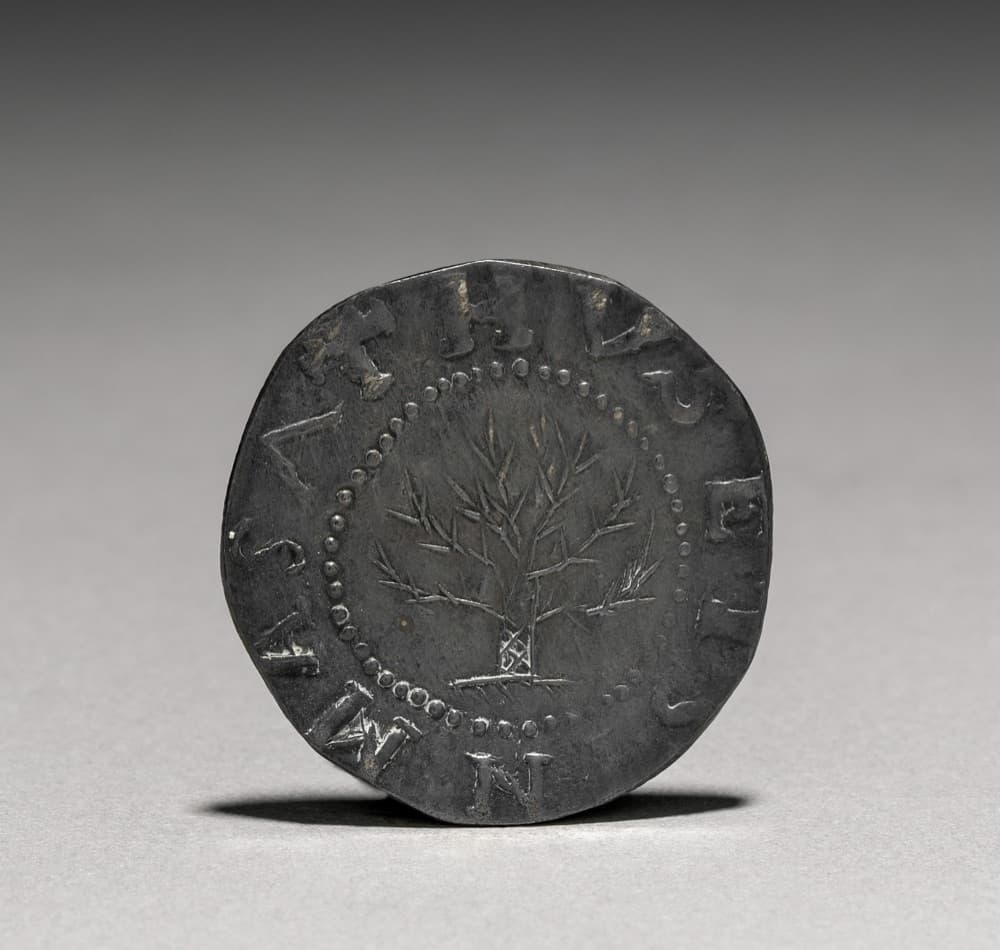
The obverse shows a tree inside a beaded inner circle, surrounded by the legend MASATHVSETS IN; the coin carries the date 1652, and the reverse legend includes the letters NGL and DOM. On IN at Bottom varieties the word IN sits below the tree; the IN at Left varieties, such as Noe-1, place it to the side. The name 'oak' dates only from the 19th century, regardless of how the tree is drawn.
Noe-4 combines Crosby's obverse 3 and reverse D. The obverse has a very full tree that fills nearly the whole inner circle, and the reverse is identified by a die flaw inside the O of DOM. This was the only use of that obverse die. The variety is usually found well centered on the reverse but off-center toward 6 o'clock on the obverse, often weakly struck there.
Salmon argued that all Oak Tree coins were struck on a rocker press, which often leaves the tops of the letters NGL on the reverse slightly streaked. Because steel for quality dies was rare at the time, dies were lapped and re-engraved to extend their life, so two coins from the same pair of dies can look different. The current population report shows two IN at Bottom shillings at MS65 with none higher.
The numbers
- Mintage
- Not recorded. The Boston mint may have produced 300,000 to 500,000 coins of all types and denominations from 1652 to 1682.
- Legal standard
- 72 grains of .925 sterling silver per shilling
- Weight of known examples
- 71.60 grains (Weinberg-Del Mar Noe-4), 72.6 grains (Newman Noe-4), 70 grains (Colonial Williamsburg Noe-6)
- Diameter
- About 26 mm (Colonial Williamsburg example)
- Composition
- Silver, .925 fine by law
- Makers
- John Hull, mintmaster, and Robert Sanderson; engraver not documented
- Variety rarity
- Noe-4 is rated rarity 4; perhaps three uncirculated Noe-4s are known
- Population at the top
- PCGS: 2 IN at Bottom shillings at MS65, none higher
- Mintmaster's cut
- Hull kept 1 shilling 7 pence of every 20 shillings coined
Timeline
John Hull is born in Market Harborough, England.
Hull's family arrives in Boston.
The Massachusetts General Court authorizes Hull to coin shillings, sixpence and threepence.
Striking of the plain NE coinage begins; it runs until October.
The court orders a more elaborate design to discourage clipping.
The Oak Tree coinage begins, replacing the Willow Tree design; it runs to about 1667.
The colony authorizes a twopence, the only Massachusetts silver coin dated 1662.
England's Privy Council orders the Boston mint to stop; the colony ignores it.
The Pine Tree design replaces the Oak Tree.
Hull buys the minting operation from the colony.
Hull's contract expires and coining ends.
John Hull dies in Boston.
Charles II revokes the Massachusetts Bay Colony charter.
The finest Noe-4 is shown in the American Numismatic Society's exhibition of Massachusetts silver.
Three Noe-4 shillings appear in the auction of the John J. Ford Jr. collection.
Christopher Salmon publishes The Silver Coins of Massachusetts, arguing the Oak Trees were struck on a rocker press.
The Newman Noe-4, NGC MS65, sells in New York for $105,750.
The Weinberg Noe-4, PCGS MS65, sells at auction for $87,000.
The same coin, now in the Del Mar Collection, sells for $96,000.
The world in 1660
Charles II enters London and the English monarchy is restored.
Mary Dyer is hanged in Boston for defying the Massachusetts law banning Quakers.
Wren, Boyle and others meet in London and decide to found what becomes the Royal Society.
The Eliot Indian Bible, the first complete Bible printed in the Americas, is published in Cambridge, Massachusetts.
Peter Stuyvesant surrenders New Amsterdam to the English; it becomes New York.
The first known death of the Great Plague of London is recorded.
The Great Fire of London begins in a Pudding Lane bakery.
John Milton signs the contract to publish Paradise Lost.
Price record
| Date | Price | Kind |
|---|---|---|
| May 16, 2014 | $105,750 | Sold at auctionIN at Bottom, Noe-4, NGC MS65, the Eric P. Newman coin. Sold at auction in New York. |
| Jan 2020 | $87,000 | Sold at auctionIN at Bottom, Noe-4, PCGS MS65, the Weinberg coin (this entry's coin). |
| Aug 15, 2023 | $96,000 | Sold at auctionSame PCGS MS65 Noe-4, Del Mar Collection. Sold at auction during the American Numismatic Association convention. |
| Aug 26, 2025 | $28,800 | Sold at auctionIN at Bottom, Noe-4, NGC MS63. |
| Feb 3, 2026 | $5,520 | Sold at auctionIN at Bottom, Noe-4, PCGS EF-40. |
A realized auction price is what a buyer actually paid on the date shown, including the buyer's premium where the sale reported it. It is the strongest kind of reference price, and it is a record of one sale of one object on one day, not a promise of what the next example will bring.
By reference price, 1652 Oak Tree Shilling is number 70 of 100 in the coins entries of the FLOAT 100. 96 of those 100 rest on a realized sale; the rest carry an asking price or a guide value, and each page says which. Rank within the FLOAT 100 itself (32 here) is editorial: how much an object defines its field, not price alone.
Did you know
- Nearly every Massachusetts silver coin is dated 1652, even ones struck in 1682.
- The 'oak' in the name is a 19th-century label, applied regardless of how much the tree resembles one.
- The only Massachusetts silver coin with a different date is the Oak Tree twopence, dated 1662.
- The colony made its shilling 22.5 percent lighter than England's so the coins would not be carried out of New England.
- England ordered the Boston mint shut in 1665; the colony kept coining for about 17 more years.
- The finest Noe-4 Oak Tree shilling sold for less in 2023 ($96,000) than a rival NGC example did in 2014 ($105,750).
- Mintmaster John Hull's only child to reach adulthood, Hannah, married the diarist and judge Samuel Sewall.
How this page is made
- The figure
- One reference price, shown with its own kind. FLOAT does not average it with anything or adjust it for time.
- Realized or not
- A realized price is a completed sale. An asking price, an estimate and a price-guide value are not sales, and are labeled as such wherever they appear.
- The story
- Researched from published records and checked fact by fact. Updated Oct 1, 2026.
- Archive
- Oct 5, 2026