FLOAT 100 · Coins · No. 15
1792 Half Disme
Before the United States Mint had a building, Thomas Jefferson handed over $75 in silver, walked away with 1,500 tiny five-cent pieces, and that evening tipped the servants at an inn with the first federal coins anyone ever spent.
- Year
- 1792
- Maker
- U.S. Mint (Philadelphia)
- By price in coins
- 21 of 100
Create a free account to see every recorded price and every grade.
Create a free account- Struck
- July 11-13, 1792, in Philadelphia, probably in saw-maker John Harper's cellar; a second striking is dated October 9, 1792
- Denomination
- Half disme: five cents, one-twentieth of a dollar
- Authority
- The Coinage Act of April 2, 1792
- Mintage
- 1,500 delivered to Jefferson on July 13, plus an estimated 200 to 500 in October; older estimates run from 1,500 to 3,500
- Known today
- Estimated 250 to 400, most of them worn from circulation
- Inscriptions
- LIB. PAR. OF SCIENCE & INDUSTRY (Liberty, parent of science and industry); UNI. STATES OF AMERICA; HALF DISME
- This example
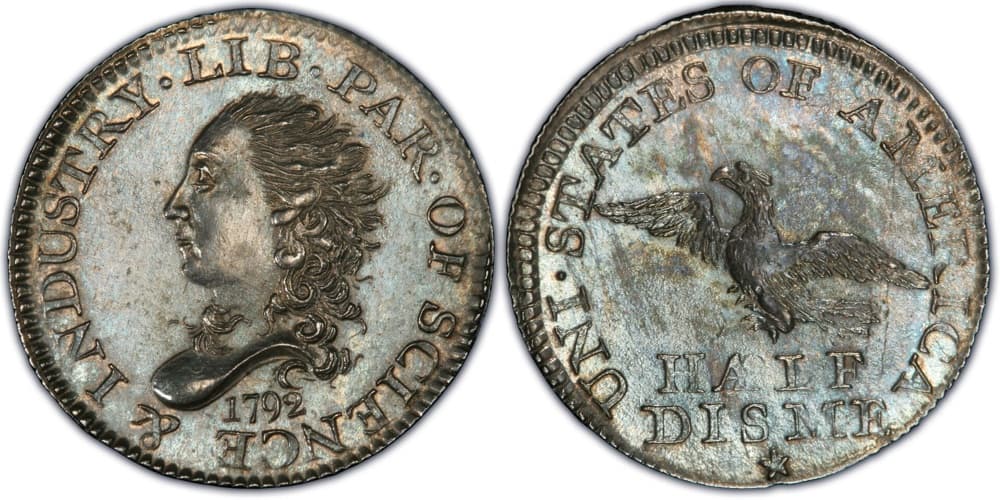
- The Starr specimen, the only 1792 half disme PCGS has designated a Specimen strike, graded SP67
- Starr specimen's best price
- $1,410,000 at auction in Orlando, January 2013
- First federal coin?
- Widely but not universally considered the first U.S. coinage under the 1792 act; the U.S. Mint itself recognizes the 1793 chain cent
A small beginning
The Coinage Act of April 2, 1792, created the United States Mint and a decimal coinage of dollars, dimes, cents and mills, a system favored by both Thomas Jefferson and Alexander Hamilton. Attempts at a national coinage went back to the Revolution: the Continental Congress authorized a mint but never funded it, and financier Robert Morris had pattern coins made in 1783 that went nowhere. It took the new federal government until 1792 to authorize, fund and staff a mint.
On April 14, 1792, President George Washington appointed David Rittenhouse, a polymath and recent Treasurer of Pennsylvania, as the first Director of the Mint. Rittenhouse found a site at Seventh and Arch Streets in Philadelphia, but Washington did not approve the purchase until July 9, demolition did not begin until July 19, and construction started July 31. On July 9 Rittenhouse asked permission to coin half cents, cents, half dismes and dismes even before the building was ready.
Jefferson, as Secretary of State, oversaw the Mint, and his private memorandum book holds the key record. On July 10 he withdrew $100 from the Bank of the United States. On July 11 he "Delivd. 75. D. at the mint to be coined." On Friday, July 13, he "Recd. from the mint 1500. half dismes of the new coinage." Under the Mint Act, any citizen could bring silver to be coined, and Jefferson had done exactly that.
Because the Mint's own building was not ready, the coins were almost certainly struck elsewhere, most likely in the cellar of John Harper, a saw maker and Mint contractor at Sixth and Cherry Streets who had coining equipment on his premises. Chief Coiner Henry Voigt probably oversaw the work. Washington told Congress in his address of November 6, 1792: "There has been a small beginning in the coinage of half dimes, the want of small coins in circulation calling the first attention to them."
Martha's silverware, and what Jefferson's notebook shows
For more than a century the half disme was wrapped in Washington legend. In 1844 the retired chief coiner Adam Eckfeldt told Philadelphia collector John McAllister Jr. that the coins had been struck expressly for Washington from $100 of his silver, never meant for circulation, and given away as presents in Virginia and Europe. In 1860 Mint Director James Ross Snowden went further: the silver had come from Washington's own table service, and Liberty's face was said to be Martha Washington's. A 1914 painting at the Philadelphia Mint shows Washington inspecting the first coins.
Jefferson's memorandum book undid most of that. The relevant entries sat unnoticed in a private account book until historian Don Taxay found one of them in 1966; Joel J. Orosz and Carl Herkowitz found the other decades later, and Pete Smith, Joel Orosz and Leonard Augsburger pieced together the rest in their 2017 book on the 1792 coinage. The silver was Jefferson's $75, probably in coin, not Washington's $100 in plate, and the 1,500 coins went to Jefferson, not the president. There is no solid evidence for the Martha Washington story either.
Nor were they presents. Jefferson left Philadelphia that afternoon with his daughter Maria for Monticello. Before July 13 his notebook never records a payment of 5 cents or small multiples of it, because no Spanish or British coin made such change. That night, at an inn in Chester, Pennsylvania, he recorded tipping servants 30 cents, six half dismes, the first known transaction in federal coin. The recipients were almost certainly African American, either free or enslaved. Jefferson kept spending in five-cent steps through Pennsylvania, Delaware, Maryland and Virginia until October 5, when the entries stop, suggesting he had spent all 1,500.
Eckfeldt was right about one thing: the first coins were struck before the Mint was ready. And Snowden, citing Voigt's now-lost account book, was right about another. Voigt recorded that the Mint received three coining presses on September 21, 1792, and an 1883 source dates a half disme striking at the Mint to October 9. Researchers now believe both happened: a first striking of 1,500 on July 11-13 and a second of perhaps 200 to 500 on October 9, recognizable by rough raised patches on the reverse from die rust or spalling over a humid summer. Many from the second striking were kept as souvenirs.
Philadelphia, 1792
Philadelphia was the temporary capital, and 1792 was a year of firsts for the new government. Washington signed the Postal Service Act on February 20 and used the presidential veto for the first time on April 5. On May 17 a group of brokers signed the Buttonwood Agreement in New York, the start of the New York Stock Exchange.
The country was growing: Kentucky became the 15th state on June 1, and Captain Robert Gray sailed into the Columbia River on May 11. On October 13 the cornerstone of the Executive Mansion, later called the White House, was laid in the new federal city. Washington was reelected in December.
Small change was a daily problem. Americans still reckoned in Spanish dollars and bits worth 12.5 cents and in British pounds, shillings and pence, and neither system could make change in round five-cent steps. The half disme was the first federal coin that could.
The Starr specimen
The finest-struck 1792 half disme known traces back to Virgil Brand, the Chicago brewery owner who assembled a collection of more than 300,000 U.S. and world coins. After his death in 1926 his family dispersed it over six decades. The coin appeared as lot 77 in an auction in October 1933, described as "Perfect mint state with brilliant proof surface. Probably the finest specimen known. Said to have been struck from Pres. Washington's own plate." Sources differ on whether it sold there: one pedigree records it as passed, and another says collector Floyd T. Starr acquired it through an intermediary on October 26, 1933.
Starr kept it until his death. When his collection was sold in October 1992, the cataloger called it "Choice Uncirculated, semi-prooflike" and noted an "exceptional sharpness of strike seen on no other specimen." It sold again in July 1993 for $96,250. PCGS later certified it as Specimen 67, the only 1792 half disme it has designated a Specimen strike; PCGS uses the SP label for a few coins struck before the Mint's first true proofs in 1820 that look like proofs.
In April 2006 the coin sold at auction for $1,322,500 (one catalog gives the hammer price as $1,150,000). On January 10, 2013, at the Florida United Numismatists convention in Orlando, it brought $1,410,000, a record for the issue, and led a sale that totaled more than $44.9 million. In August 2014 it was offered again from the Oliver Jung collection at the ANA convention in Chicago and sold for $1,292,500. Robert L. Rodriguez is recorded as a later owner.
Its rivals have their own stories. An MS68 example said to have stayed in the family of Mint Director David Rittenhouse from 1792 until 1919, a pedigree some researchers doubt, sold that year for $56, brought $68,750 in 1988, was bought privately by the Cardinal Collection for $1.5 million in 2007, and sold at auction for $1,145,625 in January 2013. In the same January 2013 sale as the Starr coin, an MS64 example brought $528,750.
Reading the coin
The half disme is a small coin, about 16.5 millimeters across (one reference gives 17.5) and 1.35 grams, struck in an alloy listed as 89.2 percent silver and 10.8 percent copper, with a diagonally reeded edge. The obverse shows a left-facing Liberty with short, curly hair, the date below and the legend LIB. PAR. OF SCIENCE & INDUSTRY. The reverse shows a small eagle in flight with HALF DISME and a single star below, and UNI. STATES OF AMERICA around the border. Its engraver is not recorded.
All silver examples come from one pair of dies. The first strikes were difficult: many coins came out off-center, the dies wore quickly, and cracks appeared after a few hundred strikes, so specialists sort survivors by die state. A unique copper example, Judd-8, also exists. The silver coin is Judd-7, Pollock-7, rarity 4.
The Starr specimen is fully struck, with every strand of Liberty's hair and the eagle's feathers defined, and it shows light die polishing lines in the fields. David Hall, founder of the service that graded it, suggested it could be the very first 1792 half disme struck, and so the first U.S. coin. A later catalog disagreed: two faint die cracks on the reverse show a later die state than coins known without them, so it was struck among the last in July 1792, not the first. Those same cracks, running from the A and M of AMERICA through the eagle's wing, and a shallow vertical scratch in the left obverse field, identify the coin.
First coin, or first test?
Whether the half disme was circulating money or a pattern has been argued for more than 150 years. Eckfeldt called the coins presents, Snowden called them patterns in 1860 and business strikes in 1861, and the U.S. Mint recognizes the 1793 chain cent as its first circulating coin. Washington's own words to Congress, the wear on most survivors and Jefferson's spending record all point toward circulation.
When the cornerstone of the second Philadelphia Mint was laid on July 4, 1829, a 1792 half disme was placed inside it alongside an 1829 half dime and copies of the Declaration of Independence, the Constitution and Washington's Farewell Address. Production of the denomination resumed in 1794 with a new Flowing Hair design that dropped the word disme, and the Coinage Act of 1837 officially renamed the denominations the half dime and the dime.
Half dismes had disappeared from circulation by 1842. By 1855, auction catalogs were calling them Washington half dismes, a name that outlived the legend behind it.
The numbers
- Mintage
- 1,500 (July 13, 1792) plus an estimated 200-500 (October 9, 1792); older estimates 1,500-3,500
- Known survivors
- Estimated 250-400; about 10% of the mintage
- Diameter
- 16.5 mm (one reference gives 17.5 mm)
- Weight
- 1.35 grams
- Composition
- 89.2% silver, 10.8% copper
- Edge
- Diagonally reeded
- Designer
- Not recorded
- References
- Judd-7, Pollock-7; rarity 4 (unique copper striking is Judd-8)
- Face value
- 5 cents
Timeline
The Coinage Act establishes the United States Mint and a decimal coinage.
Washington appoints David Rittenhouse the first Director of the Mint.
Washington approves the purchase of the Mint site; Rittenhouse asks to coin half dismes.
Jefferson delivers $75 in silver to be coined.
Jefferson receives 1,500 half dismes and spends six of them that evening at an inn in Chester, Pennsylvania.
A second striking of half dismes is reported at the Mint's new facility.
Washington tells Congress of 'a small beginning in the coinage of half dimes.'
A 1792 half disme is placed in the cornerstone of the second Philadelphia Mint.
Adam Eckfeldt gives John McAllister Jr. the account that starts the Washington legend.
Mint Director James Ross Snowden prints the story of Washington's silver plate and Martha's portrait.
A half disme said to have come from the Rittenhouse family sells at auction for $56.
The Brand coin, later called the Starr specimen, is offered at auction; Floyd Starr acquires it.
Don Taxay publishes Jefferson's July 13, 1792, memorandum entry.
The Starr collection is sold; the half disme is described as possibly a specimen strike.
The Starr specimen, now PCGS SP67, sells for $1,322,500.
The Starr specimen sets the auction record for the issue at $1,410,000 in Orlando.
The Starr specimen sells for $1,292,500 in Chicago.
Smith, Orosz and Augsburger publish their history establishing Jefferson's role and the October striking.
The world in 1792
Washington signs the Postal Service Act, creating the Post Office Department.
Washington uses the presidential veto for the first time.
Captain Robert Gray becomes the first explorer to enter the Columbia River.
The Buttonwood Agreement is signed, beginning the New York Stock Exchange.
Kentucky becomes the 15th state.
The cornerstone of the Executive Mansion, later the White House, is laid.
George Washington is reelected president.
Price record
| Date | Price | Kind |
|---|---|---|
| Oct 1919 | $56 | Sold at auctionRittenhouse family example, later graded MS68. |
| Jun 1921 | $62 | Sold at auctionRittenhouse example, Tilden collection sale. |
| 1948 | $100 | Private saleExample bought by collector John Jay Pittman at the 1948 ANA convention. |
| Oct 1988 | $68,750 | Sold at auctionRittenhouse example. |
| Jul 26, 1993 | $96,250 | Sold at auctionStarr specimen. |
| Jul 23, 2004 | $138,000 | Sold at auctionA different example, PCGS AU55. |
| Apr 2006 | $1,322,500 | Sold at auctionStarr specimen, PCGS SP67. Sources give April 26 or 27; one catalog lists $1,150,000, the price before buyer's premium. |
| 2007 | $1,500,000 | Private saleRittenhouse example, then NGC MS68, bought for the Cardinal Collection. |
| Jan 2013 | $1,145,625 | Sold at auctionRittenhouse example, NGC MS68, later crossed to PCGS MS68. |
| Jan 2013 | $528,750 | Sold at auctionA different example, PCGS MS64, Liberty Collection, in the same Orlando sale. |
| Jan 10, 2013 | $1,410,000 | Sold at auctionStarr specimen, PCGS SP67. Sold in Orlando; record for the issue. One listing dates it January 9. |
| Mar 2013 | $470,000 | Sold at auctionA different example, PCGS MS64, sold in Baltimore. |
| Aug 2013 | $793,125 | Sold at auctionA different example, PCGS MS66, once traced to David Rittenhouse by Dr. J. Hewitt Judd. |
| Aug 2014 | $1,292,500 | Sold at auctionStarr specimen, PCGS SP67 CAC, Oliver Jung collection. Sold in Chicago. |
A realized auction price is what a buyer actually paid on the date shown, including the buyer's premium where the sale reported it. It is the strongest kind of reference price, and it is a record of one sale of one object on one day, not a promise of what the next example will bring.
By reference price, 1792 Half Disme is number 21 of 100 in the coins entries of the FLOAT 100. 96 of those 100 rest on a realized sale; the rest carry an asking price or a guide value, and each page says which. Rank within the FLOAT 100 itself (15 here) is editorial: how much an object defines its field, not price alone.
Did you know
- The first known transaction in U.S. federal coin was Thomas Jefferson tipping servants 30 cents, six half dismes, at an inn in Chester, Pennsylvania, on July 13, 1792.
- The coins were struck before the Mint's own building existed; demolition on its site did not begin until six days later.
- There is no solid evidence that Martha Washington posed for the portrait or that the Washingtons' silverware was melted for the coins.
- The word 'disme' was dropped when half dime production resumed in 1794, and the Coinage Act of 1837 officially renamed the denominations the half dime and dime.
- A 1792 half disme was sealed in the cornerstone of the second Philadelphia Mint on July 4, 1829.
- A half disme said to have come from the Rittenhouse family sold for $56 in 1919 and for $1.5 million in 2007.
- The record-holding Starr specimen was once billed as possibly the first U.S. coin ever struck; its reverse die cracks show it was among the last of the July 1792 run.
How this page is made
- The figure
- One reference price, shown with its own kind. FLOAT does not average it with anything or adjust it for time.
- Realized or not
- A realized price is a completed sale. An asking price, an estimate and a price-guide value are not sales, and are labeled as such wherever they appear.
- The story
- Researched from published records and checked fact by fact. Updated Oct 1, 2026.
- Archive
- Oct 5, 2026