FLOAT 100 · Coins · No. 16
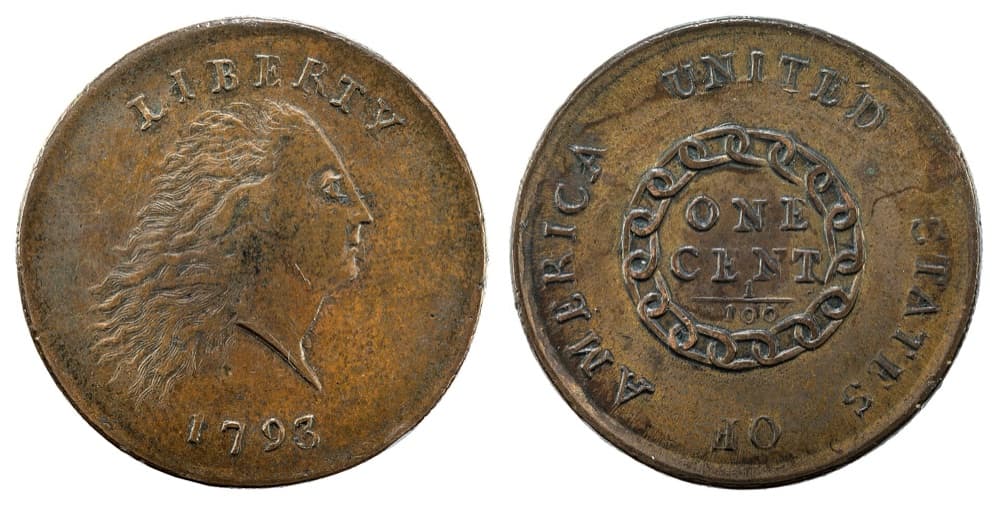
1793 Chain Cent (S-4, AMERICA)
The first coins struck in the new United States Mint were mocked as a bad omen for liberty and pulled within weeks; this Gem example sold for $27 in 1864 and $1,380,000 in 2012, and for most of the twentieth century nobody realized two famous specimens were the same coin.
- Year
- 1793
- Maker
- U.S. Mint (Philadelphia)
- By price in coins
- 23 of 100
Create a free account to see every recorded price and every grade.
Create a free account- Struck
- March 1 to March 12, 1793, Philadelphia Mint (no mintmark)
- Variety
- Sheldon-4 (Breen-5): AMERICA spelled in full, with periods after LIBERTY and after the date
- Design
- Liberty with flowing hair facing right; reverse a chain of 15 links, one for each state in 1793, around ONE CENT and 1/100
- Designer
- Generally credited to Henry Voigt, the Mint's first Chief Coiner; who cut the S-4 obverse die is unresolved
- Total Chain cent mintage
- 36,103 delivered over twelve days
- This coin
- PCGS MS65 Brown, CAC; the plate coin in Walter Breen's encyclopedia of early cents
- Pedigree
- Zanoni, Cleneay, Mills, Earle, Bement, Ellsworth, Atwater, Eliasberg, Oliver Jung, and later private collections
- Rank among S-4s
- Considered the third finest of three S-4 cents with claims to Mint State
- Record
- $1,380,000 at auction in Orlando, Florida, January 4, 2012, then a record for a U.S. copper coin at public auction
- Last public sale found
- $990,000 at auction in Long Beach, California, June 14, 2018
The first coins from the first Mint
President George Washington signed the Coinage Act on April 2, 1792. It created the dollar as the national unit of money, with the cent as one-hundredth of it, and established the United States Mint. The act called for a copper cent of 11 pennyweights. Mint Director David Rittenhouse laid the cornerstone of the Mint building in Philadelphia on July 31, 1792.
On January 29, 1793, Washington signed the certificate appointing Henry Voigt as Chief Coiner. The National Archives describes Voigt as a Philadelphia watchmaker and machinist who had helped develop the first commercially viable steamboat in the United States, and credits him with designing some of the first United States coins.
A few 1792 half dismes and patterns came first, but the Chain cents were the first actual United States coins minted at the Philadelphia Mint, in March 1793. Deliveries began with 11,178 pieces on March 1 and ended with 5,578 on March 12, for a total of 36,103. They were struck from five die combinations, four of which shared one reverse die.
The cent is called the Chain cent for its reverse: a ring of 15 interlocking links, one for each state in the Union at the time, the original thirteen plus Vermont and Kentucky. The links were meant to stand for unity, as chains had on the earlier Fugio cent and Continental currency.
"A bad omen for liberty"
The public did not like the new cent. A newspaper report quoted a letter from Newark: "The American Cents do not answer our expectations. The Chain on the reverse is but a bad omen for liberty, and Liberty herself appears to be in a fright." The March 18, 1793, edition of Philadelphia's The Mail repeated that the chain was "but a bad omen for liberty." Many readers took the chain as a symbol of slavery rather than union.
The first reverse die had another problem. The engraver had not left room for the full legend, so the earliest coins read UNITED STATES OF AMERI. One account holds that Rittenhouse ordered the abbreviation to balance the design. Every later Chain cent die combination spells out AMERICA.
By March the Mint had run out of planchets, which halted striking. In the pause, a new design with a wreath on the reverse was prepared and approved, and the Chain cent became a type made for less than two weeks.
How to tell an S-4
The S-4 obverse is unlike the other Chain cent dies. LIBERTY is closely spaced, with the I and E set high, and the date is close, especially the final 93. A period follows both LIBERTY and the date, a dual punctuation found nowhere else in the large cent series. The reverse, with AMERICA in full, is the same die used for S-2, S-3 and the NC-1 variety.
The hair is handled differently too, and the specialist Walter Breen suggested that a different engraver cut this die. Because the periods resemble those on Joseph Wright's 1792 pattern quarters, Breen proposed Wright; the researcher Harry Salyards suggested the engraver went on to make the Wreath cent obverses. Who engraved the 1793 cents remains unsettled.
S-4 is believed to be the last Chain cent die marriage, struck between March 8 and 12. Breen thought more than 8,800 were made. The edge carries a vine and bars design.
On this example, a faint die crack runs from the rim at seven o'clock into the hair, with a second following the rim toward the date. A small planchet clip and a tiny lamination sit at the same spot near the date, the slightly out-of-round edge that catalogers noted in 1912 and 1916. A small patch of corrosion on the reverse, near the F in OF, has been described in catalogs since 1996 and has not changed.
One coin, two pedigrees
The coin's recorded history begins at an October 1864 auction, where it was described as "Splendid, uncirculated, of the highest degree of rarity" and sold for $27 to the collector Joseph Zanoni. It passed privately to the collector Thomas Cleneay and reappeared at the sale of his collection in December 1890, called "the finest specimen known of this variety," bringing $122.50.
It next sold in the John G. Mills collection in April 1904 for $235, to the Philadelphia collector George Earle. At Earle's sale in June 1912 it brought only $140, then passed privately for $200 to another Philadelphian, Clarence S. Bement. At Bement's sale in May 1916 it brought $300, bought under an alias by Colonel James W. Ellsworth.
In 1923 Ellsworth's collection was bought in a partnership involving John Work Garrett, and the cent went to William Cutler Atwater. Atwater stopped collecting around then, but his coins were not sold until after his death; at the June 1946 sale this cent brought $330 from Louis E. Eliasberg Sr.
The catalogers of the 1946 sale missed the planchet clip, and the coin's pre-1923 history was lost. For decades it was listed as two different coins: the Zanoni-Cleneay-Bement cent and the Ellsworth-Atwater-Eliasberg cent. Only when the Eliasberg coin was compared with the plate photograph in the 1916 Bement catalog, as the Eliasberg collection was prepared for sale in May 1996, were the two histories joined. At that 1996 sale it was graded MS64 Brown.
Sometime between 1996 and 2004 it was certified MS65 Brown. It sold for $391,000 in the Oliver Jung collection in July 2004. On January 4, 2012, at auction in Orlando, Florida, during the Florida United Numismatists convention, it sold for $1,380,000 including the 15 percent buyer's premium, to a buyer described only as a major collector. It was then a record price for a U.S. copper coin at public auction. It returned to auction in Long Beach, California, on June 14, 2018, as part of an important New York collection of type coins, and sold for $990,000.
Third finest of the famous three
Only three S-4 cents have claims to Mint State, and a wide gap separates them from the next tier of four or five About Uncirculated pieces. The finest, sometimes called "The Coin," is certified Specimen 67 Brown and traces to the nineteenth-century collector Joseph Mickley, who may have obtained it from the Mint Cabinet; the large-cent authority William Sheldon called it possibly the most perfect Chain cent in existence. The second is the Parmelee coin, certified MS66 Brown, which sold for $2,350,000 in January 2015. This Eliasberg coin is the third.
Its 2012 record did not stand long. The Parmelee S-4 passed it in 2015, and in January 2019 the Elder-Naftzger-Weinberg S-1 AMERI. cent, graded MS64+, sold for $1.5 million.
Grading standards for early copper differ sharply between communities. The same 2018 catalog that offered the coin as PCGS MS65 Brown gave its own grade under the stricter standards of early American copper specialists as MS60.
Roughly 1,000 Chain cents of all varieties are known today, and even well-worn examples sell for thousands of dollars. As a one-year type and the first business-strike cent of the United States Mint, the Chain cent has always been in demand from both large cent specialists and type collectors.
The numbers
- Mintage
- 36,103 Chain cents of all varieties, delivered March 1 to 12, 1793; Walter Breen believed S-4 alone exceeded 8,800
- Known survivors
- About 1,000 Chain cents of all varieties; only three S-4s have claims to Mint State
- Weight
- 13.48 grams
- Diameter
- 26 to 27 mm (one reference gives 26.00 mm)
- Composition
- Copper
- Edge
- Vine and bars
- Designer
- Attributed to Henry Voigt; Breen proposed Joseph Wright for the S-4 obverse die
Timeline
Washington signs the Coinage Act, creating the dollar, the cent and the United States Mint.
Mint Director David Rittenhouse lays the cornerstone of the Mint building in Philadelphia.
Washington appoints Henry Voigt Chief Coiner of the Mint.
The Mint delivers its first 11,178 Chain cents, the AMERI. variety among them.
Final delivery of 5,578 cents; the S-4 die marriage is believed struck between March 8 and 12. Total: 36,103.
Philadelphia's The Mail calls the chain "but a bad omen for liberty."
This coin sells at auction for $27 to collector Joseph Zanoni.
Sold from the Thomas Cleneay collection for $122.50, described as the finest known of the variety.
Sold from the John G. Mills collection for $235 to George Earle.
Sold from the Earle collection for $140, then privately to Clarence S. Bement for $200.
Sold from the Bement collection for $300 to Colonel James W. Ellsworth.
Ellsworth's collection is sold; the coin goes to William Cutler Atwater.
Sold from the Atwater estate for $330 to Louis E. Eliasberg Sr.
Offered with the Eliasberg collection as MS64 Brown; its lost nineteenth-century history is reconnected through the Bement plate.
Now certified PCGS MS65 Brown, it sells for $391,000 in the Oliver Jung collection.
Sells for $1,380,000 at auction in Orlando, a record for a U.S. copper coin at public auction.
The finer Parmelee S-4, MS66 Brown, sells for $2,350,000.
Sells for $990,000 at auction in Long Beach, California.
The world in 1793
Mozart's Requiem is performed for the benefit of his widow.
Former King Louis XVI is guillotined in Paris.
The French Republic declares war on Great Britain and the Dutch Republic.
George Washington begins his second term as president.
Washington issues the Neutrality Proclamation.
A yellow fever epidemic strikes Philadelphia, the home of the Mint; about 5,000 die by November.
The Louvre in Paris opens to the public as an art museum.
Washington dedicates the cornerstone of the United States Capitol.
Price record
| Date | Price | Kind |
|---|---|---|
| Oct 1864 | $27 | Sold at auctionSold at auction to collector Joseph Zanoni. |
| Dec 1890 | $123 | Sold at auctionThomas Cleneay collection sale. |
| Apr 1904 | $235 | Sold at auctionJohn G. Mills collection sale; bought by George Earle. |
| 1912 | $200 | Private saleSold privately to Clarence S. Bement shortly after the Earle sale. |
| Jun 1912 | $140 | Sold at auctionGeorge Earle collection sale. |
| May 1916 | $300 | Sold at auctionClarence S. Bement collection sale; bought for James W. Ellsworth. |
| Jun 1946 | $330 | Sold at auctionWilliam Cutler Atwater collection sale; bought by Louis E. Eliasberg Sr. |
| Jul 2004 | $391,000 | Sold at auctionOliver Jung collection sale; PCGS MS65 Brown. |
| Jan 4, 2012 | $1,380,000 | Sold at auctionSold at auction in Orlando, Florida, including 15% buyer's premium. Then a record for a U.S. copper coin at public auction. |
| Jun 14, 2018 | $990,000 | Sold at auctionSold at auction in Long Beach, California, from an important New York collection; price includes 20% buyer's premium. |
A realized auction price is what a buyer actually paid on the date shown, including the buyer's premium where the sale reported it. It is the strongest kind of reference price, and it is a record of one sale of one object on one day, not a promise of what the next example will bring.
By reference price, 1793 Chain Cent (S-4, AMERICA) is number 23 of 100 in the coins entries of the FLOAT 100. 96 of those 100 rest on a realized sale; the rest carry an asking price or a guide value, and each page says which. Rank within the FLOAT 100 itself (16 here) is editorial: how much an object defines its field, not price alone.
Did you know
- For most of the twentieth century this coin was catalogued as two different coins, until a comparison with a 1916 catalog photograph proved the Bement cent and the Eliasberg cent were one and the same.
- Its price went from $27 in 1864 to $1,380,000 in 2012, but the climb was not steady: it brought $235 in 1904 and only $140 in 1912, and $990,000 in 2018 after $1,380,000 in 2012.
- S-4 is the only large cent with a period after both LIBERTY and the date.
- The very first Chain cents read UNITED STATES OF AMERI. because the engraver ran out of room on the die.
- A 1793 newspaper complained that Liberty on the new cent "appears to be in a fright."
- The same catalog that sold it as MS65 in 2018 noted that early copper specialists would grade it MS60.
- The Mint's first Chief Coiner, Henry Voigt, had earlier helped develop the first commercially viable steamboat in the United States.
How this page is made
- The figure
- One reference price, shown with its own kind. FLOAT does not average it with anything or adjust it for time.
- Realized or not
- A realized price is a completed sale. An asking price, an estimate and a price-guide value are not sales, and are labeled as such wherever they appear.
- The story
- Researched from published records and checked fact by fact. Updated Oct 1, 2026.
- Archive
- Oct 5, 2026