FLOAT 100 · Coins · No. 87
1792 Silver Center Cent
In December 1792 the brand-new U.S. Mint tried to solve an impossible coin by punching a hole in a copper blank and pressing a plug of silver into it, and the handful of survivors are now among the most prized pieces of early American money.
- Year
- 1792
- Maker
- U.S. Mint (Philadelphia)
- By price in coins
- 22 of 100
Create a free account to see every recorded price and every grade.
Create a free account- Struck
- First struck December 17, 1792, at the Philadelphia Mint
- Type
- Pattern one cent: copper planchet with an inserted silver plug, reeded edge
- Catalog
- Judd-1, Pollock-1
- Designer
- Traditionally credited to Chief Coiner Henry Voigt; some experts doubt he engraved it
- Known survivors
- About 12 to 14 originals, depending on the source
- This coin
- The Newman specimen, graded NGC MS63+ Brown (the record lists PCGS; Coin World reports NGC)
- Pedigree
- F.C.C. Boyd, then Eric P. Newman from 1951
- Sold
- $1,410,000, May 16, 2014, at auction in New York
- Finest known
- The Garrett specimen, PCGS SP67 Brown
A cent that was too heavy to carry
The Coinage Act of April 2, 1792, created the United States Mint and fixed the cent at 11 pennyweights, or 264 grains, of pure copper. The law wanted every coin to hold its own value in metal, but a copper cent of that weight would have been a slab far too heavy for everyday use.
Secretary of State Thomas Jefferson favored a mixed-metal answer: a smaller coin whose bit of silver made up the missing value. Treasury Secretary Alexander Hamilton worried that a copper-silver alloy would look too much like plain copper and invite counterfeiters. The silver center cent kept the two metals apart where anyone could see them. A copper ring worth about a quarter of a cent surrounded a silver plug worth about three-quarters of a cent.
The Mint tested four approaches to the cent that year: the large copper piece known as the Birch cent, the silver center cent, a fusion cent of the same small size in which silver and copper were melted together, and a small cent in pure copper. No written record of the trials survives. The large copper format won, and when cents went into production in 1793 they were plain copper; Congress lowered the weight standard to 208 grains instead.
Voigt, Jefferson and the first strikes
Henry Voigt, the Mint's first Chief Coiner, kept a journal, and a note in it records that the first silver center cents were struck on December 17, 1792. The next day Thomas Jefferson reported the new pieces to President Washington. That timing makes them the first coins struck on the grounds of the U.S. Mint, ahead of the regular copper cents of 1793.
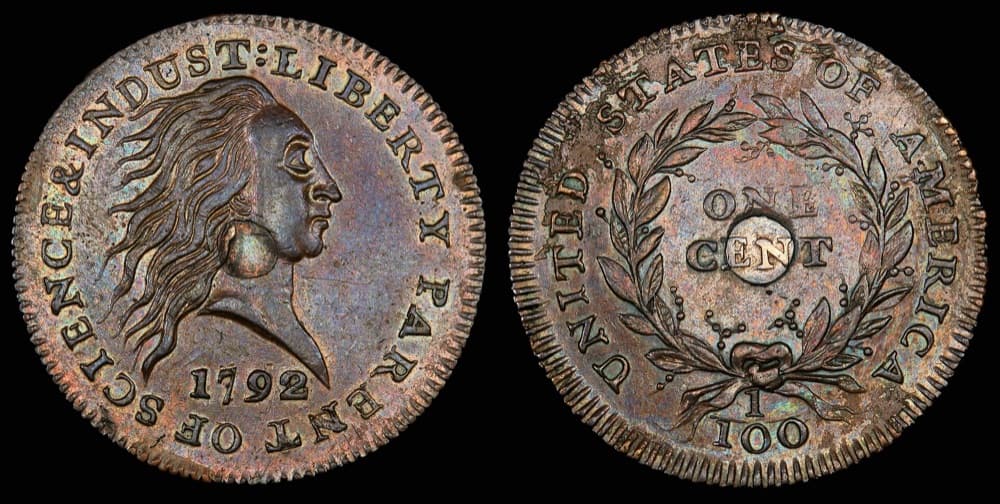
Credit for the design has usually gone to Voigt. Numismatist Ron Guth argues the attribution is probably wrong, since the engraving is finer than a man with no engraving background could likely have produced. The obverse shows Liberty facing right with loose hair, the date below, and the legend LIBERTY PARENT OF SCIENCE & INDUST. The reverse has ONE CENT inside a wreath, the fraction 1/100 below it, and UNITED STATES OF AMERICA around the edge.
Making the coins meant punching a hole in each copper blank, inserting a silver plug, and striking the two pieces together. That was too slow for a mint that needed to turn out cents by the thousand, and the experiment ended almost as soon as it began.
A government building its money from scratch
In 1792 the federal government was barely three years old. Congress set up the Post Office Department in February, Washington used the first presidential veto in April, and Kentucky joined the Union as the 15th state in June. The cornerstone of the President's House was laid in October, and Washington was reelected in December, the same month the silver center cents were struck.
Americans were still paying with a mix of foreign coins and state money. Building a mint, hiring its staff and choosing metals and weights were all part of an argument about what kind of country the United States would be. In May the Buttonwood Agreement started what became the New York Stock Exchange, while the new Mint was still working out what a cent should weigh.
The Newman coin and its rivals
This coin's early history runs through F.C.C. Boyd, one of the great 20th-century collectors of early American coins. In 1951 Eric P. Newman acquired it by trading Boyd the Clinton cent from the Theodore Grand collection. It stayed with Newman, and later with his Eric P. Newman Numismatic Education Society, for more than six decades.
On May 16, 2014, the coin sold at auction in New York as part of the fourth sale of Newman's collection. Graded NGC MS63+ Brown, it brought $1,410,000 including the 17.5 percent buyer's fee, a record for the issue at that point, according to Coin World. Sources describe its grade differently: one reference calls it extremely fine, and the PCGS condition census lists it as an estimated SP62 Brown, third finest known.
Its rivals have since gone higher. The Garrett specimen, which sold for $95,000 in 1981, reportedly changed hands privately for $5 million in January 2012 and then sold at auction in January 2021 for $2,520,000 as PCGS SP67 Brown. The Norweb coin brought $1,997,500 in August 2014, and a PCGS MS61 example sold for $1,150,000 in April 2012. Lower-grade survivors have sold for $253,000 to $499,375.
How to know a silver center cent
The silver plug sits in the middle of the coin, so it shows on both sides as a small, paler disk inside Liberty's head and inside the reverse wreath. PCGS lists the diameter as 24 millimeters and the weight as 4.48 grams, with a reeded edge. Plain-edge pieces were considered counterfeits by J. Hewitt Judd, author of the standard reference on U.S. patterns.
Not every piece is what it seems. Two examples, known as the Morris and California coins, carry plugs added after they left the Mint. Around 1924, when the original Mint building was torn down, blank planchets for the issue turned up without their silver centers. In 1994 dealer Anthony Terranova found a struck piece that never had a plug at all, weighing 72.6 grains; experts think it may have been a test of the new coin's size.
In 2015 PCGS began labeling all silver center cents as specimens (SP) rather than mint state (MS), so the same coin can appear under both prefixes in older and newer records.
The numbers
- Mintage
- Not recorded; a small number of test pieces
- Known survivors
- 12 originals (one reference) to 14 (PCGS and Coin World)
- Weight
- 4.48 grams (PCGS)
- Diameter
- 24 mm (PCGS); about 23 mm in another reference
- Composition
- Copper planchet with a silver plug; silver worth about 3/4 cent, copper about 1/4 cent
- Edge
- Reeded
- Designer
- Traditionally Henry Voigt; disputed
- This coin's grade
- NGC MS63+ Brown; PCGS census estimate SP62 Brown
Timeline
The Coinage Act creates the U.S. Mint and sets the cent at 264 grains of copper.
Henry Voigt's journal records the first silver center cents struck.
Thomas Jefferson reports the new pieces to President Washington.
Regular cents go into production in pure copper; the silver center design is dropped.
One survivor appears in an early American coin sale, the start of a recorded pedigree.
Demolition of the original Mint building turns up silver center blanks without their plugs.
Eric P. Newman acquires this coin from F.C.C. Boyd, trading the Clinton cent for it.
The Garrett specimen sells for $95,000.
Anthony Terranova discovers a struck silver center cent that never had a plug.
A PCGS MS61 example sells at auction for $1,150,000.
The Newman coin, NGC MS63+ Brown, sells at auction in New York for $1,410,000.
The Norweb coin sells for $1,997,500.
PCGS begins designating silver center cents as specimens.
The Garrett specimen, PCGS SP67 Brown, sells at auction for $2,520,000.
The world in 1792
Washington signs the Postal Service Act, creating the Post Office Department.
Washington issues the first presidential veto.
The Buttonwood Agreement begins what becomes the New York Stock Exchange.
Kentucky is admitted as the 15th state.
The cornerstone of the President's House, later the White House, is laid.
George Washington is reelected president.
Price record
| Date | Price | Kind |
|---|---|---|
| May 16, 2014 | $1,410,000 | Sold at auctionThe Newman coin, NGC MS63+ Brown, Judd-1; includes 17.5% buyer's fee. Sold at auction in New York. |
A realized auction price is what a buyer actually paid on the date shown, including the buyer's premium where the sale reported it. It is the strongest kind of reference price, and it is a record of one sale of one object on one day, not a promise of what the next example will bring.
By reference price, 1792 Silver Center Cent is number 22 of 100 in the coins entries of the FLOAT 100. 96 of those 100 rest on a realized sale; the rest carry an asking price or a guide value, and each page says which. Rank within the FLOAT 100 itself (87 here) is editorial: how much an object defines its field, not price alone.
Did you know
- Silver center cents are described as the first coins struck on the grounds of the U.S. Mint.
- The silver plug was meant to make a small coin worth a full cent in metal, with the silver supplying about three-quarters of its value.
- Eric P. Newman got this coin in 1951 by trading away a Clinton cent.
- One survivor was found in a jar of coins hidden inside a wall during a building renovation near Doylestown, Pennsylvania.
- One survivor sold for $45 in 1875.
- A struck silver center cent with no silver in it at all was discovered in 1994.
How this page is made
- The figure
- One reference price, shown with its own kind. FLOAT does not average it with anything or adjust it for time.
- Realized or not
- A realized price is a completed sale. An asking price, an estimate and a price-guide value are not sales, and are labeled as such wherever they appear.
- The story
- Researched from published records and checked fact by fact. Updated Oct 3, 2026.
- Archive
- Oct 5, 2026