FLOAT 100 · Coins · No. 86
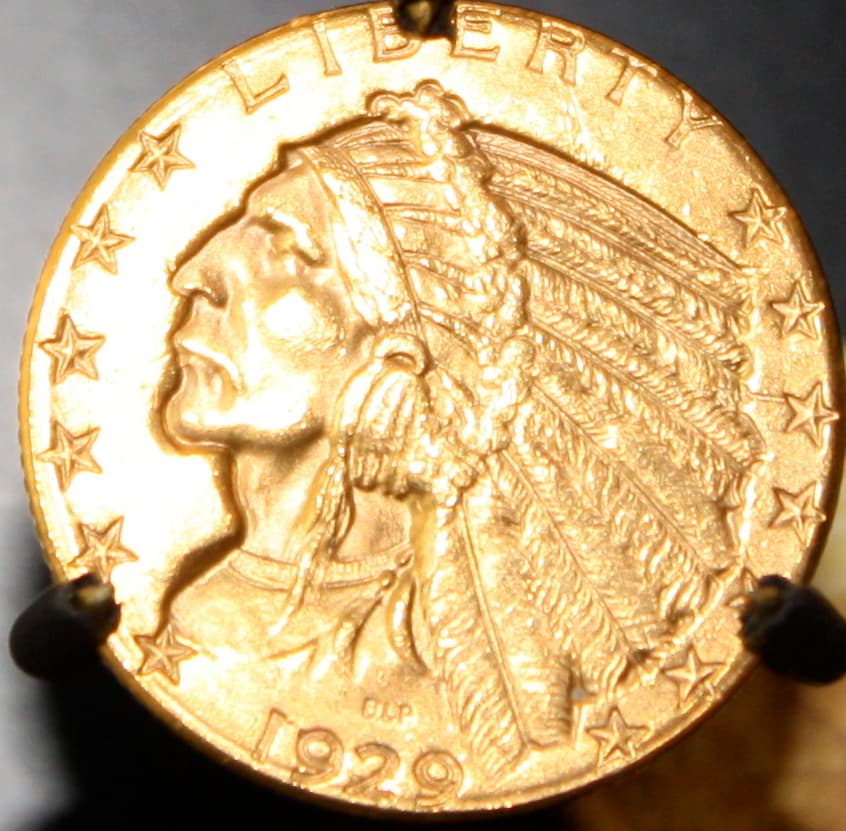
1929 Indian Head Half Eagle (Last Year)
The last five-dollar gold piece the United States ever made for circulation was struck in the year of the Crash, sat in federal vaults until the gold recall, and was melted almost entirely, leaving a coin rarer than the famous 1909-O.
- Year
- 1929
- Maker
- U.S. Mint (Philadelphia)
- By price in coins
- 82 of 100
Create a free account to see every recorded price and every grade.
Create a free account- Struck
- 1929, Philadelphia only
- Mintage
- 662,000 per PCGS; one reference gives 668,000
- Why it matters
- The final circulating U.S. half eagle and the last year of the Indian Head series; the first half eagle struck since 1916
- Survivors
- PCGS estimates 783; other estimates run from 400-500 to 480-635
- Designer
- Bela Lyon Pratt, Boston sculptor
- Specs
- 8.36 grams, 21.6 mm, 90% gold and 10% copper, reeded edge
- This entry
- PCGS MS62, a typical grade for a coin that is usually heavily bag-marked
- Auction record
- $132,000 for a PCGS MS65, January 2025
One more year of half eagles
Bela Lyon Pratt's Indian Head half eagle, with its design sunk below the surface, first appeared in 1908. It came out of an idea from President Theodore Roosevelt's friend Dr. William Sturgis Bigelow, an art lover who had spent most of 1907 in Japan. For the portrait, Pratt used a photograph of an unknown Native American man from his own collection.
The Mint stopped making half eagles after 1916. The new Federal Reserve System, created in 1913, put more banknotes into circulation, and World War I drove gold prices up and gold coins out of circulation.
In 1929 Philadelphia struck half eagles one more time. It was the first half eagle since 1916, the last of the Indian series, and the final circulating five-dollar gold coin the U.S. Mint ever produced.
From the vault to the furnace
With 662,000 struck, the 1929 has one of the higher mintages in the series; only six earlier issues were larger. But very few of the coins entered commerce. Virtually the whole mintage stayed in federal vaults until the gold recall of 1933 stopped any further distribution.
President Franklin Roosevelt ended the issuance of gold coins in 1933, and Executive Order 6102 recalled coins held privately and by banks. Beginning in 1937, gold coins that had stayed in government hands or come back through the recall were melted. That created a run of late-date rarities in the Indian half eagle, Indian eagle and Saint-Gaudens double eagle series, and it ended the half eagle, a denomination that had begun in 1795.
The best surviving coins were probably obtained straight from the Mint or Treasury by collectors of the day. A small number survived because they were shipped overseas to settle international payments; brought back in later years, they make up the majority of survivors. Some 1929 half eagles may still be in bank vaults in Europe.
Scarcer than the 1909-O
Collectors chase the 1909-O as the key to the series, but by total coins in existence the 1929 is rarer. In 2024 one writer counted a PCGS population of 392 and an NGC census of 234 for the 1929, against 747 and 1,076 for the 1909-O, and estimated that between 480 and 635 1929 half eagles exist, probably 460 to 530 of them certified. More than 1,200 1909-O half eagles survive by the same account. PCGS's survival estimate for the 1929 is higher, at 783.
Almost all survivors are uncirculated, and they cluster at MS63 to MS64, inflated by coins cracked out of their holders and resubmitted in hopes of an upgrade. Gem coins are very rare: PCGS estimates only 16 at MS65 or better, and David Akers wrote that he had never seen one finer than MS65.
The 1929 has also lagged the boom in better-date gold. A 2024 analysis found that prices for 1929 half eagles were not much higher, if higher at all, than they had been from 2011 to mid-2015, while many 19th-century gold rarities had more than doubled.
What an MS62 looks like
Akers described most uncirculated 1929s as heavily bag-marked, which puts them in the MS60 to MS62 range; choice coins at MS63 are very rare, he wrote. An MS62 is therefore a representative example of what survived.
The 1929 is generally well struck, though some show weakness on the obverse, especially the lowest feather of the headdress. Many have an unusual line or indentation running just inside the edge, easiest to see through the date and through STATES OF on the reverse. Luster is very good to excellent, surfaces are frosty or somewhat satiny, and color is medium to deep yellow gold, often with a greenish tint.
PCGS-graded MS62 examples have sold for $41,125 in October 2014, $37,600 in August 2015, $38,775 in November 2016, $33,600 in May 2022 and $40,800 in February 2026, the last with a CAC sticker.
The end of the half eagle
The 1929 has appeared at auction more than 500 times since its first appearance in 1936, mostly as uncirculated coins. One cataloger noted that five dollars was a lot of money in the Depression, which helps explain why even coins saved at the time were not carefully kept.
The finest are famous in their own right. The Jim O'Neal coin, graded PCGS MS65, brought $86,250 in January 2011 and $90,000 in July 2023. Another PCGS MS65 set the current auction record of $132,000 in January 2025.
The numbers
- Mintage
- 662,000 (PCGS); 668,000 (Wikipedia)
- Known survivors
- PCGS estimate 783 (600 at MS60+, 16 at MS65+); other estimates 400-635
- Weight
- 8.36 grams
- Diameter
- 21.60 mm
- Composition
- 90% gold, 10% copper
- Edge
- Reeded
- Designer
- Bela Lyon Pratt
- Mint
- Philadelphia
Timeline
Pratt's incuse Indian Head half eagle is introduced.
The Federal Reserve System is created.
Half eagle production stops.
Philadelphia strikes 662,000 half eagles, most of which stay in federal vaults.
Executive Order 6102 ends gold coin issuance and recalls gold coins.
A 1929 half eagle makes its first auction appearance.
Melting of recalled and stored gold coins begins.
The Jim O'Neal PCGS MS65 brings $86,250.
A PCGS MS62 brings $41,125.
A PCGS MS62 brings $33,600.
A PCGS MS65 sets the $132,000 auction record.
A PCGS MS62 CAC brings $40,800.
The world in 1929
Seven men are murdered in Chicago's St. Valentine's Day Massacre.
Grand Teton National Park is dedicated.
Herbert Hoover is sworn in as the 31st president.
The first Academy Awards are held at the Hollywood Roosevelt Hotel.
Black Thursday on the New York Stock Exchange.
Black Tuesday on the New York Stock Exchange.
The Museum of Modern Art opens to the public.
Price record
| Date | Price | Kind |
|---|---|---|
| Oct 9, 2014 | $41,125 | Sold at auctionPCGS MS62. |
| Aug 12, 2015 | $37,600 | Sold at auctionPCGS MS62. |
| Nov 1, 2016 | $38,775 | Sold at auctionPCGS MS62. |
| Feb 2019 | $28,000 | Sold at auctionPCGS MS62, internet auction. |
| Nov 2019 | $26,400 | Sold at auctionPCGS MS62 CAC, at auction in Baltimore. |
| Nov 2020 | $26,400 | Sold at auctionPCGS MS62 CAC. |
| May 5, 2022 | $33,600 | Sold at auctionPCGS MS62, no CAC sticker. |
| Feb 2026 | $40,800 | Sold at auctionPCGS MS62 CAC, in an old green holder. |
A realized auction price is what a buyer actually paid on the date shown, including the buyer's premium where the sale reported it. It is the strongest kind of reference price, and it is a record of one sale of one object on one day, not a promise of what the next example will bring.
By reference price, 1929 Indian Head Half Eagle (Last Year) is number 82 of 100 in the coins entries of the FLOAT 100. 96 of those 100 rest on a realized sale; the rest carry an asking price or a guide value, and each page says which. Rank within the FLOAT 100 itself (86 here) is editorial: how much an object defines its field, not price alone.
Did you know
- The 1929 was the first half eagle struck in 13 years and the last ever made for circulation.
- Despite a mintage over 660,000, fewer 1929 half eagles survive than 1909-O half eagles, which had a mintage of 34,200.
- Most surviving 1929 half eagles were shipped abroad to settle international payments and came back years later.
- Many 1929s show a strange line just inside the rim, most visible through the date.
- Pratt modeled the Indian on a photograph of an unknown man from his own collection.
How this page is made
- The figure
- One reference price, shown with its own kind. FLOAT does not average it with anything or adjust it for time.
- Realized or not
- A realized price is a completed sale. An asking price, an estimate and a price-guide value are not sales, and are labeled as such wherever they appear.
- The story
- Researched from published records and checked fact by fact. Updated Oct 3, 2026.
- Archive
- Oct 5, 2026