FLOAT 100 · Coins · No. 19
1796 Draped Bust Quarter Dollar
Few Americans wanted a quarter in 1796, when Spanish two-reales pieces already did the job, so the Mint made 6,146 of them, never made that design again, and created the only American quarter of the 18th century.
- Year
- 1796
- Maker
- U.S. Mint (Philadelphia)
- By price in coins
- 61 of 100
Create a free account to see every recorded price and every grade.
Create a free account- Struck
- 1796, Philadelphia Mint; first pieces struck April 9, 1796, with a final 252 delivered February 28, 1797
- Mintage
- 6,146
- Design
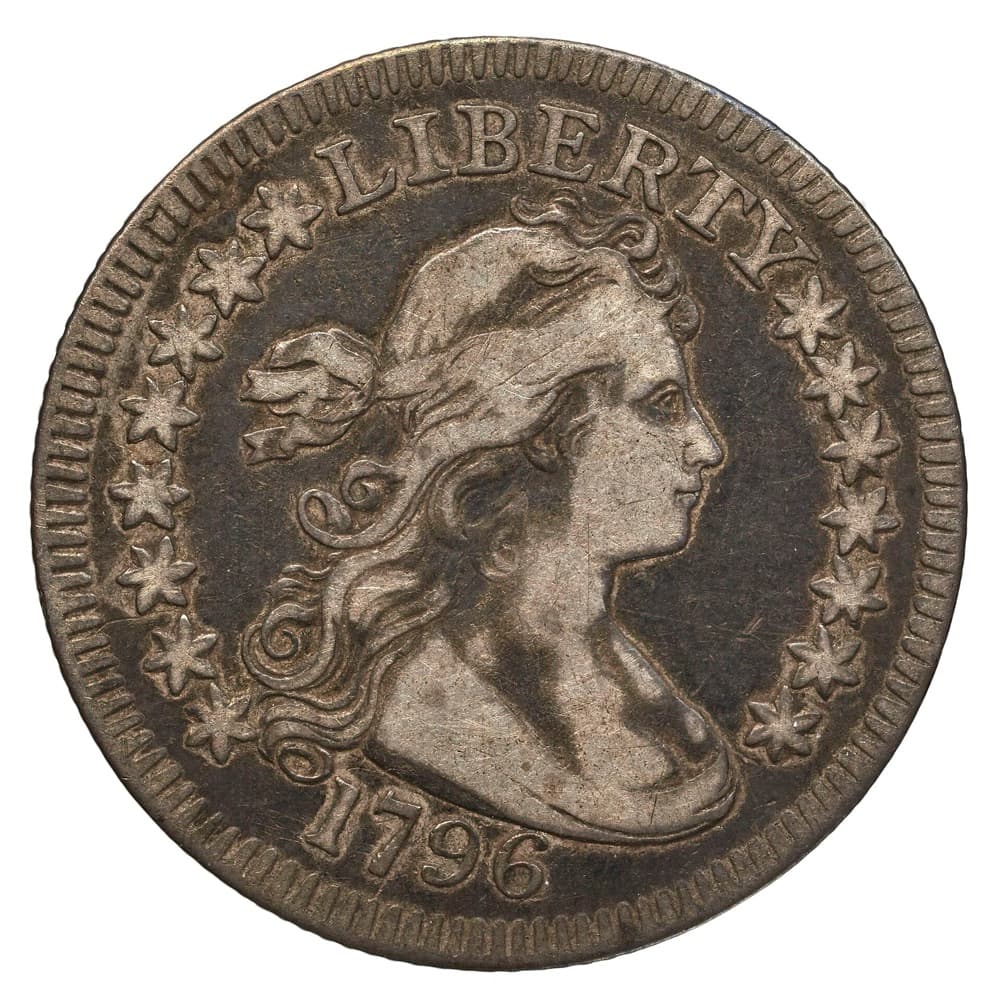
- Draped Bust obverse with 15 stars; Small Eagle reverse on clouds inside a wreath; no mark of value
- Portrait
- Attributed to Gilbert Stuart, engraved by Chief Engraver Robert Scot
- Varieties
- Two die marriages, Browning-1 (B-1, rarer) and Browning-2 (B-2), sharing one reverse die
- Why it matters
- First U.S. quarter dollar, the only quarter struck in the 18th century, and a one-year design type
- This entry
- B-1 variety, PCGS MS61, from the Frost Collection
- This coin's sale
- $168,000 at auction in Dallas, April 2025
- Highest reported price for the date
- $1,740,000 for a PCGS MS66 B-2, January 2022
A coin nobody asked for
The quarter dollar was written into law by the Coinage Act of April 2, 1792, which set it at 104 grains of silver 0.8924 fine. Thomas Jefferson had earlier toyed with a twenty-cent 'double tenth' that matched the Spanish pistareen, but the familiar 'two bits' won out: Americans had used the Spanish colonial two reales for generations, and a new money system needed a coin of equal value.
Law and demand were different things. In the 1790s the Mint struck silver only when bullion depositors asked for particular denominations, and almost nobody asked for quarters. Researchers Rory R. Rea and his co-authors, in their 2010 book Early Quarter Dollars of the United States Mint, suggest the reason was the steady supply of Spanish two reales coming up from Mexico and Central and South America. A 1796 two reales held 6.77 grams of .8330 fine silver; the new quarter held 6.74 grams of .8924 fine silver, close enough to trade as equals.
Half dimes, half dollars and dollars came first, in 1794. The dime and the quarter followed in 1796. The first quarters were struck on April 9, 1796, and the Mint recorded four deliveries in all: three in 1796 and a last, small one of 252 pieces on February 28, 1797, for a total of 6,146. After that, no quarter was struck again until 1804, and by then the design had changed.
That gap is the whole story of the coin's status. When production resumed in 1804 the Draped Bust portrait was paired with the new Heraldic Eagle reverse. The 1796 is therefore the only quarter with the Small Eagle reverse, the only quarter of the 18th century, and a design type that exists in a single year.
A painter's Liberty and an engraver's dies
Early American coins drew complaints that Liberty looked wild. To soften her, the Mint brought in Gilbert Stuart, the celebrated portrait painter, while Henry DeSaussure was Mint director. One published account says the Philadelphia socialite Mrs. William Bingham sat for the drawing. The result was a calmer, more human Liberty, facing right with her hair tied back by a ribbon.
Stuart did not like what the Mint did with it. Chief Engraver Robert Scot translated the sketches into dies, and Stuart never approved the adaptation or promoted the work. His role stayed out of print until an 1887 article in the American Journal of Numismatics made it public.
Scot himself was a Scottish-born watchmaker and line engraver who had engraved Virginia currency during the Revolution and paper money that helped finance the Siege of Yorktown. He was commissioned chief engraver on November 23, 1793, after the previous engraver, Joseph Wright, died in that year's yellow fever epidemic, and he held the post until his death in 1823 at a salary of $1,200 a year. Scot is credited with the Draped Bust design that appeared across silver and copper coins.
The reverse was borrowed from the 1794 silver dollar: a small eagle standing on a bank of clouds inside a wreath of laurel and lily tied with ribbon, ringed by UNITED STATES OF AMERICA. Like other early silver, the coin carries no denomination at all.
Fifteen stars, one state too few
The obverse shows 15 stars: the original 13 states plus Vermont, admitted in 1791, and Kentucky, admitted in 1792. Tennessee became the 16th state on June 1, 1796, less than two months after the first quarters were struck on April 9. Other denominations picked up a 16th star in mid-1796 or the next year, but the quarter never did. By 1804 the Mint had decided to cap the stars at 13 rather than let them crowd out the design.
It was a crowded year for a young country. The Jay Treaty with Britain took effect in February, and Britain handed over Detroit in July. Surveyors named a spot in Ohio 'Cleveland' that summer. On September 17 George Washington issued his Farewell Address, warning against party politics and foreign entanglements, and in November John Adams defeated Thomas Jefferson for the presidency. The Mint, like the federal government, was in Philadelphia.
Telling a B-1 from a B-2
Ard W. Browning's 1925 classification still names the two die marriages of 1796. Both share one reverse die; the obverses differ. Browning numbered the 'Low 6' as B-1 and the 'High 6' as B-2, but later research by Steve M. Tompkins in Early United States Quarters: 1796-1838 suggests B-2 was actually struck first, probably for the April and May deliveries, with B-1 following in June and again for the 252 pieces of 1797.
On a B-2, the final 6 of the date sits so high it nearly touches the bust, star 13 sits well away from Liberty's chest, and the die eventually shattered after the Mint tried to save it by lapping. On a B-1, the giveaway is the 9, canted sharply left with a tiny raised dimple near its base, plus a single malformed denticle between stars 1 and 2 that looks like a rounded mound. Star 13 sits close to the drapery. Because the shared reverse die was worn out by then, B-1 coins almost always show a weak eagle's head and a die crack through the F and A of AMERICA.
B-2 survives in much larger numbers; one published estimate calls it about three times as common as B-1, and most of the finest survivors are B-2s. B-1 is rated Rarity-4+, B-2 Rarity-3. On any 1796 quarter, wear shows first on the hair above the forehead and on the shoulder, and on the reverse at the eagle's breast and wing tops. A flat eagle's head is normal: it sits directly opposite Liberty's shoulder, where the metal had to fill both sides at once.
Many Mint State examples have prooflike or semi-prooflike fields. One B-1, graded SP66, is described as one of only two possible presentation strikes for the date; the other has not been traced since the late 1940s.
The hoard that wasn't, and the coins that were
More 1796 quarters survived than such a small, old mintage would suggest, and collectors long blamed a hoard. Walter Breen wrote in 1988 that Colonel E.H.R. Green, the collector who once owned all five 1913 Liberty Head nickels, held more than 200 Uncirculated 1796 quarters. Green's surviving inventory lists exactly six Mint State Draped Bust quarters, apparently one of each date, including one 1796. Breen's figure looks like a doubling of an older story: dealer Abe Kosoff recalled watching Philadelphia dealer James G. Macallister pull from his coat pocket a brown-paper package, 15 to 18 inches long, holding 'about 100 pieces, possibly a few more or less' of 1796 quarters.
Green's one coin became the most celebrated of all. Eric P. Newman bought it from the Green estate for $100 in the early 1940s. Graded NGC MS67+, it sold at auction in November 2013 for $1,527,500, a new record for a silver minor coin, with the proceeds going to charitable purposes. It now sits in a PCGS MS67 holder.
Other great examples have traveled just as far. The Ten Eyck coin, once described as a Proof, sold for $27,000 in 1975 and for $1,527,500 as PCGS MS66 in the Pogue family sale of May 2015. Another MS66, with a chain running from Waldo Newcomer and Green to T. James Clarke, was turned down raw at a $100,000 offer, later traded for $130,000, and sold in January 2022 for $1,740,000, the highest price reported for the date. The B-1 presentation piece went from the Stickney collection (1907) to John H. Clapp to Louis E. Eliasberg, Sr., brought $176,000 in 1997, and $881,250 in 2014.
The coin in this entry is a B-1, the rarer marriage, graded PCGS MS61 and offered from the Frost Collection. It led an April 3-6, 2025, auction in Dallas at $168,000. A senior executive of the auction firm called it one of the top half dozen B-1 examples and noted that the B-1 is 'even more elusive than the B-2.'
How many are left
Estimates differ, and the sources say so. One recent market survey believes roughly 700 survive, counts about 720 certifications across the major grading services (perhaps 550 different coins, since some are resubmitted), puts the average grade at Very Fine-30 or better, and suggests more than 100 Mint State pieces. A grading-service review of its own data concludes at least 10 to 12 percent of the mintage survives, with perhaps 50 to 60 in Mint State. Rea and his co-authors estimated 56 to 75 Uncirculated coins. FLOAT does not choose among them.
Demand reaches every grade. Holed, cleaned and heavily worn pieces still bring thousands of dollars, because no type set of American coins is complete without one, and the issue is a single-year design. At the top, the finest pieces sit in the seven-figure range.
The numbers
- Mintage
- 6,146 (5,894 delivered in 1796, 252 in February 1797)
- Known survivors
- Estimates vary: about 700 in one survey; at least 10-12% of the mintage in another. Mint State estimates range from 50-60 to more than 100.
- Weight
- 6.74 grams (104 grains)
- Diameter
- 27.5 millimeters
- Composition
- 89.2% silver, 10.8% copper (0.8924 fine)
- Designer
- Portrait attributed to Gilbert Stuart; dies engraved by Robert Scot
- Varieties
- B-1 (Rarity-4+) and B-2 (Rarity-3)
Timeline
The Coinage Act authorizes a quarter dollar of 104 grains of 0.8924 fine silver.
Robert Scot is commissioned chief engraver of the U.S. Mint.
The first quarter dollars are struck at Philadelphia.
Tennessee becomes the 16th state; the quarter keeps 15 stars.
A final delivery of 252 pieces brings the 1796 mintage to 6,146.
Quarter production resumes with the Heraldic Eagle reverse, ending the Small Eagle type.
An article in the American Journal of Numismatics makes Gilbert Stuart's role in the design public.
The B-1 presentation strike sells in the Matthew Stickney collection.
Ard W. Browning publishes the die-variety system still used for Draped Bust quarters.
John H. Clapp's collection, with the B-1 presentation strike, is sold intact to Louis E. Eliasberg, Sr.
The Newcomer-Green-Clarke MS66 is sold in the T. James Clarke collection.
The Ten Eyck example sells at auction for $27,000.
The Eliasberg B-1 presentation strike sells at auction for $176,000.
Eric P. Newman's Green coin, NGC MS67+, sells for $1,527,500.
The Pogue MS66 sells for $1,527,500.
The Simpson MS66 B-2 sells for $1,740,000, the highest price reported for the date.
The Frost Collection B-1, PCGS MS61, sells at auction in Dallas for $168,000.
A PCGS MS65 B-2 sells at auction for $480,000.
The world in 1796
Ratifications of the Jay Treaty with Britain are exchanged; Britain vacates the forts it had kept in the Great Lakes region.
Tennessee is admitted as the 16th state.
The United States takes possession of Detroit from Britain.
Surveyors name a site in Ohio 'Cleveland' after Moses Cleaveland.
George Washington issues his Farewell Address.
John Adams defeats Thomas Jefferson in the presidential election.
The Treaty of Tripoli is signed.
Price record
| Date | Price | Kind |
|---|---|---|
| May 1973 | $17,000 | Sold at auctionB-2, later PCGS MS65, Terrell Collection. |
| May 1974 | $18,500 | Sold at auctionSame B-2 coin, Austin Collection. |
| May 31, 1975 | $27,000 | Sold at auctionTen Eyck B-2, then described as a Proof; later PCGS MS66. |
| Mar 1977 | $16,500 | Sold at auctionB-2, later PCGS MS65, Reed Hawn Collection. |
| Oct 1994 | $57,500 | Sold at auctionSame B-2 coin, later PCGS MS65. |
| Apr 1997 | $176,000 | Sold at auctionB-1 presentation strike, later PCGS SP66, Eliasberg Collection. |
| Jul 2004 | $230,000 | Sold at auctionB-2, PCGS MS65, Oliver Jung Collection. |
| Aug 2010 | $322,000 | Sold at auctionNorweb B-2, PCGS MS65. |
| Nov 15, 2013 | $1,527,500 | Sold at auctionNewman-Green B-2, NGC MS67+. One census lists the price as $1,527,700. |
| Aug 7, 2014 | $881,250 | Sold at auctionB-1 presentation strike, PCGS SP66. |
| Sep 4, 2014 | $411,250 | Sold at auctionNorweb B-2, PCGS MS65, Pannonia Collection. |
| May 2015 | $1,527,500 | Sold at auctionTen Eyck-Pogue B-2, PCGS MS66. |
| Jan 19, 2020 | $303,750 | Sold at auctionPCGS MS64 in a first-generation holder, after 77 bids. |
| Jan 2022 | $1,740,000 | Sold at auctionNewcomer-Green-Clarke-Simpson B-2, PCGS MS66. Highest price reported for the date. |
| Apr 3, 2025 | $168,000 | Sold at auctionThis entry: B-1, PCGS MS61, Frost Collection. Sold at auction in Dallas on April 3, 2025, during an April 3-6 sale. |
| Nov 11, 2025 | $480,000 | Sold at auctionB-2, PCGS MS65, ex Terrell, Austin, Hawn and Jung. |
A realized auction price is what a buyer actually paid on the date shown, including the buyer's premium where the sale reported it. It is the strongest kind of reference price, and it is a record of one sale of one object on one day, not a promise of what the next example will bring.
By reference price, 1796 Draped Bust Quarter Dollar is number 61 of 100 in the coins entries of the FLOAT 100. 96 of those 100 rest on a realized sale; the rest carry an asking price or a guide value, and each page says which. Rank within the FLOAT 100 itself (19 here) is editorial: how much an object defines its field, not price alone.
Did you know
- The 1796 quarter does not say what it is worth: its design carries no denomination.
- Gilbert Stuart, one of the most celebrated portrait painters of his day, disliked the Mint's version of his Liberty, and his role stayed hidden until 1887.
- The quarter missed Tennessee's star by less than two months and never caught up, because the Mint capped the stars at 13 before the next quarter was struck.
- The finest-known 1796 quarter cost Eric P. Newman $100 in the early 1940s and sold for $1,527,500 in 2013.
- A famous story of a 200-coin hoard owned by Colonel E.H.R. Green turned out to be wrong: his inventory lists one 1796 quarter.
- A Spanish two reales and the new quarter held so nearly the same silver that merchants treated them as equals.
- One of the two obverse dies eventually shattered, and that late die state was so elusive it went unremarked until a 1935 auction in London.
How this page is made
- The figure
- One reference price, shown with its own kind. FLOAT does not average it with anything or adjust it for time.
- Realized or not
- A realized price is a completed sale. An asking price, an estimate and a price-guide value are not sales, and are labeled as such wherever they appear.
- The story
- Researched from published records and checked fact by fact. Updated Oct 1, 2026.
- Archive
- Oct 5, 2026