FLOAT 100 · Coins · No. 20
1796 No Stars Quarter Eagle
The first $2.50 gold piece came out with a bare field where every later quarter eagle has stars, nobody knows why, and fewer than a thousand were made.
- Year
- 1796
- Maker
- U.S. Mint (Philadelphia)
- By price in coins
- 75 of 100
Create a free account to see every recorded price and every grade.
Create a free account- Struck
- 1796, Philadelphia Mint; first delivery September 21, 1796
- Mintage
- 963 is the figure usually given, from deliveries of 66 and 897 coins; the exact split is uncertain
- Design
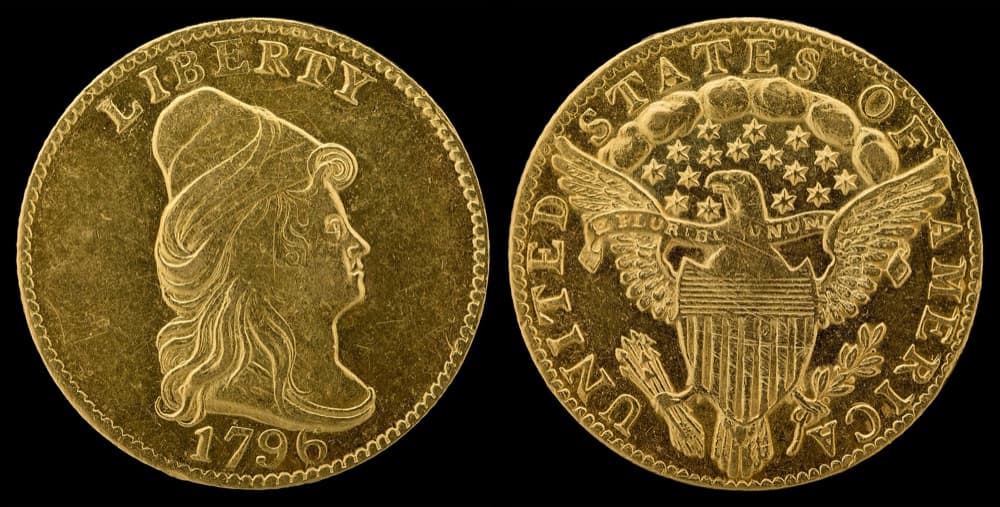
- Capped Bust Right Liberty with no stars; Heraldic Eagle reverse with 16 stars above the eagle
- Engraver
- Chief Engraver Robert Scot, probably; the reverse hubs may be John Smith Gardner's work
- Varieties
- BD-1 (4 to 6 known) and BD-2 (the variety of almost every survivor)
- Why it matters
- First U.S. quarter eagle and a one-year design: no later gold coin repeats the No Stars obverse
- This entry
- BD-2, graded NGC MS63; two NGC MS63 coins rank second in one published condition census
- Finest known
- PCGS MS65, ex Parmelee, Ward and Rogers; $1,725,000 in January 2008
- Highest reported price
- $2,160,000 for the Simpson PCGS MS62+ CAC, January 2022
Gold that had to wait for a bond
The Coinage Act of April 2, 1792 built the American money system on dollars for silver and eagles for gold. The eagle was a $10 gold coin; the quarter eagle, one-fourth of it, was worth $2.50 and was to weigh 67.5 grains of gold, .916 2/3 fine, with copper making up the rest.
Making gold was another matter. The cornerstone of the Philadelphia Mint, the first building put up by the federal government, was laid on July 31, 1792, and the first coins, 11,178 Chain cents, were delivered on March 1, 1793. But the law required the Mint's officers who handled gold and silver to post bonds of $10,000, a fortune when the assayer and chief coiner earned $1,200 a year. Congress lowered the bonds in 1794, silver coinage began that year, and gold began in 1795 with the half eagle and eagle.
The quarter eagle came last. Few depositors wanted gold in such a small unit; historian Walter Breen wondered why any were struck in the first decade at all and suggested that a few banks ordered them 'on a whim.' The denomination echoed coins Americans already used: the Spanish pistole, worth two Spanish milled dollars, and the quarter of the Portuguese johannes.
Three deliveries, two designs
No surviving record names the designer. Chief Engraver Robert Scot probably prepared the dies, and an engraver named John Smith Gardner, employed at the Mint in 1796, may have cut the reverse hubs, although researcher R.W. Julian believes Gardner was hired for routine work. The obverse copied the Capped Bust Right Liberty of the 1795 gold coins. The reverse used a heraldic eagle adapted from the Great Seal of the United States, with a shield on its breast, a cloud of 16 stars above its head, and an olive branch and arrows in its claws.
The Mint's delivery warrants tell the rest. The chief coiner delivered the first 66 quarter eagles on September 21, 1796. Numismatists think the reverse die then failed and there was no replacement, because the next delivery, 897 coins, did not arrive until December 8. A third delivery of 432 coins on January 14, 1797 carried a new obverse with 16 stars, eight on each side of Liberty.
Specialists link those deliveries to the two No Stars die marriages, BD-1 and BD-2 in the Bass-Dannreuther system, but the match is not exact. As one auction description put it, some of the January 1797 coins could have been No Stars pieces, or some of the December coins could have had stars, 'so that fewer than 963 of the No Stars varieties were struck.' The BD-1 is told apart by reverse arrows that reach the left foot of the I in UNITED.
Why the first obverse had no stars is unknown. The 16 stars that arrived in January 1797 match the number of states after Tennessee joined on June 1, 1796, and the starred coin has long invited speculation that it marked Tennessee's admission. Even the Mint was confused about its own coin: Director James Ross Snowden wrote in 1860 that the first issue was 'of the same type as the eagle,' meaning a small-eagle reverse, but no quarter eagle with that design is known.
Philadelphia, 1796
The Mint stood in Philadelphia, which had been the nation's capital when the Mint was founded. Four days before the first quarter eagles were delivered, on September 17, 1796, George Washington had published his Farewell Address. In November, John Adams beat Thomas Jefferson for the presidency, and the Treaty of Tripoli was signed two days later.
Gold coins did not stay put in that world. Many early quarter eagles, like other American gold, were exported and melted for profit, and the 1796 No Stars likely saw some circulation.
How many survive, and which are best
Estimates have moved a long way. Early claims put the number known at 15 to 20. The gold specialist David Akers called that exaggerated and suggested 30 to 40. An auction cataloger in January 2007 estimated 80 to 100. Grading-service experts now estimate 100 to 125, the Bass-Dannreuther reference gives 4 to 6 BD-1 and 100 to 125 BD-2, and another survey says 80 to 100 BD-2. One count found images of 28 different examples in About Uncirculated or better, 11 of them Mint State.
Perfect examples are hard to find. Many show lint marks of various sizes, and some show adjustment marks, usually in the center of the obverse. Akers wrote that most specimens he had seen were weakly struck on the hair curls around the face, that some showed die deterioration at the E of LIBERTY, and that most known pieces are at least partly prooflike.
The finest known is a PCGS MS65, two full points above the next best. It was in Lorin G. Parmelee's collection in 1890, passed through Robert C.H. Brock and Philip H. Ward, Jr., sold for $7,750 in 1964, belonged to the University of Pennsylvania and then Lelan Rogers, and sold for $605,000 in 1995, $1,380,000 in 2005 and $1,725,000 in January 2008. Accounts of its 1890 price differ: one gives $17.50, another $18.
This entry is a BD-2 in an NGC MS63 holder. One published census places two NGC MS63 coins in second place behind the MS65. One sold for $178,250 in 2000 and $287,500 in January 2007. The other sold as NGC MS62 for $138,000 in January 2004, was offered at a coin show in February 2012 for $750,000, sold as MS63 for $252,625 that August, and brought $300,000 in January 2020.
From a family cabinet to a $2.16 million sale
Some of these coins stayed in one family for generations. The Newlin-Garrett example was sold by Harold P. Newlin to T. Harrison Garrett on October 31, 1884, passed down to Robert and John Work Garrett, went to Johns Hopkins University by gift in 1942, and sold for $125,000 in 1980. In the Pogue family sale of May 2015 it brought $822,500 as PCGS MS62.
The coin that set the price record has a shorter but steeper path. Once owned by James Swan and Oliver Jung, it sold for $345,000 as PCGS MS62 in 2004 and $488,750 in 2008, was upgraded half a point to MS62+ with CAC approval in Bob R. Simpson's collection, and sold in January 2022 for $2,160,000, above the 2008 price of the finer MS65.
Rarer still is the BD-1. An example of it sold for $94,000 at auction in Houston in December 2013. The Bass-Dannreuther reference calls BD-1 the rarest quarter eagle variety from 1796 through 1834.
The numbers
- Mintage
- 963 usually cited (66 delivered September 21, 1796 and 897 on December 8, 1796); the exact No Stars total is uncertain
- Known survivors
- Estimates range from 30-40 (Akers) to 100-125 (grading-service and Bass-Dannreuther estimates); BD-1, 4 to 6
- Weight
- 4.37 grams (67.5 grains)
- Diameter
- About 20 millimeters (20.00 mm in one reference; 13/16 inch, 20.6 mm, in another)
- Composition
- 91.67% gold, 8.33% copper (.916 2/3 fine)
- Designer
- Robert Scot, probably; reverse hubs possibly by John Smith Gardner
Timeline
The Coinage Act authorizes a $2.50 quarter eagle.
The cornerstone of the Philadelphia Mint is laid.
The Mint strikes its first gold coins, half eagles and eagles.
Tennessee becomes the 16th state.
The first 66 quarter eagles, No Stars, are delivered.
A second delivery of 897 No Stars quarter eagles follows a die failure.
432 quarter eagles with 16 obverse stars are delivered, ending the No Stars design.
Mint Director James Ross Snowden misdescribes the first quarter eagle's reverse in a published Mint catalog.
Harold P. Newlin sells his example to T. Harrison Garrett.
The finest-known MS65 sells in the Lorin G. Parmelee collection.
The Garrett coin goes to Johns Hopkins University by gift.
The MS65 sells for $7,750 in the Philip H. Ward, Jr. collection.
The Garrett coin sells for $125,000.
The MS65 sells for $605,000.
The MS65 sells for $1,380,000.
The MS65 sells for $1,725,000.
A rare BD-1 sells for $94,000 at auction in Houston.
The Newlin-Garrett coin brings $822,500 in the Pogue family sale.
The Simpson PCGS MS62+ CAC sells for $2,160,000, the highest price reported for the issue.
The Harry W. Bass, Jr. Foundation's PCGS MS63 sells for $990,000.
The world in 1796
Ratifications of the Jay Treaty with Britain are exchanged.
John Sevier is inaugurated as the first governor of Tennessee.
Tennessee is admitted as the 16th state.
The United States takes possession of Detroit from Britain.
George Washington issues his Farewell Address.
John Adams defeats Thomas Jefferson in the presidential election.
The Treaty of Tripoli is signed.
Price record
| Date | Price | Kind |
|---|---|---|
| Dec 1921 | $140 | Sold at auctionJohn Story Jenks example, later PCGS MS61/MS62. |
| May 1964 | $7,750 | Sold at auctionFinest-known MS65, Philip H. Ward, Jr. collection, then uncertified. |
| Mar 1980 | $125,000 | Sold at auctionNewlin-Garrett example, Johns Hopkins University collection, cataloged as AU55. |
| Oct 1994 | $82,500 | Sold at auctionJenks example, James A. Stack, Sr. collection. |
| Nov 1995 | $605,000 | Sold at auctionFinest-known MS65, Lelan Rogers collection, then uncertified. |
| May 1999 | $299,000 | Sold at auctionNewlin-Garrett example, John Whitney Walter collection. |
| Mar 2000 | $178,250 | Sold at auctionNGC MS63, one of two coins ranked second in a published census. |
| Jan 2004 | $138,000 | Sold at auctionNGC MS62, later NGC MS63. |
| Jul 2004 | $345,000 | Sold at auctionPCGS MS62, Oliver Jung collection; later the record coin. |
| Jun 2005 | $1,380,000 | Sold at auctionFinest-known PCGS MS65. |
| Aug 14, 2006 | $322,000 | Sold at auctionJenks example, PCGS MS61 CAC. |
| Jan 4, 2007 | $287,500 | Sold at auctionNGC MS63. |
| Jan 10, 2008 | $1,725,000 | Sold at auctionFinest-known PCGS MS65. |
| Jul 2008 | $488,750 | Sold at auctionSamuel J. Berngard collection; later the record coin. One census lists it as PCGS MS62+ at this sale, another as MS62. |
| Feb 2012 | $750,000 | Asking price, not a saleNGC MS63 offered at a coin show in Long Beach. |
| Aug 2012 | $252,625 | Sold at auctionThe same NGC MS63. |
| Aug 2012 | $411,250 | Sold at auctionJenks example, PCGS MS61 CAC, Werner Family collection. |
| Nov 19, 2013 | $425,000 | Private saleJenks example, sold privately to the Cardinal Collection Educational Foundation. |
| Dec 2013 | $94,000 | Sold at auctionBD-1 variety, sold at auction in Houston, December 5-6, 2013. |
| May 2015 | $822,500 | Sold at auctionNewlin-Garrett example, PCGS MS62, Pogue family sale. |
| Oct 2015 | $352,500 | Sold at auctionJenks example, PCGS MS61 CAC, Cardinal Collection. |
| Jun 14, 2018 | $396,000 | Sold at auctionPCGS MS61 CAC. |
| Jan 9, 2020 | $300,000 | Sold at auctionNGC MS63, Warshaw Family collection. |
| Feb 24, 2021 | $276,000 | Sold at auctionNGC MS62, Paramount collection. |
| Jan 13, 2022 | $2,160,000 | Sold at auctionPCGS MS62+ CAC, Bob R. Simpson collection. Highest price reported for the issue. |
| Jan 5, 2023 | $990,000 | Sold at auctionPCGS MS63, Harry W. Bass, Jr. Foundation. |
| Nov 16, 2023 | $492,000 | Sold at auctionPCGS MS62, Bayfield collection. |
A realized auction price is what a buyer actually paid on the date shown, including the buyer's premium where the sale reported it. It is the strongest kind of reference price, and it is a record of one sale of one object on one day, not a promise of what the next example will bring.
By reference price, 1796 No Stars Quarter Eagle is number 75 of 100 in the coins entries of the FLOAT 100. 96 of those 100 rest on a realized sale; the rest carry an asking price or a guide value, and each page says which. Rank within the FLOAT 100 itself (20 here) is editorial: how much an object defines its field, not price alone.
Did you know
- No later American gold coin repeats the No Stars obverse, which makes the 1796 a design type of its own.
- The Mint could not strike gold at first because its officers could not afford the $10,000 bonds the law required.
- The first delivery was only 66 coins, probably because the reverse die failed and no spare was on hand.
- The finest-known example sold for less than $20 in 1890 and for $1,725,000 in 2008.
- A Mint director's 1860 catalog described the first quarter eagle with a reverse that no known example has.
- In 2012 one example was offered for $750,000 at a coin show and sold at auction six months later for $252,625.
- The Garrett example was bought privately in 1884 and did not sell again for nearly a century.
How this page is made
- The figure
- One reference price, shown with its own kind. FLOAT does not average it with anything or adjust it for time.
- Realized or not
- A realized price is a completed sale. An asking price, an estimate and a price-guide value are not sales, and are labeled as such wherever they appear.
- The story
- Researched from published records and checked fact by fact. Updated Oct 1, 2026.
- Archive
- Oct 5, 2026