FLOAT 100 · Coins · No. 66
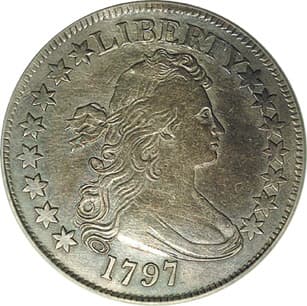
1797 Draped Bust Half Dollar (Small Eagle)
Every one of these half dollars went to a single customer, the Bank of the United States, in a year when yellow fever shut the Mint for months, and the design they carry lasted just two years.
- Year
- 1797
- Maker
- U.S. Mint (Philadelphia)
- By price in coins
- 62 of 100
Create a free account to see every recorded price and every grade.
Create a free account- Type
- Draped Bust half dollar, Small Eagle reverse, struck only in 1796 and 1797
- Mintage
- 3,918 for the whole two-year type in Mint records; 1797 alone is put at 2,984 by one reference
- Survivors
- About 175 (PCGS estimate) to 200-300 (another estimate), all grades
- Designers
- Robert Scot and John Eckstein
- Specs
- 13.48 grams, 32.50 mm; about 89.24% silver
- Edge
- Lettered: FIFTY CENTS OR HALF A DOLLAR
- This entry
- A 1797 graded NGC AU55, an About Uncirculated example of a type usually found well worn
- Stars
- 15, although 16 states were in the Union
A new face for the nation's silver
The first half dollars, the Flowing Hair type of 1794 and 1795, drew sharp criticism. Liberty's wild hair was thought undignified, and the eagle was mocked; one letter writer compared it to a turkey cock. When Henry William DeSaussure replaced David Rittenhouse as Director of the Mint, he set out to improve the designs of all the coins, especially the silver.
The result was the Draped Bust. It first appeared on the silver dollar in 1795 and was extended to the cent, half dime, dime, quarter and half dollar in 1796. DeSaussure resigned after only five months, and his successor, Elias Boudinot, former president of the Continental Congress, was in office when the new half dollar was issued.
On the half dollar the new obverse was paired with a small, naturalistic eagle perched on clouds inside an open wreath of laurel and palm. That Small Eagle reverse lasted only two years on the half dollar, later replaced by a heraldic eagle, and no half dollars were coined from 1798 through 1800, which is why the 1796 and 1797 pieces form a type of their own.
Stuart's portrait, Scot's dies
Robert Scot, the Mint's chief engraver from 1793 to 1823, cut the dies, working from a portrait of a society woman by the painter Gilbert Stuart; John Eckstein is also credited with the design. Some accounts identify the sitter as the Philadelphia socialite Ann Willing Bingham. Liberty faces right, her hair tied with a ribbon and drapery across her bust, with LIBERTY above and the date below.
The stars caused trouble. The Mint had planned to add a star for each new state, and the 1796 half dollar appears first with 15 stars and then with 16 after Tennessee joined the Union. The 1797 went back to 15, probably because it was struck from an obverse die prepared in 1796 with the last digit of the date added later. Boudinot eventually ordered that coins carry only the original 13 stars.
Below the wreath on the reverse is the fraction 1/2, with a horizontal bar. It is the only time the denomination was shown that way on any lettered-edge half dollar. The edge itself carries the words FIFTY CENTS OR HALF A DOLLAR, separated by ornaments.
One depositor, one fever season
In the 1790s the Mint struck silver only when depositors brought in bullion, and most of them asked for silver dollars. Half dollars were made only on specific request, so few were produced. Mint records lump the whole Small Eagle half dollar output into one figure, 3,918 pieces, and how many carry each date is unclear.
What is recorded is where they went. All 3,918 were delivered in three batches in 1797 to a single depositor, the Bank of the United States, which held them for years as backing for its paper money. Some numismatists speculate that bank employees, recognizing a short-lived type, set aside a few of the Mint State coins known today.
That year was also cut short. A yellow fever epidemic shut the Philadelphia Mint from August to November 1797, which may have limited half dollar production. No half dollars at all were coined from 1798 through 1800.
From pocket change to trophy
The rarity was noticed early. In January 1868 Mason's Coin and Stamp Collector's Magazine singled out the 1797 half dollar for its scarcity. Most survivors are in low grades, About Good to Very Good; Fine coins are less common, Very Fine to Extremely Fine rarer still, and pieces in About Uncirculated or better are described as extreme rarities. A coin like this NGC AU55 sits well above the typical survivor. Even in Good-4, a 1797 has been reported to cost about $40,000.
Two Mint State coins dominate the top of the market. The Norweb-Koshkarian coin, graded PCGS MS65+, set the record for any half dollar twice: $966,000 in March 2004 and $1.38 million in July 2008. The D. Brent Pogue coin, PCGS MS66 and generally considered the finest known, traces back through Virgil Brand, Judge Arthur F. Curtis of Delhi, New York, Abraham Hepner, Lelan Rogers and the Foxfire Collection. It brought $1,527,500 in May 2015 and $1,680,000 in March 2021, when it became the most valuable half dollar sold at public auction.
In About Uncirculated, prices are far lower but still steep. A PCGS AU55+ example of the rarer O-102 die pair brought $162,000 in January 2025. No public record of the specific NGC AU55 sale named for this entry could be verified.
How to identify a 1797
A Small Eagle half dollar has a slender eagle standing on clouds inside a wreath, not the heraldic eagle used on later Draped Bust halves. The 1797 has 15 stars, eight on the left and seven on the right, while 1796 coins may have 15 or 16. All were struck in Philadelphia and carry no mintmark.
There are two die varieties for 1797, O-101 and O-102, told apart by the position of the reverse lettering relative to the wreath; the O-102 is the rarer. The finest examples show heavy die cracks. On the Pogue coin the obverse is cracked through star 2 to the center, and the reverse, a die still in use from 1796, is cracked even more severely.
The type is the stumbling block for many collectors assembling one example of every U.S. silver design, which helps explain the demand. The 1797 is generally more elusive than the 1796 in high grades, and it ranks among the 100 greatest U.S. coins in one popular list.
The numbers
- Mintage
- 3,918 for 1796 and 1797 combined (Mint records); 2,984 attributed to 1797 by one reference
- Known survivors (1797)
- About 175 (PCGS estimate)
- Known survivors (type)
- About 200 to 300, all grades (another estimate)
- Weight
- 13.48 grams
- Diameter
- 32.50 mm
- Composition
- .8924 silver, .1076 copper (one reference rounds to 90% silver, 10% copper)
- Edge
- Lettered: FIFTY CENTS OR HALF A DOLLAR
- Designers
- Robert Scot and John Eckstein
- Die varieties
- O-101 (including O-101a) and the rarer O-102
Timeline
The Draped Bust design debuts on the silver dollar.
The Draped Bust, Small Eagle half dollar is introduced with 15 and then 16 stars.
1797 half dollars are struck with 15 stars from an obverse die likely prepared in 1796.
All 3,918 Small Eagle half dollars are delivered in three batches to the Bank of the United States.
Yellow fever closes the Philadelphia Mint until November.
No half dollars are struck from 1798 through 1800.
Mason's Coin and Stamp Collector's Magazine highlights the scarcity of the 1797 half dollar.
The future Pogue coin is advertised for sale in The Numismatist.
The Norweb-Koshkarian 1797 sets a half dollar record at $966,000.
The Koshkarian coin resets the record at $1.38 million.
The Pogue coin, PCGS MS66, sells for $1,527,500.
The Pogue coin sells for $1,680,000, the most paid for a half dollar at public auction.
A PCGS AU55+ 1797 (O-102) sells for $162,000.
The world in 1797
The Treaty of Tripoli with the Barbary state is signed at Algiers.
An American colonel, William Tate, leads French troops ashore in Wales in the last invasion of Britain.
John Adams is sworn in as the second president, with Thomas Jefferson as vice president.
The frigate USS United States, the Navy's first ship, is commissioned.
Senator William Blount of Tennessee becomes the first person expelled from Congress.
The frigate USS Constitution is launched in Boston Harbor.
Price record
A realized auction price is what a buyer actually paid on the date shown, including the buyer's premium where the sale reported it. It is the strongest kind of reference price, and it is a record of one sale of one object on one day, not a promise of what the next example will bring.
By reference price, 1797 Draped Bust Half Dollar (Small Eagle) is number 62 of 100 in the coins entries of the FLOAT 100. 96 of those 100 rest on a realized sale; the rest carry an asking price or a guide value, and each page says which. Rank within the FLOAT 100 itself (66 here) is editorial: how much an object defines its field, not price alone.
Did you know
- Every Small Eagle half dollar went to one customer, the Bank of the United States, which kept them as reserves behind its paper money.
- The 1797 has 15 stars even though there were 16 states, because the Mint reused a die made the year before.
- A critic of the earlier half dollar design said its eagle looked like a turkey cock.
- Yellow fever shut down the Mint for about four months in 1797.
- These are the only lettered-edge half dollars to show the denomination as the fraction 1/2.
- The finest known 1797 half dollar passed through the hands of a judge in Delhi, New York, before reaching modern collectors.
How this page is made
- The figure
- One reference price, shown with its own kind. FLOAT does not average it with anything or adjust it for time.
- Realized or not
- A realized price is a completed sale. An asking price, an estimate and a price-guide value are not sales, and are labeled as such wherever they appear.
- The story
- Researched from published records and checked fact by fact. Updated Oct 3, 2026.
- Archive
- Oct 5, 2026