FLOAT 100 · Coins · No. 65
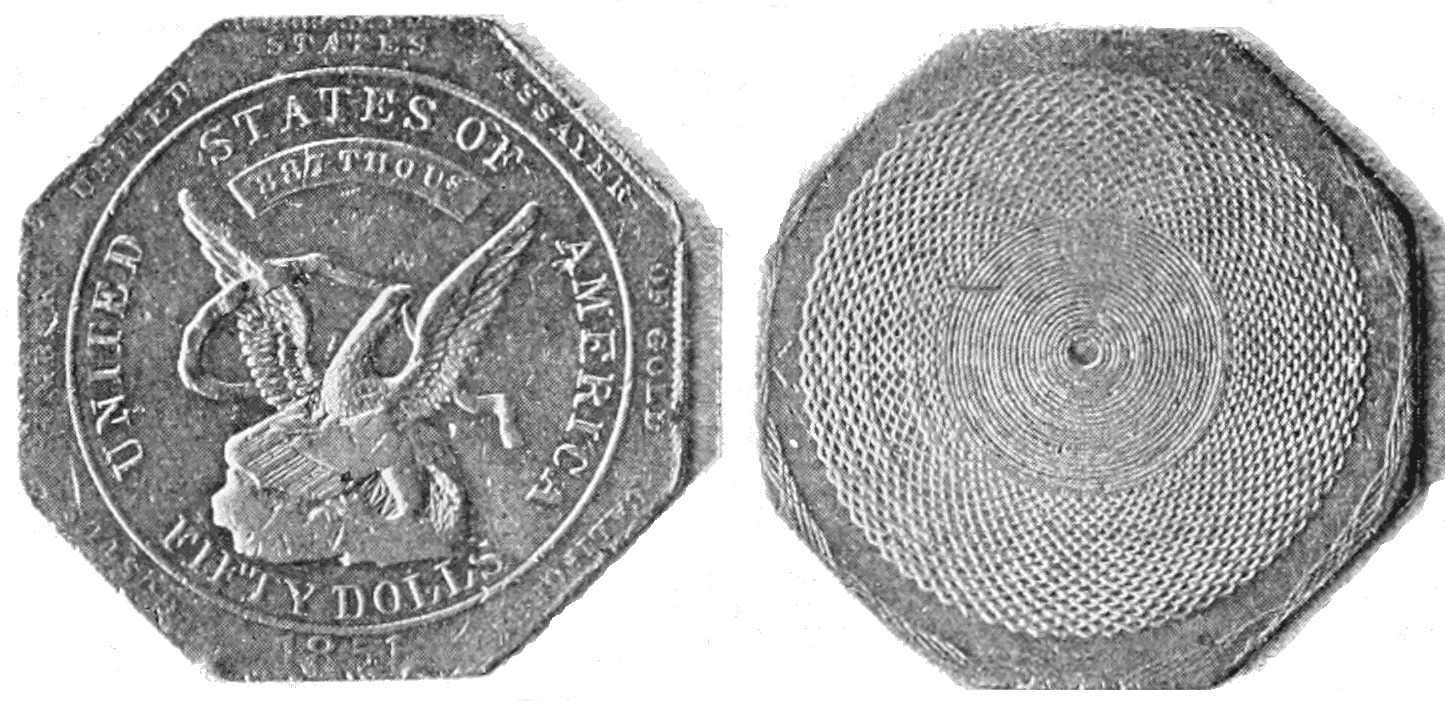
1851 Humbert Fifty Dollar (Territorial Gold)
Gold Rush San Francisco had mountains of gold dust and almost no money, so a New York watchcase maker arrived with a set of dies and began stamping out eight-sided $50 slabs of gold that weighed nearly two and a half ounces each.
- Year
- 1851
- Maker
- Augustus Humbert / U.S. Assay Office (San Francisco)
- By price in coins
- 43 of 100
Create a free account to see every recorded price and every grade.
Create a free account- Issued
- 1851, United States Assay Office of Gold, San Francisco, struck by Moffat & Co.
- Assayer
- Augustus Humbert, United States Assayer of Gold
- Variety
- Kagin-4: lettered edge, 887 THOUS. fineness, hand-punched 50 on the reverse; Rarity-5
- Form
- Octagonal gold ingot of $50 face value, nearly 2.5 ounces
- Obverse eagle
- Attributed to medalist Charles Cushing Wright
- This coin
- PCGS MS62+, ex Amon G. Carter Jr. and Bob R. Simpson; one of two in MS62 at PCGS, none finer (2025)
- Latest sale
- $456,000 at auction, February 27, 2025
- Its record
- $480,000 in January 2021, the PCGS-listed auction record for the variety
A gold rush without money
After gold was found at John Sutter's mill in 1848, thousands of migrants poured into San Francisco. Gold was plentiful, but usable coin was not. Miners carried dust in pouches, and merchants had to weigh it and judge its purity, which slowed trade and invited disputes, discounts and fraud. Private assayers and coiners stepped in, but most of what they produced was substandard.
California entered the Union on September 9, 1850, still without a federal mint. On September 30, 1850, the government reached an agreement with a private California refiner to run a federal assaying and coining operation. The obvious choice was Moffat & Co., the most respected private minter in San Francisco, whose coins were nearly equal in quality to federal issues.
The government did not run the new United States Assay Office of Gold as a conventional branch mint. Instead the Treasury authorized Moffat & Co. to assay California gold and apply a federal stamp under the supervision of a government assayer. Officials of the day called the $50 pieces ingots; collectors later called them slugs.
The watchcase maker and the medalist
The assayer was Augustus Humbert, a New York watchcase maker with strong technical skills in precision metalwork. He reached San Francisco near the end of January 1851 carrying the tools and dies needed to start, and on January 31 Moffat & Co. struck the first octagonal $50 pieces. The Pacific News reported the first piece on February 1, and on February 21 the Daily Alta California reported that the new coins had been issued the previous day, with about 300 already made.
The obverse eagle, holding a ribbon and shield before rising rays inside the legend UNITED STATES OF AMERICA, is attributed to Charles Cushing Wright, one of the leading American medalists of the century; a surviving bronze pattern signed "Wright fecit" supports the attribution. The reverse is an entirely different thing: a fine, geometric engine-turned pattern that resembles the decorated watchcases of the period, a link catalogers have long drawn to Humbert's former trade.
Every lettered-edge slug was partly handmade. Workers struck the two faces on an octagonal blank, stamped lettering across all eight edge panels, punched the fineness into the scroll on the obverse and added the denomination beside the letters D C. On this variety, the K-4, a 50 was also struck by hand into the center of the reverse. The edge reads AUGUSTUS HUMBERT UNITED STATES ASSAYER OF GOLD CALIFORNIA 1851.
Money that was too big to spend
Federal offices were directed to accept the slugs for customs duties and other government payments, and banks took them at face value. The Smithsonian Institution notes that they became a principal form of accepted currency in California for much of the next two years. Humbert's issues were trusted for their reasonably accurate gold content, and some competing private coiners whose products could not match it were driven out of business.
They were also maddening to use. A $50 piece was far too valuable for everyday purchases, and small gold coins were scarce. The historian Edgar Adams recorded that one newspaper called the octagonal pieces little less troublesome than the plagues of Egypt. Most were eventually melted.
The fineness stamped on each piece reflected California's native gold. Humbert later explained that it commonly ran .880, .884 or .887 fine, so the Assay Office adjusted each slug's total weight to its purity; a lower-fineness piece needed more gross weight to hold $50 in gold. Later issues reached the federal standard of .900. The Assay Office closed for good in December 1853 to make way for the new San Francisco Mint, though the slugs kept circulating after it opened.
The Carter-Simpson slug
Most Humbert fifties that escaped the melting pot survive worn, generally Very Fine to About Uncirculated, and often with problems; the hand-stamped edges in particular attracted bruises and knocks. Because the hand lettering was slow and invited errors and damage, the Assay Office soon replaced the lettered edge with a simpler reeded edge.
This example is one of the finest known of the K-4 variety. When it was sold from the Amon G. Carter Jr. Family Collection in January 1984 for $26,400, the cataloger called it lustrous, with prooflike surfaces on the obverse and pale coppery toning, and "certainly one of the finest examples extant of a lettered edge slug, regardless of variety." It sold again in November 2010 for $316,250, then passed to the collector Bob R. Simpson.
From the Simpson collection it sold in January 2021 for $480,000, the auction record listed for the variety. On February 27, 2025, now graded PCGS MS62+, it brought $456,000 at a multi-day auction in Long Beach, California. At that time PCGS had graded two K-4 slugs MS62, one of them MS62+, and none finer.
How to identify a K-4
Humbert's 1851 fifties are sorted by Kagin numbers, and the differences are small hand-punched details. The K-2 carries 880 THOUS. and no 50 on the reverse; the K-1 combines .880 fineness with the reverse 50; the K-4 carries a reverse 50 and records .887 fineness. All three have lettered edges.
On the Carter-Simpson coin both sides show rich yellow-gold color with reddish accents and a flashy, moderately contrasted obverse, while the engine-turned reverse, the eagle and the shield are razor-sharp. On many slugs the rock beneath the eagle is softly struck.
The K-4 is rated Rarity-5, a scarce variety. Many survivors have damaged edges, cleaning or repairs, which is why a Mint State lettered-edge slug with original surfaces is so seldom offered.
The numbers
- Denomination
- $50 (50 D C on the obverse scroll area; 50 punched into the reverse)
- Fineness
- .887 (887 THOUS.)
- Weight
- Nearly 2.5 ounces; gross weight adjusted to each piece's fineness
- Shape
- Octagonal
- Edge
- Lettered: AUGUSTUS HUMBERT UNITED STATES ASSAYER OF GOLD CALIFORNIA 1851
- Designers
- Obverse eagle attributed to Charles Cushing Wright; engine-turned reverse associated with Augustus Humbert
- Variety
- Kagin-4, Rarity-5
- Population
- PCGS: 2 in MS62 (1 in MS62+), none finer (2025)
Timeline
Gold is discovered at John Sutter's mill.
California enters the Union, still without a federal mint.
The government agrees to contract with Moffat & Co. for a federal assaying and coining operation.
Augustus Humbert arrives in San Francisco with dies and tools.
Moffat & Co. produces the first octagonal $50 pieces.
The Pacific News reports the first $50 piece.
The Daily Alta California reports the slugs issued the day before, about 300 made.
The Assay Office closes in preparation for the San Francisco Mint.
This slug sells from the Amon G. Carter Jr. Family Collection for $26,400.
It sells for $316,250.
It sells from the Bob R. Simpson collection for $480,000, the variety's auction record.
Graded PCGS MS62+, it sells for $456,000.
The world in 1851
A coin flip names the new Oregon Territory city Portland instead of Boston.
John Gorrie receives a patent for a machine to make ice.
Sojourner Truth delivers her "Ain't I a Woman?" speech in Akron, Ohio.
The yacht America wins the first America's Cup race, off England.
The New York Times is founded.
The Denny Party lands at Alki Point, the first settlers of what becomes Seattle.
Herman Melville's Moby-Dick is published in the United States.
Price record
| Date | Price | Kind |
|---|---|---|
| Jan 1984 | $26,400 | Sold at auctionThis slug, from the Amon G. Carter Jr. Family Collection. |
| Nov 2010 | $316,250 | Sold at auctionThis slug. |
| Jan 24, 2021 | $480,000 | Sold at auctionThis slug, PCGS MS62+, from the Bob R. Simpson collection; auction record for the variety. |
| Feb 27, 2025 | $456,000 | Sold at auctionThis slug, PCGS MS62+, at auction in Long Beach, California. |
A realized auction price is what a buyer actually paid on the date shown, including the buyer's premium where the sale reported it. It is the strongest kind of reference price, and it is a record of one sale of one object on one day, not a promise of what the next example will bring.
By reference price, 1851 Humbert Fifty Dollar (Territorial Gold) is number 43 of 100 in the coins entries of the FLOAT 100. 96 of those 100 rest on a realized sale; the rest carry an asking price or a guide value, and each page says which. Rank within the FLOAT 100 itself (65 here) is editorial: how much an object defines its field, not price alone.
Did you know
- The officials who made them called them ingots, not coins; slug is a collector's word.
- The reverse pattern looks like a fancy pocket-watch case because the man in charge made watchcases.
- Each slug's weight was adjusted for the purity of the gold, so not every $50 piece weighed the same.
- One newspaper of the day compared the hard-to-spend $50 pieces to the plagues of Egypt.
- Every word on the edge of this slug was stamped panel by panel, across all eight sides.
- This slug sold for $26,400 in 1984 and for $480,000 in 2021.
How this page is made
- The figure
- One reference price, shown with its own kind. FLOAT does not average it with anything or adjust it for time.
- Realized or not
- A realized price is a completed sale. An asking price, an estimate and a price-guide value are not sales, and are labeled as such wherever they appear.
- The story
- Researched from published records and checked fact by fact. Updated Oct 3, 2026.
- Archive
- Oct 5, 2026