FLOAT 100 · Coins · No. 5
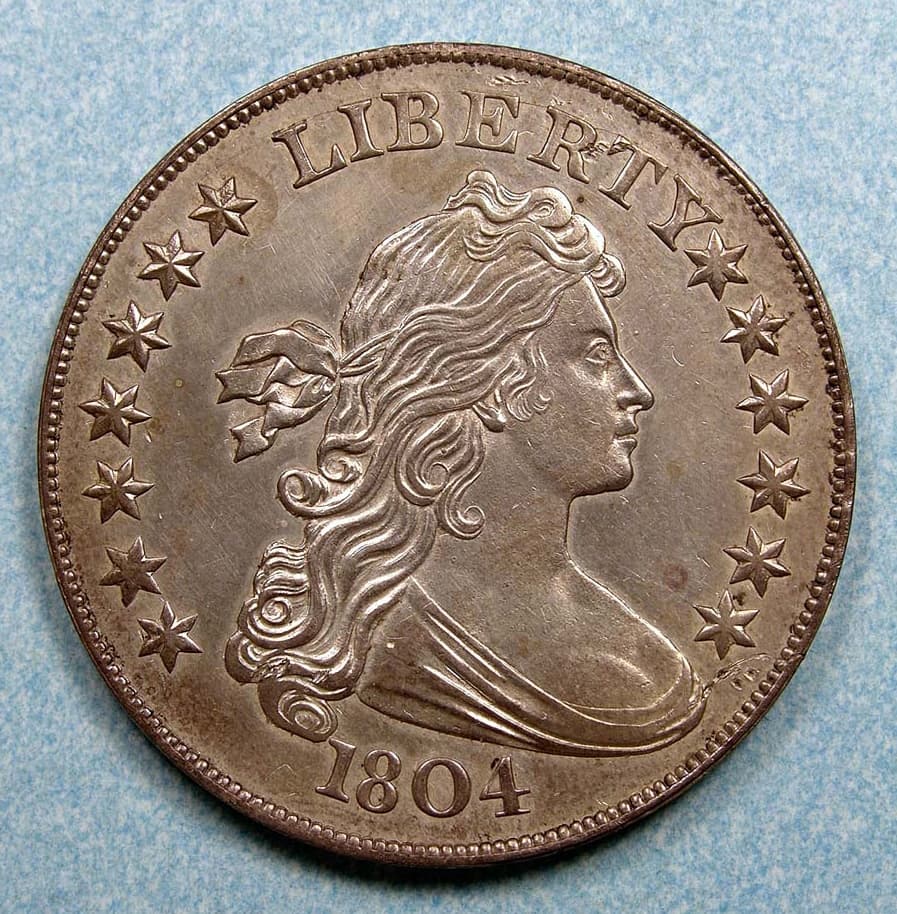
1804 Draped Bust Dollar, Class I
The 'King of American Coins' was not struck in 1804 at all: the Mint made it thirty years later, by mistake, as a diplomatic gift for a sultan and a king on the far side of the world.
- Year
- 1804 (struck c.1834)
- Maker
- U.S. Mint (Philadelphia)
- By price in coins
- 6 of 100
Create a free account to see every recorded price and every grade.
Create a free account- Dated
- 1804, but struck at the Philadelphia Mint in the mid-1830s
- Why it exists
- Made for cased Proof sets of U.S. coins that President Andrew Jackson's envoy Edmund Roberts carried to Asia and Arabia
- Class I
- The 'original' 1804 dollars of the 1830s, struck with lettered edges; eight are known
- All 1804 dollars
- Sixteen known: eight Class I, one Class II and seven Class III, the later Mint restrikes
- Most famous examples
- Sultan of Muscat (PCGS Proof 68, finest known), King of Siam (PCGS Proof 67, still in its presentation set), Stickney (PCGS Proof 65)
- Design
- Draped Bust Liberty with the Heraldic Eagle reverse; edge lettered HUNDRED CENTS ONE DOLLAR OR UNIT
- Nickname
- 'The king of coins,' coined by auctioneer W. Elliot Woodward in 1885
- Highest price
- $7,680,000 for the Sultan of Muscat specimen at auction, August 2021
A coin dated for a year that never made it
Early American silver dollars had a way of leaving the country. Large silver coins were preferred in world trade, especially in China, and many U.S. dollars were exported soon after they were struck. Mint Director Elias Boudinot began urging depositors to take smaller coins, and dollar production stopped in March 1804. Those last dollars were struck from older dies and carried the date 1803. On May 1, 1806, Secretary of State James Madison formally suspended dollar coinage, ordering that no coin larger than a half dollar be struck.
Mint records nonetheless listed 19,570 dollars as coined in 1804, and for decades that entry was taken at face value. It was the source of the confusion that made the 1804 dollar. When the Mint was later asked for a dollar 'now in use,' it went looking for the last year one had been made, and the books said 1804.
Whether the dies were cut in 1834 or a little earlier is debated. One historian suggests they were prepared around 1831, when the Mint briefly expected to resume dollar coinage; others place them in 1834. Either way, the Class I coins were struck in the mid-1830s, with edge lettering applied by the old Castaing machine and then slightly crushed when the coin was struck inside the close collar adopted at the Mint in the 1830s. That crushed edge, the raised flat border and beaded dentils first used in 1828, and the pre-1837 weight standard are the physical proof that none was made in 1804.
Edmund Roberts and the gifts for kings
Edmund Roberts was born in Portsmouth, New Hampshire, on June 29, 1784, went to sea in 1800 and became a merchant shipper. An earlier visit to Said bin Sultan, the Sultan of Muscat and Oman, around 1827 sparked his interest in diplomacy. In 1832 President Andrew Jackson sent him to Asia as a 'special agent' aboard the sloop of war Peacock, sailing as the captain's clerk to keep the mission quiet. He signed a treaty with Siam and, on September 21, 1833, a treaty with the Sultan at Muscat.
The gifts he had carried were, in his own words, of 'very mean quality, and of inconsiderable value.' In a letter of October 8, 1834, he proposed something better for his return trip: 'a complete set of new gold & silver & copper coins of the U.S. neatly arranged in a morocco case.' On November 11, 1834, Secretary of State John Forsyth told Mint Director Samuel Moore that the President wanted a complete set 'of each kind now in use' sent to the King of Siam and another to the Sultan of Muscat, in leather boxes, one yellow and one crimson.
The Mint took 'every kind' literally and included the silver dollar and the $10 gold eagle, neither of which had been struck in about thirty years. To avoid making 1834-dated coins of designs no longer current, it dated both 1804. The eagles of 1804 really had carried that date; the dollars had not, so the Mint created the first 1804-dated dollars ever made. Four sets left New York aboard the Peacock in April 1835, two of them for rulers in Cochin-China and Japan.
On his return voyage to exchange treaty ratifications, Roberts delivered the first set to Said bin Sultan on October 1, 1835, and the second to King Rama III of Siam on April 6, 1836. He fell ill and died in Macau on June 12, 1836, before reaching Cochin-China or Japan, and the remaining sets were sent home.
Jackson's America, 1834
The order for the presentation sets came in the middle of President Jackson's war with the Second Bank of the United States. On March 28, 1834, the Senate censured Jackson for his actions in defunding the bank, and on April 14 Senator Henry Clay gave his opponents a name, the Whig Party. On June 28 Jackson signed the Coinage Act of 1834, which raised the legal ratio of silver to gold from 15 to 1 to 16 to 1 and cut the weight of U.S. gold coins.
Two days later, on June 30, 1834, the Senate ratified Roberts' treaties with Siam and Muscat. The 1804 dollars that went to Muscat and Siam were part of the ceremony of exchanging those ratifications.
From the Mint Cabinet to a sultan's case
Collectors learned of the coin in 1842, when Mint assayers Jacob R. Eckfeldt and William E. DuBois pictured one on Plate II of their Manual of Gold and Silver Coins of All Nations without remarking on its rarity. Matthew A. Stickney of Salem, Massachusetts, noticed. On May 9, 1843, he traveled to the Mint and obtained one in trade for rare coins from his collection, including a unique gold Immune Columbia piece. Joseph J. Mickley got the next, around 1847. By 1885 auctioneer W. Elliot Woodward was calling the 1804 dollar 'the king of coins.'
Demand outran supply. Around 1858 Mint employees secretly struck more: a single plain-edged coin, now called Class II, struck over a Swiss shooting thaler, and later coins with edge lettering added after striking, called Class III. A scandal followed. In 1860 Mint assayer DuBois tried to recall the privately held pieces and reported that three were destroyed in his presence; the Class II coin went into the Mint Cabinet, now the Smithsonian, where it remains.
The Sultan of Muscat coin disappeared from view for eight decades. It surfaced in the collection of Charles A. Watters of Liverpool and was sold in London in May 1917, then passed to Henry Chapman, the vast Chicago collection of Virgil Brand, the Green family and the Childs family. Offered in August 1999, it sold for $4,140,000 to Mack and Brent Pogue, then the highest price ever paid for a coin. In May 2016 in New York, a bid of $9.2 million failed to meet the family's reserve. In August 2021 it sold for $7,680,000, the highest price for any 1804 dollar.
The King of Siam set resurfaced in 1962, when a British numismatist announced at the American Numismatic Association convention that he had a previously unknown 1804 dollar in a yellow leather case embossed with an eagle. Every coin in the set was dated 1834 except the dollar and the eagle, the first hard proof that 1804 dollars had been in the diplomatic sets. He said he had bought it from two women he believed descended from Anna Leonowens, the governess immortalized in The King and I; there is no evidence for that link. The set remains intact, with the dollar graded PCGS Proof 67.
The eight Class I coins
Eight Class I 1804 dollars are known, and the count likely represents the entire mintage. By name they are the Sultan of Muscat (PCGS Proof 68), King of Siam (PCGS Proof 67), Stickney (PCGS Proof 65), Dexter (PCGS Proof 65), Parmelee (Proof 64, held by the Durham Museum in Omaha), Mickley (PCGS Proof 62), the Mint Cabinet coin (an impaired Proof, in the Smithsonian) and the Cohen coin (Proof 30, stolen from the duPont family, recovered in Zurich in 1993 and donated to the American Numismatic Association's museum). Several are permanently held by or on loan to museums.
All Class I coins share a single obverse die and the reverse die collectors call Reverse X, on which the first S of STATES sits slightly left of the gap between the two leftmost clouds. Their edges read HUNDRED CENTS ONE DOLLAR OR UNIT, with letters flattened and partly illegible from the collar. Class II has a plain edge, and Class III coins have edge lettering added after striking, which left their surfaces slightly concave. Because the term 'original' implies coins of 1804, researchers more precisely call the Class I pieces novodels: coins struck from newly made, backdated dies.
The 1804 dollar has been counterfeited for as long as it has been valuable. Forgers altered dates on genuine dollars of 1800 to 1803, most often 1801; electrotype copies were made for study and for fraud; and cheap replicas known as 'Saigon copies' were sold to American soldiers during the Vietnam War.
Still the king
From its discovery, the 1804 dollar has commanded prices out of all proportion to its silver. A Class I brought $1,000 at auction in 1885 and, in the Stickney sale of 1907, the Stickney coin brought $3,600 from James W. Ellsworth. In 1941 the dealer B. Max Mehl called it 'The King of American Coins,' and the title stuck. The Eliasberg example, once Stickney's, became the first 1804 dollar to pass $1 million at auction, in 1997.
The story still moves. In 2025 a previously unknown Class III example from the collection of James A. Stack Sr., who died in 1951, came to light, raising the census to sixteen; graded PCGS Proof 65, it sold in December 2025 for $6,000,000. In October 2025 the U.S. Mint announced a 2026 gold coin dated 1804 with a Liberty Bell privy mark, part of its observance of the 250th anniversary of American independence.
The numbers
- Mintage
- Not recorded; eight Class I coins are known and likely represent the whole striking
- Known survivors
- 8 Class I; 16 of all classes (8 Class I, 1 Class II, 7 Class III, counting the 2025 discovery)
- Weight
- 416 grains, the pre-1837 standard; recorded Class I weights run about 26.58 to 26.98 g
- Diameter
- About 39 to 40 mm (one source gives 37 to 40 mm)
- Composition
- Silver with about 10% copper; sources give 90% or the 1792 Act's 89.2% silver
- Edge
- Lettered HUNDRED CENTS ONE DOLLAR OR UNIT
- Designer
- Robert Scot and John Eckstein (Draped Bust obverse, 1795; Heraldic Eagle reverse, 1798)
Timeline
Silver dollar production stops; the last coins struck carry the date 1803.
Secretary of State James Madison formally suspends dollar coinage.
Edmund Roberts signs a treaty with the Sultan of Muscat.
Roberts asks the State Department for cased sets of U.S. coins as gifts.
Secretary of State John Forsyth orders the Mint to prepare the sets; Class I 1804 dollars are struck for them.
Four presentation sets leave New York aboard the sloop Peacock.
Roberts presents a set, with its 1804 dollar, to Said bin Sultan of Muscat.
Roberts presents a set to King Rama III of Siam.
Roberts dies in Macau; the undelivered sets are sent home.
An 1804 dollar is pictured in Eckfeldt and DuBois' Manual, the first notice of the coin in print.
Matthew A. Stickney obtains an 1804 dollar from the Mint in trade, the first in private hands.
Mint employees secretly strike the plain-edged Class II 1804 dollar; Class III coins, with edges lettered after striking, follow.
The Stickney coin sells for $3,600 to James W. Ellsworth.
The Sultan of Muscat coin is sold in London from the Watters collection.
The intact King of Siam presentation set is revealed at the ANA convention.
The Stickney-Eliasberg coin becomes the first 1804 dollar to pass $1 million at auction.
The Sultan of Muscat coin sells for $4,140,000, then a record for any coin.
The Sultan of Muscat coin fails to meet its reserve in New York after a $9.2 million bid.
The Sultan of Muscat coin sells at auction for $7,680,000.
A newly discovered Class III 1804 dollar sells for $6,000,000.
The world in 1834
The Senate censures President Andrew Jackson for his actions in defunding the Second Bank of the United States.
Senator Henry Clay names the Whig Party.
Jackson signs the Coinage Act of 1834, moving the silver-to-gold ratio from 15:1 to 16:1.
Roberts' treaties with Siam and Muscat are ratified in Washington.
Anti-abolitionist riots break out in New York City.
A mob burns the Ursuline convent near Boston.
Price record
| Date | Price | Kind |
|---|---|---|
| Oct 1867 | $750 | Sold at auctionMickley specimen, from the Joseph J. Mickley collection. |
| Nov 1874 | $700 | Sold at auctionParmelee specimen, from the Sanford collection. |
| Oct 1875 | $325 | Sold at auctionCohen specimen. |
| Nov 1876 | $500 | Sold at auctionCohen specimen. |
| Oct 1884 | $216 | Sold at auctionDexter specimen, at auction in Berlin. |
| May 1885 | $1,000 | Sold at auctionDexter specimen. |
| Jun 1890 | $570 | Sold at auctionParmelee specimen, bought by Byron Reed. |
| Oct 1904 | $1,100 | Sold at auctionDexter specimen. |
| Jun 1906 | $720 | Sold at auctionCohen specimen. |
| Jun 1907 | $3,600 | Sold at auctionStickney specimen, bought by James W. Ellsworth. |
| Jun 1918 | $2,500 | Private saleSultan of Muscat specimen, price recorded when it passed to Henry Chapman. Its May 1917 London sale was in pounds (330). |
| May 1921 | $2,500 | Sold at auctionCohen specimen. |
| Aug 10, 1945 | $3,150 | Private saleSultan of Muscat specimen, sold by the Brand family. |
| Oct 1, 1945 | $5,000 | Private saleSultan of Muscat specimen, to Ruth and Charles Green. |
| Jun 1946 | $10,500 | Sold at auctionStickney specimen, from the Atwater collection. |
| Oct 1970 | $77,500 | Sold at auctionMickley specimen, from the Massachusetts Historical Society. |
| Oct 1981 | $280,000 | Sold at auctionDexter specimen, from the Bareford collection. |
| 1989 | $990,000 | Sold at auctionDexter specimen. |
| May 1990 | $1,815,000 | Sold at auctionKing of Siam presentation set, the entire cased set including the 1804 dollar. |
| Oct 1993 | $475,000 | Sold at auctionMickley specimen, from the Reed Hawn collection. |
| Apr 1997 | $1,815,000 | Sold at auctionStickney specimen, from the Eliasberg collection; first 1804 dollar over $1 million. |
| Aug 1999 | $4,140,000 | Sold at auctionSultan of Muscat specimen, PCGS Proof 68; then the highest price for any coin. |
| Oct 2000 | $1,840,000 | Sold at auctionDexter specimen. |
| Apr 17, 2008 | $3,737,500 | Sold at auctionMickley specimen, from the Queller family collection. |
| Aug 9, 2013 | $3,877,500 | Sold at auctionMickley specimen, Proof 62. |
| Mar 31, 2017 | $3,290,000 | Sold at auctionDexter specimen, PCGS Proof 65, at auction in New York. |
| Jun 14, 2018 | $2,640,000 | Sold at auctionMickley specimen, PCGS Proof 62. |
| Dec 17, 2020 | $3,360,000 | Sold at auctionStickney specimen, PCGS Proof 65. |
| Aug 2021 | $7,680,000 | Sold at auctionSultan of Muscat specimen, PCGS Proof 68; the highest price for any 1804 dollar. |
A realized auction price is what a buyer actually paid on the date shown, including the buyer's premium where the sale reported it. It is the strongest kind of reference price, and it is a record of one sale of one object on one day, not a promise of what the next example will bring.
By reference price, 1804 Draped Bust Dollar, Class I is number 6 of 100 in the coins entries of the FLOAT 100. 96 of those 100 rest on a realized sale; the rest carry an asking price or a guide value, and each page says which. Rank within the FLOAT 100 itself (5 here) is editorial: how much an object defines its field, not price alone.
Did you know
- No 1804 dollar was struck in 1804. The real dollars of that year carry the date 1803.
- Matthew Stickney got his 1804 dollar from the Mint in 1843 by trading away a unique gold Immune Columbia piece.
- The King of Siam set was linked by its seller to Anna Leonowens of The King and I, a connection no evidence supports.
- The Cohen specimen was stolen from the duPont family and recovered in Zurich, Switzerland, on April 23, 1993.
- In the 19th century, collectors explained the coin's rarity with tales of dollars paid as ransom to Barbary pirates or lost at sea en route to China.
- The only Class II 1804 dollar was struck over a Swiss shooting-festival thaler.
- In 2016 the finest 1804 dollar drew a $9.2 million bid and still did not sell.
How this page is made
- The figure
- One reference price, shown with its own kind. FLOAT does not average it with anything or adjust it for time.
- Realized or not
- A realized price is a completed sale. An asking price, an estimate and a price-guide value are not sales, and are labeled as such wherever they appear.
- The story
- Researched from published records and checked fact by fact. Updated Oct 1, 2026.
- Archive
- Oct 5, 2026