FLOAT 100 · Coins · No. 6
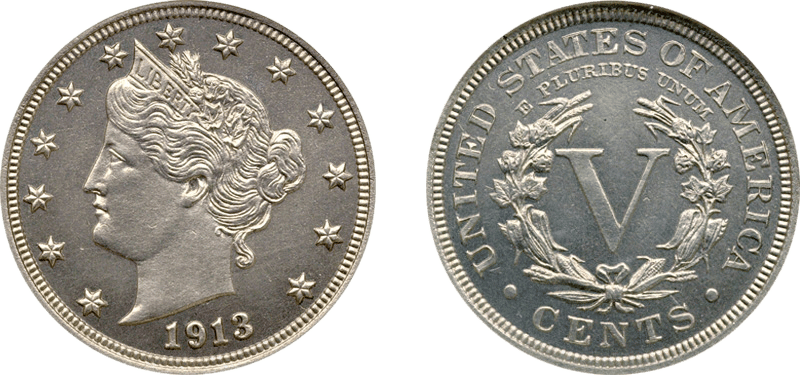
1913 Liberty Head Nickel (Eliasberg specimen)
The Mint never recorded making a single one, yet five 1913 Liberty Head nickels slipped out of Philadelphia, and the finest of them, a mirror-bright coin once owned by the only man to complete a set of U.S. coins, became the first coin ever to sell for more than a million dollars.
- Year
- 1913
- Maker
- U.S. Mint (Philadelphia, clandestine)
- By price in coins
- 7 of 100
Create a free account to see every recorded price and every grade.
Create a free account- Struck
- Philadelphia Mint, dated 1913; no official record of production exists
- Design
- Liberty Head ("V") nickel by Chief Engraver Charles E. Barber, introduced in 1883
- How many
- Five known; two are in museums (the Smithsonian and the American Numismatic Association)
- First seen
- December 3, 1919, at a Chicago Coin Club meeting, shown by former Mint employee Samuel W. Brown
- This coin
- The Eliasberg specimen, graded Proof-66 by PCGS with a CAC sticker; the finest known
- What sets it apart
- The only one of the five with deeply reflective, mirror-like Proof surfaces
- Famous owners
- Col. E.H.R. Green, Eric P. Newman, Louis E. Eliasberg Sr., Dr. William Morton-Smith
- Milestone
- $1,485,000 in May 1996, the first coin to cross the million-dollar mark at auction
- Highest auction price
- $4,560,000, at auction in Philadelphia, August 15, 2018
A coin that should not exist
Charles E. Barber's Liberty Head nickel went into production on January 30, 1883. Its reverse carried a large Roman numeral V, and for almost thirty years the Mint struck it in large quantities as coin-operated machines made the five-cent piece ever more useful. By 1912 its time was up: sculptor James Earle Fraser's Native American and bison design had been approved, and on December 13, 1912, Mint Director George E. Roberts told the staff to take no action on 1913 nickels until the new design was ready. He ended production of the Liberty Head nickel at the Philadelphia Mint the same day.
The Buffalo nickel was introduced in February 1913, and the Mint's records list no Liberty Head nickels made that year. As the editor Lee F. Hewitt pointed out in 1958, Buffalo coinage did not begin until February 21, 1913, so the Mint had almost two months in which it could have struck Liberty Head coins dated 1913 had it intended to. Officially, it never did.
How five pieces came to exist anyway has never been settled. Many historians conclude that Samuel W. Brown, a Mint employee in 1913, struck them or had them struck and took them out of the building. Other accounts point to different possibilities, among them that they were lawfully made by the Mint's Medal Department 'for cabinet purposes' or struck in late 1912 as trial pieces to test the new year's dies, while not entirely ruling out a private striking. Other theories hold that they were made as a favor to a wealthy collector, struck to trade for rare coins the Mint's own collection needed, or made for a Mint employee's amusement.
Clandestine strikes of this kind were not unheard of. The Class II and III 1804 silver dollars, made decades after their date, are the best-known earlier example, and collectors now group the 1913 nickel with the 1804 dollar and the 1894-S dime as the 'holy trinity' of American rarities.
Samuel Brown and the men behind the five
Samuel W. Brown was no outsider. He joined the American Numismatic Association in 1906 as member no. 808, sponsored by the Philadelphia insider Stephen K. Nagy, and worked at the Philadelphia Mint as an assistant curator of its coin cabinet and as a storekeeper. On November 14, 1913, he resigned, saying he wanted to start his own business, and moved to North Tonawanda, New York, where he ran a chocolate factory, became a pillar of local society and served as the city's mayor in 1932 and 1933. He was appointed to the Mint's Assay Commission in 1923 and again in 1924, a rare honor.
In the December 1919 issue of The Numismatist, Brown advertised to buy 1913 Liberty Head nickels, a coin then completely unknown to collectors, offering $500 apiece and later $600. On December 3, 1919, he showed one at a meeting of the Chicago Coin Club at the Hotel Sherman; the club's report recorded a 'Proof nickel of 1913, of the old type. Proof nickels are not supposed to have been struck during that year.' That entry, found in 2017, is the coin's first documented appearance. At the August 1920 ANA convention in Chicago he displayed a 1913 nickel with a label valuing it at $600.
Bowers believes Brown's display coin and the rest were Nagy's all along, and that Nagy preferred to work behind the scenes. In December 1923 a Philadelphia stamp dealer, August Wagner, advertised all five for sale as 'the only five-cent Liberty Head coins of this design and year in existence.' No buyer came forward, and in 1924 Nagy sold the five to New York dealer Wayte Raymond, who placed them with Col. Edward H.R. Green.
Through the 1920s and 1930s the Texas dealer B. Max Mehl kept the coin famous without owning one, advertising on radio, in magazines and in Sunday newspaper supplements that he would pay handsomely for a 1913 Liberty nickel found in pocket change. The idea that an ordinary-looking nickel could be worth a fortune made it a household legend.
Five coins, five paths
Green kept all five until his death in 1936. His estate sold them to St. Louis numismatist Eric P. Newman and dealer B.G. Johnson, who broke up the set for the first time. Each coin has since carried the name of an owner. The Olsen specimen passed through King Farouk of Egypt, sold for $100,000 in 1972 and then starred in a December 11, 1973, episode of Hawaii Five-O, 'The $100,000 Nickel,' which made the 1913 nickel famous with people who had never collected a coin.
The Norweb specimen also went to Farouk, who bought it in 1949 to replace the Olsen coin. After he was deposed in 1952 his collection was sold by the new Egyptian government, and Ambassador Henry Norweb and his wife Emery May later donated the coin to the Smithsonian's National Numismatic Collection in 1978. The McDermott specimen, the only one with circulation wear, was carried around by J.V. McDermott, who showed it off to bar patrons; Aubrey Bebee bought it at auction in 1967 for $46,000 and with his wife gave it to the ANA's Money Museum in Colorado Springs in 1989.
The Walton specimen vanished for four decades. Collector George O. Walton was killed in a car crash on March 9, 1962, on his way to a coin show; the nickel was recovered, but when his heirs consigned his coins in 1963 it was wrongly judged not genuine and returned. It sat in a closet until a 2003 publicity hunt for the missing fifth coin, when experts at the ANA convention in Baltimore confirmed it was real. It sold for $3,172,500 in April 2013 and for $4.2 million in October 2022.
Sources disagree on how the five are split today. One account says three are in museums and two in private hands; another, from 2021, says two are permanently held by the Smithsonian and the ANA and three are privately owned. The Walton coin was on display at the ANA museum from 2018 before it was sold in 2022, which may explain the difference.
The Eliasberg coin
Of the five, Newman chose this one to keep in 1942. The dealers Abe Kosoff and Abner Kreisberg acquired it from him in 1948, and on December 14 of that year Kosoff offered it to Louis E. Eliasberg Sr., a Baltimore financier; the sale went through in early 1949. Kosoff later remembered it differently, writing in 1977 that he bought the coin over dinner at Newman's home in 1945 and sold it to Eliasberg for '$2,350 or $2,400, not more.' Bowers notes that a dozen accounts of the coin's history will give a dozen different dates and owners.
Eliasberg, born in Selma, Alabama, in 1896, assembled the only complete collection of U.S. coins by date and mintmark, finishing it in 1950. In a 1956 exhibition booklet he wrote that 'apparently, only five specimens of the Liberty Head type were struck in 1913.... This is regarded as the finest Proof specimen.' After his death in 1976 the coin passed to his son, Richard A. Eliasberg, who consigned it to the 1996 sale of his father's collection in New York. It brought $1,485,000, the first coin ever to cross the million-dollar barrier, and the room broke into applause. The buyer was the dealer Jay Parrino.
The coin then moved quickly. It sold again in March 2001 for $1,840,000 and went to Dwight Manley; on July 29, 2003, Manley's sale of it to Edward C. Lee was announced at a reception in Timonium, Maryland, where all four then-known specimens were shown together, at a price not disclosed but reported to be around $3 million. In 2005 it passed to a partnership of Bruce Morelan, Laura Sperber and George Huang for $4,150,000; one account dates the purchase to May, while the transfer was announced in June. In 2007, through dealer Ron Gillio, it went to Dr. William Morton-Smith; one widely repeated report puts that April 25, 2007, sale at $5 million.
Morton-Smith, a Santa Barbara physician born in New York in 1948, came to coins by accident. In an antique Colonial desk he inherited, he found a compartment holding his grandfather's collection, including a complete set of Proof Liberty Head nickels missing only the 1913. He spent decades adding to it, and buying the Eliasberg coin finally completed his grandfather's set. His family consigned it to the auction held during the ANA World's Fair of Money in Philadelphia, the city where the coin was made. On August 15, 2018, it sold for $4,560,000 on a winning bid placed by Laura Sperber. The new owner's name was not disclosed.
How to tell the Eliasberg coin
All five 1913 Liberty Head nickels share the same obverse die. What separates the Eliasberg coin is its surface: it has a glittering, deeply reflective mirror finish, and it is the only one of the five with that character. The others have a more satiny finish. A small planchet lamination at the rim is a further identifying mark. It is graded Proof-66 by PCGS, has carried a 66 grade from more than one major grading service, and bears a CAC sticker.
Experts do not agree on exactly how it was made. Bowers wrote that it seems to have been struck from Proof dies but on an ordinary planchet, and that it alone has a real claim to Proof status; Newman suggested to him that one coin was struck on a planchet intended for a Proof and the rest on ordinary ones. When Brown showed his coin in 1919 and 1920 he presented all five as Proofs.
The rest of the roster ranks behind it. The Olsen coin, often called the second finest, has satiny luster and has been graded from MS-60 to Proof-64 over the years; Newman considered the Smithsonian's Norweb coin second best. The Walton coin follows, and the worn McDermott coin is a distant fifth.
Like every Liberty Head nickel, it is 75 percent copper and 25 percent nickel, weighs 5 grams and measures 21.21 millimeters across, with a plain edge.
The most famous coin in America
In 1972 the Olsen specimen became the first coin to change hands for $100,000, and in 1996 the Eliasberg specimen became the first to bring more than $1 million at auction. Until about then, numismatic interest in the coin had been narrow; Bowers dates its wider fame to the 1972 sale, and the Hawaii Five-O episode the next year carried it into living rooms across the country.
The Eliasberg coin appears on the cover of the second edition of 100 Greatest American Coins by Jeff Garrett and Ron Guth, and the 1913 Liberty Head nickel has ranked as high as first in that book and was sixth in a later edition. The coin has also turned up in fiction, from Lawrence Block's Bernie Rhodenbarr novel The Burglar Who Studied Spinoza to the 1981 Hardy Boys book The Vanishing Thieves.
After the 2018 sale it was described as the most valuable coin ever sold that is not made of a precious metal. Of the five, only the coins outside museum collections can still change hands.
The numbers
- Official mintage
- None recorded
- Known survivors
- 5 (all accounted for)
- Weight
- 5 grams
- Diameter
- 21.21 mm
- Composition
- 75% copper, 25% nickel
- Edge
- Plain
- Designer
- Charles E. Barber
- This coin's grade
- Proof-66 (PCGS), CAC
Timeline
Striking of Charles Barber's Liberty Head nickel begins at the Philadelphia Mint.
Samuel W. Brown is proposed for ANA membership, sponsored by Stephen K. Nagy.
Mint Director George E. Roberts ends Liberty Head nickel production at Philadelphia.
Coinage of the new Buffalo nickel begins; no 1913 Liberty Head nickels appear in Mint records.
Brown resigns from the Mint and soon moves to North Tonawanda, New York.
Brown shows a 1913 Liberty Head nickel at a Chicago Coin Club meeting, its first recorded appearance.
Brown exhibits a 1913 nickel at the ANA convention in Chicago, labeled as valued at $600.
Philadelphia dealer August Wagner advertises all five coins for sale.
Nagy sells the five to Wayte Raymond, who places them with Col. E.H.R. Green.
Green dies; his estate later sells the five to Eric P. Newman and B.G. Johnson, who split them up.
Newman chooses the Eliasberg coin as the one to keep.
Abe Kosoff offers the coin to Louis E. Eliasberg Sr.; the sale closes in early 1949.
Eliasberg dies; the coin passes to his son Richard A. Eliasberg.
Sold in New York for $1,485,000 to Jay Parrino, the first coin to top $1 million at auction.
Sold again at auction for $1,840,000.
Sale from Dwight Manley to Edward C. Lee announced at a reception in Timonium, Maryland.
Title passes to Bruce Morelan, Laura Sperber and George Huang for $4,150,000.
Dr. William Morton-Smith acquires the coin through Ron Gillio.
Sold for $4,560,000 at auction in Philadelphia during the ANA World's Fair of Money.
The world in 1913
The Sixteenth Amendment is ratified, authorizing a federal income tax.
The Armory Show opens in New York, introducing many Americans to modern art.
The Woman Suffrage Procession, organized by Alice Paul, marches in Washington, D.C.
The Woolworth Building opens in New York as the tallest building in the world.
Ford begins moving-assembly-line production of Model T chassis at Highland Park, Michigan.
President Woodrow Wilson triggers the explosion of the Gamboa Dike, ending construction on the Panama Canal.
Arthur Wynne's 'word-cross,' the first crossword puzzle, is published in the New York World.
Price record
| Date | Price | Kind |
|---|---|---|
| 1944 | $3,750 | Sold at auctionOlsen specimen, sold at auction. |
| 1945 | $3,750 | Private saleWalton specimen, bought by George O. Walton from Newman and Johnson for approximately this amount. |
| 1967 | $46,000 | Sold at auctionMcDermott specimen, bought by Aubrey Bebee; now in the ANA Money Museum. |
| 1972 | $100,000 | Private saleOlsen specimen; the price assigned to it in a two-coin deal, making it the first coin to change hands for $100,000. |
| 1978 | $200,000 | Private saleOlsen specimen, resold to a dealer. |
| May 1996 | $1,485,000 | Sold at auctionEliasberg specimen, sold in New York; the first coin to top $1 million at auction. |
| Mar 2001 | $1,840,000 | Sold at auctionEliasberg specimen. |
| Jul 2003 | $3,000,000 | Private saleEliasberg specimen, Manley to Lee; price not disclosed, reported to be in the neighborhood of $3 million. |
| Jun 2004 | $3,000,000 | Private saleOlsen specimen, sold privately by Dwight Manley. |
| 2005 | $4,150,000 | Private saleEliasberg specimen, to Morelan, Sperber and Huang. |
| Apr 25, 2007 | $5,000,000 | Private saleEliasberg specimen, to an unnamed California collector, as reported; the price is not confirmed by the coin's later sale catalog. |
| Jan 2010 | $3,737,500 | Sold at auctionOlsen specimen. |
| Apr 2013 | $3,172,500 | Sold at auctionWalton specimen, sold by Walton's heirs. |
| Jan 2014 | $3,290,000 | Sold at auctionOlsen specimen. |
| Aug 15, 2018 | $4,560,000 | Sold at auctionEliasberg specimen, PCGS Proof-66 CAC, sold in Philadelphia; the record for a 1913 Liberty Head nickel at auction. |
| Nov 2021 | $4,000,000 | Private saleOlsen (Hawaii Five-O) specimen, NGC Proof-64+ CAC; reported only as 'exceeding $4 million.' |
| Oct 2022 | $4,200,000 | Private saleWalton specimen, sold by the Firman family. |
A realized auction price is what a buyer actually paid on the date shown, including the buyer's premium where the sale reported it. It is the strongest kind of reference price, and it is a record of one sale of one object on one day, not a promise of what the next example will bring.
By reference price, 1913 Liberty Head Nickel (Eliasberg specimen) is number 7 of 100 in the coins entries of the FLOAT 100. 96 of those 100 rest on a realized sale; the rest carry an asking price or a guide value, and each page says which. Rank within the FLOAT 100 itself (6 here) is editorial: how much an object defines its field, not price alone.
Did you know
- The coin's first documented showing, at a Chicago Coin Club meeting on December 3, 1919, was only rediscovered in club reports in 2017; for decades the 1920 ANA convention was thought to be its debut.
- Samuel Brown, the former Mint employee most often linked to the coins, later served as mayor of North Tonawanda, New York, in 1932 and 1933.
- The Walton specimen spent about 40 years in a closet after it was wrongly judged a fake in 1963, and was confirmed genuine only after a 2003 nationwide search.
- J.V. McDermott used to show his 1913 nickel off to bar patrons; it is the only one of the five with circulation wear.
- Dr. William Morton-Smith bought the Eliasberg coin to finish a set of Proof Liberty Head nickels he found in a hidden compartment of his grandfather's desk.
- The Smithsonian's coin came from Ambassador and Mrs. Henry Norweb, who donated it in 1978.
- Writing in 1977, dealer Abe Kosoff recalled the price in his Eliasberg transaction as '$2,350 or $2,400, not more.'
How this page is made
- The figure
- One reference price, shown with its own kind. FLOAT does not average it with anything or adjust it for time.
- Realized or not
- A realized price is a completed sale. An asking price, an estimate and a price-guide value are not sales, and are labeled as such wherever they appear.
- The story
- Researched from published records and checked fact by fact. Updated Oct 1, 2026.
- Archive
- Oct 5, 2026