FLOAT 100 · Coins · No. 30
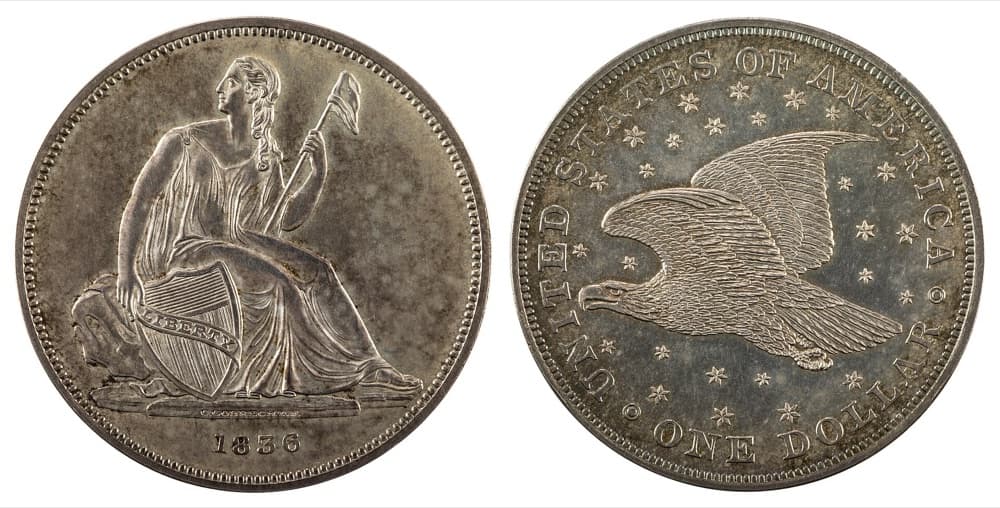
1836 Gobrecht Dollar
After three decades without a silver dollar, the Mint brought one back with a seated Liberty and a soaring eagle, and the engraver's signature on it caused a small scandal in Philadelphia.
- Year
- 1836
- Maker
- U.S. Mint (Philadelphia), designed by Christian Gobrecht
- By price in coins
- 73 of 100
Create a free account to see every recorded price and every grade.
Create a free account- Struck
- December 1836, Philadelphia Mint
- Variety
- Judd-60 Original: name C. GOBRECHT F. on the base of the rock, no stars on the obverse, 26 stars on the reverse, plain edge
- Mintage
- 1,000 for circulation in December 1836
- Design
- Seated Liberty after Thomas Sully, flying eagle after Titian Peale, engraved by Christian Gobrecht
- Why it matters
- The first United States silver dollar struck for circulation since production stopped in the early 1800s
- Pattern or coin?
- Long listed among patterns; modern research treats the December 1836 striking as a circulating issue
- Survivors
- About 500 of the Alignment I originals in all grades, per one grading service's estimate, and about 5 in 65 or better
- Auction record
- $99,000 for a PCGS PR64, August 22, 2021
Bringing back the dollar
The United States first struck silver dollars in 1794. Within a decade many were being exported for their silver, especially to Canton in China, and the Mint stopped making them. In 1806 Secretary of State James Madison ordered the halt made official. For the next three decades the demand for dollar coins was met largely by Spanish dollars.
In 1831 Mint Director Samuel Moore noticed the flow had reversed, with Spanish dollars arriving from Canton, and President Andrew Jackson lifted the ban at his request. Little happened until Robert M. Patterson replaced Moore as director in June 1835. Patterson wanted a new dollar, struck for circulation, partly to see whether the public would take to the denomination, and he wanted it to be a work of art.
On August 1, 1835, Patterson wrote to the Philadelphia painter Thomas Sully proposing a figure of Liberty 'in a sitting posture, sitting, for example, on a rock,' holding a pole topped with a liberty cap. For the reverse he asked Titian Peale for 'an Eagle flying, and rising in flight, amidst a constellation, irregularly dispersed, of 24 stars.' He disliked the heraldic eagle of earlier coins, calling it a 'mere creature of imagination.'
Christian Gobrecht
Christian Gobrecht was born December 23, 1785, in Hanover, Pennsylvania. He apprenticed in Manheim, engraved ornamental clockwork in Baltimore and moved to Philadelphia, where he joined an engraving firm. He was also an inventor, credited with a medal-ruling machine, improvements to the camera lucida, a talking doll and a kind of melodeon. In 1823, after the death of Chief Engraver Robert Scot, he worked for the Mint on a temporary basis until William Kneass was hired as chief engraver in January 1824.
On August 27, 1835, Kneass suffered a stroke that left him partly disabled. Patterson won approval to hire Gobrecht at once, and he became second engraver in September 1835. From then on he did most of the Mint's pattern and die work. Gobrecht turned Sully's sketches into a copper engraving by October 14, 1835, and on October 17 Treasury Secretary Levi Woodbury authorized dies after Jackson and his cabinet approved the design.
Soft-metal die trials followed in January 1836. Peale's eagle took longer to satisfy Patterson; Gobrecht began the reverse die in June, and Jackson approved both sides in August. In September Chief Coiner Adam Eckfeldt began sinking working dies. Gobrecht became chief engraver on December 21, 1840, after Kneass's death, and died in July 1844. His seated Liberty design remained on American coinage as late as 1891.
A conceited signature
Patterson ordered Gobrecht's name added to the coin as C. GOBRECHT F., the F for fecit, Latin for 'made it.' In the first trial pieces the signature sat in the field below Liberty, and a small number, presumably about 18, were distributed in Philadelphia. Reaction to the design was warm, with one exception: the signature. Gobrecht was attacked as a 'conceited German' in the local press.
Gobrecht asked that his name be removed altogether. Patterson instead had it moved onto the base of the rock where Liberty sits, small enough to notice only on close inspection. Those name-on-base coins are the Judd-60 dollars of December 1836.
By the time full production began, the eagle flew among 26 stars rather than the 24 Patterson had asked for, because Arkansas and Michigan had joined the Union since his 1835 letter. The coins were struck with a proof-like finish, and the Mint even advertised the new dollar in newspapers before the end of 1836.
Original, restrike, pattern: sorting the Gobrechts
The Mint struck 1,000 Judd-60 dollars in December 1836. They went into circulation, and many survivors are worn, damaged or holed from use as jewelry. In January 1837 Congress changed the silver standard, and 600 more dollars dated 1836 were struck in March 1837. References disagree about those 600: some describe them as coins issued at the new standard, while the die-state study by Craig Sholley, John Dannreuther and Saul Teichman concludes they were a test striking that was later melted. In 1839 the Mint struck 300 more Gobrecht dollars with a revised design, and the Seated Liberty dollar entered full production in 1840.
As coin collecting boomed in the 1850s, Mint Director James Ross Snowden had Gobrecht dollars restruck to sell or trade for rare medals for the Mint's cabinet, probably in 1859 and 1860. The practice was curbed after a scandal over Mint employees selling restrikes for profit. Restrikes show the eagle flying level when the coin is turned over, rather than rising, and most come from a reverse die with a small crack.
Collectors sort Gobrecht dollars by die alignment: I (coin turn, eagle flying upward), II (medal turn, eagle upward), III (coin turn, eagle level) and IV (medal turn, eagle level). Walter Breen in 1988 called only Alignment I originals from 1836. The Sholley, Dannreuther and Teichman study found that the December 1836 originals were struck in the sequence I, IV, II, IV, I, IV, and that only Alignment III pieces are restrikes. Alignment I, the variety in this entry, is the most readily available.
Even the best examples have stayed below $100,000 at auction. The grading service that lists the variety has certified none above PR64, and its condition census lists ten coins at that grade. One, from the D. Brent Pogue collection, sold for $82,250 in May 2016. The record came at auction in August 2021, when a PCGS PR64 with CAC approval, ex TradeDollarNut and Simpson, brought $99,000.
How to identify a Judd-60 original
The obverse shows Liberty seated on a rock with a shield and a liberty pole and cap, the date 1836 below, no stars in the field, and C. GOBRECHT F. in small letters on the base of the rock. The reverse shows an eagle in flight among 26 stars. The edge is plain.
Turn an original over on its horizontal axis and, in Alignment I, the eagle appears to fly 'onward and upward.' On restrikes the eagle flies level. Specialists also check die states, since alignment alone does not prove an original.
Sources disagree on the metal. One grading service lists 26.73 grams and 90% silver. Other references say the December 1836 coins were struck at the old 1792 standard of 89.24% silver and 416 grains (26.96 grams), and that the 90% standard and lighter weight began only after the act of January 18, 1837.
The numbers
- Mintage
- 1,000 (December 1836)
- Known survivors
- About 500 in all grades, 125 in 60 or better and 5 in 65 or better (one grading service's estimate for Alignment I originals)
- Weight
- 26.73 grams per one grading service; other references give 416 grains (26.96 grams) for the December 1836 striking
- Diameter
- 39.00 mm
- Composition
- 90% silver, 10% copper per one grading service; other references give 89.24% silver for the December 1836 striking
- Edge
- Plain
- Designer
- Christian Gobrecht, after designs by Thomas Sully (obverse) and Titian Peale (reverse)
- Reference
- Judd-60, Pollock-65
Timeline
Christian Gobrecht is born in Hanover, Pennsylvania.
Secretary of State James Madison orders silver dollar production halted.
President Jackson lifts the ban on silver dollars at Mint Director Samuel Moore's request.
Robert M. Patterson becomes Mint Director.
Patterson asks Thomas Sully for a seated Liberty and Titian Peale for a flying eagle.
Chief Engraver William Kneass suffers a stroke; Gobrecht is hired as second engraver in September.
Treasury Secretary Levi Woodbury authorizes dies after Jackson and his cabinet approve the design.
Soft-metal die trials of the obverse are struck.
Jackson approves both sides of the coin.
Adam Eckfeldt begins sinking working dies; Gobrecht's name is added at Patterson's order.
1,000 Judd-60 dollars with the name on the base are struck for circulation.
Congress changes the legal standard for silver coins to 90% silver.
600 more dollars dated 1836 are struck; later research concludes they were melted.
300 Gobrecht dollars with the revised design are struck for circulation.
Full production of the Seated Liberty dollar begins; Gobrecht becomes chief engraver on December 21.
Christian Gobrecht dies.
Director Snowden begins restriking Gobrecht dollars for trade and sale, probably in 1859 and 1860.
The Pogue PR64 sells for $82,250 at auction.
A PCGS PR64 sets the auction record of $99,000.
The world in 1836
Samuel Colt receives a patent for his revolver.
The Battle of the Alamo ends.
Sam Houston's forces defeat Santa Anna at San Jacinto.
Arkansas becomes the 25th state.
James Madison dies at Montpelier, Virginia.
Jackson issues the Specie Circular, a step toward the Panic of 1837.
Martin Van Buren wins the presidential election.
The United States Patent Office burns in Washington.
Price record
| Date | Price | Kind |
|---|---|---|
| Nov 2004 | $39,100 | Sold at auctionJudd-60 original, Alignment I, PCGS PR64. |
| Jan 2007 | $74,750 | Sold at auctionJudd-60 original, Alignment I, PCGS PR64. |
| May 2016 | $82,250 | Sold at auctionPCGS PR64, ex D. Brent Pogue collection. |
| Aug 22, 2021 | $99,000 | Sold at auctionPCGS PR64 CAC, ex TradeDollarNut and Simpson collections; the auction record for the variety. |
| Aug 2023 | $42,000 | Sold at auctionPCGS PR62 CAC, Alignment I, ex Korein. |
A realized auction price is what a buyer actually paid on the date shown, including the buyer's premium where the sale reported it. It is the strongest kind of reference price, and it is a record of one sale of one object on one day, not a promise of what the next example will bring.
By reference price, 1836 Gobrecht Dollar is number 73 of 100 in the coins entries of the FLOAT 100. 96 of those 100 rest on a realized sale; the rest carry an asking price or a guide value, and each page says which. Rank within the FLOAT 100 itself (30 here) is editorial: how much an object defines its field, not price alone.
Did you know
- The 26 stars on the reverse were two more than Patterson asked for, because Arkansas and Michigan joined the Union while the coin was being designed.
- Gobrecht asked to have his name taken off the coin entirely after critics called it conceited. The Mint moved it to the rock instead.
- A common story says the flying eagle was modeled on Peter, the Mint's pet eagle, who is still on display at the Mint.
- Gobrecht dollars were intended for circulation yet struck with a proof finish, something one grading service calls unique among United States coins.
- The same flying eagle later appeared on the Flying Eagle cent, which began production in 1856.
How this page is made
- The figure
- One reference price, shown with its own kind. FLOAT does not average it with anything or adjust it for time.
- Realized or not
- A realized price is a completed sale. An asking price, an estimate and a price-guide value are not sales, and are labeled as such wherever they appear.
- The story
- Researched from published records and checked fact by fact. Updated Oct 1, 2026.
- Archive
- Oct 5, 2026