FLOAT 100 · Coins · No. 31
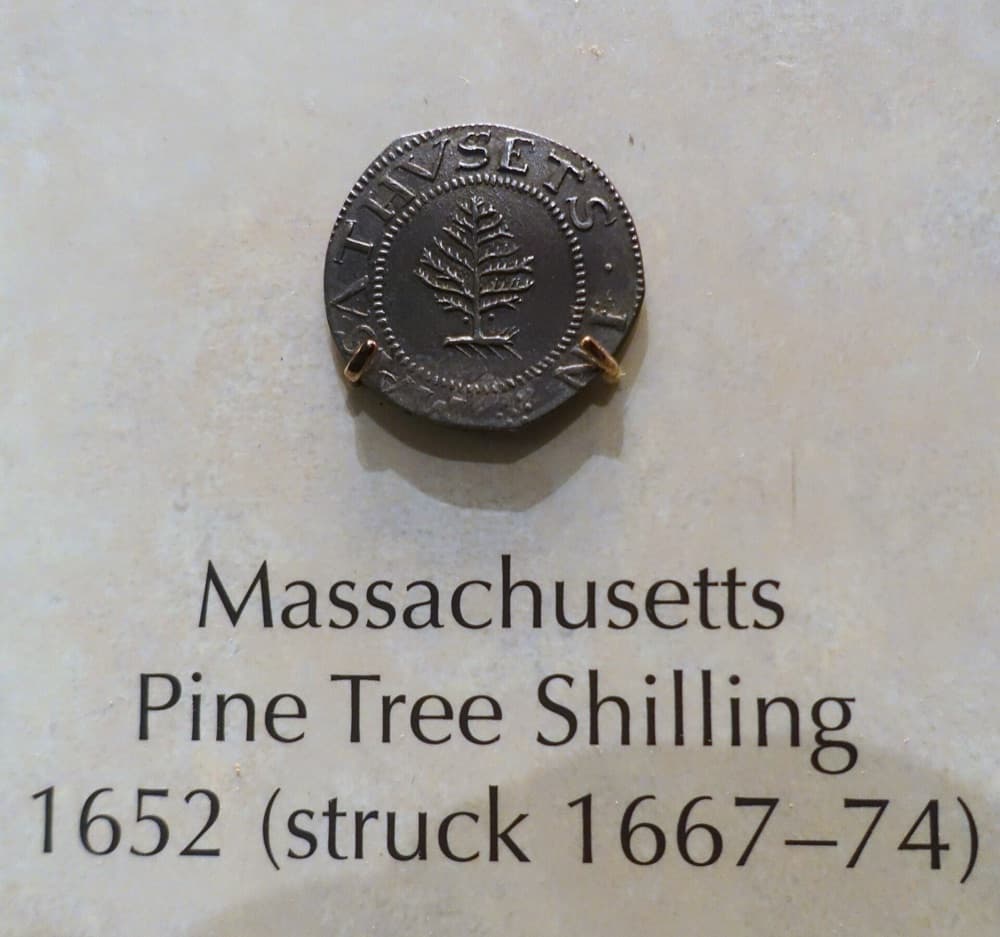
1652 Pine Tree Shilling (Large Planchet)
A Puritan colony with no king's permission melted down Spanish silver and made its own money, then kept stamping the same date on it for 30 years.
- Year
- 1652
- Maker
- Massachusetts Bay Colony (Boston mint, John Hull)
- By price in coins
- 65 of 100
Create a free account to see every recorded price and every grade.
Create a free account- Issuer
- Massachusetts Bay Colony, Boston mint of John Hull and Robert Sanderson
- Date on coin
- 1652, the year the mint was authorized; Pine Tree coins were actually struck from about 1667 to 1682
- Large Planchet
- The earlier, broader Pine Tree shilling, struck on a rocker press, about 1667 to 1674
- Legends
- MASATHVSETS IN around the tree; NEW ENGLAND, AN DOM, 1652 and XII on the reverse
- Standard
- 72 grains of sterling-standard silver, lighter than the English shilling of about 92.9 grains
- The coin in this entry
- Noe-7, no pellets at trunk, PCGS MS65 CAC, ex Ford; one of about 11 known of its die variety
- Sale
- $141,000 at auction, June 2017
- How many survive
- Thousands of Pine Tree shillings in all; mintage was never recorded
A colony short of money
By the middle of the 17th century Massachusetts Bay had a busy trading economy and almost no reliable money. English coins were scarce, and those that arrived tended to flow back across the Atlantic to pay for imports. Colonists got by with barter, credit, wampum and a jumble of foreign coins, English, Spanish, Dutch and Portuguese, many of them clipped, underweight or counterfeit. A debasement scandal at the Spanish mint at Potosí in the late 1640s made matters worse.
In 1652 the General Court first asked the Boston silversmith John Hull to weigh, assay and countermark foreign coins. Hull declined, since it would not have paid. On May 26, 1652, the Court instead authorized him to make Massachusetts coins in shilling, sixpence and threepence denominations by reminting foreign silver. Residents could bring in bullion, plate and Spanish coin, and the colony paid for tools and a mint house built on Hull's land.
The colony set its shilling at 72 grains of sterling-standard silver, well below the English shilling's roughly 92.9 grains. Inside Massachusetts it still passed for 12 pence. The idea was a coin worth more at home than as bullion abroad, so it would stay in the colony. It did not fully work; merchants still exported the coins, and the General Court later tried to stop them.
John Hull, mintmaster
John Hull was born December 18, 1624, in Market Harborough, Leicestershire, the son of a blacksmith. He sailed from Bristol with his family in September 1635 and reached Boston on November 7. After two years at Boston Latin School and a long apprenticeship, he set up as a silversmith in 1646, and in 1647 he married Judith Quincy in a ceremony officiated by John Winthrop. His partner at the mint was the silversmith Robert Sanderson, who may have done much of the actual coining.
The mint made Hull rich. He kept one shilling and seven pence for every 20 shillings he struck, and in some years cleared more than £1,000. The General Court tried at least seven times to cut his share, and charged him rent on the mint house until he bought the operation in 1675. He became a major merchant with stakes in more than a dozen ships, served as colony treasurer from 1676 to 1680, and was one of Harvard's earliest benefactors.
His record also includes the slave trade. During King Philip's War in 1675 and 1676 he arranged the sale of Native American captives into slavery, and in 1682 he instructed a captain to sell two Black people, Jeofrey and Mary, in Madeira. Hull died October 1, 1683, and is buried in Boston's Granary Burying Ground.
Nathaniel Hawthorne popularized a legend in 1840 that Hull gave his daughter Hannah her weight in pine tree shillings, about 10,000 coins, when she married Samuel Sewall. The real dowry was £500, paid in two installments.
From NE to the pine tree
The first Massachusetts coins, struck from June to October 1652, were plain discs punched NE on one side and the value in Roman numerals on the other. They were easy to clip, since silver could be shaved from the edge without touching the design. In October 1652 the General Court ordered a more elaborate design with a double ring of beads. The tree coins followed in three stages, named for the style of tree: Willow Tree, about 1652 to 1660; Oak Tree, about 1660 to 1667; and Pine Tree, about 1667 to 1682. Sources differ slightly on these dates, and one grading-service narrative has Hull striking the pine design from 1652.
Nearly every tree coin, whenever it was struck, carries the date 1652. A popular story holds that Massachusetts froze the date because England had no king in 1652, giving the colony cover after Charles II regained the throne in 1660. The Smithsonian presents that as one possibility and notes the date may simply mark the founding of the mint. One grading service calls the royal-deception story a myth.
The tree itself may have stood for one of the colony's important exports: New England timber, especially tall pines for ship masts. Later generations read it as a symbol of independence, but the surviving record does not show that Hull meant it that way.
Minting was a royal prerogative, and Massachusetts had no royal permission. In 1665 a royal commission demanded repeal of the mint law and the Privy Council ordered the mint closed; the colony ignored it. In 1676 Edward Randolph petitioned the Crown to shut it down. The mint stopped in 1682 when Hull's contract expired and was not renewed. The coinage was one of the grievances behind the revocation of the colony's charter in 1684, though the Crown's quarrel with Massachusetts was much broader than money.
The Ford-Manley Noe-7
The coin in this entry is a Large Planchet shilling of the Noe-7 variety (Crosby 7-B3), with no pellets beside the tree trunk. Michael Hodder wrote in 2005 that only 11 examples of Noe-7 are known. Its obverse die was used for no other pairing, and the tree sits directly over the M in MASATHVSETS. A die crack runs across the reverse without obscuring any letters.
It weighs 71.4 grains according to the Ford catalog, close to the 72-grain standard. The surfaces are gunmetal gray with hazel accents on the obverse and a bluish center on the reverse. Almost every letter is bold. Only the VS in MASATHVSETS is soft, a typical effect of the rocker press. An early owner, Carl Wurtzbach, who illustrated it in his own work, summed it up: 'Gem Coin. Cannot Be Excelled.'
Its recorded line runs from Charles E. Clapp to Wurtzbach, T. James Clarke, F.C.C. Boyd and John J. Ford, Jr., whose collection was sold at auction in October 2005. Graded PCGS MS65 with CAC approval, it sold for $141,000 at auction in June 2017, described as probably the finest Noe-7.
Reading a Large Planchet shilling
Large Planchet coins are the earlier Pine Tree shillings, with examples around 30 mm across. They were struck on a rocker or roller press with curved dies, which often left a wave or slight S-bend in the coin. Around 1675 a screw press arrived, and the later Small Planchet shillings measure about 24 mm.
Collectors sort them by die marriage using Sydney P. Noe's numbering, refined by Walter Breen, Richard Picker and Christopher J. Salmon. Features such as pellets at the trunk (Noe-1), a reversed N (Noe-4) or the centered tree of Noe-7 identify the dies. Weight matters too: full-weight coins near 72 grains are prized, and some pieces were trimmed at the mint itself to bring them to standard.
Pedigree carries real weight in this series. One Noe-4 bought by Robert Garrett for $30 in 1904 brought $35,000 in the 1980 Garrett sale and $78,000 in 2020. The Noe plate coin for Noe-1, ex Boyd and Ford, brought $43,125 in 2005 and $76,375 in 2013.
The numbers
- Mintage
- Unknown. The Boston mint may have struck 300,000 to 500,000 coins of all types and denominations
- Known survivors
- Thousands of Pine Tree shillings; about 11 of the Noe-7 variety in this entry
- Weight
- 72 grains authorized; this coin 71.4 grains
- Diameter
- Variable; Large Planchet examples around 30 mm
- Composition
- Sterling-standard silver
- Mintmasters
- John Hull and Robert Sanderson
- Press
- Rocker or roller press (Large Planchet)
- Variety
- Noe-7, Crosby 7-B3, W-730, High Rarity-6
Timeline
John Hull is born in Market Harborough, England.
The young John Hull arrives in Boston with his family.
Hull begins working as a silversmith in a house his father deeded to him.
The Massachusetts General Court authorizes Hull to coin shillings, sixpences and threepences.
The Boston mint begins striking plain NE coins.
The General Court orders a more complex design with beaded rings to deter clipping.
The Oak Tree design replaces the Willow Tree, by the usual dating.
A royal commission demands repeal of the mint law; the Privy Council orders the mint closed. The colony ignores it.
The Pine Tree design is introduced, struck first on large planchets with a rocker press.
A screw press ushers in the Small Planchet shillings; Hull buys the mint operation from the colony.
Edward Randolph petitions the English government to close the mint.
Hull's contract expires and the Boston mint closes.
John Hull dies in Boston.
England revokes the Massachusetts Bay charter; the coinage is one of the grievances.
Robert Garrett buys a Noe-4 Large Planchet shilling for $30.
Michael Hodder records only 11 known examples of Noe-7.
The coin in this entry is sold with the John J. Ford, Jr. collection.
The coin in this entry, PCGS MS65 CAC, sells for $141,000.
The world in 1649
Charles I loses his throne and his life; England becomes a republic.
Jan van Riebeeck founds a Dutch East India Company station at the Cape of Good Hope, the start of Cape Town.
Rhode Island passes the first law in North America making slavery illegal.
George Fox preaches on Firbank Fell, a founding moment for the Quakers.
The First Anglo-Dutch War formally begins.
A great fire destroys a third of Glasgow.
Charles II regains the English throne.
King Philip's War breaks out in New England.
Price record
| Date | Price | Kind |
|---|---|---|
| 1904 | $30 | Sold at auctionA Noe-4 Large Planchet shilling, John G. Mills collection, bought by Robert Garrett. |
| 1980 | $35,000 | Sold at auctionThe same Noe-4, Garrett collection sale. |
| Oct 2005 | $43,125 | Sold at auctionNoe-1 plate coin, ex Boyd, John J. Ford, Jr. collection. |
| Aug 11, 2010 | $92,000 | Sold at auctionA Large Planchet shilling graded MS65; listed by the grading service as the auction record for its Large Planchet entry. |
| Aug 2013 | $76,375 | Sold at auctionNoe-1 plate coin, NGC MS65+, 73.9 grains. |
| Mar 2015 | $25,850 | Sold at auctionNoe-2, no pellets, PCGS MS61, 72.5 grains. |
| Jun 8, 2017 | $141,000 | Sold at auctionThe coin in this entry: Noe-7, no pellets at trunk, PCGS MS65 CAC, ex Ford. |
| 2020 | $78,000 | Sold at auctionThe Mills-Garrett-Weinberg Noe-4, PCGS MS64, 71.45 grains. |
| Jan 2022 | $66,000 | Sold at auctionThe Norweb-Hain Noe-4, PCGS MS64, 72.2 grains. |
A realized auction price is what a buyer actually paid on the date shown, including the buyer's premium where the sale reported it. It is the strongest kind of reference price, and it is a record of one sale of one object on one day, not a promise of what the next example will bring.
By reference price, 1652 Pine Tree Shilling (Large Planchet) is number 65 of 100 in the coins entries of the FLOAT 100. 96 of those 100 rest on a realized sale; the rest carry an asking price or a guide value, and each page says which. Rank within the FLOAT 100 itself (31 here) is editorial: how much an object defines its field, not price alone.
Did you know
- Massachusetts deliberately made its shilling lighter than England's so the coins would be worth more at home than melted abroad.
- Pine Tree shillings were made for about 15 years, yet nearly all carry the date 1652.
- John Hull earned about one shilling and seven pence on every 20 shillings he coined, and the colony tried at least seven times to reduce his cut.
- The story that Hull paid his daughter's dowry with her weight in shillings comes from Nathaniel Hawthorne; the real dowry was £500.
- The wavy bend seen on many Large Planchet shillings comes from the curved dies of the rocker press.
- One Large Planchet shilling bought for $30 in 1904 sold for $78,000 in 2020.
How this page is made
- The figure
- One reference price, shown with its own kind. FLOAT does not average it with anything or adjust it for time.
- Realized or not
- A realized price is a completed sale. An asking price, an estimate and a price-guide value are not sales, and are labeled as such wherever they appear.
- The story
- Researched from published records and checked fact by fact. Updated Oct 1, 2026.
- Archive
- Oct 5, 2026