FLOAT 100 · Coins · No. 17
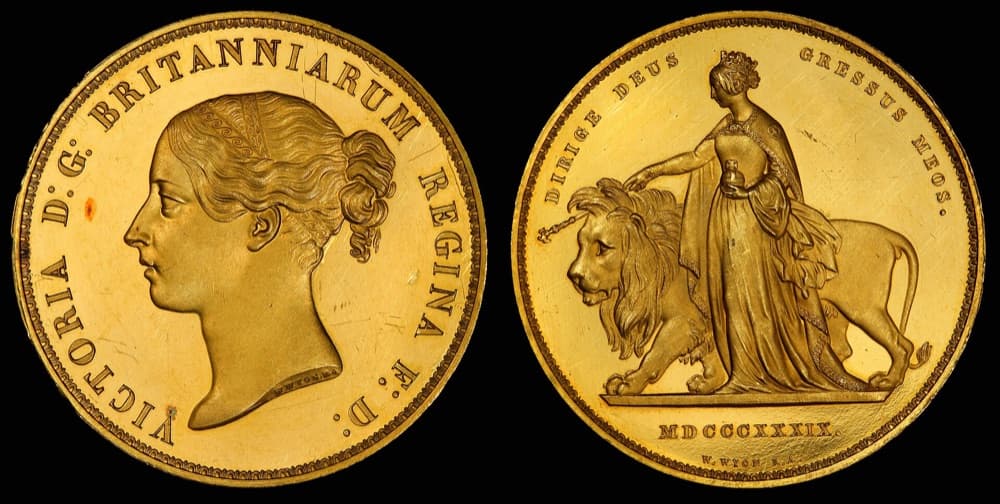
1839 Victoria 'Una and the Lion' £5 Gold Proof
A twenty-year-old queen cast as a heroine of Elizabethan poetry, leading a lion: William Wyon's 1839 gold five pounds was never meant to be spent, and collectors have treated it as Britain's most beautiful coin ever since.
- Year
- 1839
- Maker
- Royal Mint (Great Britain), designed by William Wyon
- By price in coins
- 20 of 100
Create a free account to see every recorded price and every grade.
Create a free account- Issued
- 1839, Royal Mint, for Queen Victoria's proof set; never intended for circulation
- Designer
- William Wyon, Chief Engraver of the Royal Mint from 1828 to 1851
- Obverse
- Wyon's young head of Victoria, with VICTORIA D: G: BRITANNIARUM REGINA F: D:
- Reverse
- Victoria as Una from Spenser's The Faerie Queene, with orb and scepter, leading a lion; DIRIGE DEUS GRESSUS MEOS ("May God direct my steps") and the date MDCCCXXXIX
- Struck
- About 400 originally, with more made to order for decades afterward
- This coin
- NGC PR66 star Ultra Cameo; W&R-279, DIRIGE legend, medal alignment, small lettered edge with five scrolls
- Census
- Of 155 examples given straight grades by the two major grading services, only one grades a point higher (as of January 2026)
- Record
- $1,440,000 at auction, August 19, 2021, the most ever paid for the type
- Last public sale
- $915,000 at auction in January 2026
A coin for a new queen
Victoria became queen on June 20, 1837, at eighteen, after the death of her uncle William IV, and was crowned in June 1838. The Royal Mint prepared a set of proof coins to mark the new reign, and the five-pound gold piece was made for that set. The set was long delayed: the Royal Mint Museum notes that specimen sets reached collectors in 1843.
The five pounds was never a working coin. Proof pieces like it were legal tender but were struck for presentation sets, not for circulation. The Cleveland Museum of Art, which holds an example, notes that it never circulated.
Everything about it came from one engraver. William Wyon, born in Birmingham in 1795 into a family of engravers and die sinkers, joined the Royal Mint as an assistant engraver in 1816 and served as its chief engraver from 1828 until his death in 1851. He was elected a full member of the Royal Academy in 1838.
The queen as Una
Wyon chose to show the young queen as Una, the heroine of Edmund Spenser's The Faerie Queene, published in 1590. In the poem Una stands for Truth, since truth is one, and she is accompanied by a lion. On the coin Victoria, crowned and holding a scepter, walks beside the lion, which represents England. It was the first time a British monarch had been shown on a coin as a fictional character.
The Royal Mint Museum calls the obverse portrait the finest of all Wyon's portraits of the queen, and describes the reverse as unusual for a British coin, setting the restrained energy of the lion against Una's peace and grace. The Cleveland Museum of Art records that Victoria was twenty years old when the coin was made.
The reverse legend reads DIRIGE DEUS GRESSUS MEOS, "May God direct my steps," and the date is given in Roman numerals, MDCCCXXXIX. Some dies spell the first word DIRIGIT.
The coin has also been criticized as too medallic for a coin. The Royal Mint Museum argues that the complaint is unfair, since these pieces were only ever meant as proofs for specimen sets.
Varieties and how to read one
The pieces vary in the ornament of the queen's hairband, the edge, the metal and the spelling of the reverse legend. The Royal Mint Museum's own holdings show the range: 13 specimens, two in gold, four in silver, two in bronzed copper and five in tin. Some edges are plain and some are lettered; one lettered edge reads DECUS ET TUTAMEN ANNO REGNI TERTIO, "An ornament and a safeguard, in the third year of the reign."
The standard reference by Wilson and Rasmussen catalogs the gold varieties. One major catalog description counts nine varieties, ranging in rarity from R2 to R7, while another recent article counts eight. This example is W&R-279 (R2), with the DIRIGE legend, medal alignment and a small lettered edge with five scrolls.
Published measurements differ. One catalog gives the standard weight as 39.94 grams and the diameter as 35.5 mm; the Cleveland example weighs 38.724 grams with a diameter of 3.7 cm; and an encyclopedia entry gives a range of 38.7 to 39.3 grams. Its gold content is listed at 1.1775 troy ounces.
How many were made is also uncertain. About 400 are generally said to have been struck for the 1839 sets; other accounts give 300 to 500, and the Royal Mint Museum says no more than a few hundred. Demand outran supply, and the Mint went on striking pieces to order for decades. One account says the last strikings from Wyon's original die came in 1880; auction catalogers say the Mint may have filled orders as late as 1886.
This coin and the market for the type
This example, graded PR66 Ultra Cameo by NGC with the grader's star for exceptional eye appeal, came to auction on August 19, 2021, during the American Numismatic Association's World's Fair of Money. Its catalog called its surfaces so deeply contrasted that the coin looked almost like a modern striking, with the folds and lace of Victoria's gown and the hairs of the lion's mane rendered razor-sharp. At the time it was the single finest example certified by either major grading service and the only one awarded the star.
It sold for $1,440,000, a record for the type. The record had been climbing fast. In January 2020 a PR64 Deep Cameo example brought $690,000. In May 2020 an NGC PF65 Ultra Cameo example sold in Japan for about $930,000. On October 29, 2020, a PR66 Ultra Cameo example sold at auction in Monaco for 984,000 euros, about $1.148 million.
The same coin, the same certificate, returned to auction in January 2026 during the NYINC show and sold for $915,000, above its presale expectations but well below its 2021 price. By then one Una and the Lion in either service's census graded a point higher. At the same event a PR63 Ultra Cameo example brought $244,000.
The most beautiful British coin
The Royal Mint Museum calls the Una and the Lion arguably one of the most beautiful coins in the world, and graders and catalogers routinely describe it as the most beautiful in British numismatics.
Wyon's portrait work reached far beyond this one coin. His young head of Victoria was used on her coinage from 1838 to 1887, and his work influenced the design of the Penny Black of 1840, the world's first adhesive postage stamp. His son Leonard Charles Wyon also became a coin engraver.
The design has been revived several times. The Royal Mint used it on a 2012 five-pound crown for Elizabeth II's Diamond Jubilee and on a silver one-ounce coin in its millennium series. In November 2019 the Mint reissued it in six denominations in its Great Engravers series, with the original die digitally scanned and remastered by its chief engraver, Gordon Summers.
The numbers
- Mintage
- About 400 struck for the 1839 sets (other accounts: 300 to 500, or a few hundred), plus later pieces made to order
- Known survivors
- 155 examples received straight grades from the two major grading services as of January 2026
- Weight
- 39.94 g standard per one catalog; a museum example weighs 38.724 g; another reference gives 38.7 to 39.3 g
- Diameter
- 35.5 mm per one catalog; 3.7 cm per a museum record
- Composition
- Gold, 1.1775 troy ounces of gold content; pieces also exist in silver, bronzed copper and tin
- Designer
- William Wyon
- References
- KM742, S-3851, W&R-279
Timeline
William Wyon is born in Birmingham, the son of the engraver Peter Wyon.
Wyon joins the Royal Mint as an assistant engraver.
Wyon becomes Chief Engraver of the Royal Mint.
Victoria, eighteen, becomes queen.
Victoria is crowned in June; Wyon becomes a full member of the Royal Academy.
Wyon's Una and the Lion five pounds is struck for the new reign's proof set, about 400 pieces.
The Penny Black, the first adhesive postage stamp, is issued; Wyon's work influenced its design.
Specimen sets are distributed to collectors.
Wyon dies in Brighton.
Last striking from Wyon's original die, by one account; catalogers say orders may have been filled as late as 1886.
The Royal Mint revives the design on a five-pound crown for the Diamond Jubilee.
The Royal Mint reissues the design in six denominations from a digitally scanned original die.
A PR64 Deep Cameo example sells for $690,000.
A PR66 Ultra Cameo example sells in Monaco for 984,000 euros, about $1.148 million, a record at the time.
This PR66 star Ultra Cameo example sells for $1,440,000, a new record for the type.
The same coin sells at auction for $915,000.
The world in 1839
The French Academy of Sciences announces the daguerreotype photographic process.
A British expedition captures Aden.
The Treaty of London establishes Belgium as a kingdom with guaranteed independence and neutrality.
The Bedchamber Crisis: Robert Peel asks the young Queen Victoria to dismiss some of her attendants.
Chinese officials begin destroying opium at Humen, the spark for the First Opium War with Britain.
Captives aboard the Amistad rebel and take the ship.
Thousands of Chartists march on Newport, Wales; about 22 are killed.
Price record
| Date | Price | Kind |
|---|---|---|
| Aug 19, 2021 | $1,440,000 | Sold at auctionThis coin, NGC PR66 star Ultra Cameo. Sold at auction during the ANA World's Fair of Money; a record for the type. |
| Jan 12, 2026 | $915,000 | Sold at auctionSame coin and certificate, sold at auction during the January 2026 NYINC show. |
A realized auction price is what a buyer actually paid on the date shown, including the buyer's premium where the sale reported it. It is the strongest kind of reference price, and it is a record of one sale of one object on one day, not a promise of what the next example will bring.
By reference price, 1839 Victoria 'Una and the Lion' £5 Gold Proof is number 20 of 100 in the coins entries of the FLOAT 100. 96 of those 100 rest on a realized sale; the rest carry an asking price or a guide value, and each page says which. Rank within the FLOAT 100 itself (17 here) is editorial: how much an object defines its field, not price alone.
Did you know
- It was the first time a British monarch appeared on a coin as a fictional character.
- Una stands for Truth in Spenser's poem because truth is one, and una means one.
- Demand was so strong that the Royal Mint kept striking them to order for decades after 1839.
- The Royal Mint Museum holds 13 examples, and only two of them are gold; five are tin.
- The engraver who designed it also influenced the design of the Penny Black, the world's first adhesive postage stamp.
- The record example sold for $1,440,000 in 2021 and for $915,000 when it returned in 2026.
How this page is made
- The figure
- One reference price, shown with its own kind. FLOAT does not average it with anything or adjust it for time.
- Realized or not
- A realized price is a completed sale. An asking price, an estimate and a price-guide value are not sales, and are labeled as such wherever they appear.
- The story
- Researched from published records and checked fact by fact. Updated Oct 1, 2026.
- Archive
- Oct 5, 2026