FLOAT 100 · Coins · No. 62
1856-O Liberty Head Double Eagle
New Orleans struck just 2,250 of these $20 gold pieces in a year when the city's gold was drying up, and the near-perfect survivor that once sat in the only complete collection of American coins vanished from the market for 42 years.
- Year
- 1856
- Maker
- U.S. Mint (New Orleans)
- By price in coins
- 34 of 100
Create a free account to see every recorded price and every grade.
Create a free account- Struck
- 1856, New Orleans Mint (O mintmark below the eagle's tail)
- Mintage
- 2,250, the smallest of any New Orleans double eagle
- Designer
- James Barton Longacre, fourth Chief Engraver of the U.S. Mint
- Specs
- $20 gold, .900 gold and .100 copper, about 33.4 grams, 34 mm, reeded edge
- Survivors
- Estimates run from 15-18 (1982) to 30-40; one 2025 catalog could trace 27
- This coin
- PCGS AU58, the Eliasberg coin, described as the third-finest known
- Finest known
- A PCGS SP63 specimen saved by the New Orleans Mint superintendent, the only Uncirculated example
- Record
- $690,000 for this coin at auction, February 27, 2025, a record for the issue
A gold rush coin from a mint running out of gold
Congress created the $20 double eagle in the Coinage Act of 1849, as gold from California began flooding east. It was the largest gold coin the United States issued for circulation, meant to make it easier to move the enormous quantities of metal coming out of the gold fields. Until San Francisco got its own mint in 1854, most of that gold was coined in Philadelphia, but New Orleans, a busy port, received enough to justify striking $10 and $20 pieces too.
In the series' first four years New Orleans struck between about a hundred thousand and three hundred thousand double eagles a year. Then the flow stopped. Deposits slowed in 1853 in anticipation of the San Francisco Mint, and once that mint opened in 1854 they fell to a trickle. New Orleans coined only 3,250 double eagles in 1854 and 8,000 in 1855. In 1856, using a single pair of dies, it struck just 2,250.
The building itself cut the year short. The New Orleans Mint had been designed by William Strickland without accounting for the swampy ground and high water table, and it suffered structural problems for decades. In 1854 the government hired a West Point engineer and Louisiana native, Pierre Gustave Toutant Beauregard, to fireproof it and rebuild the arches under the basement ceiling. Coinage stopped in October 1856 so the repairs could go on. Beauregard finished by 1859; less than two years later he ordered the attack on Fort Sumter that began the Civil War.
Longacre's Liberty
The design is the work of James Barton Longacre (1794-1869), appointed Chief Engraver by President John Tyler in 1844 after the death of Christian Gobrecht. Longacre had no experience sinking dies when he took the job, and his tenure was marked by conflict with the coiner Franklin Peale and Mint Director Robert M. Patterson. He outlasted both and went on to design dozens of medals and coins, including the Indian Head cent.
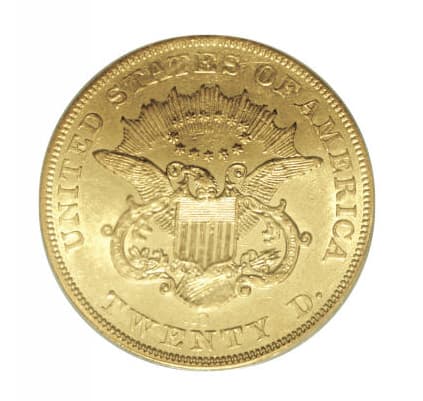
His double eagle shows Liberty facing left in a coronet inscribed LIBERTY, with his initials JBL on the truncation of the bust and thirteen six-pointed stars above. On the reverse an eagle with spread wings holds an olive branch and a bundle of arrows, its chest covered by a shield, under the legend UNITED STATES OF AMERICA. The denomination reads TWENTY D., and on this coin a small O for New Orleans sits just below the eagle's tail feathers.
Collectors call the issues of 1850 through 1866, which lack the motto IN GOD WE TRUST, Type One double eagles. Among them the 1856-O and the 1854-O are the two keys. The 1854-O may be rarer by a handful of coins overall, but the 1856-O is the rarer of the two in high grade, and specialist Doug Winter calls it the single rarest coin struck at the New Orleans Mint.
Spent in a divided South
Almost every 1856-O went straight into circulation. Only one is known to have been set aside: the New Orleans Mint superintendent, Charles Bienvenu, saved a sharply struck example that stayed with his family until 1979. It is graded PCGS SP63 today and is the only Uncirculated 1856-O known. Every other survivor shows the wear of years in commerce.
Few people could have collected them at the time. A $20 gold piece was a large sum, the handful of wealthy collectors who did assemble double eagles mostly bought Philadelphia proof sets, and almost nobody cared about branch-mint coins until Augustus Heaton published his treatise on mintmarks in 1893. Heaton singled out the 1856-O as a coin no longer found in circulation, and advised that the only way to get one was through bullion brokers, bank tellers and Mint employees who handled old double eagles turned in for recoinage.
The coins circulated in the South before the Civil War. The 2025 sale catalog suggests many were lost when the Confederacy shipped gold to Europe, where it was later melted. Another surfaced in an unlikely place: the Baltimore Hoard, gold coins found by two boys in a cellar on South Eden Street in August 1934, contained a single 1856-O. When the hoard was sold on May 2, 1935, that coin brought the highest price of any piece in it.
The Eliasberg coin
After the gold recall of 1933 closed most legal avenues for holding gold, financiers such as Louis E. Eliasberg Sr. of Baltimore turned to rare gold coins, and the 1856-O quickly became known as a landmark rarity. Eliasberg, who died in 1976, was the only collector ever to complete a collection of U.S. federal coinage by date, mintmark and major variety. His gold was sold at auction in October 1982, where this 1856-O was cataloged as Choice Extremely Fine to About Uncirculated, prooflike, and realized $49,000.
The 1982 catalog guessed the coin had earlier belonged to either the J.F. Bell collection, sold in 1944, or the William Cutler Atwater collection, sold in June 1946. Neither of those catalogs illustrated the coin, so the link cannot be proved. Over the following decades both major grading services graded it AU58 at different times, but it was never offered publicly again.
It returned in the Mississippi Collection of Double Eagles, Part II, still accompanied by the large plastic holder it had been housed in for the Eliasberg sale. On February 27, 2025, it sold for $690,000, a record for the issue, and led a multi-day auction in Long Beach, California, that totaled $22,246,194. The previous high for an 1856-O was $576,150, paid in October 2008 for a different AU58 example.
How to know it
Every 1856-O shares one die pair, and the type has a recognizable look: the obverse is usually strongly struck while the reverse often shows weakness on the eagle's wings and tail feathers. Most survivors are heavily marked from circulation or have been cleaned. The Eliasberg coin is orange-gold with a mix of original luster and prooflike reflectivity, only a trace of friction on the high points, and fine detail in Liberty's hair and the stars.
Specialists track the population coin by coin, using marks as fingerprints. On this example, small parallel scratches on Liberty's cheek serve as the pedigree marker; one census of the issue also notes a gouge at the jaw near the ear. Survival estimates have moved over time: David W. Akers counted 15 to 18 in 1982, Garrett and Guth suggest fewer than 25, Winter's 2018 book lists 25, and one grading-service reference estimates 30 to 40 in all grades. The 2025 catalog could positively trace 27, and noted that the two grading services together had certified 31, including resubmissions.
Two 1856-O double eagles are in the National Numismatic Collection at the Smithsonian Institution and will never be sold. Sources differ slightly on the weight, listing 33.40 or 33.44 grams.
The numbers
- Mintage
- 2,250 (one die pair)
- Known survivors
- 27 traced (2025 catalog); estimates range from 15-18 (Akers, 1982) to 30-40 (grading-service reference)
- Certified
- 31 by NGC and PCGS combined, including resubmissions (2025)
- Weight
- 33.40 g or 33.44 g, depending on the reference
- Diameter
- 34.00 mm
- Composition
- .900 gold, .100 copper
- Edge
- Reeded
- Designer
- James Barton Longacre (obverse and reverse)
- Top population
- PCGS SP63 (1); NGC AU58 (3), as of December 2024
Timeline
The Coinage Act of 1849 creates the $20 double eagle.
The San Francisco Mint opens; gold deposits at New Orleans fall to a trickle.
P.G.T. Beauregard is hired to fireproof and repair the New Orleans Mint.
New Orleans strikes 2,250 double eagles from a single die pair.
Coinage at New Orleans is cut short for structural repairs.
Augustus Heaton's treatise on mintmarks names the 1856-O as a coin no longer found in circulation.
An 1856-O in the John Nickerson Collection is described as extremely rare, possibly the first in such sales.
Two boys find the Baltimore Hoard, which includes one 1856-O.
The Baltimore Hoard is sold; the 1856-O brings the top price.
The Bienvenu family sells the superintendent's specimen, the finest known 1856-O.
This coin sells from the Eliasberg collection for $49,000.
A different AU58 example sells for $576,150, an issue record for 17 years.
Doug Winter's book on New Orleans gold lists 25 known 1856-O double eagles.
The Eliasberg coin, PCGS AU58, sells for a record $690,000 after 42 years off the market.
The world in 1856
Pro-slavery forces sack Lawrence, Kansas, during Bleeding Kansas.
Congressman Preston Brooks beats Senator Charles Sumner with a cane in the Senate chamber.
Followers of John Brown kill five pro-slavery settlers in the Pottawatomie Massacre.
The Great Train Wreck of 1856 near Philadelphia kills at least 59.
A hurricane destroys Last Island, Louisiana, leaving at least 200 dead.
Kate Warne, the first female private detective, begins work for the Pinkerton agency.
James Buchanan wins the presidential election.
Price record
| Date | Price | Kind |
|---|---|---|
| Oct 1982 | $49,000 | Sold at auctionThis coin, from the Louis E. Eliasberg Sr. gold collection; cataloged then as Choice EF-45 to AU-50, prooflike. |
| Feb 27, 2025 | $690,000 | Sold at auctionThis coin, PCGS AU58, ex Eliasberg, Mississippi Collection; record for the issue. |
A realized auction price is what a buyer actually paid on the date shown, including the buyer's premium where the sale reported it. It is the strongest kind of reference price, and it is a record of one sale of one object on one day, not a promise of what the next example will bring.
By reference price, 1856-O Liberty Head Double Eagle is number 34 of 100 in the coins entries of the FLOAT 100. 96 of those 100 rest on a realized sale; the rest carry an asking price or a guide value, and each page says which. Rank within the FLOAT 100 itself (62 here) is editorial: how much an object defines its field, not price alone.
Did you know
- The only Uncirculated 1856-O was saved by the New Orleans Mint's own superintendent and stayed in his family until 1979.
- The engineer hired to fireproof the New Orleans Mint while these coins were being struck was P.G.T. Beauregard, who later ordered the attack on Fort Sumter.
- A lone 1856-O turned up in a gold hoard two boys found in a Baltimore cellar in 1934, and it outsold every other coin in the find.
- The Eliasberg coin went 42 years between public sales and came back still in the plastic holder made for its 1982 auction.
- Collectors identify individual 1856-O double eagles by their scratches; on this one, small parallel lines on Liberty's cheek are the giveaway.
- In 1893 the best advice for finding an 1856-O was to befriend bank tellers and bullion brokers.
How this page is made
- The figure
- One reference price, shown with its own kind. FLOAT does not average it with anything or adjust it for time.
- Realized or not
- A realized price is a completed sale. An asking price, an estimate and a price-guide value are not sales, and are labeled as such wherever they appear.
- The story
- Researched from published records and checked fact by fact. Updated Oct 3, 2026.
- Archive
- Oct 5, 2026