FLOAT 100 · Coins · No. 61
1861 Confederate States Half Dollar (Original)
In the spring of 1861 the seized New Orleans Mint struck exactly four half dollars with a Confederate reverse, the only coins the Confederacy ever designed and made, and nobody outside a few officials knew they existed for eighteen years.
- Year
- 1861
- Maker
- Confederate States of America (New Orleans Mint)
- By price in coins
- 27 of 100
Create a free account to see every recorded price and every grade.
Create a free account- Struck
- April 1861 by most accounts, New Orleans Mint under Confederate control, on a hand-operated screw press
- Number struck
- Four
- Design
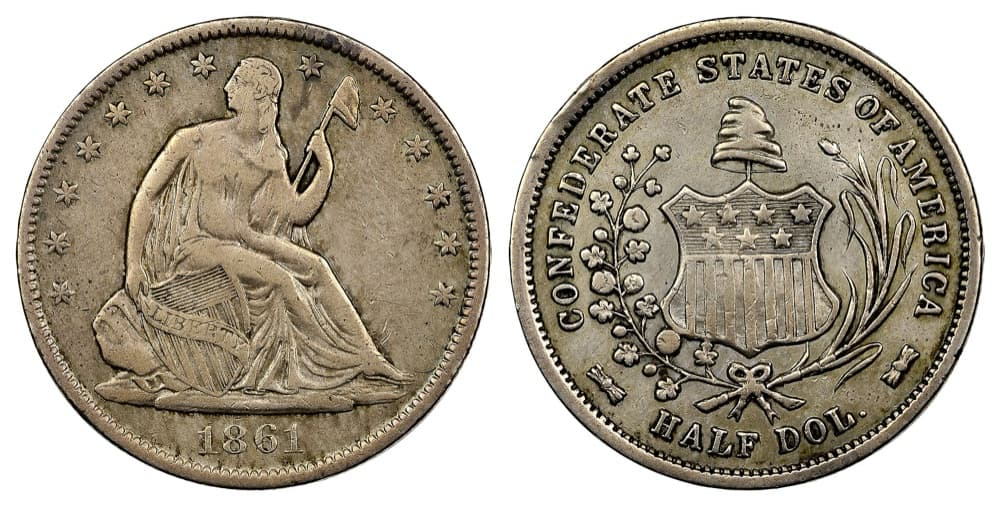
- Federal Seated Liberty obverse dated 1861; Confederate reverse with a seven-star shield, liberty cap, sugar cane and cotton and CONFEDERATE STATES OF AMERICA
- Reverse engraved by
- A.H.M. Peterson of New Orleans; prepared for the press by coining-room foreman Conrad Schmidt
- Where they are
- One in the American Numismatic Society; three in private hands, all sold at auction since 2015
- This coin
- NGC PR40, the Eric P. Newman specimen, first found in a roll of change around 1880
- Record
- $960,000 at auction in Dallas, November 1, 2017, for the Newman coin
- Restrikes
- 500 made in 1879 by John W. Scott on federal 1861 half dollars with the reverse planed off
A mint that changed flags
In early 1861 the New Orleans Mint served three governments in four months. Under federal control from January 1 to January 26, it struck 330,000 Seated Liberty half dollars and 5,000 double eagles. On January 26, the day Louisiana seceded, the state took the mint 'under trust' and coined 1,240,000 half dollars and 9,750 double eagles. The Confederacy then took over and struck 962,633 half dollars and 2,991 double eagles during April. Sources differ on when the handover happened: the mint's chief coiner later recalled the end of February, while one cataloger's reading of the records puts it at March 31 or April 1.
All of those coins carried the federal design and cannot be told apart. But the Confederate government also considered a coinage of its own. According to chief coiner Benjamin F. Taylor, Treasury Secretary Christopher Memminger ordered in April that designs for a half dollar be submitted to him. The design he approved kept the familiar Liberty obverse with its thirteen stars and the date 1861, and paired it with a new reverse: a shield bearing seven stars for the seceded states, a liberty cap above it, stalks of sugar cane and cotton around it, and the words CONFEDERATE STATES OF AMERICA.
The reverse die was cut by A.H.M. Peterson, an engraver and die sinker in New Orleans who was not experienced in coin dies. The mint's melter and refiner later wrote that Peterson 'produced a half dollar die of such high relief as rendered it impractical for use in a coining press.' Foreman Conrad Schmidt prepared the dies, and four coins were struck on ordinary half dollar planchets by successive blows of a screw press. Then the project stopped. Memminger notified the mint's superintendent of its closing on May 14, 1861, writing that 'the stern necessities of war compel the government to collect and receive all of its resources.'
Two witnesses, two stories
Almost everything known about the striking comes from two men who described it decades later. In April 1879 Taylor wrote to Gen. Marcus J. Wright, who was compiling the Confederate archives for the War Department. He said four pieces were struck before the mint closed on April 30, 1861, and that one went to the government, one to 'Prof. Biddle' of the University of Louisiana, one to Dr. E. Ames of New Orleans, and one he kept. Some of his details were wrong or garbled in print: the engraver's name was Peterson, not Patterson, and 'Biddle' almost certainly meant John Leonard Riddell, a former melter and refiner of the mint who was then the city's postmaster.
Peterson told it differently. In an interview published on January 24, 1889, and rediscovered in 2015 by researchers Nancy Oliver and Richard Kelly, he said he and the foreman finished the die in late May, after which four pieces were struck: one for Memminger, one for President Jefferson Davis, one for Peterson himself and one for Taylor. If his dates are right, the coins were struck after Memminger ordered the mint closed, and one researcher has suggested they were a clandestine striking.
The two accounts agree that Taylor kept one and that one went to Memminger. Beyond that, the original owners cannot be fixed with certainty. One leading cataloger thinks the most likely four were Taylor, Memminger, Peterson and Riddell. Davis did confirm in 1879 that a 'Confederate coin' had been stolen from his wife's trunks after the war, but he could not say whether it was this half dollar, and one reference says the popular story that Davis received one has no basis in fact.
The spring the war began
Louisiana seceded on January 26, 1861, after Mississippi, Florida, Alabama and Georgia had left the Union that month; Texas followed on February 1. Delegates met in Montgomery, Alabama, in February to form the Confederate States of America, and Jefferson Davis was inaugurated as its provisional president on February 18. Abraham Lincoln took office in Washington on March 4.
On April 12 Confederate guns opened fire on Fort Sumter in South Carolina, and the fort surrendered two days later. Virginia seceded on April 17, and on April 27 Lincoln suspended the writ of habeas corpus in Maryland. In May the Confederacy named Richmond its capital, and in July it won the first major battle of the war at Bull Run. In that same spring, inside the New Orleans Mint, four half dollars were quietly struck for a nation that would never issue a coinage of its own.
Four coins, four trails
Taylor's coin came to light first. On January 2, 1879, a dealer named Ebenezer Locke Mason published an article about rare coins in the Philadelphia Record, and Taylor answered that he owned an original Confederate half dollar and the reverse die. Mason bought both and in May 1879 sold them together for $310 to the New York dealer John Walter Scott. Collectors were wary: one journal editor argued the coin, struck by government officers with government tools on silver taken from the United States, belonged in the Mint's own cabinet. Scott offered it for $1,000 that September with no takers, and in his own 1882 sale it drew a top bid of $870, short of his reserve. Offered again in March 1910, it failed to sell. In 1918 J. Sanford Saltus bought it with the die for $3,000 and presented the coin to the American Numismatic Society on July 30, 1918. It is the finest known and is permanently off the market.
The coin featured here surfaced second. On April 20, 1910, a tailor named Mark Jacobs of Rondout, New York, showed a New York dealer a Confederate half dollar he said he had received in a roll of change from the bank about 30 years earlier. The dealer bought it in 1912. It passed to H.O. Granberg, Waldo Newcomer and 'Colonel' E.H.R. Green, then to Eric P. Newman and B.G. Johnson after Green's estate was sold. Newman paid $4,000 for it and kept it for decades, exhibiting it in his Mercantile Money Museum in St. Louis. Its earlier history is uncertain; Oliver and Kelly think it was Memminger's coin and tentatively trace it to former Confederate Gen. Francis T. Nicholls and his son.
The third coin turned up in 1961, when dealer Ted Schnur bought it for $75 as one of Scott's restrikes and sold it to collector John J. Ford Jr. for $425. Ford and his associate realized it was an original, and Schnur and the man who had sold it to him later sued. A 1971 settlement gave Ford 75 percent ownership, and he bought out the rest. It sold at auction for $632,500 in October 2003, the first public sale of an original, and for $881,250 in January 2015, graded NGC PR30.
The fourth surfaced in New Orleans around 1970 or 1971, when an elderly man brought it to dealer James Cohen. Walter Breen pronounced it genuine, and a New York dealer sold it to collector Henry P. Kendall on June 21, 1971. Traditionally believed to be the coin given to Riddell, it sold at auction in March 2015 for $646,250, graded NGC PR40.
The Newman coin, also NGC PR40, finally came to public auction on November 1, 2017, in Dallas. It sold for $960,000, a record for a Confederate half dollar, with Newman's original envelope recording his $4,000 purchase price included. Its appearance was only the sixth time an original had ever been offered at auction; for 93 years, from 1910 to 2003, none had been.
Original or restrike
In 1879 Scott made a restrike program from the die he had bought. Having no obverse die, he gathered 500 genuine 1861 half dollars, said to be from New Orleans, had their reverses planed off, and struck the Confederate design onto the blank side. The one-sided strike slightly flattened the Liberty obverse and the edge reeding. Worried the rusty die would break, he first struck 500 white-metal tokens reading '4 ORIGINALS STRUCK BY ORDER OF C.S.A. IN NEW ORLEANS 1861.' He sold restrikes at $2 each and tokens at 50 cents. The die later went missing in the 1920s.
Weight is the most reliable test. Originals were struck on full planchets, close to the federal standard one cataloger gives as 192 grains: the Newman coin weighs 190.5 grains and the Kendall coin 190.0 grains. Because their reverses were shaved down, restrikes typically weigh about 185 grains. Restrikes also tend to show a flattened obverse and a crumbling rim above ER in AMERICA from the deteriorating die. Many restrikes were mistaken for originals over the years, which has muddied the pedigree record.
The originals were struck in proof format and are certified as proofs, though some researchers dispute that status. The Newman coin shows a faint die crack from the rim to Liberty's nose, softness at the center of the reverse, and lavender-gray and golden-brown toning; the Kendall coin has sharper detail but more granular surfaces. The federal obverse design came from a standard New Orleans half dollar die of 1861, a coin of 90 percent silver weighing 12.40 grams and 30 millimeters across.
The only coin of the Confederacy
Collector L.L. Wilson wrote in 1915 that the Confederate half dollar was 'the only Numismatic Record of a nation of nine million people,' and that its pairing of the devices of two opposing powers 'probably has not another parallel in history.' Wilson's own coin, which he believed was an original, was almost certainly a well-preserved restrike, which shows how long the confusion lasted.
For most of their history the originals almost never traded. Before 2003 no example had ever sold at auction, and a 2014 news report noted that no private sale had been known since the 1970s. Then, between January 2015 and November 2017, all three coins in private hands sold at public auction, for $881,250, $646,250 and $960,000. With the Taylor coin held by the American Numismatic Society, collectors may wait decades for another chance.
The numbers
- Mintage
- 4 originals (plus 500 restrikes made in 1879 on altered federal half dollars)
- Known survivors
- All 4: one in the American Numismatic Society, three in private hands
- Weight
- 190.5 grains (Newman coin) and 190.0 grains (Kendall coin); restrikes typically about 185 grains
- Federal planchet standard
- 12.40 grams, 30 millimeters, 90% silver, 10% copper, reeded edge (1861-O half dollar)
- Obverse
- Federal Seated Liberty die (design credited to Thomas Sully and Christian Gobrecht)
- Reverse
- Engraved by A.H.M. Peterson, New Orleans
- Attribution
- Breen-8000
Timeline
Louisiana secedes and takes the New Orleans Mint 'under trust.'
Under Confederate control, the mint strikes four half dollars with a Confederate reverse, by the chief coiner's account.
Confederate Treasury Secretary Memminger notifies the mint of its closing.
Ebenezer Mason's article on rare coins prompts former chief coiner B.F. Taylor to reveal his original and the die.
Taylor writes his account of the striking for the Confederate archives.
Mason sells the Taylor coin and the reverse die to John W. Scott for $310.
Scott begins selling 500 restrikes at $2 each and offers the original for $1,000.
The Taylor coin draws an $870 top bid at auction but does not sell.
Engraver A.H.M. Peterson's interview gives a different account of the striking and the four owners.
Mark Jacobs shows a second original, the future Newman coin, to a New York dealer.
The dealer buys the Jacobs coin.
J. Sanford Saltus, who bought the Taylor coin with the die, presents the coin to the American Numismatic Society.
A third original is bought as a restrike for $75 and sold to John J. Ford Jr. for $425.
The fourth original, found in New Orleans, is sold to Henry P. Kendall.
The Ford coin becomes the first original sold at public auction, for $632,500.
The Ford-Partrick coin, NGC PR30, sells at auction for $881,250.
The Kendall coin, NGC PR40, sells at auction for $646,250.
The Newman coin, NGC PR40, sells at auction in Dallas for $960,000, a record.
The world in 1861
Louisiana secedes from the Union.
Jefferson Davis is inaugurated as provisional president of the Confederacy in Montgomery, Alabama.
Abraham Lincoln is sworn in as the sixteenth president.
The Civil War begins at Fort Sumter, which surrenders two days later.
Lincoln suspends the writ of habeas corpus in Maryland.
Richmond, Virginia, is named the Confederate capital.
The First Battle of Bull Run ends in a Confederate victory.
The Revenue Act of 1861 creates the first federal income tax.
Price record
| Date | Price | Kind |
|---|---|---|
| Sep 1879 | $1,000 | Asking price, not a saleTaylor coin offered by John W. Scott; no buyer. |
| 1961 | $75 | Private saleFord-Partrick coin, bought by a dealer believing it was a restrike. |
| 1961 | $425 | Private saleSame coin, sold to John J. Ford Jr., still identified as a restrike. |
| Oct 2003 | $632,500 | Sold at auctionFord coin, later NGC PR30, first original ever sold at auction. |
| Jan 2015 | $881,250 | Sold at auctionFord-Partrick coin, NGC PR30, at auction in Florida. |
| Mar 2015 | $646,250 | Sold at auctionKendall (traditionally Riddell) coin, NGC PR40. |
| Nov 1, 2017 | $960,000 | Sold at auctionEric P. Newman coin, NGC PR40, at auction in Dallas. Record for the issue. |
A realized auction price is what a buyer actually paid on the date shown, including the buyer's premium where the sale reported it. It is the strongest kind of reference price, and it is a record of one sale of one object on one day, not a promise of what the next example will bring.
By reference price, 1861 Confederate States Half Dollar (Original) is number 27 of 100 in the coins entries of the FLOAT 100. 96 of those 100 rest on a realized sale; the rest carry an asking price or a guide value, and each page says which. Rank within the FLOAT 100 itself (61 here) is editorial: how much an object defines its field, not price alone.
Did you know
- The second known original was found by a New York tailor in a roll of change from his bank.
- The third known original was sold in 1961 for $75 because it was thought to be a restrike; the lawsuits over it were not settled until 1971.
- Scott struck 500 white-metal tokens announcing '4 ORIGINALS STRUCK BY ORDER OF C.S.A.' before risking the rusty die on his restrikes.
- No original sold at public auction until 2003; then all three in private hands sold between 2015 and 2017.
- Eric P. Newman's original envelope, recording the $4,000 he paid, went with his coin when it sold for $960,000.
- The Confederate reverse die went missing in the 1920s and has not been seen since.
How this page is made
- The figure
- One reference price, shown with its own kind. FLOAT does not average it with anything or adjust it for time.
- Realized or not
- A realized price is a completed sale. An asking price, an estimate and a price-guide value are not sales, and are labeled as such wherever they appear.
- The story
- Researched from published records and checked fact by fact. Updated Oct 1, 2026.
- Archive
- Oct 5, 2026