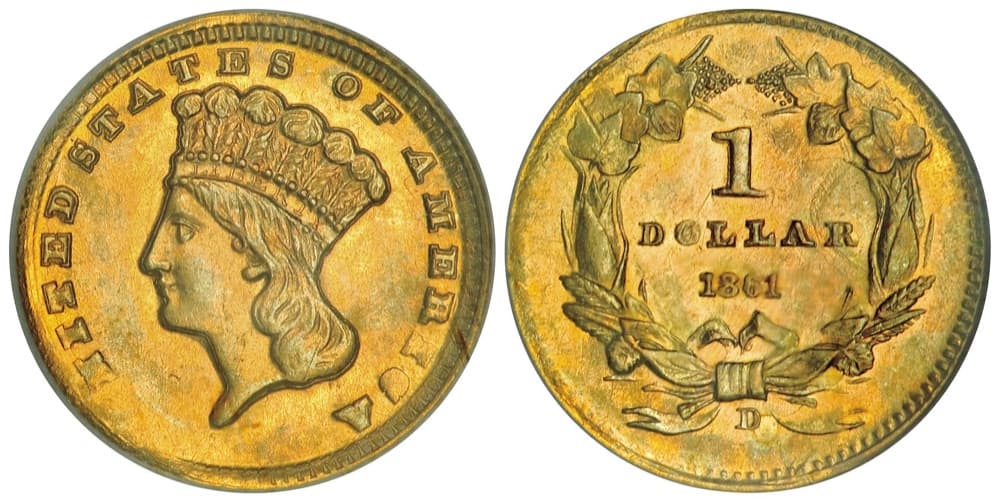
FLOAT 100 · Coins · No. 83
1861-D Gold Dollar (Confederate-struck)
In the spring of 1861 the mint in a Georgia gold town kept striking coins with Union dies after the Confederacy took it over, and the tiny gold dollars it made are the only U.S. coins struck entirely under Confederate authority.
- Year
- 1861
- Maker
- Dahlonega Mint (under Confederate authority)
- By price in coins
- 72 of 100
Create a free account to see every recorded price and every grade.
Create a free account- Struck
- May 1861, Dahlonega Mint, Georgia, under Confederate control
- Why it matters
- The only circulating U.S. coin struck exclusively by Confederate authorities, and the last coin struck at Dahlonega
- Mintage
- Unknown; estimates run from 1,000 (PCGS) to 1,250 (the Guide Book), within a range of 1,000 to 1,500
- Survivors
- About 45-60 per one estimate; PCGS's survival estimate is 75
- Designer
- James Barton Longacre, Indian Princess (Type 3) gold dollar
- Specs
- 14.3 mm, about 1.7 grams, 90% gold and 10% copper, reeded edge
- Dies
- One pair (Winter 12-Q), with a leftover 1860-D obverse die
- This entry
- PCGS AU58 CAC; one brought $102,000 at auction in November 2024
- Record for the date
- $180,000, a PCGS MS64+ in September 2020
A gold mint in the Georgia hills
The Mint Act of 1835 created a branch at Dahlonega 'for the coinage of gold only.' Commissioner Ignatius Alphonso Few bought ten acres in August 1835, and architect Benjamin Towns built the mint for $33,450. Superintendent Dr. Joseph Singleton opened it in February 1838.
From 1838 to 1861 Dahlonega struck gold dollars, quarter eagles, half eagles and, in 1854 only, three-dollar pieces, all marked D. Its total output topped $6 million in gold. Congress had authorized the gold dollar on March 3, 1849, and Chief Engraver James B. Longacre designed all three of its types; the third, with a large Indian Princess head, began in 1856.
The 1861-D is the most coveted gold dollar of all. The 1856-D is rarer in mint state, and the two are roughly equal in circulated grades, but PCGS calls the 1861-D typically the second most valuable coin in the series, behind only the 1849-C Open Wreath, of which five are known.
Union dies, Confederate mint
The Treasury withheld new bullion as secession loomed, but Philadelphia still shipped two pairs of coining dies to Dahlonega. They arrived on January 7, 1861. About two weeks later Georgia left the Union.
On orders from Governor Joseph E. Brown, state officials seized the building, equipment and materiel, brushing aside local Unionists who wanted to secure it. The formal surrender came on April 8, 1861, when Confederate troops occupied the mint. Superintendent George Kellogg wrote to President Lincoln that Georgia had turned all United States public property over to the Confederate government.
The old staff stayed on and kept coining until the mint closed in June 1861, striking about $3,000 face value in gold dollars and half eagles. The difference is in the timing: 1,597 half eagles had been struck before the takeover, but no gold dollars were struck before April. That makes the gold dollar the only circulating U.S. coin produced exclusively under Confederate authority. One general account says small quantities were coined before the remaining coins went to the Confederate treasury; PCGS is specific that the dollars all came after.
A crude coin, and how to know it
Gold specialist Doug Winter places every 1861-D gold dollar on a single die pair, his Variety 12-Q, struck in May 1861 from a leftover 1860-D obverse die. The old die had a profound weakness, and with what PCGS calls the Confederates' widely noted lack of minting expertise, the result was a crude, primitive coin next to a Philadelphia product.
On every known example the U in UNITED is very faint and the N is weak. The IC in AMERICA is sometimes soft, Liberty's hair and plumes always show weakness, and the denticles are sharp from 12 to 6 o'clock but weak on the left. Clash marks sometimes show at the center of both sides. Planchets were poor, and many coins have splits, cracks or graininess around Liberty's head.
Higher-grade pieces can still have thick, frosty luster, and original coins range from yellow-gold to orange-gold to deep green-gold. Totally original, uncleaned pieces are rare and bring a substantial premium.
Saved as souvenirs
Since no one recorded how many were made, the mintage is inferred from survivors. Sources disagree on how many there are: one general reference puts the known population at about 45 to 60, while PCGS's survival estimate is 75.
The 1861-D survives in unusually high grades. More than half the known pieces grade AU50 or better and as many as a dozen are in mint state, a rate Winter calls greater than normal for so small a mintage. PCGS reads that as a sign of a small hoard saved by locals who knew what they had.
The finest pieces have famous names behind them. A PCGS MS63 traced to John M. Clapp and Louis E. Eliasberg Sr. brought $86,250 in 2004 and $180,000 in May 2023. The top coin, now PCGS MS64+, brought $138,000 in 2006 and $149,500 in 2008 as an NGC MS65, and holds the $180,000 auction record from September 2020.
At the AU58 grade of this entry, PCGS-graded coins have sold for $33,350 in 2005, $55,812.50 in January 2014, $84,000 in August 2024, $102,000 in November 2024 for one also stickered by CAC, and $96,000 in August 2025.
The last coin of Dahlonega
Dahlonega closed in June 1861 and became an assay office on August 24, 1861. The government never reopened it as a mint after the war, so the 1861-D gold dollar is the last coin it ever struck.
North Georgia College used the building from 1873 until a fire destroyed it in December 1878. Price Memorial Hall now stands on the original foundations. The D mintmark itself moved west: Denver adopted it when that mint opened in 1906.
The gold dollar outlived the Dahlonega Mint by less than three decades. The last were struck in 1889, and Congress abolished the denomination on September 26, 1890.
The numbers
- Mintage
- Unrecorded; estimated 1,000 (PCGS) or 1,250 (Guide Book)
- Known survivors
- About 45-60 (one estimate); PCGS survival estimate 75
- Weight
- 1.672 grams (PCGS lists 1.70)
- Diameter
- 14.3 mm
- Composition
- 90% gold, 10% copper
- Edge
- Reeded
- Designer
- James Barton Longacre
- Dies
- One pair, Winter 12-Q; obverse carried over from 1860-D
Timeline
The Mint Act creates a gold-only branch at Dahlonega, Georgia.
The Dahlonega Mint opens under Dr. Joseph Singleton.
Congress authorizes the gold dollar.
The large-head Indian Princess (Type 3) gold dollar begins.
Two pairs of dies from Philadelphia arrive at Dahlonega.
Georgia secedes; state officials seize the mint on Governor Brown's orders.
Formal surrender: Confederate troops occupy the mint.
All 1861-D gold dollars are struck from one die pair.
The Dahlonega Mint closes.
The building becomes an assay office.
Fire destroys the old mint building, then used by North Georgia College.
Congress abolishes the gold dollar.
A PCGS MS64+ 1861-D sets the auction record at $180,000.
A PCGS AU58 CAC example brings $102,000.
The world in 1861
Kansas is admitted as the 34th state.
The Confederate States adopt a provisional constitution.
Jefferson Davis is inaugurated provisional Confederate president.
Abraham Lincoln is sworn in as the 16th president.
The Civil War begins at Fort Sumter.
Richmond is named the Confederate capital.
First Battle of Bull Run ends in a Confederate victory.
Price record
| Date | Price | Kind |
|---|---|---|
| Nov 2024 | $102,000 | Sold at auctionPCGS AU58 CAC, Winter 12-Q. |
A realized auction price is what a buyer actually paid on the date shown, including the buyer's premium where the sale reported it. It is the strongest kind of reference price, and it is a record of one sale of one object on one day, not a promise of what the next example will bring.
By reference price, 1861-D Gold Dollar (Confederate-struck) is number 72 of 100 in the coins entries of the FLOAT 100. 96 of those 100 rest on a realized sale; the rest carry an asking price or a guide value, and each page says which. Rank within the FLOAT 100 itself (83 here) is editorial: how much an object defines its field, not price alone.
Did you know
- The dies used to strike these Confederate coins were sent from the U.S. Mint in Philadelphia in January 1861.
- Dahlonega struck 1,597 half eagles in 1861 before the takeover, but not a single gold dollar.
- The Dahlonega superintendent wrote to Lincoln himself to report that Georgia had handed the mint to the Confederacy.
- Denver's D mintmark was borrowed from Dahlonega, which had closed 45 years earlier.
- Price Memorial Hall at the University of North Georgia stands on the old mint's foundations.
- A higher share of 1861-D dollars survives in high grade than usual, likely because locals kept them as souvenirs.
How this page is made
- The figure
- One reference price, shown with its own kind. FLOAT does not average it with anything or adjust it for time.
- Realized or not
- A realized price is a completed sale. An asking price, an estimate and a price-guide value are not sales, and are labeled as such wherever they appear.
- The story
- Researched from published records and checked fact by fact. Updated Oct 3, 2026.
- Archive
- Oct 5, 2026