FLOAT 100 · Coins · No. 82
1876-CC Twenty Cent Piece
Carson City struck 10,000 of a coin nobody wanted, left them in the vault for a year and then melted them, and the handful that slipped out now sell for more than most houses.
- Year
- 1876
- Maker
- U.S. Mint (Carson City)
- By price in coins
- 35 of 100
Create a free account to see every recorded price and every grade.
Create a free account- Struck
- 1876 at the Carson City Mint, Nevada; specialists believe the whole run came off the press in the first week of May
- Mintage
- 10,000, almost all melted in 1877
- Survivors
- Fewer than 20; PCGS puts its survival estimate at 19
- Designer
- Liberty Seated obverse after Christian Gobrecht, re-engraved by William Barber; eagle reverse by William Barber
- Specs
- 5 grams, 22 mm, 90% silver and 10% copper, plain edge
- Dies
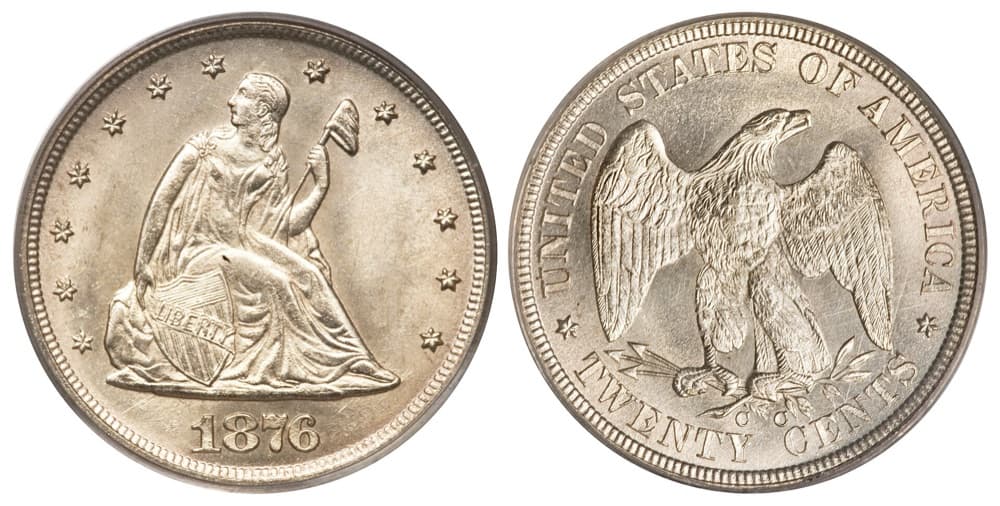
- One pair; every genuine piece shows a doubled obverse die, strongest on LIBERTY
- This entry
- PCGS MS65, the grade of the coin that sold for $690,000 at auction in August 2024
- Record
- $870,000 for a different PCGS MS65, August 24, 2022
A coin made for Nevada silver
Nevada Senator John Percival Jones, a mining tycoon, introduced the bill for a twenty-cent piece on February 10, 1874. He pointed to a shortage of small change in the West, where base-metal coins did not circulate, half dimes had been abolished in 1873, and prices were still quoted in 'bits' of 12½ cents. Mining interests also wanted more outlets for silver after the Coinage Act of 1873. President Ulysses S. Grant signed the bill on March 3, 1875.
Critics called the coin commercially unnecessary and a subsidy for the silver interests of the Comstock Lode. It was worth about one French franc under the Latin Monetary Union standard, and in practice it was little more than a substitute for two dimes.
The trouble was its look. At 22 millimeters it was only slightly smaller than the 24.3-millimeter quarter, and both carried a nearly identical Seated Liberty. The Mint gave the new coin a plain edge and a different eagle, but mistakes in making change were widespread and the coin became unpopular almost immediately.
Carson City and the men who ran it
The Carson City Mint was established in 1863 and began coining on February 4, 1870, built near the Comstock mines, though most Comstock silver actually went to San Francisco for processing. It ran from 1870 to 1885 and again from 1889 to 1893, and the building is now the Nevada State Museum.
Mint Director Henry R. Linderman stayed sensitive to political pressure to turn Nevada silver into coin. After Carson City distributed 133,290 twenty-cent pieces in 1875, Superintendent James Crawford authorized another 10,000 in 1876. Those coins sat in the vault for a year and never officially entered circulation.
Philadelphia supplied the dies, and it made a mess of the obverse: the die shows pronounced doubling, most visible in LIBERTY on the shield. A single pair of dies struck every known 1876-CC, so that doubling is on every genuine coin.
The melt
The denomination died fast. Philadelphia struck only proofs for collectors in 1877 and 1878. Sources disagree on the legal end: a PCGS narrative says Congress took up repeal in July 1876 and Grant signed it in January 1877, while the standard Wikipedia account says Congress abolished the coin on May 2, 1878. Either way, the 1876-CC dies were destroyed at Carson City on January 20, 1877.
In 1877 Linderman ordered the stored coins melted. One account says he authorized melting 12,359 twenty-cent pieces at Carson City in March 1877, almost the whole 1876 mintage among them; PCGS quotes his final order to Crawford of May 19, 1877, to 'melt all 20-cent pieces you have on hand.'
A few escaped, either paid out before the order or, more likely, set aside for the Annual Assay and later passed into private hands. One numismatist has suggested the survivors were souvenirs obtained by visitors to the Mint.
From $7 to $870,000
Nineteenth-century collectors barely knew the coin. The first public offering came in January 1890 in the Robert Coulton Davis sale, where the cataloger wrote that he knew of no duplicate; the coin's auction debut price was $7.00. The census grew slowly. The largest single source was a hoard of uncirculated pieces found near Baltimore and unveiled by a local dealer, Tom Warfield, in 1957; accounts put it at five to ten coins.
The coin behind this entry has one of the longest paper trails of any survivor. PCGS traces it to collector F.C.C. Boyd, who advertised it in 1935 for $350. It brought $1,500 at auction in March 1945, $1,675 in the Jerome David Kern collection in May 1950, and $6,900 in the Edwin M. Hydeman collection in March 1961. It then passed through the Armand Champa collection and several dealers; Stephen Tebo advertised it in November 1974 at $100,000, and it sold for $45,000 in August 1975.
It brought $44,000 in September 1984, $57,750 from the Reed Hawn collection in July 1985, and $115,000 in March 2002. Graded PCGS MS65, it sold for $564,000 on January 22, 2013, and for $690,000 on August 14, 2024, at auction during the August ANA convention sale after 118 bids. PCGS describes it with champagne toning and a serrated contact mark across Liberty's right arm and torso.
Other gems have done better. A PCGS MS65 from the E. Horatio Morgan collection brought $456,000 in August 2019 and then $870,000 on August 24, 2022, the auction record for the date. The two finest, both PCGS MS66, include the Norweb coin, bought for $1,325 in June 1950 and sold for $69,300 in 1987 and $138,000 in 2001, and the Joseph C. Thomas coin, which brought $460,000 in April 2009. The Eliasberg coin, first sold in an 1899 collection for $26.25, brought $148,500 in 1997 and $470,000 in 2014.
How to know one
A twenty-cent piece weighs 5 grams, measures 22 millimeters and has a plain edge, which separates it from the reeded quarter at a glance.
For the 1876-CC, the test is the obverse die. Every genuine example shows bold doubling on LIBERTY and on several stars, and PCGS lists the coin's die variety as a doubled die with a misplaced date. A coin without that doubling is not an 1876-CC.
Nearly every survivor is uncirculated, a sign they left the Mint as saved pieces rather than pocket change. PCGS reports two coins at MS66 and nine between MS64 and MS65.
The numbers
- Mintage
- 10,000
- Known survivors
- Fewer than 20; PCGS survival estimate 19
- Weight
- 5.00 grams
- Diameter
- 22.00 mm
- Composition
- 90% silver, 10% copper
- Edge
- Plain
- Designer
- William Barber, after Christian Gobrecht's Seated Liberty
- Finest known
- Two at PCGS MS66; nine at MS64 to MS65
Timeline
Senator John P. Jones of Nevada introduces the twenty-cent bill.
President Grant signs the twenty-cent piece into law.
Carson City distributes 133,290 twenty-cent pieces.
Carson City strikes 10,000 twenty-cent pieces, believed to be in the first week of May; they stay in the vault.
The 1876-CC dies are destroyed at Carson City.
Director Linderman orders Carson City to melt all twenty-cent pieces on hand.
Congress abolishes the denomination, per the standard Wikipedia account; a PCGS narrative dates the repeal to January 1877.
First public offering, in the Robert Coulton Davis sale.
F.C.C. Boyd advertises this entry's coin for $350.
A hoard of uncirculated 1876-CC pieces surfaces near Baltimore.
This entry's coin brings $6,900 in the Hydeman collection sale.
The coin, now PCGS MS65, sells for $564,000.
A different PCGS MS65 sets the record at $870,000.
This entry's coin sells for $690,000 after 118 bids.
The world in 1876
Baseball's National League is formed in Chicago.
Alexander Graham Bell receives his telephone patent.
The Centennial Exposition opens in Philadelphia.
Battle of the Little Bighorn.
Colorado becomes the 38th state.
Wild Bill Hickok is killed in Deadwood.
The Hayes-Tilden election ends with 20 electoral votes in dispute.
Price record
| Date | Price | Kind |
|---|---|---|
| 1935 | $350 | Asking price, not a saleThis entry's coin, advertised by F.C.C. Boyd. |
| Mar 1945 | $1,500 | Sold at auctionThis entry's coin. |
| May 1950 | $1,675 | Sold at auctionThis entry's coin, Jerome David Kern collection. |
| Mar 1961 | $6,900 | Sold at auctionThis entry's coin, Edwin M. Hydeman collection. |
| Nov 1974 | $100,000 | Asking price, not a saleThis entry's coin, advertised by Stephen Tebo. |
| Aug 1975 | $45,000 | Sold at auctionThis entry's coin. |
| Sep 1984 | $44,000 | Sold at auctionThis entry's coin, Arnold and Romisa collections. |
| Jul 1985 | $57,750 | Sold at auctionThis entry's coin, Reed Hawn collection. |
| Mar 2002 | $115,000 | Sold at auctionThis entry's coin. |
| Jan 22, 2013 | $564,000 | Sold at auctionThis entry's coin, PCGS MS65. |
| Aug 15, 2019 | $456,000 | Sold at auctionA different PCGS MS65, E. Horatio Morgan collection. |
| Aug 24, 2022 | $870,000 | Sold at auctionA different PCGS MS65, Bender Family collection. Auction record for the date. |
| Aug 14, 2024 | $690,000 | Sold at auctionThis entry's coin, PCGS MS65; 118 bids. |
A realized auction price is what a buyer actually paid on the date shown, including the buyer's premium where the sale reported it. It is the strongest kind of reference price, and it is a record of one sale of one object on one day, not a promise of what the next example will bring.
By reference price, 1876-CC Twenty Cent Piece is number 35 of 100 in the coins entries of the FLOAT 100. 96 of those 100 rest on a realized sale; the rest carry an asking price or a guide value, and each page says which. Rank within the FLOAT 100 itself (82 here) is editorial: how much an object defines its field, not price alone.
Did you know
- The twenty-cent piece was worth about one French franc, matching the Latin Monetary Union standard.
- Every genuine 1876-CC comes from a single obverse die that Philadelphia botched, leaving LIBERTY visibly doubled.
- The 1876-CC coins sat in the Carson City vault for about a year before the melt order and never officially circulated.
- When it first appeared at auction in 1890, the cataloger said he knew of no other example.
- The coin's first auction appearance brought $7.00; a gem brought $870,000 in 2022.
- The Carson City Mint building is now the Nevada State Museum, and its original press still strikes CC medallions.
How this page is made
- The figure
- One reference price, shown with its own kind. FLOAT does not average it with anything or adjust it for time.
- Realized or not
- A realized price is a completed sale. An asking price, an estimate and a price-guide value are not sales, and are labeled as such wherever they appear.
- The story
- Researched from published records and checked fact by fact. Updated Oct 3, 2026.
- Archive
- Oct 5, 2026