FLOAT 100 · Coins · No. 23
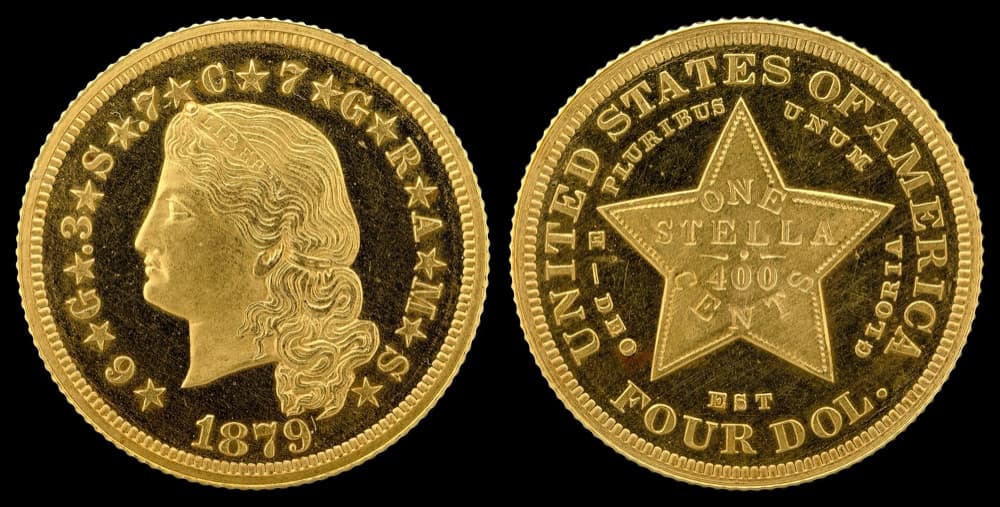
1879 Flowing Hair Stella ($4 Gold)
Congress was offered a four-dollar gold coin that would let Americans spend like Europeans; lawmakers bought hundreds of samples at cost, some ended up as jewelry, and the idea never became money, yet the leftovers now sell for six figures.
- Year
- 1879
- Maker
- U.S. Mint (Philadelphia)
- By price in coins
- 47 of 100
Create a free account to see every recorded price and every grade.
Create a free account- Type
- $4 gold pattern, Flowing Hair obverse, Judd-1635, Pollock-1833
- Struck
- Philadelphia Mint, dated 1879; documents point to production running into 1880
- Mintage
- 425 is the documented figure; some specialists think 500 to 750 were made
- Designer
- Charles E. Barber, adapting his father William Barber's 1878 half eagle pattern
- Inscribed recipe
- 6 G .3 S .7 C 7 GRAMS: 6 grams of gold, 0.3 of silver, 0.7 of copper
- Reverse
- A five-pointed star reading ONE STELLA / 400 CENTS
- Who got them
- Members of Congress, in three-coin sets with two goloid dollar patterns, at roughly production cost
- Status
- The most available of the four gold stellas, and the usual way a collector owns one
- This example
- PR66 Cameo certified by CAC Grading; sold for $324,000 at auction on May 9, 2024
A coin for a world currency that never came
On January 3, 1879, John A. Kasson, the American minister to Austria and a former chairman of the House Committee on Coinage, Weights, and Measures, wrote to the State Department. The United States, he said, had no coin close to the French 20-franc piece, the gold coin best known in Europe. A new American coin of exactly that value, replacing the three-dollar piece, could become a standard for customs accounts and perhaps for international trade. The Austrian 8-florin piece and several other European gold coins were worth about $3.88.
The letter went to the Treasury and then to the coinage committee, chaired by Representative Alexander Stephens of Georgia, the former vice president of the Confederacy. Stephens admired Dr. William Wheeler Hubbell, a Philadelphia patent lawyer and metric-system advocate who held the patent on goloid, an alloy of gold, silver and copper. Historian Roger W. Burdette, writing in the Journal of Numismatic Research in 2015, argues that Hubbell, not Kasson, was the real force behind the coin. Hubbell proposed a four-dollar piece as a round-number stand-in for Kasson's $3.88, one fifth of his own metric twenty-dollar pattern, with its metal content spelled out in grams. The committee reported favorably on March 3, 1879.
The name came from the star on the reverse. Stella means star, and an early account explained the choice as an analogy to the eagle, both being national emblems on American coins. But the coin was only a loose match for the European pieces it was meant to mirror: it weighed 7 grams against the 20-franc piece's 6.45 grams. Kasson made no further contribution, Congress never approved the stella, and no business-strike coins were ever made.
The Barbers' Liberty
Two portraits of Liberty were prepared for the stella in 1879. George T. Morgan, designer of the silver dollar of 1878, cut a Liberty with braided hair coiled on top of her head. Charles E. Barber cut the Flowing Hair version, with long loose locks and a headband reading LIBERTY. Barber's design was taken almost directly from a pattern half eagle of 1878 (Judd-1574) designed by his father, William Barber.
Around the portrait, separated by stars, runs the coin's own recipe: 6 G .3 S .7 C 7 GRAMS. The reverse is dominated by a large five-pointed star carrying ONE STELLA and 400 CENTS. E PLURIBUS UNUM and DEO EST GLORIA are set between the star's points, and UNITED STATES OF AMERICA and FOUR DOL. run around the rim. The D in UNITED is sharply doubled.
The Flowing Hair design is the only stella struck in meaningful numbers. Of the four gold stellas, 1879 and 1880 in Flowing Hair and Coiled Hair, a specialist cited in a 2026 sale catalog estimates fewer than 20 survivors for each of the other three issues.
Samples for Congress, and a scandal
The stellas were made for lawmakers to examine, and lawmakers wanted them. Sale catalogs citing the documentary record say 425 examples were struck for three-coin sets that also held an 1879 goloid dollar and an 1879 goloid metric dollar, and that the sets were offered to members of Congress at their bullion cost. Accounts of the details differ. One recent catalog dates the striking from October 4, 1879, to May 10, 1880, and gives the price as $6.10 a set; another cites Burdette for December 1879 to May 1880. An older account by David Akers says 15 coins were struck in 1879 and another 400 early in 1880 from the same dated dies, offered at the production cost of $6.50.
Collectors and dealers were angry when they learned that congressmen and their friends were buying coins the public could not. Akers records that the dealer S.K. Harzfeld learned from Mint Superintendent A.L. Snowden that 150 of the coins were still in the Mint's vaults as late as October 1880. Many stellas were handed on to people who did not collect coins, and even into the late 20th century some were used as jewelry or cufflinks. A widely repeated but unsourced story holds that some ended up around the necks of madams who ran Washington bordellos.
The stella arrived in a year when American money was being reset. On January 1, 1879, the Specie Resumption Act took effect and the greenback was valued the same as gold for the first time since the Civil War. That October, Thomas Edison tested his first practical electric light bulb.
How to read one
The paperwork called for the coins to be struck in Hubbell's goloid alloy, and the coin's own legend says so. But most survivors that have been tested turned out to be standard .900 fine coinage gold; one catalog knew of only two examples confirmed as goloid. One theory holds that about 25 early pieces were struck in goloid and the rest on shaved-down half eagle blanks. Specialists still argue about it.
Almost every example shows fine parallel lines, called striations, across the surface, especially on Liberty's head. The most common explanation is that the blanks were shaved or rolled down to size. Akers noted that the later pieces are usually recognizable by these adjustment marks and that they do not always weigh the official 103.2 grains, so some have been sold as rare early 'originals' when they were not.
Condition varies widely. Because many were carried, mounted or worn, a large share are impaired. Mirror-like proofs with frosted portraits, graded Cameo or Deep Cameo, are much scarcer. At one major grading service the finest regular proof is a single PR67+, and the auction record for the issue in any designation is $840,000, for a PCGS PR67 Deep Cameo in April 2024.
The coin behind this entry
The FLOAT 100 entry is a proof graded PR66 Cameo with a CAC endorsement. The specific coin whose sale anchors the entry was certified by CAC Grading (CACG), not by PCGS. Its catalog description notes the usual softness on the hair at Liberty's temple and only faint traces of striations, nearly horizontal and angling slightly down from left to right across the portrait.
Its auction history can be traced through four sales. It sold for $253,000 in May 2007 from the Palakika Collection, for $195,500 in January 2009 after passing through the Scott Rudolph Collection, and for $223,250 in August 2012. On May 9, 2024, in its CACG holder, it sold at auction during the Central States convention for $324,000.
That price stood out. In the same month an NGC PF66 Cameo without a CAC sticker sold for $216,000. A PCGS PR66 Cameo with a CAC sticker brought $264,000 that August, and a PCGS PR66 with a CAC sticker sold for $281,250 in September 2024. In 2026 a second CACG PR66 Cameo came to auction, and its catalog called the 2024 coin directly comparable in quality and eye appeal.
A failed coin that became a trophy
Technically the stella is a pattern, an experimental piece and not a circulating coin. Like the 1856 Flying Eagle cent and the 1836 Gobrecht dollar, though, it is collected alongside regular U.S. coinage, and it is listed among the 100 Greatest U.S. Coins.
Estimates of how many survive vary. Akers guessed that at least 300 to 350 remained. A specialist quoted in a 2026 catalog estimates 400 to 500, and a leading grading service's current survival estimate is 243 in all grades. Whatever the true number, there are enough that the 1879 Flowing Hair is the stella a collector can realistically own, while the other three are true rarities. In 2026 one collection offered all four gold stellas in a single sale. Its 1879 Flowing Hair, an NGC PR65 Cameo, brought $201,300, and the four together realized $3,968,050.
The numbers
- Mintage
- 425 documented; estimates run from about 500 to 750
- Known survivors
- Estimates differ: 243 (current grading-service estimate), at least 300-350 (Akers), 400-500 (Dannreuther)
- Weight
- 7.00 grams
- Diameter
- 22 mm
- Stated composition
- 86% gold, 4% silver, 10% copper (goloid); most tested survivors are .900 fine gold
- Edge
- Reeded
- Designer
- Charles E. Barber, after William Barber's 1878 half eagle pattern
- Reference numbers
- Judd-1635, Pollock-1833, JD-1; rarity 3
- Mint
- Philadelphia (no mintmark)
Timeline
William Barber designs the pattern half eagle (Judd-1574) whose portrait his son Charles adapts for the stella.
John A. Kasson writes to the State Department proposing a gold coin equal to the 20-franc piece.
The House coinage committee reports favorably on the four-dollar stella.
Striking begins, according to one catalog's reading of the record; another source cites December 1879.
The documented run of 425 Flowing Hair stellas ends.
About 150 stellas are reported still in the Mint's vaults.
An example sells at auction for $60,375.
The coin behind this entry sells for $253,000 from the Palakika Collection.
The same coin sells for $195,500.
The same coin sells for $223,250.
Roger W. Burdette publishes research arguing that William W. Hubbell drove the stella project.
A PCGS PR67 brings $600,000, the record for a non-Cameo proof.
A PCGS PR67 Deep Cameo sells for $840,000, the issue's auction record.
The coin behind this entry, now CACG PR66 Cameo, sells for $324,000.
The Presidio Collection's NGC PR65 Cameo sells for $201,300 in a sale offering all four gold stellas.
The world in 1879
The Specie Resumption Act takes effect; the greenback is valued the same as gold for the first time since the Civil War.
President Rutherford B. Hayes signs a bill allowing women attorneys to argue before the Supreme Court.
Frank Woolworth opens his first five-and-ten store in Utica, New York.
Congress creates the U.S. Geological Survey.
The Jeannette Expedition leaves San Francisco for the North Pole.
Thomas Edison tests his first practical electric light bulb.
Edison demonstrates incandescent lighting to the public at Menlo Park, New Jersey.
Price record
| Date | Price | Kind |
|---|---|---|
| Jun 5, 2004 | $60,375 | Sold at auctionGrade not shown in the listing. |
| Aug 2004 | $224,250 | Sold at auctionPCGS PR66 Deep Cameo. |
| Jan 2005 | $310,500 | Sold at auctionGold Rush Collection; later PCGS PR67 Cameo. |
| Aug 2006 | $253,000 | Sold at auctionLater PCGS PR67 Cameo (Ohringer coin). |
| Sep 2006 | $207,000 | Sold at auctionPCGS PR65 Deep Cameo. |
| May 2007 | $253,000 | Sold at auctionThe coin behind this entry, Palakika Collection; then PCGS PR66 Cameo. |
| Aug 2007 | $207,000 | Sold at auctionSame PR65 Deep Cameo as the September 2006 sale. |
| Sep 2008 | $230,000 | Sold at auctionOhringer Family Trust; PCGS PR67 Cameo. |
| Jan 2009 | $195,500 | Sold at auctionThe coin behind this entry. |
| May 31, 2009 | $92,000 | Sold at auctionPCGS PR61 Cameo. |
| Nov 2011 | $146,625 | Sold at auctionNGC Proof 64 Cameo, sold at auction in Baltimore. |
| Jan 2012 | $253,000 | Sold at auctionJim O'Neal Collection; PCGS PR66 Deep Cameo. |
| Jun 2012 | $402,500 | Sold at auctionListed at an estimated PR67 Deep Cameo. |
| Aug 2012 | $223,250 | Sold at auctionThe coin behind this entry. |
| Jan 2013 | $264,375 | Sold at auctionEx-Ohringer PCGS PR67 Cameo. |
| Jun 2013 | $258,500 | Sold at auctionEx-O'Neal PCGS PR66 Deep Cameo. |
| Sep 2013 | $280,800 | Sold at auctionTacasyl Collection; PCGS PR67 Cameo. |
| Mar 2014 | $199,750 | Sold at auctionCherry Blossom Collection; PCGS PR65 Deep Cameo. |
| Jun 2015 | $258,500 | Sold at auctionEx-Cherry Blossom PCGS PR65 Deep Cameo. |
| Mar 2018 | $384,000 | Sold at auctionPCGS PR67 Cameo. |
| Apr 26, 2018 | $132,000 | Sold at auctionPCGS PR62 Cameo. |
| Jan 5, 2023 | $600,000 | Sold at auctionPCGS PR67, record for the non-Cameo designation. |
| Sep 14, 2023 | $198,000 | Sold at auctionPCGS PR64 Cameo, CAC. |
| Apr 3, 2024 | $840,000 | Sold at auctionPCGS PR67 Deep Cameo, auction record for the issue. |
| May 3, 2024 | $216,000 | Sold at auctionNGC PF66 Cameo, no CAC sticker. |
| May 9, 2024 | $324,000 | Sold at auctionThe coin behind this entry, CACG PR66 Cameo, Central States convention sale. |
| Jun 18, 2024 | $336,000 | Sold at auctionPCGS PR67 Cameo. |
| Aug 14, 2024 | $264,000 | Sold at auctionPCGS PR66 Cameo, CAC. |
| Sep 22, 2024 | $281,250 | Sold at auctionPCGS PR66, CAC. |
| Nov 19, 2024 | $162,000 | Sold at auctionPCGS PR63 Cameo, CAC. |
| Aug 26, 2025 | $168,000 | Sold at auctionNGC PR63 Cameo. |
| Nov 13, 2025 | $216,000 | Sold at auctionNGC PR66 Cameo. |
| Mar 26, 2026 | $201,300 | Sold at auctionNGC PR65 Cameo; the same price as the April 2026 Presidio sale, possibly the same coin. |
| Apr 29, 2026 | $201,300 | Sold at auctionNGC PR65 Cameo, Presidio Collection. |
A realized auction price is what a buyer actually paid on the date shown, including the buyer's premium where the sale reported it. It is the strongest kind of reference price, and it is a record of one sale of one object on one day, not a promise of what the next example will bring.
By reference price, 1879 Flowing Hair Stella ($4 Gold) is number 47 of 100 in the coins entries of the FLOAT 100. 96 of those 100 rest on a realized sale; the rest carry an asking price or a guide value, and each page says which. Rank within the FLOAT 100 itself (23 here) is editorial: how much an object defines its field, not price alone.
Did you know
- The coin spells out its own recipe around Liberty's head: 6 grams of gold, 0.3 of silver and 0.7 of copper, 7 grams in all.
- Members of Congress could buy a three-coin set including a stella for roughly its cost; accounts give $6.10 or $6.50.
- In October 1880, about 150 of the stellas made for Congress were reportedly still sitting in the Mint's vaults.
- Although the coins were supposed to be struck in goloid, most tested survivors turned out to be ordinary .900 gold.
- The coin behind this entry sold four times between 2007 and 2024, for $253,000, $195,500, $223,250 and $324,000.
- Some stellas given away by congressmen were later worn as jewelry or cufflinks.
- Barber's Liberty was taken almost unchanged from a half eagle pattern his father designed the year before.
How this page is made
- The figure
- One reference price, shown with its own kind. FLOAT does not average it with anything or adjust it for time.
- Realized or not
- A realized price is a completed sale. An asking price, an estimate and a price-guide value are not sales, and are labeled as such wherever they appear.
- The story
- Researched from published records and checked fact by fact. Updated Oct 1, 2026.
- Archive
- Oct 5, 2026