FLOAT 100 · Coins · No. 22
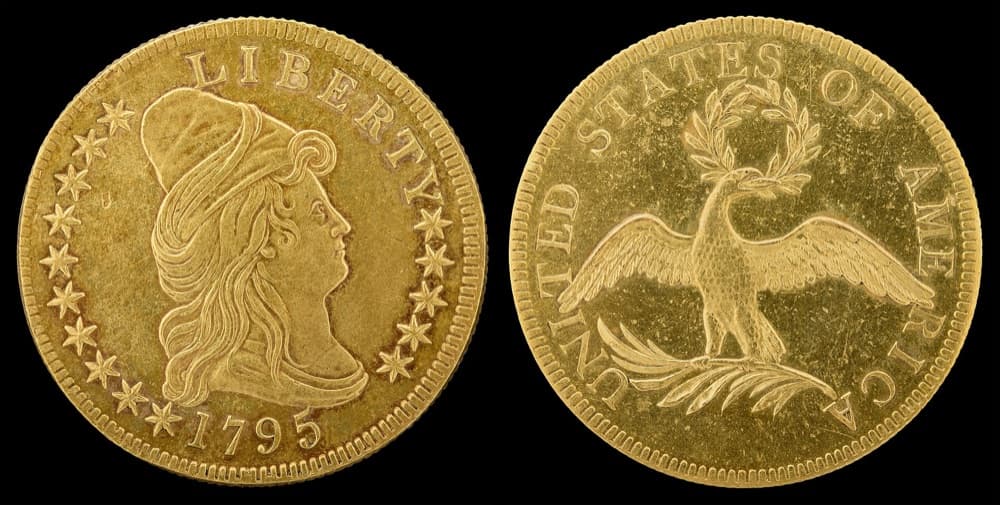
1795 Capped Bust Eagle (First US $10 Gold)
Thomas Jefferson imagined it, Alexander Hamilton grumbled about its name, and in September 1795 a hand-cranked press in Philadelphia finally struck it: the first ten-dollar gold piece of the United States, most of which were melted or shipped abroad within a decade.
- Year
- 1795
- Maker
- U.S. Mint (Philadelphia)
- By price in coins
- 53 of 100
Create a free account to see every recorded price and every grade.
Create a free account- Struck
- 1795 (and into 1796 from 1795-dated dies), Philadelphia Mint
- Denomination
- $10 gold eagle, the highest denomination authorized by the Mint Act of 1792
- Designer
- Robert Scot, first chief engraver of the U.S. Mint
- Type
- Capped Bust Right (also called Turban Head), Small Eagle reverse, used only on eagles dated 1795-1797
- Specs
- About 33 mm, 17.50 grams, .9167 gold with silver and copper, reeded edge
- Varieties
- Five die marriages: four with 13 leaves on the palm branch, one (BD-3) with 9
- This entry
- 13 Leaves, BD-1 die pair, Mint State 63-64
- BD-1 survivors
- About 325 believed extant in all grades, the most available 1795 variety
- First release
- 1,097 eagles made available for circulation on September 22, 1795
- Record for the date
- $2,585,000 for the Garrett-Pogue BD-4, PCGS MS66+, September 2015
Jefferson's golden piece
The eagle began on paper. In the spring of 1784 Thomas Jefferson, then a Virginia delegate to Congress, proposed a decimal coinage pegged to the Spanish dollar, with 'a golden piece equal in value to 10 dollars' at the top. In 1785 he called it a 'crown.' On August 8, 1786, Congress resolved that the ten-dollar coin, 'stamped with the impression of the American eagle,' would be called an Eagle. Alexander Hamilton was unimpressed: 'The eagle is not a very expressive or apt appellation for the largest gold piece, but nothing better occurs.'
The Mint Act of April 2, 1792, made the eagle the nation's highest denomination. But the new Philadelphia Mint struck copper first, then silver, and precious-metal coinage was held up because the assayer and chief coiner each had to post a $10,000 bond. Congress lowered the bonds in 1794. The first gold deposit to be coined arrived in February 1795 from Moses Brown of Boston.
Around May 1795, Mint director David Rittenhouse set engraver Robert Scot to preparing gold dies. Rittenhouse resigned in June, and his successor, Henry deSaussure, took office on July 9 and pushed hard. The first half eagles were struck 22 days later. The eagles followed, struck in August and September; 1,097 were made available on September 22, 1795, and 400 went straight to the Bank of Pennsylvania, which had deposited the gold.
Scot's design, and what it is called
Scot designed both sides. Liberty faces right with flowing hair under a tall, soft cap, with LIBERTY above, the date below and 15 stars, one for each state in 1795. The reverse shows a slender eagle holding a wreath in its beak and a palm branch in its talons, inside UNITED STATES OF AMERICA. There is no denomination on the coin: its value was its weight and fineness.
The names collectors use are argued over. 'Capped Bust Right' is traditional, but 'Capped Bust' also names a later design by John Reich, so some prefer 'Conical Cap Right.' 'Turban Head' is common too, though the cap only looks like a turban because of the hair wrapped around it. Art historian Cornelius Vermeule suggested the portrait may trace to Martha Washington; numismatic historian Walter Breen thought Scot copied an engraving of a classical goddess and suggested the palm branch honored deSaussure, a South Carolinian.
The public did not love the bird. The small eagle was thought scrawny and unworthy of the nation, and in 1797 Scot replaced it with a heraldic eagle based on the Great Seal. The small-eagle eagles, dated 1795, 1796 and 1797, total 13,344 by the standard reference count; John Dannreuther's study puts the type at 10,609 to 18,676.
Philadelphia, 1795
The young country spent 1795 settling its borders and its dealings abroad. That year the Treaty of Greenville ended the Northwest Indian War, Washington sent the Jay Treaty to the Senate, the United States agreed to pay tribute to Algiers to protect its ships, and the Treaty of Madrid fixed the border with Spain's colonies.
At the Mint, striking a coin this large on an unpowered screw press was hard physical work, and few of these eagles show every detail strongly. Coinage stopped in late 1795 after the death of the assayer, Albion Cox, and resumed with 1795-dated dies in late March 1796.
A legend holds that Washington supplied the gold for the first 400 eagles. Author Dean Albanese considered that improbable, since $4,000 in coin would have tied up much of Washington's capital, and suggested instead that the government may have bought well-preserved pieces to give to dignitaries. By some reports one eagle was presented to Washington, though whether it came from the first striking is uncertain.
Made, then melted
How many 1795 eagles were made is itself disputed. Mint records give 5,583 eagles delivered in calendar 1795, and PCGS lists 5,083 for the date; Dannreuther, counting 1795-dated coins struck into 1796, estimates 5,859 to 10,915. The figures do not agree, and this page does not pick one.
Most did not last. The eagle was too large for everyday trade and had no foreign equivalent, unlike the half eagle. As gold rose against silver, merchants could buy eagles with silver and ship the gold to Europe, and gold vanished from American circulation by about 1800. On December 31, 1804, President Jefferson stopped eagle coinage altogether; it did not resume until 1838, with a smaller, lighter coin. Most scholars believe fewer than 1 percent of the early eagles survive.
The 1795 is nonetheless the most available date of the small-eagle type, and an unusual number of survivors show little wear. One PCGS narrative says a small number of extremely choice pieces were obviously saved as gifts or mementos from the day they were struck, and that many show prooflike surfaces.
The great examples
The most celebrated 1795 eagle is a 13 Leaves BD-4 graded PCGS MS66+. Its recorded provenance runs from George Stenz through an 1880 sale, the T. Harrison, Robert and John Work Garrett collections and Johns Hopkins University, to the Pogue family, who paid $130,000 for it at the Garrett sale in 1980. A grading executive once called it 'the one monster MS66.' It sold for $2,585,000 in September 2015.
Other gems have long pedigrees too. An MS65 traced to S.H. Chapman in 1909 and the John H. Clapp and Louis E. Eliasberg Sr. collections sold for $57,200 in 1982 and $675,625 in August 2013. Another MS65 brought $82,500 in 1988 and $881,250 in August 2014.
For BD-1, this entry's die pair, the finest PCGS lists is an MS65 that sold for $506,000 in August 2003. An MS64+ rose from $138,000 in 1999 to $414,000 in 2005, and PCGS records $822,500 for an MS64+ in March 2019 as the BD-1 auction record. An NGC MS64 eagle sold for $264,500 at auction in Los Angeles on September 22-23, 2013, against an estimate of $200,000 and up; it is often cited for this date, but the sale report identifies it as the scarcer BD-4 die pair, not BD-1.
The 9 Leaves variety is far scarcer: Dannreuther estimates 210 to 500 struck and 20 to 22 survivors. Collector William H. Woodin, later Treasury secretary, discovered it and bought his example in 1926 for $100; a second did not surface until 1960. The finest known, an MS63+, sold for $1,057,500 in the 2015 Pogue sale, and an MS63 brought $630,000 in August 2019.
How to identify a BD-1
Start with the reverse: count the leaves on the palm branch in the eagle's talons. Thirteen hearty leaves means one of the four 13 Leaves die marriages; nine thin ones means the rare BD-3.
BD-1 is identified by its dies. On the obverse, the tip of the 5 in the date overlaps the bottom of the bust; on the reverse, the eighth palm leaf sits close to the U in UNITED. Dannreuther estimates 2,795 to 5,583 coins were struck from this pair, and about 325 are believed to survive, which is why BD-1 is the variety most type collectors end up with.
Adjustment marks, such as those often seen on the eagle's breast, are typical for the issue, and because the coins were struck on a hand-powered screw press, few show every part of the design strongly. Those traits come from the Mint, not from later damage.
The numbers
- Mintage
- Disputed: 5,583 delivered in 1795 per Mint records; 5,083 per PCGS; 5,859-10,915 per Dannreuther's die study
- BD-1 struck
- 2,795 to 5,583 (Dannreuther estimate)
- Survivors
- About 325 BD-1 in all grades; 400 to 500 of all 13 Leaves varieties per one PCGS narrative; 20 to 22 of the 9 Leaves
- Weight
- 17.50 grams
- Diameter
- About 33 mm
- Composition
- .9167 gold, balance silver and copper (PCGS lists 91.7% gold, 8.3% copper)
- Edge
- Reeded
- Designer
- Robert Scot
- Type mintage, 1795-1797
- 13,344 per the standard reference; 10,609 to 18,676 per Dannreuther
Timeline
Jefferson's 'Notes on Coinage' proposes a ten-dollar gold piece.
Congress names the ten-dollar coin 'an Eagle.'
The Mint Act makes the eagle the highest U.S. denomination.
Moses Brown of Boston makes the first gold deposit to be coined.
Henry deSaussure becomes Mint director and presses for gold coinage.
1,097 eagles are made available for circulation; 400 go to the Bank of Pennsylvania.
Coinage resumes with 1795-dated dies after the assayer's death halted it.
The small-eagle reverse is replaced by a heraldic eagle.
Jefferson orders eagle coinage stopped; it resumes in 1838.
William H. Woodin buys the first known 9 Leaves eagle for $100.
The Garrett BD-4 MS66+ sells for $130,000 to the Pogue family.
The finest BD-1, an MS65, sells for $506,000.
An NGC MS64 BD-4 eagle sells for $264,500 in Los Angeles.
The Garrett-Pogue BD-4 sells for $2,585,000, the record for the date.
A BD-1 MS64+ sets the variety record at $822,500.
A 9 Leaves MS63 sells for $630,000 in the Taraszka collection sale.
The world in 1795
The University of North Carolina opens, the first state university in the United States.
Congress passes the 11th Amendment.
Kamehameha I wins the Battle of Nu'uanu, founding the Kingdom of Hawaii.
Washington submits the Jay Treaty to the Senate.
The Treaty of Greenville ends the Northwest Indian War.
The U.S. agrees to pay Algiers $23,000 a year to prevent attacks on American ships.
The Treaty of Madrid sets the border between the U.S. and Spain's colonies.
Future president James K. Polk is born.
Price record
| Date | Price | Kind |
|---|---|---|
| Oct 1980 | $130,000 | Sold at auctionBD-4, later PCGS MS66+. Garrett collection sale; bought by the Pogue family. |
| Oct 1982 | $57,200 | Sold at auction13 Leaves, later PCGS MS65. Eliasberg collection. |
| Oct 1988 | $82,500 | Sold at auction13 Leaves, later PCGS MS65. |
| Aug 1999 | $138,000 | Sold at auctionBD-1, PCGS MS64+. |
| May 2001 | $92,000 | Sold at auctionBD-4, estimated MS63. |
| Aug 2003 | $506,000 | Sold at auctionBD-1, PCGS MS65, finest known of the variety. |
| Jan 2005 | $460,000 | Sold at auctionBD-1, estimated MS64. |
| Jun 2005 | $414,000 | Sold at auctionBD-1, PCGS MS64+ (same coin as the 1999 sale). |
| May 2006 | $299,000 | Sold at auctionBD-4, estimated MS63. |
| Aug 8, 2006 | $494,500 | Sold at auctionBD-1, the same coin as the January 2005 sale. PCGS lists the grade as MS65 on one page and as an estimated MS64 on its census. |
| May 3, 2011 | $379,500 | Sold at auction9 Leaves, PCGS MS61. |
| Aug 2013 | $675,625 | Sold at auction13 Leaves, PCGS MS65. Clapp-Eliasberg pedigree. |
| Sep 22, 2013 | $264,500 | Sold at auction13 Leaves BD-4, NGC MS64. Sold in Los Angeles; estimate was $200,000 and up. Includes 15 percent buyer's fee. |
| Aug 2014 | $881,250 | Sold at auction13 Leaves, PCGS MS65. |
| Apr 2015 | $282,000 | Sold at auctionBD-1, PCGS MS63. |
| Sep 2015 | $1,057,500 | Sold at auction9 Leaves BD-3, PCGS MS63+, finest known. Pogue collection. |
| Sep 15, 2015 | $2,585,000 | Sold at auctionBD-4, PCGS MS66+. Garrett-Pogue coin; record for the date. |
| Mar 21, 2019 | $822,500 | Sold at auctionBD-1, PCGS MS64+. Variety auction record per PCGS. |
| Aug 15, 2019 | $630,000 | Sold at auction9 Leaves BD-3, PCGS MS63. Taraszka collection. |
A realized auction price is what a buyer actually paid on the date shown, including the buyer's premium where the sale reported it. It is the strongest kind of reference price, and it is a record of one sale of one object on one day, not a promise of what the next example will bring.
By reference price, 1795 Capped Bust Eagle (First US $10 Gold) is number 53 of 100 in the coins entries of the FLOAT 100. 96 of those 100 rest on a realized sale; the rest carry an asking price or a guide value, and each page says which. Rank within the FLOAT 100 itself (22 here) is editorial: how much an object defines its field, not price alone.
Did you know
- The coin carries no statement of its value. Early gold traded by weight and purity.
- Hamilton wrote that 'eagle' was 'not a very expressive or apt appellation' for the coin, but that nothing better occurred to him.
- One of the first eagles was set aside by Mint employee Adam Eckfeldt for the Mint's own coin collection.
- Coinage of 1795 eagles stopped in late 1795 when the Mint's assayer, Albion Cox, died.
- The first eagles had 15 stars; a 16th was added when Tennessee became a state in 1796, and the Mint then settled on 13.
- The rare 9 Leaves variety was discovered by William H. Woodin, who was Treasury secretary during the 1933 gold recall.
- Jefferson stopped the eagle in 1804 because so many were being exported and melted; it stayed out of production for more than 30 years.
How this page is made
- The figure
- One reference price, shown with its own kind. FLOAT does not average it with anything or adjust it for time.
- Realized or not
- A realized price is a completed sale. An asking price, an estimate and a price-guide value are not sales, and are labeled as such wherever they appear.
- The story
- Researched from published records and checked fact by fact. Updated Oct 1, 2026.
- Archive
- Oct 5, 2026