FLOAT 100 · Coins · No. 12
1880 Coiled Hair Stella ($4 Gold)
A four-dollar gold coin built for a world currency that never came, struck in perhaps ten pieces; the first to reach auction brought $37 in 1906, and this one sold for $2.28 million in 2025.
- Year
- 1880
- Maker
- U.S. Mint (Philadelphia)
- By price in coins
- 16 of 100
Create a free account to see every recorded price and every grade.
Create a free account- Coin
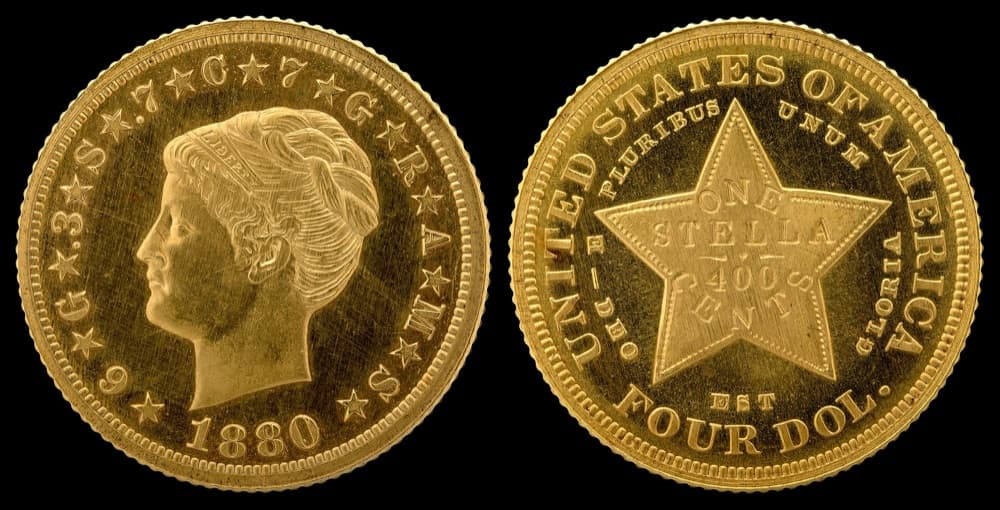
- 1880 $4 gold 'stella,' Coiled Hair design, Judd-1660, a pattern struck at the Philadelphia Mint
- This entry
- The du Pont specimen, graded PR67 by NGC with a CAC sticker, the finest non-Cameo example certified
- Design
- Coiled Hair Liberty usually credited to George T. Morgan, with Charles Barber's role debated; star reverse reading ONE STELLA / 400 CENTS
- Composition
- About 85.7% gold, 4.3% silver, 10% copper
- Weight and size
- 7 grams, 22 mm, reeded edge
- Mintage
- Unknown; probably about 10, possibly up to 20
- Known today
- Nine examples traced in a 2025 roster; one is in the Smithsonian
- Standing
- The rarest of the four stella varieties
- Auction record for the variety
- $2,574,000, September 23, 2013 (the Delp specimen)
- This coin's last sale
- $2,280,000 at auction, August 26, 2025
A coin for a world currency
In the late 1870s several European countries traded gold coins of equal value under the Latin Monetary Union, a forerunner of today's euro zone. On January 3, 1879, John A. Kasson, a former Iowa congressman then serving as U.S. minister to Austria-Hungary, wrote to Secretary of State William M. Evarts that Europe's interchangeable gold pieces gave its merchants an advantage, and that the United States needed a coin of the same exact value for invoices and trade.
The traditional story makes Kasson the father of a four-dollar coin. More recent research by the numismatic historian Roger Burdette, published in 2015, argues that Kasson never proposed one: the coin he described was worth about $3.88, the value of the Austrian eight-florin piece, and four dollars would not have matched it. The four-dollar idea came from Dr. William Wheeler Hubbell, who persuaded Representative Alexander H. Stephens, the former Confederate vice president who then chaired the House Committee on Coinage, Weights, and Measures. Hubbell's plan used his patented gold-silver alloy and would have paid him handsomely.
Stephens asked Treasury Secretary John Sherman to strike pattern coins for Congress to review. The coin was named for the large five-pointed star, or stella, on its reverse. Its metal value came to about $3.85, short of the parity it was meant to achieve, and it was also clumsier to count than larger gold coins in big transactions. Congress never adopted it, and the United States has never struck a regular coin meant for international exchange.
Two engravers and two portraits
The stella came in two obverse designs, each dated both 1879 and 1880. The Flowing Hair version is credited to Charles E. Barber, the heir apparent to the chief engraver's post. The Coiled Hair version, with Liberty's braided hair wound on top of her head and a band reading LIBERTY, has long been credited to George T. Morgan because it resembles his portraits on the goloid and metric dollar patterns. Burdette's research suggests Barber may have adapted Morgan's design for the stella. The reverse is generally attributed to Barber.
Morgan was born in Bilston, England, on November 24, 1845, and joined the Mint in October 1876 as an assistant engraver under William Barber, Charles's father. He became chief engraver in 1917, after Charles Barber's death, and served until his own death on January 4, 1925. His Morgan silver dollar became one of the best-known American coin designs, but the stella patterns he worked on never left the pattern stage.
The coin spells out its own makeup. Around Liberty runs the legend 6 G .3 S .7 C 7 GRAMS, for 6 grams of gold, 0.3 of silver and 0.7 of copper. The reverse reads ONE STELLA / 400 CENTS inside the star, with E PLURIBUS UNUM and DEO EST GLORIA around it and UNITED STATES OF AMERICA / FOUR DOL. at the border.
The rarest of the four
Most stellas are 1879 Flowing Hair coins. Accounts of how many were made differ: one source puts the total near 425, delivered to Congress in batches through 1880, with an outside figure of 725; another says the first 40 sets were struck on a medal press in January 1880 and that 100 more were ordered in March. Lore holds that some of the coins given to lawmakers ended up in Washington bordellos, a story supported mainly by the number of stellas that show signs of having been mounted as jewelry.
The 1880 Coiled Hair is in another class. It was issued in three-coin sets with Morgan's goloid and metric dollars, and the original mintage is generally put at about ten pieces, possibly 10 to 20. The pattern specialist David Akers could trace seven when he wrote his book on gold patterns and nine later. Of those nine, five have frosted devices against mirror fields and four are fully brilliant, which suggests they were not all struck at the same time. Estimates still differ: a 2025 roster traces nine, PCGS puts survivors at eight, and one expert writing for PCGS thinks only five or six survive.
It was the last of the four stella varieties to appear at auction, first offered in May 1906, and it has appeared far less often than the others. One count found only 35 auction appearances in more than a century, against at least 919 for the 1879 Flowing Hair. Unlike the 1879 coins, the 1880 Coiled Hair was not restruck in the usual sense. The design was also struck in copper (Judd-1661) and aluminum (Judd-1662).
The du Pont coin and its rivals
The coin in this entry is known as the du Pont specimen. It was part of a four-piece set of stellas in the collection of S. Hallock du Pont, offered as individual coins in September 1982, when it brought $102,300. It sold for $440,000 in August 1991 and $1,821,250 in April 2015. On August 26, 2025, graded PR67 by NGC with a CAC sticker, it sold at auction for $2,280,000, the second-highest auction price for the variety.
Its history may reach back further. A June 1943 catalog described an 1880 Coiled Hair as 'a magnificent perfect brilliant proof with partly wire edge' and 'of excessive rarity'; the cataloger hoped it would reach four figures, and it brought $850. The 2025 catalogers wrote that the description fits the du Pont coin exactly but that there is no definitive evidence they are the same piece.
The other eight have their own trails. The Delp specimen, now PR67 Cameo, sold for $35,000 in 1972, $977,500 in 2005 and a record $2,574,000 on September 23, 2013. The Eliasberg specimen, the coin first offered in 1906 for $37, sold for $99,000 in 1982 and $1,860,000 in February 2021. The Trompeter coin brought $1,116,250 in 2015, and the Lilly coin is in the National Numismatic Collection at the Smithsonian Institution. Earlier owners of examples included King Farouk of Egypt, whose collection was sold in 1954.
What to look for
The du Pont coin shows fully detailed frosty devices on orange-gold surfaces with touches of red and green, deeply reflective fields and a partial wire rim. Like every coin of this denomination it shows fine parallel striations, which some numismatists think come from half eagle planchets that were filed down to the correct weight; others think they came from drawing and rolling the metal.
NGC's census shows it as the only non-Cameo example at PR67, with none finer, and PCGS has certified no non-Cameo example above PR66. The 1880 Coiled Hair stella is listed among the 100 Greatest U.S. Coins. Because only about nine are traced and most can be followed by name, an example's pedigree is part of its identity.
The numbers
- Denomination
- $4 (one stella, 400 cents)
- Catalog numbers
- Judd-1660, Pollock-1860; PCGS #8060
- Mintage
- Unknown; generally put at about 10, possibly 10-20
- Known survivors
- 9 traced in a 2025 roster; PCGS survival estimate 8 (4 in PR65 or better)
- Weight
- 7 grams
- Diameter
- 22 mm
- Composition
- About 85.7% gold, 4.3% silver, 10% copper (6 g gold, 0.3 g silver, 0.7 g copper per the legend)
- Edge
- Reeded
- Designer
- Obverse usually credited to George T. Morgan, possibly adapted by Charles E. Barber; reverse attributed to Barber
- Mint
- Philadelphia
Timeline
George T. Morgan joins the U.S. Mint as an assistant engraver.
John A. Kasson writes to the State Department about a gold coin of equal value to Europe's.
The first stellas are delivered to Congress; accounts differ on whether 25 coins or 40 sets.
A handful of 1880 Coiled Hair stellas are struck and issued in three-coin sets with the goloid and metric dollars.
The variety's first auction appearance, the future Eliasberg coin, brings $37.
An 1880 Coiled Hair, possibly the du Pont coin, sells for $850.
King Farouk's example is sold with the Palace Collections of Egypt.
The Delp specimen sells for $35,000.
The du Pont specimen sells for $102,300 from a four-piece stella set.
The du Pont specimen sells for $440,000.
The Delp specimen sets the record for the variety at $2,574,000.
The du Pont specimen sells for $1,821,250.
The Eliasberg specimen sells for $1,860,000.
The du Pont specimen, NGC PR67 CAC, sells at auction for $2,280,000.
The world in 1880
Wabash, Indiana, switches on electric lights at its courthouse and claims to be the world's first electrically lighted city.
Thomas Edison tests his first electric railway at Menlo Park, New Jersey.
The U.S. Census counts a population of 50,155,783.
Henry Draper takes the first photograph of the Orion Nebula.
The University of Southern California opens.
James Garfield defeats Winfield S. Hancock for president.
James and John Ritty of Dayton, Ohio, patent the first cash register.
Price record
| Date | Price | Kind |
|---|---|---|
| May 1906 | $37 | Sold at auctionEliasberg specimen; the variety's first auction appearance. |
| Jun 1943 | $850 | Sold at auctionPossibly the du Pont specimen; not confirmed. |
| Nov 1972 | $35,000 | Sold at auctionDelp specimen. |
| Sep 1982 | $102,300 | Sold at auctionDu Pont specimen (this coin), from a four-piece stella set offered coin by coin. |
| Oct 1982 | $99,000 | Sold at auctionEliasberg specimen. |
| Aug 1991 | $440,000 | Sold at auctionDu Pont specimen (this coin). |
| Oct 1995 | $308,000 | Sold at auctionTrompeter specimen. |
| Jan 2005 | $977,500 | Sold at auctionDelp specimen, then graded PR66. |
| Jul 2005 | $618,125 | Sold at auctionKern specimen, PR62 NGC. |
| Jan 2009 | $575,000 | Sold at auctionKern specimen. |
| Jul 2009 | $546,250 | Sold at auctionKern specimen. |
| Sep 23, 2013 | $2,574,000 | Sold at auctionDelp specimen, PR67 Cameo NGC. Auction record for the variety. |
| Apr 2015 | $1,821,250 | Sold at auctionDu Pont specimen (this coin). |
| Jun 2015 | $1,116,250 | Sold at auctionTrompeter specimen, PR65 Cameo PCGS. |
| Oct 2015 | $258,500 | Sold at auctionDallas Bank specimen, PR61 NGC. |
| Aug 2019 | $204,000 | Sold at auctionDallas Bank specimen. |
| Feb 2021 | $1,860,000 | Sold at auctionEliasberg specimen, PR67 Cameo NGC. |
| Jan 2022 | $504,000 | Sold at auctionDallas Bank specimen. |
| Aug 26, 2025 | $2,280,000 | Sold at auctionDu Pont specimen (this coin), PR67 NGC CAC. Second-highest auction price for the variety. |
| May 2026 | $854,000 | Sold at auctionAn 1880 Coiled Hair sold at auction; specimen and grade not identified in the source. |
A realized auction price is what a buyer actually paid on the date shown, including the buyer's premium where the sale reported it. It is the strongest kind of reference price, and it is a record of one sale of one object on one day, not a promise of what the next example will bring.
By reference price, 1880 Coiled Hair Stella ($4 Gold) is number 16 of 100 in the coins entries of the FLOAT 100. 96 of those 100 rest on a realized sale; the rest carry an asking price or a guide value, and each page says which. Rank within the FLOAT 100 itself (12 here) is editorial: how much an object defines its field, not price alone.
Did you know
- The obverse legend spells out the alloy: 6 G .3 S .7 C 7 GRAMS.
- The coin Kasson actually described would have been worth about $3.88, so a four-dollar piece never matched the European coins it was meant to equal.
- Every stella shows fine parallel striations, possibly from half eagle planchets filed down to weight.
- The 1880 Coiled Hair was the last of the four stella varieties to reach auction, in 1906, where it brought $37.
- Five of the nine traced examples have frosted devices and four are fully brilliant, suggesting more than one striking.
- One of the nine is in the Smithsonian's National Numismatic Collection.
- King Farouk of Egypt once owned an 1880 Coiled Hair stella.
How this page is made
- The figure
- One reference price, shown with its own kind. FLOAT does not average it with anything or adjust it for time.
- Realized or not
- A realized price is a completed sale. An asking price, an estimate and a price-guide value are not sales, and are labeled as such wherever they appear.
- The story
- Researched from published records and checked fact by fact. Updated Oct 1, 2026.
- Archive
- Oct 5, 2026