FLOAT 100 · Coins · No. 13
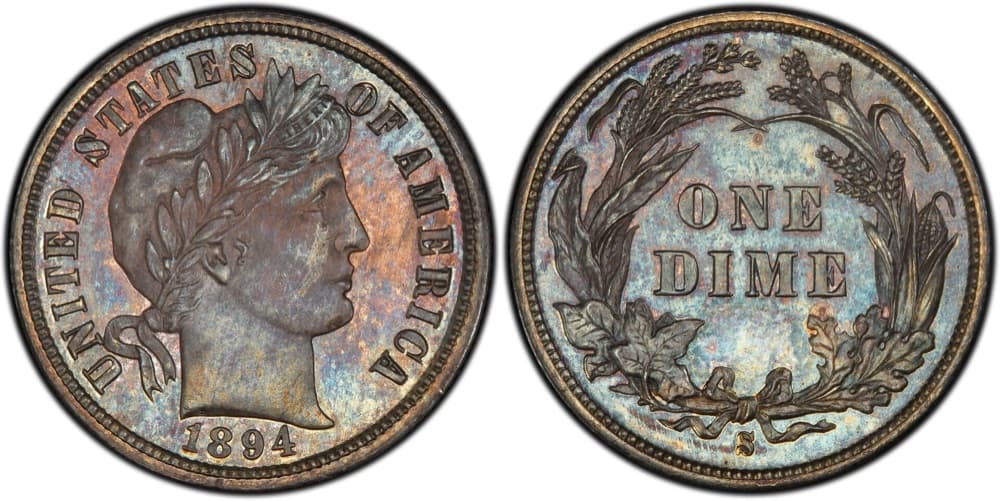
1894-S Barber Dime
In 1894 the San Francisco Mint struck exactly $2.40 worth of dimes, nobody has ever proved why, and the nine that survive have become one of the three most famous rarities in American coinage.
- Year
- 1894
- Maker
- U.S. Mint (San Francisco)
- By price in coins
- 18 of 100
Create a free account to see every recorded price and every grade.
Create a free account- Struck
- 1894, San Francisco Mint, during the first half of the year; one account gives June 9, 1894
- Mintage
- 24 pieces, all struck as proofs from a single pair of dies
- Known today
- Nine, by the most widely cited count; one researcher's roster allows that the true number may be eight
- Condition of survivors
- Seven keep some or all of their mirrored proof finish; two are heavily worn
- Designer
- Charles E. Barber, Chief Engraver of the U.S. Mint
- Mint superintendent
- John Daggett, in office July 31, 1893, to July 31, 1897
- Finest certified
- Two examples graded Proof 66 by PCGS, including the coin from the 1947 Eliasberg duplicate sale
- Highest reported price
- $2,160,000, the PCGS Proof 66 example, at auction in Dallas, January 2025
- Most recent sale
- $1,250,500 at auction on September 1, 2026, for the example once bought at 19 by a future coin dealer
Twenty-four dimes and no explanation
Official mint records say the San Francisco Mint struck 24 Barber dimes in the first half of 1894, and no more for the rest of the year. At ten cents apiece that is $2.40 of coinage. Every one was struck as a proof, with mirrored fields, and all came from a single pair of dies, which suggests they were made at roughly the same time. Aside from the line in the mint report, the first public notice that the coins existed did not appear until the March 1900 issue of The Numismatist.
Why so few were made has never been settled. The oldest explanation, printed in The Numismatist in April 1928 from information Farran Zerbe said he was given at the San Francisco Mint in 1905, holds that a bullion account had to be closed at the end of the fiscal year on June 30, 1894, and the dime dies were put to work to balance it. A related version says the mint's audit was off by $2.40. Later researchers found the story hard to square with the coins themselves: if the job was simply to balance a ledger, nobody would have bothered to strike the pieces as proofs.
A second account came from James Johnson in a Coin World article of September 13, 1972, based on what collector Earl Parker said he heard from Hallie Daggett, daughter of the mint superintendent. In that telling, seven banker friends of Superintendent John Daggett visited the mint in 1894 and each received three freshly struck proof dimes, and the last three went to Daggett, who gave them to Hallie. William Burd, writing in The Numismatist in February 1994, rejected the bankers detail as fiction and suggested Daggett may simply have produced the dimes as souvenirs for a reception or party. Other theories hold that the pieces were die trials, or that a small leftover of bullion could only be coined into dimes.
One more fact complicates every theory. One or more examples were reserved for the Assay Commission, which met on February 13, 1895, and it is not known whether those coins were among the 24 or struck in addition to them. As one widely reprinted catalog analysis concluded, until someone finds day-to-day mint records from San Francisco, everything beyond the mintage, the proof finish, the single die pair and the assay reservation is speculation.
The superintendent and his daughter
John Daggett was born on May 9, 1833. He came to California in 1852 with his brother David, who fell ill, turned back and died on the voyage home. John stayed, served as postmaster of the small town of Sawyer's Bar, entered politics in 1859, spent the Civil War years in Nevada and from 1865 ran a mine with partners that they sold in 1872. He bought it back in 1895.
He served 11 sessions in the California legislature and was elected lieutenant governor, holding the office from 1882 to 1888 while living in Los Angeles. In those years he founded the town of Daggett, California, northeast of Los Angeles. He was also chosen to represent California at the World's Columbian Exposition. He became superintendent of the San Francisco Mint on July 31, 1893, and served until July 31, 1897. He died on August 30, 1919, at 86.
Daggett and his wife, Alice Foree, whom he married in 1870, had three surviving children: Ben, Hallie and Leslie. Hallie is the center of the most famous story about the coin. As it is usually told, her father gave her three of the new dimes and told her to save them until she was as old as he was, and on the way home she spent one on a dish of ice cream. She kept the other two for decades and sold them in the 1950s; one pedigree record says Earl Parker bought from her sometime between 1949 and 1954, and the Johnson account dates the purchase to 1950.
The ice cream story rests on thin evidence. It reached print through Parker's memory two decades after the fact, and Parker was relying on what Hallie recalled when she was 72. One cataloger asked the obvious question: why would Daggett give all three coins to his middle child and none to the others? The story survives because it explains something real, a worn 1894-S dime in a series where every other known piece was carefully preserved.
San Francisco in a hard year
The dimes were struck during the slump that followed the Panic of 1893, when demand for newly minted coin fell sharply. One explanation offered for the tiny mintage is simply that San Francisco already had plenty of dimes on hand and no reason to strike more.
It was a turbulent year across the country. Coxey's Army, the first significant American protest march, set out from Massillon, Ohio, for Washington on March 25. On May 11 some 3,000 workers at the Pullman Palace Car Company walked out in a wildcat strike against wage cuts, and a bituminous coal strike had already closed mines across the central states. In September a forest fire at Hinckley, Minnesota, killed more than 450 people.
The same year brought small modern beginnings: Coca-Cola was sold in bottles for the first time on March 12, Milton S. Hershey founded his chocolate company in February, and the first issue of Billboard was published in Cincinnati on November 1. On July 4 the short-lived Republic of Hawaii was proclaimed.
From $2.40 to $2.16 million
Collectors have tracked each known coin by its chain of owners, and the record is unusually detailed. The Newcomer specimen sold for $2,350 in 1945. The coin long known as the Eliasberg duplicate, from the cabinet of J.M. Clapp and then Louis Eliasberg Sr., sold for $2,150 at auction in New York in October 1947. In 1957 a 19-year-old collector paid $4,750 at auction for another example, a sum that made national news; he later sold it for $6,000 and went on to a prominent career in rare coins. A heavily worn piece, the one most often called the Ice Cream specimen, turned up in a New York department store in 1957; one account says it was bought there for $2.40.
Prices climbed steadily. The Eliasberg duplicate brought $275,000 in January 1990 and sold privately in 1998 for $825,000. The primary Eliasberg coin brought $451,000 in May 1996. In 2005 two examples sold for more than $1 million: the Daggett coin at $1,035,000 in January and the Eliasberg duplicate at $1,322,500 in March. In July 2007 the Eliasberg duplicate sold privately for $1.9 million, and that October another example, graded PCGS Proof 64, brought $1,552,500 at auction.
On January 7, 2016, at the Florida United Numismatists convention in Tampa, the Eliasberg duplicate, by then graded Proof 66 by PCGS with a green CAC sticker, sold for $1,997,500. In August 2019 a Proof 63 example once owned by Los Angeles Lakers owner Jerry Buss brought $1,320,000 at auction in Chicago; the buyer was Dell Loy Hansen, then owner of Real Salt Lake, who was trying to assemble an example of every coin the U.S. Mint has made since 1792. In December 2020 the primary Eliasberg coin, graded NGC Proof 65, sold for $1,440,000.
In January 2025 the Eliasberg duplicate sold again, this time from the Bruce S. Sherman Collection, for $2,160,000, a record for any proof Barber dime. On September 1, 2026, the coin the teenage collector had bought in 1957 returned to auction for the first time in 36 years, after sales of $77,000 in 1987 and about $93,500 around 1990, and brought $1,250,500 against an estimate of $1.5 million.
How the nine are told apart
The 1894-S is a standard Barber dime in every physical respect: 2.50 grams, 17.9 millimeters across, 90 percent silver and 10 percent copper, with a reeded edge. The obverse shows Liberty with a cap and cropped hair; the reverse has a wreath around the words ONE DIME. What sets the coins apart is their proof finish and their history, and authentication rests on matching a coin to a known specimen.
Researchers have published competing rosters since 1972. Walter Breen's lists counted 12 coins; a 1991 roster counted 10; most specialists now accept nine, and William Burd's numbering is the standard. Three of the older entries are now considered duplicates or unverified, including a coin once said to be in the Connecticut State Library, which researcher Phil Carrigan found the library does not have.
Individual coins are identified by small marks. The Daggett specimen, for instance, has a slight depression below the D of UNITED and a lint mark between the final S and the O. Grades on the census run from about Good 4 and Almost Good 3 for the two worn pieces up to Proof 66, and the rankings are disputed: one cataloger argued that the Daggett coin and the primary Eliasberg coin are the two finest, despite the higher certified grade of the Eliasberg duplicate.
Some of the nine drop out of sight for decades. A 2005 catalog roster noted that the Rappaport specimen had not been seen since the late 1950s and listed the former Buss coin as unlocated; the Buss coin reappeared at auction in 2019, its first public offering since 1988.
One of the Big Three
Collectors group the 1894-S dime with the 1804 silver dollar and the 1913 Liberty Head nickel as the Big Three of American coin rarities. Of the three, it is the only one that was officially recorded in the Mint's reports at the time it was made.
Charles E. Barber, who designed it, was Chief Engraver of the Mint and designed the dime, quarter and half dollar introduced in 1892. Barber dimes were struck through 1916 at four mints: Philadelphia, New Orleans, San Francisco and Denver. Many ordinary Barber coins were melted for their silver when prices spiked in the late 1970s and early 1980s.
Before 2026, only five had appeared at auction since 2005, according to the firm that sold one that year, and the sales have drawn national coverage. For a coin with a face value of ten cents, the 1894-S remains defined by the gap between its tiny mintage and the size of its legend.
The numbers
- Mintage
- 24, all proofs
- Known survivors
- 9 (one roster allows only 8); 7 proofs with mirrored surfaces and 2 heavily worn
- Weight
- 2.50 grams
- Diameter
- 17.9 mm
- Thickness
- 1.35 mm
- Composition
- 90% silver, 10% copper
- Edge
- Reeded
- Designer
- Charles E. Barber (design dated 1892)
- Mint
- San Francisco (S mintmark)
Timeline
John Daggett, future superintendent of the San Francisco Mint, is born.
Daggett takes office as superintendent of the San Francisco Mint.
The San Francisco Mint strikes 24 proof Barber dimes in the first half of the year, from a single pair of dies.
The Assay Commission meets; one or more 1894-S dimes had been reserved for it.
The Numismatist carries the first public notice that the coins exist.
The Numismatist prints the bullion-account explanation for the 24-coin mintage.
The Newcomer specimen sells for $2,350 at auction.
The Eliasberg duplicate sells at auction in New York for $2,150.
A 19-year-old collector buys an example at auction for a record $4,750; a worn piece surfaces in a New York department store.
James Johnson publishes the Daggett 'presentation' account and the first modern roster in Coin World.
William Burd publishes 'The Inscrutable 1894-S Dime' and the nine-coin roster now in common use.
The Daggett specimen sells for $1,035,000 at auction.
The Eliasberg duplicate sells privately for $1.9 million.
The PCGS Proof 66 Eliasberg duplicate sells for $1,997,500 in Tampa.
The former Jerry Buss coin sells for $1,320,000 in Chicago to Dell Loy Hansen.
The primary Eliasberg coin, NGC Proof 65, sells for $1,440,000.
The Eliasberg duplicate sells for $2,160,000, a record for a proof Barber dime.
The coin bought by a teenager in 1957 sells for $1,250,500, its first auction in 36 years.
The world in 1894
Milton S. Hershey founds the Hershey Chocolate Company in Lancaster, Pennsylvania.
Coca-Cola is sold in bottles for the first time.
Coxey's Army sets out from Massillon, Ohio, for Washington.
About 3,000 Pullman Palace Car Company workers begin a wildcat strike.
The Republic of Hawaii is proclaimed.
The Great Hinckley Fire in Minnesota kills more than 450 people.
The first issue of Billboard is published in Cincinnati.
Price record
| Date | Price | Kind |
|---|---|---|
| May 1945 | $2,350 | Sold at auctionNewcomer specimen. |
| Jun 1947 | $2,325 | Sold at auctionNewcomer specimen. |
| Oct 1947 | $2,150 | Sold at auctionEliasberg duplicate, sold at auction in New York. |
| Jan 1953 | $2,100 | Sold at auctionSpecimen later owned by Jerry Buss. |
| Nov 1957 | $4,750 | Sold at auctionCass specimen, bought by a 19-year-old collector; then a record. |
| Jun 1958 | $3,200 | Sold at auctionHeavily worn 'Ice Cream' specimen, found in 1957. |
| Mar 1961 | $13,000 | Sold at auctionNewcomer specimen. |
| Apr 1965 | $12,250 | Sold at auctionNewcomer specimen. |
| Nov 1969 | $7,400 | Sold at auctionWorn 'Ice Cream' specimen. |
| Nov 1973 | $52,000 | Sold at auctionSpecimen later owned by Jerry Buss. |
| Sep 1974 | $97,500 | Asking price, not a saleDaggett specimen, offered in a dealer's fixed-price list. |
| 1980 | $31,000 | Sold at auctionWorn 'Ice Cream' specimen, at the ANA convention sale. |
| Aug 1980 | $145,000 | Sold at auctionNewcomer specimen. |
| 1981 | $25,500 | Sold at auctionWorn 'Ice Cream' specimen, at the ANA convention sale. |
| Jan 1985 | $50,600 | Sold at auctionSpecimen from the Jerry Buss collection. |
| Sep 1986 | $91,300 | Sold at auctionNewcomer specimen. |
| Oct 1987 | $77,000 | Sold at auctionCass/Norweb specimen. |
| Jun 1988 | $70,400 | Sold at auctionFormer Jerry Buss specimen. |
| Mar 1989 | $33,000 | Sold at auctionWorn 'Ice Cream' specimen. |
| Jan 1990 | $275,000 | Sold at auctionEliasberg duplicate. |
| Oct 1990 | $93,500 | Sold at auctionCass/Norweb specimen. Sources differ on the date (1990 or 1991) and on the figure ($93,000 or $93,500). |
| Aug 1992 | $165,000 | Sold at auctionDaggett specimen. |
| May 20, 1996 | $451,000 | Sold at auctionPrimary Eliasberg specimen, cataloged as Proof 64 or finer. |
| 1998 | $825,000 | Private saleEliasberg duplicate. |
| Oct 2000 | $431,250 | Sold at auctionPrimary Eliasberg specimen. |
| Jan 2005 | $1,035,000 | Sold at auctionDaggett specimen, PCGS Proof 65. |
| Mar 2005 | $1,322,500 | Sold at auctionEliasberg duplicate, NGC Proof 66. |
| Jul 2007 | $1,900,000 | Private saleEliasberg duplicate, PCGS Specimen 66. |
| Oct 2007 | $1,552,500 | Sold at auctionDaggett-family specimen, PCGS Proof 64. |
| Jan 7, 2016 | $1,997,500 | Sold at auctionEliasberg duplicate, PCGS Proof 66 CAC. Sold in Tampa at the Florida United Numismatists convention. |
| Aug 2019 | $1,320,000 | Sold at auctionFormer Jerry Buss specimen, PCGS Proof 63 CAC. Sold in Chicago to Dell Loy Hansen. |
| Dec 2020 | $1,440,000 | Sold at auctionPrimary Eliasberg specimen, NGC Proof 65. |
| Jan 2025 | $2,160,000 | Sold at auctionEliasberg duplicate, PCGS Proof 66 CAC, Bruce S. Sherman Collection. Sold in Dallas; record for a proof Barber dime. |
| Sep 1, 2026 | $1,250,500 | Sold at auctionCass/Norweb specimen, PCGS Proof 63 CAC. Estimate was $1.5 million. |
A realized auction price is what a buyer actually paid on the date shown, including the buyer's premium where the sale reported it. It is the strongest kind of reference price, and it is a record of one sale of one object on one day, not a promise of what the next example will bring.
By reference price, 1894-S Barber Dime is number 18 of 100 in the coins entries of the FLOAT 100. 96 of those 100 rest on a realized sale; the rest carry an asking price or a guide value, and each page says which. Rank within the FLOAT 100 itself (13 here) is editorial: how much an object defines its field, not price alone.
Did you know
- The whole 1894-S mintage had a face value of $2.40.
- Of the Big Three American rarities, the 1894-S dime is the only one that was officially recorded in the Mint's reports at the time it was made.
- Superintendent John Daggett had earlier been lieutenant governor of California and founded the town of Daggett, California.
- The story that Hallie Daggett spent one of the dimes on ice cream was recorded through a collector's memory of what she told him when she was 72.
- A 19-year-old who paid $4,750 for an example in 1957 later sold it for $6,000; the same coin brought $1,250,500 in 2026.
- Older rosters counted as many as 12 known coins; a coin once said to be in the Connecticut State Library turned out not to be there.
- Basketball team owner Jerry Buss and soccer team owner Dell Loy Hansen have both owned the same 1894-S dime.
How this page is made
- The figure
- One reference price, shown with its own kind. FLOAT does not average it with anything or adjust it for time.
- Realized or not
- A realized price is a completed sale. An asking price, an estimate and a price-guide value are not sales, and are labeled as such wherever they appear.
- The story
- Researched from published records and checked fact by fact. Updated Oct 1, 2026.
- Archive
- Oct 5, 2026