FLOAT 100 · Coins · No. 7
1907 Ultra High Relief Double Eagle
A president who called America's money 'atrocious hideousness' and a dying sculptor who wanted coins as deep as Greek medallions forced the Mint to try the impossible, and the fewer than two dozen gold pieces that took about nine blows of a press to strike became the most admired coins the country ever made.
- Year
- 1907
- Maker
- U.S. Mint (Philadelphia), designed by Augustus Saint-Gaudens
- By price in coins
- 8 of 100
Create a free account to see every recorded price and every grade.
Create a free account- Struck
- Philadelphia Mint, 1907, as patterns on a medal press
- Designer
- Augustus Saint-Gaudens, with models finished by his assistant Henry Hering
- Champion
- President Theodore Roosevelt, who commissioned the redesign
- Date
- Roman numerals, MCMVII
- How many
- Fewer than two dozen struck; estimates of survivors run from about 13 to about 20
- Strikes per coin
- About nine blows of the press, by most accounts
- This coin
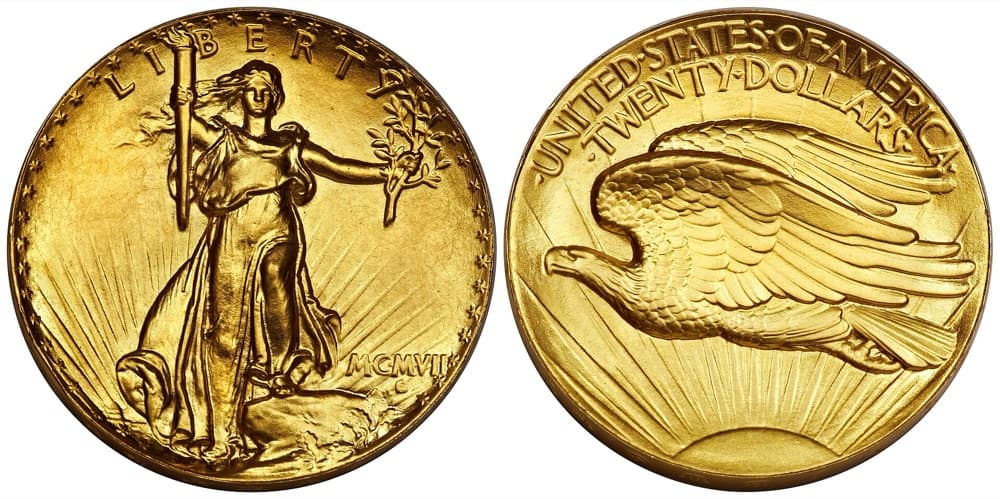
- The Eliasberg-Bass specimen, PCGS PR69, inverted edge lettering; tied for finest known
- Owners
- John H. Clapp, Louis E. Eliasberg Sr., Harry W. Bass Jr.
- Price
- $4,320,000 at auction, August 2023, after 73 bids
A president's war on ugly money
On December 27, 1904, President Theodore Roosevelt wrote to his Treasury Secretary, Leslie M. Shaw: 'I think the state of our coinage is artistically of atrocious hideousness. Would it be possible, without asking permission of Congress, to employ a man like Saint-Gaudens to give us a coinage which would have some beauty?' The coins that could be changed without an act of Congress were the cent and the four gold denominations, and the Mint engaged Augustus Saint-Gaudens to redesign them. No U.S. coin had ever been designed by anyone outside the Mint.
Both men admired the coins of ancient Greece and their deep, sculptural relief. Accounts differ on who first proposed it for the double eagle: one has Roosevelt, in a November 1905 letter, mentioning that he had been studying Greek gold coins; another quotes Saint-Gaudens writing to Roosevelt on November 6, 1905, that he had been looking at gold coins of Alexander the Great and was 'struck by their high relief.' Either way, they agreed the new $20 piece should be in high relief with a high rim to protect it.
Saint-Gaudens had no love for the Mint. In 1892 his design for the World's Columbian Exposition medal was attacked as obscene and replaced with one by Chief Engraver Charles E. Barber, and he swore off work with the Mint for a decade. In January 1906 he wrote to Roosevelt that 'whatever I produce cannot be worse than the inanities now displayed on our coins,' and predicted resistance from Barber, who 'will be found standing in its ruins.'
Treasury Secretary Shaw also balked at the Roman-numeral date, writing that he would 'dismiss the first one who puts a V on a public building where a U is intended.' Roosevelt overruled him, and the coin was dated MCMVII.
Saint-Gaudens's last work
Augustus Saint-Gaudens was born in Dublin on March 1, 1848, to an Irish mother and a French shoemaker father, and was raised in New York City, where he apprenticed as a cameo cutter before studying at the Ecole des Beaux-Arts in Paris. His Admiral Farragut monument in Madison Square, unveiled in 1881, made his name, and he went on to the Robert Gould Shaw Memorial in Boston and the Sherman monument at the corner of Central Park.
He was diagnosed with cancer in 1900 and worked from his home and studio in Cornish, New Hampshire. As his health failed through 1906, his assistant Henry Hering handled much of the coin work, and Saint-Gaudens had the models made outside the Mint to avoid obstruction. In December 1906 Hering delivered coin-sized models to Roosevelt, who wrote to the sculptor: 'It is simply splendid. I suppose I shall be impeached for it by Congress, but I shall regard that as a very cheap payment!'
The obverse shows Liberty striding forward with a torch in her right hand and an olive branch in her left, the Capitol behind her and the sun's rays at her back, ringed by 46 stars for the 46 states. The figure grew out of the winged Victory Saint-Gaudens made for the Sherman monument, modeled by Hettie Anderson, with the Nike of Samothrace as the ultimate inspiration; another account names Mary Cunningham, a young Irish woman from near Cornish, as his model. The reverse is a flying eagle over a rising sun. There was no room for a motto, so E PLURIBUS UNUM went on the edge, and 'In God We Trust' was left off entirely.
Saint-Gaudens died at Cornish on August 3, 1907, before a version of his double eagle had gone into circulation. In May, after learning how hard the first coins had been to strike, he had written to Roosevelt: 'Evidently it is no trifling matter to make Greek art conform with modern numismatics.'
Nine blows for one coin
Barber was certain the design would never coin. On November 26, 1906, he wrote that the Mint was 'just as certain that the relief of his eagle will never coin, as we are certain that the Sun will rise each morning,' and he initially rejected the models outright. Only after considerable discussion did he agree to make experimental dies.
Hering described the first trial at the Mint in February 1907: a gold disc was placed in the die and struck under hydraulic pressure of '172 tons, I think it was,' and the impression 'showed little more than half the modeling.' The coin went back under the press again and again, 'until on the ninth strike, when the coin showed up in every detail.' Mint Director Frank Leach later put the figure at about twelve blows, with the coin annealed between strikes; most accounts settle on nine.
The result looked more like a medal than money. The coins are deeply dished, much thicker at the edge than in the fields, with no rim at all, and they could not be stacked. On May 8, 1907, Roosevelt conceded to Saint-Gaudens that 'it has proved hitherto impossible to strike them by one blow, which is necessary under the conditions of making coins of the present day.' A second, lower-relief design still took three blows; on November 18, 1907, the impatient president ordered the Mint to 'begin the new issue, even if it takes you all day to strike one piece,' and more than 12,000 of these High Relief coins were struck. Barber then flattened the design further for mass production, replacing MCMVII with '1907.'
How many Ultra High Relief pieces were made is not known. Contemporary and later accounts give 13, 16, 18, 19 and 22, and some say two were destroyed in testing; the Smithsonian says fewer than two dozen were minted, in February and March 1907, while Roger Burdette's research places later groups between March and July and on December 31, 1907. Estimates of how many survive also vary, from about 13 to 15 with lettered edges plus one plain-edge piece, to about 20.
Reading the edge
Every Ultra High Relief double eagle is a pattern, cataloged in the Judd reference, and the edge tells you which batch a coin came from. According to research by Roger Burdette, the first group, struck February 7 to 14, 1907, used a collar left over from Barber's 1906 pattern, with small sans-serif letters reading E*P*L*U*R*I*B*U*S*U*N*U*M*. Three complete coins received this so-called Gothic edge; two are known today, and the third, thought to be the one loaned to Saint-Gaudens, has never been traced. A fourth coin from that group has a plain edge, because the die cracked before the edge could be lettered.
The later groups were struck with a new reverse die and a collar with serifed letters, E*PLURIBUS*UNUM followed by a run of stars. On the second group the lettering reads upright with the reverse facing up; on the third it reads with the obverse up, the variety collectors call 'inverted edge lettering.'
The Eliasberg-Bass coin is an inverted-edge piece, cataloged as Judd-1909, and is graded PR69 by PCGS, tied for the finest known. Like the others it was struck as a proof on a specially polished planchet, and the specimens are known for satiny surfaces and razor-sharp detail. Because nearly all of them trace directly to Roosevelt, Barber or other officials and were handled with care, most survivors are of gem quality.
The Ultra High Relief should not be confused with the far more common 1907 High Relief, struck by the thousands later that year from the second, lower-relief model, which has a visible rim, or with Barber's low-relief version, dated with Arabic numerals, that went into circulation at the end of December 1907. A separate 1907 experiment struck the design on a smaller, thicker planchet of the same weight; those 'checker' pieces were melted, except two kept in the Mint's collection, when officials realized Congress had to approve any change in diameter.
From Clapp to Eliasberg to Bass
The Eliasberg-Bass specimen spent most of the twentieth century in two of the greatest American collections. It belonged to Washington, D.C., collector John H. Clapp until his death in 1940. In 1942 Louis E. Eliasberg Sr. bought Clapp's entire collection for more than $100,000, at the time one of the largest recorded numismatic transactions, and the purchase helped Eliasberg become the only collector to complete a set of U.S. coins by date, mintmark and major variety.
Eliasberg kept the coin until his death in 1976. In 1982 his family sold his gold collection at auction, and Harry W. Bass Jr. of Dallas, who formed one of the largest collections of U.S. gold ever assembled, bought the Ultra High Relief for $242,000. It stayed out of public view for more than four decades.
In August 2023 the coin led the fourth and final auction of the Harry W. Bass Jr. Core Collection, held during the American Numismatic Association's World's Fair of Money. It sold for $4,320,000 after 73 bids. Proceeds from the Bass sales, which together exceeded $83 million, went to Dallas nonprofits supported by the Harry W. Bass Jr. Foundation, with an emphasis on early childhood education and literacy.
The other famous examples
The coin that shares the PR69 grade has its own record. It was bought in April 1980 as part of a 'Million Dollar Set' of 1907 coinage, passed through several collections, and sold at auction for $2,990,000 in November 2005 and for $2,760,000 in June 2012.
The Saint-Gaudens family's own coin, now PCGS PR68, came from the Mint cabinet and was presented to the sculptor's widow, Augusta, in 1908. It was lent to the American Numismatic Society on December 1, 1910, returned to their son Homer in 1950 and later sold privately. California collector Dan O'Dowd bought it at auction in January 2015 for $2,115,000 and has shown it publicly only a handful of times since.
Of the two Gothic-edge coins, the one graded PCGS Proof-58 sold at auction for $143,000 in 1992, $488,750 in 2005, $690,000 in 2008 and $1,057,500 in 2012, and sold for $840,000 in February 2026. Like its twin, it shows light wear consistent with use as a pocket piece. Two Ultra High Relief coins are in the Smithsonian's National Numismatic Collection, and another that came directly from Barber is in the American Numismatic Society's collection.
The design never stopped pulling at the Mint. In 2009 it struck a modern Ultra High Relief gold coin from Saint-Gaudens's original design, in one ounce of .999 gold with a 50-star obverse, and in November 2025 it announced a 2026 gold coin with the 1907 date in Roman numerals for the 250th anniversary of American independence.
The numbers
- Mintage
- Not recorded; accounts range from 13 to 22, the Smithsonian says fewer than two dozen
- Known survivors
- About 13-15 lettered-edge plus one plain-edge (one estimate); about 20 (another)
- Weight
- Struck to the double eagle standard of 33.431 grams
- Diameter
- 34.1 mm, the double eagle standard
- Composition
- 90% gold, 10% copper
- Edge
- Lettered E PLURIBUS UNUM (Gothic, upright or inverted), one plain
- Designer
- Augustus Saint-Gaudens; models by Henry Hering
- This coin's grade
- PR69 (PCGS), tied for finest known
Timeline
Theodore Roosevelt and Augustus Saint-Gaudens meet at the Pan-American Exposition and begin corresponding.
Roosevelt calls U.S. coinage 'atrocious hideousness' and proposes hiring Saint-Gaudens.
Roosevelt and Saint-Gaudens settle on high relief for the new gold coins, inspired by ancient Greek coins.
Saint-Gaudens asks to date the coin in Roman numerals; Roosevelt overrules the Treasury Secretary's objection.
Chief Engraver Charles Barber writes that the design 'will never coin.'
Henry Hering delivers coin-sized models; Roosevelt orders dies made 'just as they are.'
First Ultra High Relief pieces struck, with Gothic edge lettering, through February 14.
Roosevelt tells Saint-Gaudens the coins cannot be struck with one blow.
Saint-Gaudens dies at Cornish, New Hampshire.
Roosevelt orders the lower High Relief version into production 'even if it takes you all day to strike one piece.'
The Mint presents an Ultra High Relief coin to Saint-Gaudens's widow, Augusta.
Collector John H. Clapp dies, still owning the Eliasberg-Bass coin.
Louis E. Eliasberg Sr. buys the Clapp collection for more than $100,000.
Eliasberg dies.
Harry W. Bass Jr. buys the coin at auction for $242,000.
The Mint issues a modern one-ounce Ultra High Relief gold coin from the original design.
The Eliasberg-Bass coin sells for $4,320,000 after 73 bids.
The world in 1907
Charles Curtis of Kansas becomes the first Native American U.S. senator.
Ellis Island has its busiest day ever, in a year that brings 1.1 million immigrants.
Roosevelt opens the Jamestown Exposition for the colony's 300th anniversary.
The liner RMS Lusitania sets out on its maiden voyage from Liverpool to New York.
A run on the Knickerbocker Trust Company sets off the Panic of 1907.
J.P. Morgan and other financiers pool $25 million to halt the panic, a crisis that later leads to the Federal Reserve.
The Great White Fleet leaves Hampton Roads on a 14-month voyage around the world.
The first electric ball drops in Times Square.
Price record
| Date | Price | Kind |
|---|---|---|
| May 1974 | $200,000 | Sold at auctionAn Ultra High Relief example, bought at auction in New York by a New York firm. |
| 1982 | $242,000 | Sold at auctionEliasberg-Bass specimen, bought by Harry W. Bass Jr. from the Eliasberg collection. |
| Dec 1992 | $143,000 | Sold at auctionGothic (sans-serif) edge example, now PCGS Proof-58. |
| Mar 2005 | $488,750 | Sold at auctionSame Gothic-edge Proof-58 example. |
| Nov 2005 | $2,990,000 | Sold at auctionThe other PCGS PR69 example, from a collection of Saint-Gaudens coinage. |
| Jul 2008 | $690,000 | Sold at auctionGothic-edge Proof-58 example. |
| Jun 2012 | $2,760,000 | Sold at auctionThe other PCGS PR69 example. |
| Aug 2012 | $1,057,500 | Sold at auctionGothic-edge Proof-58 example. |
| Jan 2015 | $2,115,000 | Sold at auctionSaint-Gaudens family coin, then NGC PR68, now PCGS PR68; bought by collector Dan O'Dowd. |
| Aug 10, 2023 | $4,320,000 | Sold at auctionEliasberg-Bass specimen, PCGS PR69, inverted edge lettering; 73 bids. |
| Feb 2026 | $840,000 | Sold at auctionGothic-edge Proof-58 example. |
A realized auction price is what a buyer actually paid on the date shown, including the buyer's premium where the sale reported it. It is the strongest kind of reference price, and it is a record of one sale of one object on one day, not a promise of what the next example will bring.
By reference price, 1907 Ultra High Relief Double Eagle is number 8 of 100 in the coins entries of the FLOAT 100. 96 of those 100 rest on a realized sale; the rest carry an asking price or a guide value, and each page says which. Rank within the FLOAT 100 itself (7 here) is editorial: how much an object defines its field, not price alone.
Did you know
- Roosevelt told Saint-Gaudens he expected to be impeached by Congress for the coin, and that he would 'regard that as a very cheap payment.'
- When critics complained that the eagle's talons trailed behind it, Roosevelt sent Mint Director Frank Leach to the aviary at Rock Creek Park, where the first eagle he saw flew exactly as the coin shows.
- Treasury Secretary Leslie Shaw opposed the Roman-numeral date, but Roosevelt overruled him.
- Saint-Gaudens left 'In God We Trust' off the coin at Roosevelt's request; public outcry led Congress to order the motto restored.
- Of the three Gothic-edge coins struck, the one believed to have been loaned to Saint-Gaudens himself has never been found.
- In 1907 the Mint also tried the design on a smaller, thicker 'checker' planchet, then melted almost all of them because changing a coin's diameter required Congress's consent.
- The Saint-Gaudens family's own Ultra High Relief spent four decades on loan to the American Numismatic Society before returning to the sculptor's son in 1950.
How this page is made
- The figure
- One reference price, shown with its own kind. FLOAT does not average it with anything or adjust it for time.
- Realized or not
- A realized price is a completed sale. An asking price, an estimate and a price-guide value are not sales, and are labeled as such wherever they appear.
- The story
- Researched from published records and checked fact by fact. Updated Oct 1, 2026.
- Archive
- Oct 5, 2026