FLOAT 100 · Coins · No. 64
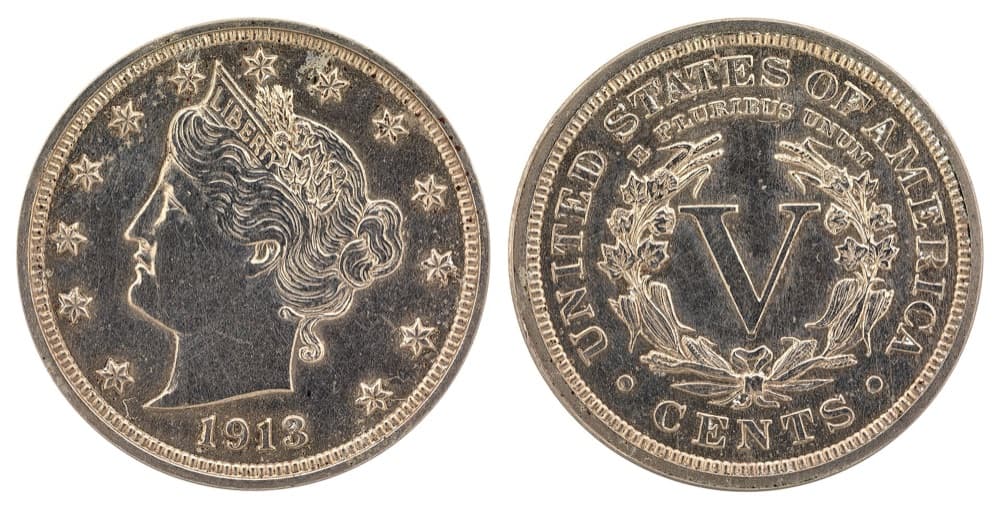
1913 Liberty Head Nickel (Walton specimen)
Pulled from the wreck of a fatal car crash, written off as a fake and left in a closet for four decades, this nickel turned out to be one of only five ever made, and sold for more than $3 million.
- Year
- 1913
- Maker
- U.S. Mint (Philadelphia, clandestine)
- By price in coins
- 12 of 100
Create a free account to see every recorded price and every grade.
Create a free account- Coin
- 1913 Liberty Head five-cent piece, a date the Mint never officially struck
- Known
- Five: two in museums, three in private hands
- This specimen
- The Walton coin, graded PCGS PR63 (third-finest of the five)
- Designer
- Charles E. Barber (Liberty Head design, 1883-1913)
- Specs
- 75% copper, 25% nickel, 5.00 grams, 21.20 mm, plain edge
- Missing
- From the 1962 death of owner George O. Walton until 2003
- 2013 sale
- $3,172,500 at auction in Schaumburg, Illinois, April 25, 2013
- Latest reported sale
- $4.2 million, October 2022
Five nickels that should not exist
In February 1913 the U.S. Mint introduced the Indian Head, or Buffalo, nickel, replacing Charles E. Barber's Liberty Head design that had been in use since 1883. The Mint's official records list no Liberty Head nickels struck that year. Yet in December 1919 a 1913 Liberty Head nickel was shown at a meeting of the Chicago Coin Club, and in August 1920 Samuel Brown displayed five of them at the American Numismatic Association's convention.
Brown had advertised in the December 1919 issue of The Numismatist offering $500 apiece for 1913 Liberty nickels, ostensibly buying the coins that way. But he had been a Mint employee in 1913, working there from 1903 to November 1913 according to one pedigree record, and many historians conclude that he struck them himself or had them struck, then took them out of the Mint. No one has ever proved how they were made.
The five stayed together for years. They were sold as a set in January 1924, advertised in The Numismatist in 1923 and 1924, and passed through several dealers to Colonel E.H.R. Green, son of the Gilded Age investor Hetty Green, who kept them until his death in 1936. In December 1941 the dealers Eric P. Newman and Burdette G. Johnson bought all five from the Green estate for $2,000 and broke up the set for the first time.
George Walton's nickel
The paths of the five then diverged. One pedigree record traces this coin from Newman and Johnson to James Kelly, who bought three of the nickels in March 1943 for $750 each, then to Dr. Conway A. Bolt and possibly the R.J. Reynolds family of North Carolina before it reached George O. Walton, a North Carolina collector. Another account says Walton bought it directly from Newman and Johnson in 1945 for about $3,750.
On March 9, 1962, Walton was killed in a car crash on his way to a coin show where he had promised to exhibit the nickel. About $250,000 worth of coins was recovered from the wreck, the 1913 nickel among them, protected in a custom-made holder that had housed it since the 1950s.
When Walton's heirs consigned his coins to auction in 1963, the nickel was returned to the family because it had been mistakenly judged not genuine. Walton's sister, Melva Givens (some records spell it Melba), kept it in a strongbox on the floor of a closet in her home in Salem, Virginia. For more than 40 years collectors believed the fifth 1913 nickel was lost.
The hunt and the reunion
In July 2003 the American Numismatic Association arranged to show the four known 1913 nickels together at its World's Fair of Money in Baltimore. As a publicity stunt, the public relations consultant and former ANA governor Donn Pearlman launched a nationwide search for the missing fifth coin, backed by a guaranteed offer of at least $1 million to buy or consign it and a $10,000 reward just for the first look.
Givens's children heard about the search and brought the family's coin to Baltimore. A six-member panel of experts, including Jeff Garrett and PCGS co-founder David Hall, examined it at length against the other four and declared it genuine. All five 1913 Liberty Head nickels were finally in one place, and the Walton coin joined the exhibit.
The family kept it another decade. Graders re-examined the coin on January 3, 2013, and the same six experts looked at it again the following week at a convention in Orlando. At the heirs' request it was not sealed in a plastic slab; instead Hall personally affixed a certificate of authenticity and grade, PR63, to Walton's own holder, the one recovered from the crash.
From closet to $4.2 million
On April 25, 2013, the Walton nickel sold at auction in Schaumburg, Illinois, during the Central States Numismatic Society convention, for $3,172,500, well above its estimated value of $2,500,000. The buyers were Jeff Garrett of Lexington, Kentucky, and Larry Lee of Panama City, Florida, who displayed it at Lee's store for five years.
In June 2018 Garrett and Lee sold it privately, reportedly for between $3 million and $4 million, to the brothers Martin Burns, a Las Vegas lawyer, and Ron Firman of Miami. PCGS reauthenticated it and placed it in a secure holder, and the brothers lent it to the ANA Money Museum in Colorado Springs. That November they briefly offered it online at a fixed price of $3.49 million.
In October 2022 the Firman family sold the coin to a U.S. coin auction firm for $4.2 million. It was the second of the five 1913 nickels that firm had bought within 12 months; the year before it had acquired the finest known Eliasberg specimen as part of a $13.35 million three-coin deal. With that, all three privately owned 1913 nickels had changed hands in a single year.
Telling the five apart
All five 1913 Liberty nickels are struck in the standard nickel alloy of 75 percent copper and 25 percent nickel, weigh 5.00 grams and measure 21.20 millimeters, with a plain edge. Each is known by a pedigree name and has its own grade. The Eliasberg coin, PR66, is the finest; the Olsen coin, PR64, became the first coin to sell for $100,000, in 1972; the Walton coin is PR63; the Norweb coin is in the Smithsonian; and the McDermott coin, carried for years as a pocket piece and shown off in bars, is at the ANA museum.
Sources differ on how the coins were made. One reference says two have proof surfaces and three were struck normally, while the leading pedigree census lists all five as proofs. The Walton coin was graded Proof 63 and received a green sticker from a second service indicating it is superior for the grade.
Because the coin had been rejected as not genuine in 1963, its 2003 authentication rested on direct side-by-side comparison with the other four.
The numbers
- Official mintage
- None recorded; five known
- Weight
- 5.00 grams
- Diameter
- 21.20 mm
- Composition
- 75% copper, 25% nickel
- Edge
- Plain
- Designer
- Charles E. Barber
- Mint
- Philadelphia
- Walton grade
- PCGS PR63, third of five in the condition census
Timeline
The Buffalo nickel replaces the Liberty Head design; Mint records list no 1913 Liberty nickels.
Samuel Brown leaves his job at the Philadelphia Mint.
A 1913 Liberty nickel is shown at the Chicago Coin Club; Brown advertises to buy them for $500 each.
Brown displays five 1913 Liberty nickels at the ANA convention.
The five nickels are sold as a set; Colonel E.H.R. Green eventually owns them all.
Eric P. Newman and Burdette G. Johnson buy the five from Green's estate for $2,000.
James Kelly buys three of the nickels, including, by one account, this one.
By another account, George O. Walton buys the coin from Newman and Johnson.
Walton dies in a car crash en route to a coin show; the nickel is recovered from the wreck.
The nickel is judged not genuine and returned to Walton's heirs.
The Walton heirs bring the coin to Baltimore, where experts declare it genuine; all five are reunited.
The coin is re-examined and certified PR63.
It sells at auction in Schaumburg, Illinois, for $3,172,500.
Martin Burns and Ron Firman buy it privately for a reported $3 million to $4 million.
The brothers offer it online for $3.49 million.
The Firman family sells the coin for $4.2 million.
The world in 1913
The Sixteenth Amendment is ratified, authorizing a federal income tax.
The Armory Show opens in New York.
Alice Paul's Woman Suffrage Procession marches in Washington.
The Woolworth Building opens as the tallest building in the world.
Ford begins using a moving assembly line for Model T chassis.
The first crossword puzzle is published in the New York World.
Woodrow Wilson creates the Federal Reserve.
Price record
| Date | Price | Kind |
|---|---|---|
| Apr 25, 2013 | $3,172,500 | Sold at auctionThe Walton coin, PCGS PR63, sold by Walton's heirs; estimate $2,500,000. |
| Oct 2022 | $4,200,000 | Private saleThe Walton coin, sold by the Firman family. |
A realized auction price is what a buyer actually paid on the date shown, including the buyer's premium where the sale reported it. It is the strongest kind of reference price, and it is a record of one sale of one object on one day, not a promise of what the next example will bring.
By reference price, 1913 Liberty Head Nickel (Walton specimen) is number 12 of 100 in the coins entries of the FLOAT 100. 96 of those 100 rest on a realized sale; the rest carry an asking price or a guide value, and each page says which. Rank within the FLOAT 100 itself (64 here) is editorial: how much an object defines its field, not price alone.
Did you know
- The Walton nickel survived the 1962 car crash that killed its owner, tucked in a custom holder.
- It spent decades in a strongbox on a closet floor because an auction cataloger thought it was fake.
- The 2003 search that found it offered a $10,000 reward just to be the first to see the coin.
- Its 2013 certificate was attached to Walton's original holder instead of a modern slab, at the family's request.
- Another 1913 nickel inspired a 1973 Hawaii Five-O episode called "The $100,000 Nickel."
- The man who first showed all five coins, Samuel Brown, had worked at the Mint the year they are dated.
How this page is made
- The figure
- One reference price, shown with its own kind. FLOAT does not average it with anything or adjust it for time.
- Realized or not
- A realized price is a completed sale. An asking price, an estimate and a price-guide value are not sales, and are labeled as such wherever they appear.
- The story
- Researched from published records and checked fact by fact. Updated Oct 3, 2026.
- Archive
- Oct 5, 2026